Navigating Semantic Drift in Task-Agnostic Class-Incremental Learning
Fangwen Wu, Lechao Cheng, Shengeng Tang, Xiaofeng Zhu, Chaowei Fang, Dingwen Zhang, Meng Wang
Overview
The field of continual or incremental learning stands as a critical frontier in artificial intelligence, aiming to build models that can acquire new knowledge sequentially without forgetting previously learned information. This talk, "Navigating Semantic Drift in Task-Agnostic Class-Incremental Learning," delivered by Hanmo Liu on behalf of a team of researchers, addresses one of the most significant challenges in this domain: catastrophic forgetting. Specifically, the presentation delves into the nuanced issue of feature distribution shifts that occur as a model learns new tasks, identifying a phenomenon termed "semantic drift."
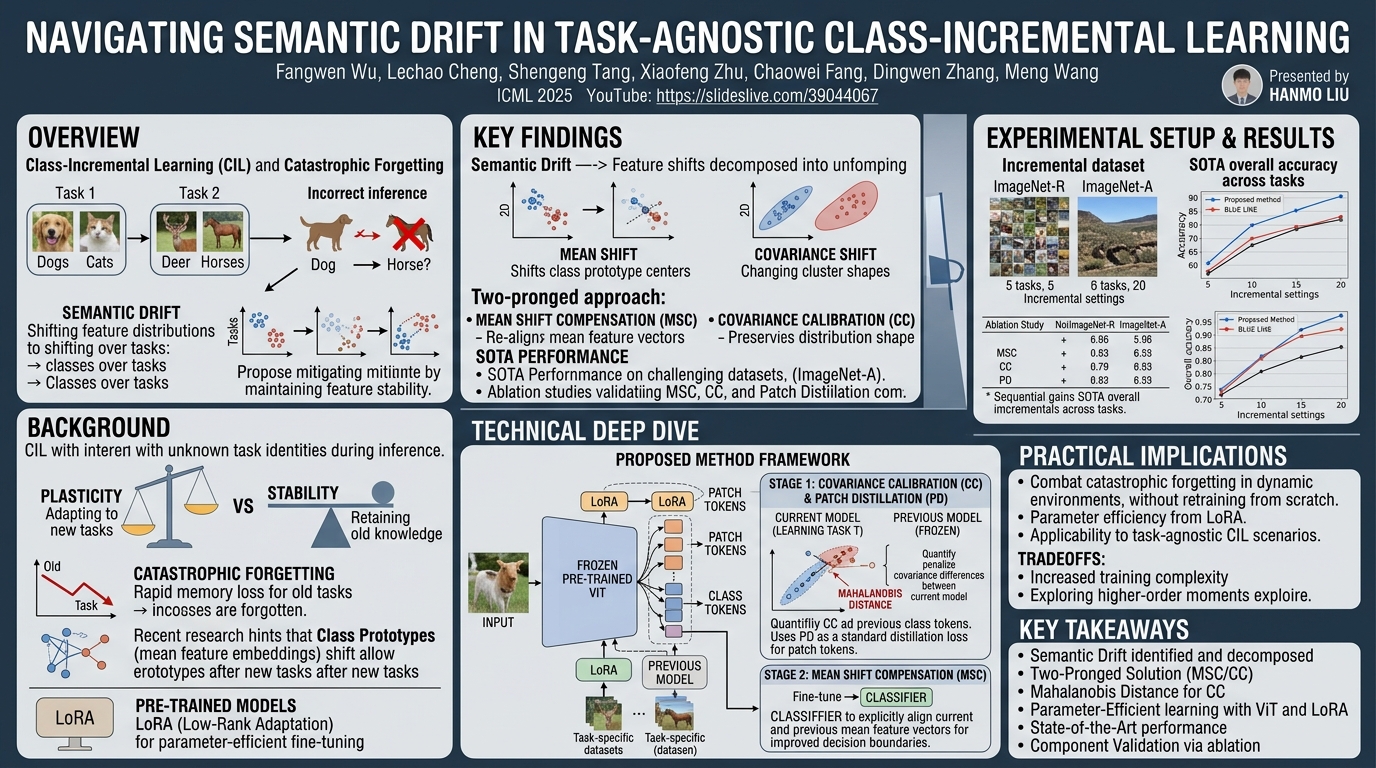
Key moments
- 0:00 Introduction to Class-Incremental Learning and Challenges
- 2:00 Understanding Catastrophic Forgetting: Plasticity vs. Stability
- 3:30 Feature Shifts and Introduction of Semantic Drift
- 4:50 Proposed Method Overview: Mean Shift and Covariance Compensation
- 6:00 Detailed Explanation of Covariance Calibration Module
- 7:00 Mean Shift Compensation and Classifier Retraining
Navigating Semantic Drift in Task-Agnostic Class-Incremental Learning
Speakers: Fangwen Wu, Lechao Cheng, Shengeng Tang, Xiaofeng Zhu, Chaowei Fang, Dingwen Zhang, Meng Wang
Conference: ICML 2025
YouTube: https://slideslive.com/39044067
Overview
The field of continual or incremental learning stands as a critical frontier in artificial intelligence, aiming to build models that can acquire new knowledge sequentially without forgetting previously learned information. This talk, "Navigating Semantic Drift in Task-Agnostic Class-Incremental Learning," delivered by Hanmo Liu on behalf of a team of researchers, addresses one of the most significant challenges in this domain: catastrophic forgetting. Specifically, the presentation delves into the nuanced issue of feature distribution shifts that occur as a model learns new tasks, identifying a phenomenon termed "semantic drift."
The core contribution of this work lies in decomposing feature shifts into mean and covariance components, collectively referred to as semantic drift, and proposing a novel framework to mitigate these shifts. By maintaining the stability of feature representations across tasks, the researchers aim to enhance the model's ability to retain old knowledge while effectively integrating new information. This research is particularly relevant for the development of robust and adaptive AI systems that operate in dynamic, real-world environments where continuous learning is a necessity, rather than a luxury.
The presented methodology, which combines mean shift compensation and covariance calibration, offers a principled approach to address the dual challenge of plasticity (learning new tasks) and stability (retaining old knowledge). The findings demonstrate state-of-the-art performance on challenging incremental learning benchmarks, underscoring the practical significance of understanding and counteracting semantic drift. This work provides valuable insights for practitioners and researchers grappling with the complexities of deploying continually learning models.
Background
▶ Watch: Introduction to Class-Incremental Learning and Challenges (0:00)
The concept of incremental learning, often used interchangeably with continual learning, describes a paradigm where an AI model must learn a sequence of tasks one after another. The overarching goal is to achieve high performance on all learned tasks, both old and new, under the stringent constraint of limited or no access to data from previous tasks during subsequent learning stages. This process inherently prohibits retraining the model from scratch with the entire accumulated dataset, making it a particularly challenging problem.
A specialized and highly demanding variant of this paradigm is class-incremental learning (CIL). In CIL, the model learns new classes with each successive task. Critically, during inference, the task identity is unknown; the model must classify an input image into any of the classes it has learned so far using a unified classifier. This setup is more complex than task-incremental learning, where task boundaries might be provided at test time, and significantly exacerbates the primary hurdle in continual learning: catastrophic forgetting.
Catastrophic forgetting refers to the phenomenon where a neural network, upon learning new information, rapidly loses the ability to perform tasks it was previously proficient at. The talk highlights an intuitive example: a model trained on dogs and cats, then on deer and horses, might later misclassify a dog as a horse. This issue can be conceptualized as a trade-off between plasticity (the model's ability to adapt and learn new tasks) and stability (its ability to retain previously acquired knowledge). Over-emphasizing plasticity leads to rapid forgetting, while excessive stability can hinder the model from learning anything new at all. Striking the right balance is central to continual learning research.
Recent investigations into the root causes of catastrophic forgetting have pointed towards feature shifts occurring during the learning of new tasks. Specifically, studies have shown that the class prototypes – the mean feature embeddings of data points belonging to a particular class – exhibit significant shifts in the feature space after the model learns new tasks. These shifts indicate that the model's internal representation of previously learned classes changes, leading to misclassifications. Prior work in this area has often leveraged pre-trained models combined with low-rank adaptation (LoRA) methods. LoRA, a parameter-efficient fine-tuning technique, adds small, trainable low-rank matrices to the existing weights of a pre-trained model, allowing for adaptation to new tasks with minimal parameter updates and reduced risk of disturbing the original knowledge. While these methods offer some mitigation, a deeper understanding of the nature of these feature shifts is necessary for more robust solutions.
Key Findings
▶ Watch: Feature Shifts and Introduction of Semantic Drift (3:30)
The central discovery presented in this talk is the identification and formalization of semantic drift as a primary driver of catastrophic forgetting in class-incremental learning. Building upon previous observations of feature shifts, the researchers conducted a deeper investigation into how pre-trained models, often characterized by well-clustered and roughly single-peaked feature distributions for different classes, behave under incremental learning. They found that these feature shifts can be precisely decomposed into two distinct components: a mean shift and a covariance shift.
The mean shift refers to the change in the average feature vector (or class prototype) for a given class over time, as new tasks are learned. The covariance shift, on the other hand, describes the alteration in the shape or spread of a class's feature distribution. Together, these two types of shifts constitute what the authors term "semantic drift," indicating a fundamental change in how the model internally represents the semantics of previously learned classes.
To counteract this newly identified phenomenon, the research proposes a novel two-pronged approach:
- Mean Shift Compensation (MSC): A module designed to re-align the mean feature vectors of learned classes, making subsequent classification easier.
- Covariance Calibration (CC): A module focused on preserving the shape and spread of feature distributions, ensuring that the internal representations remain consistent across tasks.
These modules are integrated into a framework built upon a pre-trained model and LoRA modules for parameter-efficient tuning, following established practices. The key findings demonstrate that by explicitly addressing both the mean and covariance components of semantic drift, the proposed method achieves state-of-the-art (SOTA) performance across various challenging image datasets, including ImageNet-R and ImageNet-A, which are known for their significant domain shifts and susceptibility to catastrophic forgetting. The ablation studies further validate the independent and synergistic contributions of each proposed component (MSC, CC, and patch distillation), confirming their effectiveness in mitigating semantic drift and improving overall incremental learning performance.
Technical Deep Dive
▶ Watch: Proposed Method Overview: Mean Shift and Covariance Compensation (4:50)
The proposed methodology, designed to navigate semantic drift, integrates a pre-trained Vision Transformer (ViT) backbone with LoRA modules and two novel components: Covariance Calibration (CC) and Mean Shift Compensation (MSC). The overall architecture is built on the principle of leveraging a powerful, frozen feature extractor while using parameter-efficient tuning to adapt to new tasks.
The core of the system starts with a frozen pre-trained ViT model, which serves as a robust feature extractor. When a new task $T$ arrives, new knowledge is primarily stored in a dedicated LoRA module associated with that task. This LoRA module, comprising low-rank matrices, is added to the ViT's transformer layers. For each new task, a new LoRA module is instantiated and trained. During inference, the final model parameters are effectively a combination of the frozen ViT weights and the accumulated LoRA modules from all previously learned tasks, ensuring that old knowledge is retained while new knowledge is integrated. The model extracts both patch tokens and class tokens from input data, which are then used to train a unified classifier for all learned classes.
The training pipeline is structured into two main stages:
Stage 1: Covariance Calibration (CC) and Patch Distillation
This stage focuses on preserving the distributional shape of features and aligning representations.
- Covariance Calibration (CC): The primary goal of CC is to ensure the consistency of class-wise covariance across tasks, thereby maintaining the semantic distribution and preserving model stability. To achieve this, the method utilizes a model trained on the previous task ($T-1$), with its parameters frozen. This "previous model" is used to extract patch tokens and class tokens from the same dataset as the current task $T$. The crucial step involves comparing the class tokens generated by the current model (learning task $T$) with those from the previous model. A novel loss function is introduced to enforce that the covariance of the class tokens from the current model remains close to that of the previous model.
- Mahalanobis Distance: To quantify the similarity between distributions and penalize covariance shifts, the framework employs Mahalanobis distance. Unlike Euclidean distance, Mahalanobis distance accounts for the correlation between variables and scales features according to their variance, making it highly sensitive to the shape of the data distribution. By using the covariance matrix from the previous model as a reference, the loss function encourages the current model's feature embeddings to maintain a similar distribution. Specifically, for a given class, the Mahalanobis distance between current and previous embeddings, using the previous task's covariance matrix, is minimized. This ensures that the current model's feature space for that class preserves the distributional characteristics learned in the prior task.
- Patch Distillation (PD): To further enhance alignment and stability, a conventional distillation loss is applied to the patch tokens. This loss encourages the patch tokens extracted by the current model to be aligned with those extracted by the previous model. This helps in preserving local feature representations and preventing drastic changes in the model's fundamental visual understanding as it learns new tasks. The distillation loss acts as a regularization term, guiding the current model to retain the feature extraction capabilities of its predecessor.
Stage 2: Mean Shift Compensation (MSC)
After the initial training phase with CC and PD, the second stage addresses the mean component of semantic drift.
- Mean Shift Compensation (MSC): This module is applied after the primary training pipeline is completed. The objective is to explicitly align the mean feature vectors (class prototypes) of the current model with those of the previous model. The process involves a targeted retraining of the classifier. By making the class tokens of the current model and the previous model more aligned in the mean perspective, the decision boundaries of the classifier can be made clearer and more stable across different classes. This compensation step corrects any remaining shifts in the central tendency of class features, leading to improved classification performance, especially for older classes.
In summary, the framework operates by sequentially learning new tasks, freezing the ViT backbone, and adding task-specific LoRA modules. The first stage uses CC with Mahalanobis distance and PD to preserve distributional shapes and local features. The second stage then fine-tunes the classifier with MSC to correct mean shifts. This two-stage approach provides a comprehensive solution to semantic drift by tackling both first-order (mean) and second-order (covariance) statistics of feature distributions. The use of LoRA ensures parameter efficiency, allowing the model to scale to many tasks without prohibitive memory or computational costs.
Experimental Setup & Results
▶ Watch: Detailed Explanation of Covariance Calibration Module (6:00)
The effectiveness of the proposed "Navigating Semantic Drift" framework was rigorously evaluated across various class-incremental learning scenarios, primarily focusing on image classification tasks.
Datasets: The experiments utilized several standard image datasets, with a particular emphasis on those known to present significant challenges due to domain shifts.
- ImageNet-R (ImageNet-Renditions) and ImageNet-A (ImageNet-Adversarial) were highlighted as crucial benchmarks. These datasets are designed to test model robustness against different visual styles and adversarial examples, respectively, making them highly susceptible to catastrophic forgetting and domain shift issues in incremental learning settings.
- Other general image datasets were also used to demonstrate broad applicability.
Incremental Settings: The evaluation covered different incremental learning configurations to assess the method's scalability and robustness over extended learning sequences.
- The primary setting involved a 10-task incremental scenario, where the model sequentially learned 10 distinct sets of new classes.
- Further experiments were conducted with 5-task, 10-task, and 20-task sequences to thoroughly evaluate performance as the number of incremental steps increased.
Base Model: The foundation of the proposed framework was a Vision Transformer (ViT), specifically a pre-trained ViT model. This choice leverages the strong feature extraction capabilities of large pre-trained models. The ViT was pre-trained on the comprehensive ImageNet dataset, providing a rich initial understanding of visual features.
Metrics and Performance: The evaluation focused on the overall accuracy across all learned classes after each incremental step.
- The framework achieved state-of-the-art (SOTA) performance on the four different datasets tested.
- Notably, the method demonstrated significantly better performance on ImageNet-R and ImageNet-A. The explanation provided is that these datasets inherently possess more pronounced domain shifts, making them more prone to forgetting. The proposed approach's ability to effectively mitigate semantic drift proved particularly beneficial in these challenging environments.
- Visual representations (e.g., plots showing performance over tasks) consistently depicted the proposed method (represented by a "blue line") maintaining a higher accuracy than competing methods across all incremental settings (5, 10, and 20 tasks). This graphical evidence robustly supported the claim of superior and consistent performance irrespective of the length of the incremental learning sequence.
Ablation Study: To understand the individual contributions of each component within the framework, a detailed ablation study was conducted.
- The baseline was established, likely a pre-trained ViT with LoRA and basic incremental learning techniques.
- The study sequentially added the proposed components: Mean Shift Compensation (MSC), Covariance Calibration (CC), and Patch Distillation (PD).
- The results consistently showed that each component, when added to the baseline, led to a measurable improvement in performance. This incremental gain validated the effectiveness of MSC in correcting mean shifts, CC in preserving covariance, and PD in maintaining patch-level feature alignment. The synergistic effect of all components working together led to the observed SOTA results.
In conclusion, the experimental results provide compelling evidence for the efficacy of navigating semantic drift through explicit mean and covariance adjustments. The SOTA performance, particularly on challenging datasets with significant domain shifts, alongside the clear validation from the ablation studies, firmly establishes the proposed framework as a significant advancement in class-incremental learning.
Practical Implications
▶ Watch: Mean Shift Compensation and Classifier Retraining (7:00)
The research on "Navigating Semantic Drift in Task-Agnostic Class-Incremental Learning" carries substantial practical implications for the development and deployment of AI/ML systems, particularly in scenarios requiring continuous adaptation and learning.
Firstly, for practitioners and model builders, this work offers a principled and effective strategy to combat catastrophic forgetting, which remains a major bottleneck in deploying AI models in dynamic environments. By explicitly addressing semantic drift—the shifts in mean and covariance of feature distributions—the proposed framework enables models to learn new classes without unduly compromising their knowledge of previous ones. This means that AI systems can be continuously updated with new information, such as new product categories, evolving threat patterns, or emerging medical conditions, without the prohibitive cost of retraining on the entire historical dataset or the risk of performance degradation on established tasks.
For infrastructure teams and those responsible for model deployment, the integration of LoRA modules is highly significant. Parameter-efficient tuning techniques like LoRA allow for the adaptation of large pre-trained models (like ViT) to new tasks by training only a small fraction of additional parameters. This translates directly into reduced computational resources, lower memory footprint for storing task-specific knowledge, and faster deployment cycles for updates. Instead of deploying entirely new, large models or retraining massive backbones, only compact LoRA modules need to be managed and updated, making continual learning more resource-friendly and scalable in production environments.
The focus on task-agnostic class-incremental learning is also crucial. In many real-world applications, the system cannot rely on knowing the task identity at inference time. The ability of this framework to maintain a unified classifier across all learned classes, without requiring explicit task cues, makes it directly applicable to scenarios like object recognition in autonomous systems, content moderation, or medical image analysis, where inputs can belong to any previously encountered class.
However, the approach also introduces certain tradeoffs and limitations. The two-stage training process, involving both covariance calibration and mean shift compensation, adds complexity to the training pipeline compared to simpler incremental learning methods. Calculating and maintaining covariance matrices, especially in high-dimensional feature spaces, can introduce computational overhead, although the paper implies efficient implementation. The current work focuses on first-order (mean) and second-order (covariance) statistics. As acknowledged by the authors, exploring higher-order moments like skewness or kurtosis in feature distributions could potentially yield further improvements, but would also increase complexity. This suggests an ongoing research frontier where the balance between model fidelity and computational tractability will continue to be refined.
Ultimately, this research moves the needle towards building more robust, adaptive, and maintainable AI systems. It provides a deeper understanding of the mechanisms behind catastrophic forgetting and offers concrete, empirically validated solutions that can be integrated into future continual learning frameworks, particularly those leveraging powerful pre-trained models.
Key Takeaways
- Semantic Drift Identified: The talk introduces and formalizes "semantic drift" as a key cause of catastrophic forgetting in class-incremental learning, decomposing it into mean shifts and covariance shifts in feature distributions.
- Two-Pronged Solution: A novel framework is proposed to mitigate semantic drift through Mean Shift Compensation (MSC) for aligning feature means and Covariance Calibration (CC) for preserving feature distribution shapes.
- Mahalanobis Distance for Covariance: Covariance Calibration effectively uses Mahalanobis distance to measure and maintain the consistency of class-wise feature covariances across incremental tasks, leveraging the previous model's covariance matrix as a reference.
- Parameter-Efficient Learning: The framework is built upon a frozen pre-trained ViT backbone combined with LoRA modules, ensuring parameter-efficient adaptation to new tasks and minimizing computational overhead.
- State-of-the-Art Performance: The method achieves SOTA results on challenging image datasets like ImageNet-R and ImageNet-A, which are prone to domain shifts, demonstrating robust performance across various incremental task settings (5, 10, 20 tasks).
- Component Validation: Ablation studies confirm that each proposed component—MSC, CC, and Patch Distillation (PD)—independently and synergistically contributes to significant performance improvements, validating their effectiveness.
About the Speaker(s)
The research presented in this talk is a collaborative effort by a team of authors: Fangwen Wu, Lechao Cheng, Shengeng Tang, Xiaofeng Zhu, Chaowei Fang, Dingwen Zhang, and Meng Wang. The presentation at ICML 2025 was delivered by Hanmo Liu, who also stated his affiliation with HKUST (Hong Kong University of Science and Technology) and noted his personal work in the field of continual learning. While specific titles for all authors were not detailed in the transcript, the collective expertise reflects a strong background in machine learning and computer vision, particularly in the challenging domain of continual and incremental learning.
Reviews
Maya Iyer (Theoretical ML Researcher) — WEAK
This paper addresses catastrophic forgetting in class-incremental learning by decomposing feature shift into mean and covariance components ('semantic drift') and proposing corrections via Mean Shift Compensation and Covariance Calibration using Mahalanobis distance, on top of a frozen ViT with LoRA modules. The framing is clean and the ablation is structured, but the theoretical contribution is thin: the decomposition into first- and second-order statistics is a completely standard move in distribution shift analysis, the 'novel' loss functions appear to be minor variations on well-established distillation and distribution-matching objectives, and the claimed mechanisms are validated only…
Chen Zhao (Applied ML Researcher & Empiricist) — SOLID
A competent incremental learning paper that decomposes feature shift into mean and covariance components, proposes targeted modules for each, and validates on standard CIL benchmarks. The decomposition framing is clean and the ablation structure is reasonable, but the article description contains too many red flags for experimental rigor — no mention of seed counts or error bars, vague baseline characterization, SOTA claims without matched-compute evidence, and an evaluation story that leans heavily on two datasets that happen to show the largest gains. The mechanism is plausible but the coverage of why Mahalanobis calibration works versus alternatives is thin. Solid contributed paper; not…
→ Top-rated talks at International Conference on Machine Learning 2025
All talks from International Conference on Machine Learning 2025