One-Step Generalization Ratio Guided Optimization for Domain Generalization
Sumin Cho (Sungkyunkwan University), Dongwon Kim (Sungkyunkwan University), Kwangsu Kim
Overview
In the rapidly evolving landscape of machine learning, the ability of models to generalize effectively to unseen data distributions remains a paramount challenge. This talk, presented by Sumin Cho and Dongwon Kim from Sungkyunkwan University, South Korea, introduces Genie, a novel optimizer designed to tackle the critical problem of Domain Generalization (DG). DG aims to train models on a set of source domains such that they perform robustly on entirely new, unseen target domains, a task frequently hindered by models learning spurious correlations inherent in the training data rather than truly generalizable features.
Key moments
- 0:00 Introducing Genie: an optimizer for domain generalization
- 2:00 Genie's three core components: preconditioning, noise, masking
- 4:00 Preconditioning: modifying OSGR for generalization ability
- 6:00 Theoretical analysis: tighter generalization bound and fast convergence
- 7:55 Experimental results: Genie outperforms existing DG methods
- 9:55 Visualizations: flatter loss landscapes and high OSGR values
- 11:45 Conclusion: Genie's plug-and-play benefits and contributions
One-Step Generalization Ratio Guided Optimization for Domain Generalization
Speakers: Sumin Cho, Dongwon Kim, Kwangsu Kim
Conference: ICML 2025
YouTube: https://slideslive.com/39044020
Overview
In the rapidly evolving landscape of machine learning, the ability of models to generalize effectively to unseen data distributions remains a paramount challenge. This talk, presented by Sumin Cho and Dongwon Kim from Sungkyunkwan University, South Korea, introduces Genie, a novel optimizer designed to tackle the critical problem of Domain Generalization (DG). DG aims to train models on a set of source domains such that they perform robustly on entirely new, unseen target domains, a task frequently hindered by models learning spurious correlations inherent in the training data rather than truly generalizable features.
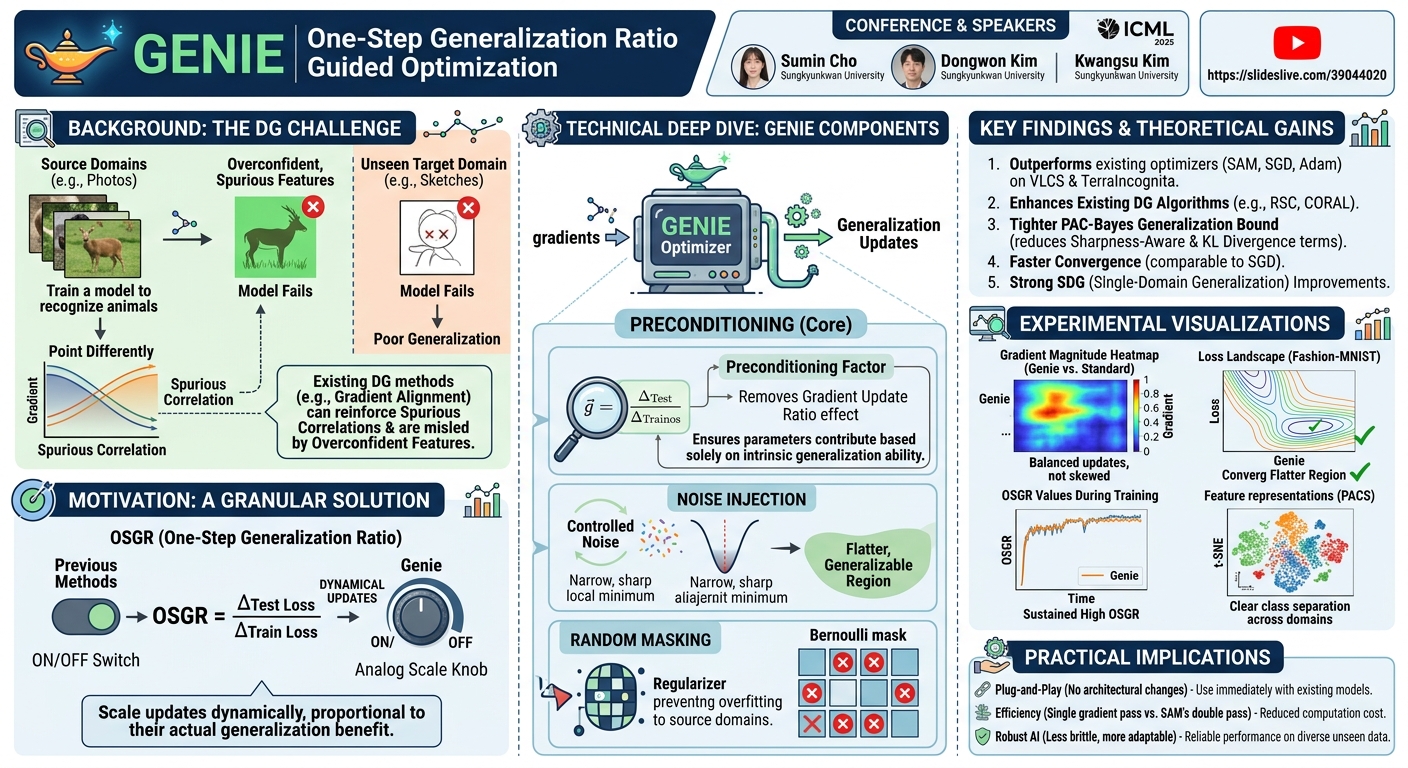
Existing DG methods often attempt to align gradients across domains, but these approaches can be misled by "overconfident" features, inadvertently reinforcing the very spurious correlations they seek to mitigate. While prior work has explored using the One-Step Generalization Ratio (OSGR) to prune overly confident parameters, these methods typically employ a binary "on or off" switch for updates, lacking the nuance to scale parameter adjustments based on their actual contribution to generalization. Genie addresses this critical gap by proposing an optimization framework that dynamically tunes each parameter's update magnitude according to its estimated generalization benefit, as quantified by OSGR.
Genie represents a significant paradigm shift in how we approach generalization in machine learning. Instead of solely focusing on what features the model should learn, Genie emphasizes how the model learns, guiding the optimization process to intrinsically foster better generalization. By integrating a sophisticated preconditioning mechanism, controlled noise injection, and random masking, Genie offers a plug-and-play solution that not only consistently outperforms existing optimizers and DG algorithms but also enhances their efficacy without requiring any changes to the underlying model architecture or training pipeline. This makes Genie a highly practical and impactful contribution for practitioners and researchers striving to build more robust and adaptable AI systems.
Background
▶ Watch: Introducing Genie: an optimizer for domain generalization (0:00)
The core challenge in Domain Generalization (DG) lies in training a machine learning model on one or more source domains and expecting it to perform well on a target domain whose data distribution differs from the source domains. This problem is pervasive in real-world applications where data collection across all possible deployment environments is infeasible or too costly. For instance, a medical diagnostic AI trained on hospital data from one city might struggle when deployed in another city with different patient demographics, equipment, or imaging protocols. The root cause of this performance drop is often the model's tendency to learn spurious correlations: patterns that appear predictive within the source domains but do not hold true across different distributions. These correlations arise from dataset biases and can lead to models that are brittle and lack true understanding of the underlying task.
Traditional machine learning often assumes that training and test data come from the same distribution, an assumption violated in DG settings. To combat this, various DG methods have been proposed. A common strategy involves attempting to align the gradient directions of different domains during training. The intuition here is that if gradients point in similar directions across diverse source domains, the model is likely learning features that are invariant to domain shifts. However, as highlighted in the talk, this approach has significant limitations. These gradient alignment directions can often be disproportionately influenced or "controlled" by overconfident features. Such features might exhibit strong predictive power on the training data, leading to large gradients, but they might be precisely the spurious correlations that fail to generalize. Consequently, merely aligning these dominant gradients can inadvertently reinforce these undesirable patterns rather than reducing their influence, trapping the model in local minima that are optimal for the source domains but poor for generalization.
More recent work has started to explore the concept of the One-Step Generalization Ratio (OSGR). OSGR quantifies how much a single parameter update contributes to generalization, reflecting both the magnitude of the gradient update and its actual benefit to the model's ability to perform on unseen data. Some methods have utilized OSGR to identify and potentially "drop" or ignore updates from overly confident parameters, effectively switching their updates on or off. While a step in the right direction, this binary control lacks the granularity needed for optimal generalization. The critical insight that prompted the development of Genie is the recognition that simply enabling or disabling updates is insufficient. Instead, a more effective approach would be to scale parameter updates dynamically, directly proportional to their measured generalization benefit. This precisely articulated gap in existing methodologies forms the foundational motivation for Genie, aiming to provide a more nuanced and effective mechanism for guiding model optimization towards robust generalization.
Key Findings
▶ Watch: Preconditioning: modifying OSGR for generalization ability (4:00)
The presentation of Genie (Generalization Ratio Guided Optimization) unveiled a series of compelling findings that underscore its efficacy and innovative approach to Domain Generalization. The core contributions and results can be summarized as follows:
First and foremost, Genie consistently outperforms existing optimizers on challenging domain generalization tasks. Across diverse and benchmark datasets such as VLCS and TerraIncognita, which are known for their significant domain shifts, Genie demonstrated superior generalization performance. This highlights its robustness and ability to learn features that transfer more effectively to unseen domains.
A particularly significant finding is Genie's ability to enhance existing domain generalization algorithms. When integrated as an optimizer, Genie significantly improves the generalization performance of established DG methods like RSC and CORAL. This "plug-and-play" capability, without requiring any modifications to the model architecture or training pipeline, underscores its versatility and practical value as a drop-in replacement that boosts the performance of a wide array of DG solutions.
Genie exhibits faster convergence compared to other optimizers, aligning with its theoretical convergence analysis. This efficiency translates directly to accelerated training speed in real-world applications. Notably, Genie achieves this speedup even when compared to generalization-focused optimizers like SAM, which often requires computing gradients twice per update, whereas Genie maintains the efficiency of a single gradient computation.
From a theoretical standpoint, Genie's preconditioning method was shown to induce a larger OSGR value compared to simpler gradient balancing schemes. Furthermore, an analysis based on the PAC-Bayes generalization bound revealed that Genie leads to a tighter generalization bound during optimization. This is achieved because its unique preconditioning factor, termed a **variation adopting factor q, not only reduces the sharpness-aware term (a focus of optimizers like SAM) but also effectively decreases the KL divergence term** in the bound, thereby providing stronger theoretical guarantees for generalization.
Experimental visualizations provided concrete evidence of Genie's mechanisms at work. A heatmap of normalized gradient magnitudes demonstrated that Genie's parameter updates are not skewed towards specific parameters, showcasing its intended balancing effect. Furthermore, visualizations of the loss landscape using the Fashion-MNIST dataset confirmed that Genie converges towards flatter regions of the loss landscape, which are widely recognized as being beneficial for generalization performance. Direct observation of the OSGR values during training also confirmed Genie's consistent ability to maintain high OSGR, validating its core design principle.
Finally, feature representation visualizations on the PACS dataset illustrated that Genie achieves clear class separation across domains. This indicates that the optimizer effectively encourages the learning of truly domain-invariant features, which is the ultimate goal of domain generalization and a strong indicator of robust model performance on unseen data. These collective findings firmly establish Genie as a leading-edge optimizer for enhancing generalization capabilities in machine learning models.
Technical Deep Dive
▶ Watch: Theoretical analysis: tighter generalization bound and fast convergence (6:00)
Genie's technical ingenuity lies in its multi-faceted approach to optimizing model parameters, driven by the core principle of maximizing the One-Step Generalization Ratio (OSGR). The optimizer is fundamentally designed to dynamically adjust each parameter's update magnitude based on its actual contribution to generalization, rather than merely its gradient magnitude.
At its heart, OSGR is defined as the ratio of the reduction in test loss to the reduction in training loss resulting from a single parameter update. A higher OSGR signifies that an update direction is more beneficial for generalization. The presenters explained that OSGR can be decomposed into two critical components: the gradient update ratio and the generalization ability of each parameter. Standard optimizers, by their very nature, tend to aggressively update parameters with high gradients. While this might rapidly reduce training loss, it inadvertently boosts the gradient update ratio component of OSGR, even if those high-gradient parameters are linked to spurious correlations and possess low generalization ability. This imbalance ultimately harms overall generalization.
Genie addresses this by introducing three integrated components:
- Preconditioning (Core Component): This is the most crucial part of Genie. The preconditioning step modifies the standard OSGR formulation. Genie introduces a preconditioning factor for each parameter, which is dynamically computed from its gradient during the optimization process. The fundamental role of this factor is to remove the effect of the gradient update ratio from the OSGR calculation. By doing so, Genie ensures that parameter updates are scaled based solely on their intrinsic generalization ability. This mechanism effectively debiases the gradient updates, leading to a more balanced contribution from all parameters towards generalization, preventing dominant, yet non-generalizable, features from dictating the learning process. The modification transforms the update rule to prioritize generalization directly.
- Noise Injection: To prevent the model from getting stuck in narrow, sub-optimal local minima, especially for parameters that might be "under-training" or contributing less significantly, Genie incorporates controlled noise injection. This strategically introduced noise encourages exploration in the parameter space, allowing the model to escape undesirable plateaus or sharp minima and potentially discover flatter, more generalizable regions of the loss landscape.
- Random Masking: The third component, random masking, employs a Bernoulli mask to selectively drop some parameter updates during training. This technique serves a dual purpose: it helps achieve more balanced learning by reducing the reliance on specific parameters and acts as a regularizer, preventing overfitting to the source domains.
The theoretical underpinnings of Genie were also thoroughly explored.
Firstly, a derivation of OSGR for Genie's preconditioning method demonstrated that it induces a larger OSGR value compared to simpler preconditioning schemes that merely equalize the mean square value of gradients (e.g., using Jensen's inequality). This highlights Genie's more effective strategy in directly enhancing generalization contributions rather than just normalizing update sizes.
Secondly, a PAC-Bayes generalization bound analysis provided a strong theoretical justification. Comparing Genie with SAM (Sharpness-Aware Minimization), a well-known generalization optimizer, revealed key differences. SAM primarily focuses on reducing the "sharpness-aware" term in the generalization bound by seeking flatter minima. In contrast, Genie's preconditioning factor, specifically through a **variation adopting factor q, not only contributes to reducing the sharpness-aware term but also critically decreases the KL divergence term** in the PAC-Bayes bound. This dual reduction leads to a significantly tighter generalization bound, offering a more robust theoretical guarantee for Genie's superior generalization performance.
Finally, the convergence rate of Genie was analyzed under standard optimization assumptions, including bounded gradient norm, Lipschitz smoothness, and non-zero variance. Under these conditions, Genie was shown to achieve fast convergence comparable to Stochastic Gradient Descent (SGD) in non-convex settings. This theoretical efficiency, combined with its practical benefits, positions Genie as a powerful and well-justified optimization strategy for domain generalization.
Experimental Setup & Results
▶ Watch: Visualizations: flatter loss landscapes and high OSGR values (9:55)
The experimental validation of Genie was comprehensive, demonstrating its superiority across various benchmarks and offering insightful visualizations into its operational mechanisms. The evaluation spanned multiple datasets, optimizers, and domain generalization algorithms, rigorously testing Genie's claims.
Datasets:
The primary benchmarks for evaluating generalization performance were VLCS (a collection of datasets including Caltech101, LabelMe, SUN09, and VOC2007) and TerraIncognita, both recognized as challenging datasets in the domain generalization community due to their significant domain shifts and diverse characteristics. For illustrative purposes, Fashion-MNIST was used for visualizing loss landscapes, and PACS (Photo, Art, Cartoon, Sketch) was employed for visualizing feature representations and class separation across domains.
Baselines and Comparisons:
Genie's performance was benchmarked against a wide array of existing optimizers and DG algorithms:
- Standard Optimizers: Implicitly compared against common optimizers like SGD and Adam, which often serve as baselines.
- Generalization-Specific Optimizers: Direct comparisons were made with optimizers specifically designed for generalization, such as SAM (Sharpness-Aware Minimization) and Fed (Federated Learning optimizer).
- Existing DG Algorithms: Genie was also evaluated as a plug-and-play optimizer to enhance established domain generalization algorithms like RSC (Risk Extrapolation) and CORAL (Correlation Alignment).
Metrics:
The key performance indicators included:
- Generalization Performance: Measured by accuracy on unseen target domains.
- Convergence Speed: How quickly the model reaches a stable performance level.
- Training Speed: The computational efficiency, often measured by wall-clock time or number of gradient computations.
- Qualitative Metrics: Visualizations of gradient magnitudes, loss landscapes, OSGR values, and feature representations.
Headline Numbers and Key Observations:
- Superior Generalization Performance: Genie consistently outperformed all existing optimizers on DG tasks. On challenging datasets like VLCS and TerraIncognita, Genie showed particularly significant improvements, indicating its ability to learn more robust, transferable features.
- Enhancement of Existing DG Algorithms: A striking result was Genie's ability to act as a "force multiplier" for other DG methods. When used as an optimizer, Genie further enhanced the generalization performance of algorithms like RSC and CORAL. This validated its practical utility as a flexible, plug-and-play component that doesn't require architectural modifications.
- Significant Gains in Single-Domain Generalization (SDG): The talk highlighted that Genie's improvements were even more pronounced in the challenging scenario of Single-Domain Generalization (SDG), where models are trained on only one source domain. This underscores its robustness in limited-data, high-variability settings.
- Faster Convergence and Training Speed: Aligning with theoretical predictions, Genie exhibited faster convergence rates than competing optimizers. Crucially, it also demonstrated accelerated training speed compared to SAM, primarily because SAM requires computing gradients twice per update while Genie maintains single-pass efficiency. This translates to practical benefits in terms of reduced computational cost and faster iteration cycles.
- Balanced Parameter Updates: A heatmap visualization of normalized gradient magnitudes across different training data of the VLCS dataset showed that Genie's parameter updates were not skewed towards specific parameters. This directly demonstrated the intended "balancing effect" of its preconditioning mechanism, ensuring that all parameters contribute meaningfully to generalization.
- Convergence to Flatter Loss Landscapes: Visualizations on the Fashion-MNIST dataset illustrated that Genie consistently converged towards flatter regions of the loss landscape. This is a highly desirable characteristic, as flatter minima are known to correlate with better generalization performance.
- Sustained High OSGR Values: Direct observation of the OSGR values during training confirmed that Genie maintained consistently high OSGR throughout the optimization process. This empirical validation confirmed the efficacy of Genie's core design principle in prioritizing updates that genuinely contribute to generalization.
- Learning Domain-Invariant Features: Feature representation visualizations on the PACS dataset showed that Genie achieved clear class separation across different domains. This strong visual evidence suggests that Genie effectively encourages the model to learn domain-invariant features, which are fundamental for successful domain generalization.
Collectively, these experimental results strongly support Genie's claims, positioning it as an effective, efficient, and theoretically grounded optimizer for advancing the state-of-the-art in domain generalization.
Practical Implications
▶ Watch: Conclusion: Genie's plug-and-play benefits and contributions (11:45)
Genie presents several significant practical implications for various stakeholders involved in the development, deployment, and research of AI/ML systems, particularly those grappling with real-world data distribution shifts.
For Practitioners and Model Builders:
The most immediate and impactful implication for practitioners is Genie's plug-and-play nature. Its ability to be applied to any existing Domain Generalization (DG) or Single-Domain Generalization (SDG) method without requiring changes to the model architecture or training pipeline is a game-changer. This means that data scientists and ML engineers can readily integrate Genie into their existing workflows and models, instantly boosting generalization performance with minimal effort. This flexibility reduces the barrier to adoption and allows for rapid experimentation. The observed improvements in challenging datasets like VLCS and TerraIncognita, as well as the enhanced performance of established DG algorithms like RSC and CORAL, directly translate to more robust and reliable models in real-world scenarios where unseen domains are common. This empowers model builders to create AI systems that are less brittle and more adaptable to diverse environments.
For Infrastructure Teams and Deployers:
The efficiency gains offered by Genie are highly relevant for infrastructure teams and those responsible for deploying and maintaining ML models. Genie achieves faster convergence and accelerated training speeds compared to many other optimizers, including generalization-focused ones like SAM. This efficiency stems from its ability to achieve strong generalization without requiring computationally expensive operations like multiple gradient computations per update (as SAM does). Faster training cycles mean quicker iteration on models, reduced computational resource consumption (e.g., GPU/TPU hours), and potentially lower operational costs. For models deployed in production, a faster training process can significantly impact the agility with which models can be updated or retrained, especially in dynamic environments.
Tradeoffs and Limitations:
While the talk primarily emphasizes Genie's benefits, a detailed technical article should consider potential tradeoffs or areas not explicitly covered. The presentation does not delve into the specific computational overhead of calculating the "preconditioning factor" or the precise mechanisms for "noise injection" and "random masking" beyond their conceptual roles. While claimed to be efficient, the exact computational cost relative to a barebones SGD or Adam might be a consideration for extremely resource-constrained environments, though it's likely minor given the "faster training speed" claim. The specific hyperparameters for noise injection and masking might also require careful tuning, adding a layer of complexity during initial setup. Furthermore, the theoretical guarantees are based on standard assumptions (bounded gradient norm, Lipschitz smoothness, non-zero variance); while widely accepted, real-world data can sometimes violate these, which is a general limitation of many theoretical analyses. The talk also doesn't specify the exact hardware used for experiments, which, for a truly detailed article, would provide more context on the observed speedups. However, given its plug-and-play nature and demonstrated performance across various tasks, these are minor considerations against its substantial advantages.
In summary, Genie offers a powerful, efficient, and user-friendly optimization paradigm that directly addresses the critical challenge of domain generalization. Its practical implications range from enabling more robust model development to optimizing resource utilization, making it a valuable tool for advancing the practical application of machine learning.
Key Takeaways
- Novel Optimization Paradigm for Generalization: Genie introduces a new approach to optimization for Domain Generalization (DG) and Single-Domain Generalization (SDG) by dynamically adjusting parameter updates based on their measured generalization benefit, as quantified by the One-Step Generalization Ratio (OSGR).
- Core Preconditioning Mechanism: The central innovation is a preconditioning factor that modifies standard update rules, ensuring parameters contribute based purely on their intrinsic generalization ability rather than being skewed by high gradient magnitudes, thereby mitigating spurious correlations.
- Superior Performance and Enhanced Existing Methods: Genie consistently outperforms state-of-the-art optimizers and significantly enhances the generalization performance of existing DG algorithms (like RSC and CORAL) across challenging datasets such as VLCS and TerraIncognita.
- Theoretical Guarantees and Efficiency: Supported by theoretical analysis, Genie leads to a tighter PAC-Bayes generalization bound by reducing both sharpness-aware and KL divergence terms, and achieves fast convergence comparable to SGD while demonstrating accelerated training speed compared to optimizers like SAM.
- Plug-and-Play Practicality: Genie is designed as a flexible, plug-and-play optimizer, requiring no architectural changes to existing models or training pipelines, making it highly accessible and practical for immediate integration into diverse ML projects.
- Improved Model Robustness: Experimental evidence shows Genie encourages models to converge to flatter regions of the loss landscape, maintains high OSGR values, and learns clear domain-invariant features, all contributing to more robust and adaptable AI systems.
About the Speaker(s)
The talk "One-Step Generalization Ratio Guided Optimization for Domain Generalization" was presented by Sumin Cho and Dongwon Kim. They are both affiliated with Sungkyunkwan University in South Korea. The work was also co-authored by Kwangsu Kim, suggesting a collaborative research effort from the same institution. Their presentation highlights their expertise in machine learning optimization and domain generalization research.
Reviews
Maya Iyer (Theoretical ML Researcher) — SOLID
Genie is a competently executed optimizer for domain generalization that builds a preconditioning scheme around the One-Step Generalization Ratio (OSGR). The core idea — scale updates by their generalization contribution rather than their gradient magnitude — is sensible and motivated, and the PAC-Bayes framing provides a theoretical wrapper that is at least gesturing in the right direction. The work sits comfortably in the space of solid, honest applied-theory: it advances a narrow question, the experiments are reasonably broad, and the plug-and-play design lowers friction for adoption. What prevents a higher rating is the gap between how much theoretical weight the article claims and how…
Chen Zhao (Applied ML Researcher & Empiricist) — WEAK
Genie proposes a preconditioned optimizer for domain generalization that dynamically scales parameter updates by an estimated one-step generalization ratio. The core idea—debiasing gradient updates away from high-magnitude spurious features—is reasonable, and the PAC-Bayes analysis is at least attempted. But the experimental evidence as described is thin: evaluations are limited to VLCS and TerraIncognita with no reported seed counts, no error bars, no matched-compute comparisons against SAM, and no ablation that cleanly isolates the three components (preconditioning, noise, masking). The plug-and-play framing is appealing but unsubstantiated at scale, and the mechanistic case for why OSGR…
→ Top-rated talks at International Conference on Machine Learning 2025
All talks from International Conference on Machine Learning 2025