Orthogonal Subspace Decomposition for Generalizable AI-Generated Image Detection
Zhiyuan Yan, Jiangming Wang, Peng Jin, Ke-Yue Zhang, Chengchun Liu, Shen Chen, Taiping Yao, Shouhong Ding, Baoyuan Wu, Li Yuan
Overview
The proliferation of sophisticated AI models capable of generating highly realistic images has introduced a critical challenge: the reliable detection of AI-generated images (AIGI). This talk, presented by Zhiyuan Yan from Shanghai AI Lab on behalf of a collaborative team from Tencent Youtu Lab and Peking University, delves into the inherent difficulties of AIGI detection and proposes a novel solution: Orthogonal Subspace Decomposition (OSD). The core problem lies in the "asymmetry" of the AIGI detection task, where conventional models tend to quickly overfit to specific fake patterns, leading to poor generalization to unseen or novel AI-generated content.
Key moments
- 0:00 AI-Generated Image Detection: Challenges and Overfitting
- 2:00 Quantifying Model Overfitting using PCA and t-SNE
- 4:00 VFM fine-tuning limitations and SVD-based module introduction
- 4:30 Orthogonal Subspace Decomposition: Preserving semantics, learning forgery
- 6:00 SVD achieves best generalization across diverse detection benchmarks
- 7:00 Key insight: Fake data derived hierarchically from real data
- 8:00 Conclusion: Leveraging hierarchical prior for robust AIGI detection
Orthogonal Subspace Decomposition for Generalizable AI-Generated Image Detection
Speakers: Zhiyuan Yan, Shanghai AI Lab; Jiangming Wang, Tencent Youtu Lab; Peng Jin, Tencent Youtu Lab; Ke-Yue Zhang, Peking University; Chengchun Liu, Tencent Youtu Lab; Shen Chen, Tencent Youtu Lab; Taiping Yao, Tencent Youtu Lab; Shouhong Ding, Tencent Youtu Lab; Baoyuan Wu, Peking University; Li Yuan, Shanghai AI Lab
Conference: ICML 2025
YouTube: https://slideslive.com/39043891
Overview
The proliferation of sophisticated AI models capable of generating highly realistic images has introduced a critical challenge: the reliable detection of AI-generated images (AIGI). This talk, presented by Zhiyuan Yan from Shanghai AI Lab on behalf of a collaborative team from Tencent Youtu Lab and Peking University, delves into the inherent difficulties of AIGI detection and proposes a novel solution: Orthogonal Subspace Decomposition (OSD). The core problem lies in the "asymmetry" of the AIGI detection task, where conventional models tend to quickly overfit to specific fake patterns, leading to poor generalization to unseen or novel AI-generated content.
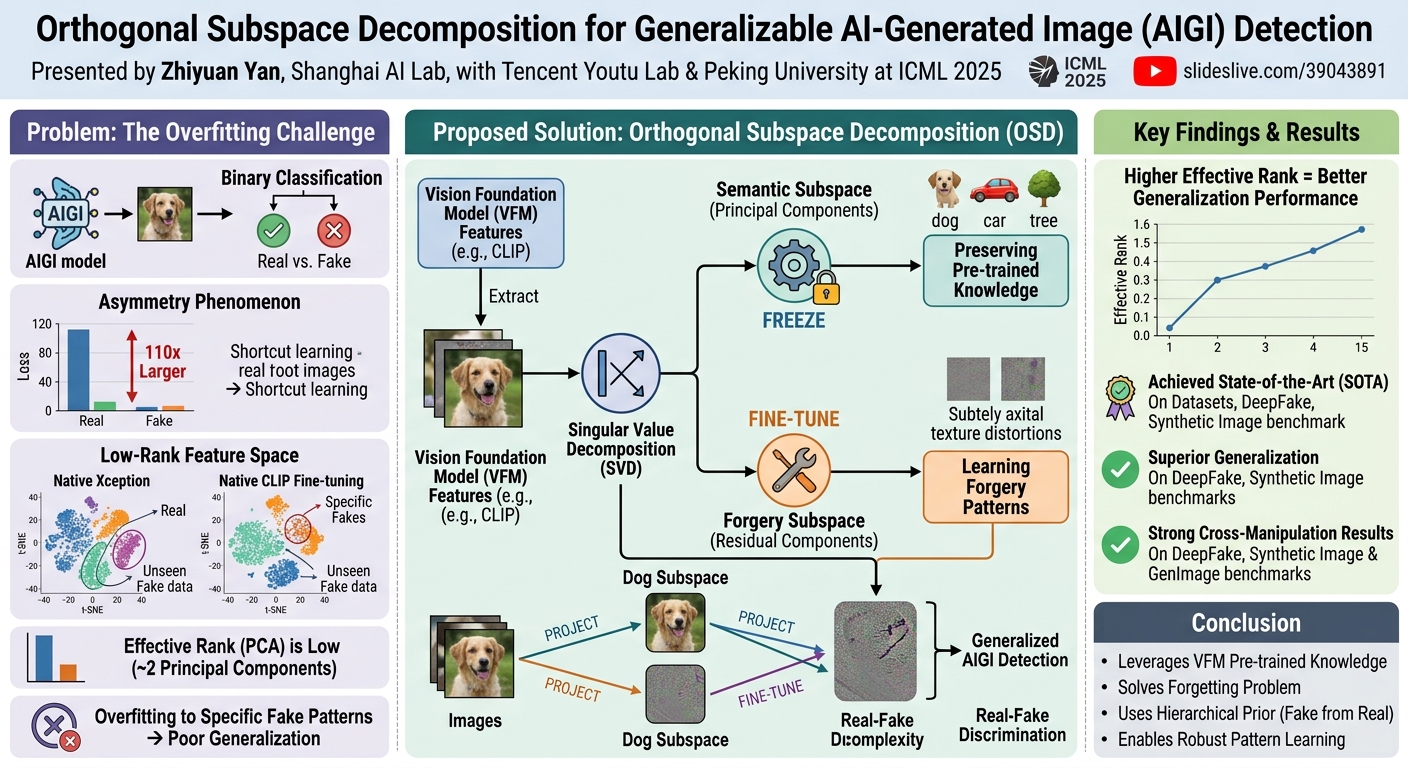
The research highlights that while AIGI detection appears to be a straightforward binary classification problem—distinguishing real images from fake ones—it fundamentally differs from tasks like "cat vs. dog" classification. Native neural network models, when trained on AIGI datasets, exhibit a strong tendency to shortcut learning, focusing on superficial forgery artifacts rather than robust, generalizable features. This results in a feature space that is highly constrained and low-rank, severely limiting the model's ability to detect images generated by models not encountered during training.
To combat this critical generalization gap, the presented work introduces an SVD-based approach that decomposes the feature space of powerful Vision Foundation Models (VFMs), such as CLIP, into two orthogonal subspaces. One subspace, comprising the principal components, is dedicated to preserving the rich semantic knowledge learned during VFM pre-training and is frozen during fine-tuning. The other, composed of residual components, is specifically fine-tuned to learn forgery-related discriminative patterns. This innovative methodology allows the detector to leverage deep semantic understanding while robustly identifying synthetic artifacts, thereby achieving superior generalization performance across a wide array of AIGI detection benchmarks.
Background
▶ Watch: AI-Generated Image Detection: Challenges and Overfitting (0:00)
The task of AI-generated image (AIGI) detection is typically framed as a binary classification problem: given an image, determine if it was captured from the real world or synthesized by an AI model. Intuitively, one might expect standard convolutional neural networks (ConvNets) to perform well, similar to their success in tasks like distinguishing cats from dogs. However, as highlighted by the speakers, AIGI detection presents a unique and significant challenge due to its inherent asymmetry.
When a standard ConvNet is natively trained for AIGI detection, a peculiar phenomenon emerges. The model quickly learns to identify specific fake patterns present in the training set, leading to a very low loss value for the fake class. Concurrently, the loss for the real class remains disproportionately high—observed to be approximately 110 times larger than the fake loss. This stark difference indicates that the fake class is significantly "simpler" for the model to learn, likely because it can exploit easily identifiable, dataset-specific artifacts or "shortcuts."
This shortcut learning behavior leads to severe overfitting. As the model overfits to these specific forgery patterns early in training, its entire feature space becomes dominated by these narrow characteristics. Visualizations such as t-SNE clearly demonstrate this effect: both Xception and CLIP models, when natively trained, collapse specific fake patterns from the training set into a single, tight cluster. In contrast, all other data, including real samples and fake samples from unseen forgery methods, are mapped into a separate, often diffuse, cluster. This indicates a failure to learn generalizable features that can distinguish novel AI-generated content.
To quantify this degree of overfitting and the associated limitations, the researchers analyzed the effective information within the feature space using Principal Component Analysis (PCA). The results were concerning: the feature space of a natively trained detector was found to be highly constrained, exhibiting a remarkably low rank. Specifically, only two principal components were sufficient to capture almost all the information learned by the model. This observation aligns with the concept of "effective rank," a term officially defined in a 2007 work, which measures the effective dimensionality of a model's feature space. A low effective rank, despite a potentially high-dimensional feature space, signifies that the model is severely overfitted, requiring only a minimal set of features to represent the entire dataset's information.
Recognizing the limitations of native training, researchers have explored leveraging Vision Foundation Models (VFMs), such as CLIP, which are pre-trained on massive datasets and possess rich semantic knowledge of the real world. The hypothesis was that fine-tuning these powerful VFMs might mitigate overfitting and enhance generalization. However, the talk reveals that even native fine-tuning of VFMs, including advanced techniques like LoRA (Low-Rank Adaptation), still suffers from a "forgetting problem." The number of principal components in the VFM's feature space can drop dramatically during fine-tuning, pushing the model back towards overfitting to specific forgery patterns. This underscores the persistent challenge of adapting powerful pre-trained models for AIGI detection without sacrificing their inherent generalization capabilities. The problem, therefore, lies not just in a lack of complex models, but in how these models are adapted and trained for this unique and asymmetric classification task.
Key Findings
▶ Watch: VFM fine-tuning limitations and SVD-based module introduction (4:00)
The research presented unveils several critical findings that collectively address the challenges of generalizable AIGI detection. At its core, the work identifies that the fundamental reason for the failure of generalization in AIGI detection stems from the asymmetry phenomenon. Native detectors quickly learn "shortcuts," overfitting to specific fake patterns seen during training, rather than acquiring robust, transferable features. This leads to a highly constrained, low-rank feature space, which is a direct impediment to detecting novel AI-generated images.
A significant observation is that even advanced techniques like fine-tuning Vision Foundation Models (VFMs) such as CLIP, or using parameter-efficient methods like LoRA, do not entirely resolve the issue. These approaches still exhibit a "forgetting problem," where the valuable pre-trained semantic knowledge is degraded, and the model's feature space again tends towards overfitting. This demonstrates that simply leveraging powerful pre-trained models isn't sufficient; a more nuanced approach to adaptation is required.
The central contribution and key finding of this work is the proposal of Orthogonal Subspace Decomposition (OSD), implemented via Singular Value Decomposition (SVD). This method effectively addresses the overfitting and generalization issues by decomposing the VFM's feature space into two distinct, orthogonal subspaces. The principal components of this decomposition are identified as preserving the rich, semantic knowledge acquired during VFM pre-training, and crucially, these components are frozen during the fine-tuning process. Concurrently, the residual components are dedicated to learning forgery-related discriminative patterns, and these are the only parts that are fine-tuned. This strategic separation ensures that the model can learn to detect forgeries without corrupting its foundational understanding of real-world semantics.
A direct correlation between the effective rank of the feature space and generalization performance was empirically observed. The higher the effective rank, the better the model's ability to generalize to unseen data. The proposed SVD-based method demonstrably retains a significantly higher number of principal components, thereby preserving a richer, higher-rank feature space, which directly translates into superior detection results.
Furthermore, the research reveals a profound prior for generalized AIGI detection: fake data is not independently generated but derived from real data in a hierarchical structure. This means that an AI-generated image of a dog, for instance, is fundamentally rooted in the concept of a "dog." Leveraging this prior is crucial. By preserving the semantic components, the OSD-based module can effectively transform an image (e.g., a dog image) into its corresponding semantic subspace (e.g., the "dog subspace"), allowing for real-fake discrimination within this focused, semantically aligned context. This reduces the complexity of the discrimination task and enables more robust pattern learning.
In terms of performance, the OSD-based approach achieved state-of-the-art results across various challenging benchmarks, including DeepFake image detection, synthetic image detection, synthetic image detection ACC, and GenImage benchmarks. The method also demonstrated strong performance in cross-manipulation and in-domain scenarios, confirming its superior generalization capabilities compared to existing detectors like Xception and native CLIP fine-tuning.
Technical Deep Dive
▶ Watch: Orthogonal Subspace Decomposition: Preserving semantics, learning forgery (4:30)
The core innovation presented in this work is the Orthogonal Subspace Decomposition (OSD), a technique designed to enable generalizable AI-generated image (AIGI) detection by strategically leveraging and adapting pre-trained Vision Foundation Models (VFMs). The method directly confronts the challenge of overfitting to specific forgery patterns while preserving the rich semantic understanding embedded within VFMs.
The fundamental idea is to decompose the original feature space obtained from a VFM, such as CLIP, into two orthogonal subspaces. This decomposition is achieved using Singular Value Decomposition (SVD). Given a feature representation from the VFM, SVD allows for a principled separation of information based on its variance and importance.
Here's a breakdown of the technical process:
- VFM Feature Extraction: The process begins by extracting feature representations from a powerful, pre-trained VFM. The talk specifically mentions CLIP, which is renowned for its robust image-text understanding and generalizable visual features. These features serve as the foundation for the subsequent decomposition.
- SVD-based Decomposition:
- Application of SVD: SVD is applied to the aggregated feature space or feature vectors obtained from the VFM. SVD decomposes a matrix (representing the feature space) into three matrices: $U \Sigma V^T$. Here, $U$ and $V$ are orthogonal matrices, and $\Sigma$ is a diagonal matrix containing singular values. The columns of $U$ (or rows of $V^T$) correspond to the principal components.
- Principal Components (Semantic Subspace): The singular values in $\Sigma$ are ordered by magnitude, with larger values corresponding to more significant components (i.e., those capturing more variance in the data). The components associated with these larger singular values are identified as the principal components. These components are posited to encapsulate the semantic knowledge that the VFM has learned about the real world during its extensive pre-training. Critically, during the subsequent fine-tuning phase, these principal components are frozen. This freezing mechanism is vital; it ensures that the foundational semantic understanding of the VFM remains intact and is not corrupted by the fine-tuning process aimed at detecting specific forgery artifacts.
- Residual Components (Forgery Subspace): The remaining components, corresponding to smaller singular values, constitute the residual components. These components are hypothesized to contain less critical semantic information but are more amenable to learning the subtle, discriminative patterns associated with AI-generated forgeries. It is these residual components that are subjected to fine-tuning. The model learns to adjust these components to effectively distinguish between real and fake images.
- Intuitive Rationale: The intuition behind this decomposition is elegant: preserve the "most important" parts of the VFM's knowledge (the principal components) which represent general semantics, while tuning only the "relatively unimportant" parts (the residual components) for the specific task of forgery detection. This allows the model to leverage its vast understanding of the real world without being distracted or misled by the fleeting, dataset-specific artifacts of fake images.
- Hierarchical Understanding and Discrimination: The method leverages the crucial insight that "fake is actually derived from the real." By preserving the principal, semantic components, the module is capable of first transforming an input image into its semantically relevant subspace. For example, if an image contains a dog, the model can project it into a "dog subspace." Within this semantically aligned and reduced-complexity subspace, the task of real-fake discrimination becomes significantly easier and more robust. This is supported by concepts like Rademacher complexity, where simpler discrimination tasks tend to generalize better. Instead of treating real and fake data as entirely separate, the model operates within a shared, semantically meaningful context, focusing its discriminative power on the subtle differences introduced by the generative process.
- Reduced Model Complexity and Improved Generalization: By freezing a significant portion of the VFM's parameters (the principal components) and focusing fine-tuning on a smaller, dedicated subspace (the residual components), the approach effectively reduces the learning capacity dedicated to forgery detection. This, counter-intuitively perhaps, prevents the model from overfitting to superficial patterns. The model is forced to learn more robust, generalizable forgery features that are consistent across different semantic categories and generative models, leading to a higher effective rank in its feature space and, consequently, superior generalization performance. The specific architectural modifications and training protocols for fine-tuning the residual components are not explicitly detailed in the transcript, but the core mechanism revolves around standard classification heads applied to these adapted features.
In essence, OSD with SVD provides a principled mechanism to disentangle general semantic knowledge from task-specific forgery patterns, allowing AIGI detectors to become more resilient to unseen generative models and diverse synthetic content.
Experimental Setup & Results
▶ Watch: Key insight: Fake data derived hierarchically from real data (7:00)
The research team conducted extensive evaluations to benchmark the performance and generalization capabilities of their Orthogonal Subspace Decomposition (OSD) method for AI-generated image (AIGI) detection. The experiments aimed to validate the core hypotheses regarding overfitting, effective rank, and the efficacy of their SVD-based approach against established baselines.
Baselines and Comparison:
The proposed SVD-based module was rigorously compared against several prominent AIGI detection methods and VFM adaptation strategies:
- Xception: A widely used convolutional neural network architecture, often employed as a baseline in AIGI detection due to its historical performance in early DeepFake detection.
- CLIP (Native Fine-tuning): Direct fine-tuning of the pre-trained CLIP model on AIGI detection datasets. This serves to evaluate whether simply leveraging a powerful VFM is sufficient.
- LoRA (Low-Rank Adaptation with CLIP): A parameter-efficient fine-tuning technique applied to CLIP, which is designed to reduce the number of trainable parameters and mitigate catastrophic forgetting. This baseline tests if efficient adaptation alone can resolve the generalization issues.
Benchmarks and Datasets:
The evaluation spanned a comprehensive set of AIGI detection benchmarks, designed to test both in-domain and out-of-domain generalization:
- DeepFake Image Detection: Likely involves datasets focusing on facial manipulation, a common target for early AIGI detection research.
- Synthetic Image Detection: Broader datasets encompassing various types of AI-generated content beyond just faces.
- Synthetic Image Detection ACC: Implies a specific focus on accuracy metrics within synthetic image detection tasks.
- GenImage Benchmarks: A more recent and challenging benchmark for general AI-generated image detection, likely featuring diverse generative models and image content.
- Cross-manipulation: Critical for evaluating generalization, where the model is trained on images generated by one set of manipulation techniques/models and tested on images generated by entirely different, unseen techniques.
- In-domain results: Standard evaluation on test sets that follow the same distribution as the training data.
Key Metrics:
While specific numerical metrics (e.g., AUC, accuracy, F1-score) are not explicitly stated in the transcript, the discussion strongly implies the use of standard classification performance metrics, with a particular emphasis on demonstrating superior generalization performance. The concept of effective rank was also used as an analytical metric to quantify model overfitting and feature space dimensionality.
Headline Results and Observations:
- Overfitting Confirmation: Initial experiments with native detectors (e.g., Xception, native CLIP fine-tuning) robustly confirmed the overfitting phenomenon. The t-SNE visualization showed these models grouping only specific fake patterns from the training set into a single cluster, while real samples and unseen forgeries were clustered separately, indicating poor generalization.
- Low Effective Rank: PCA analysis on native detectors revealed a highly constrained feature space with a low effective rank, where only around two principal components captured most of the information. This diagnostic metric directly supported the claim of severe overfitting.
- VFM Limitations: Even with native fine-tuning of VFMs like CLIP, and using techniques like LoRA, the problem of "forgetting" persisted. The number of principal components in their feature spaces still dropped dramatically, pushing them back towards overfitting.
- OSD's Superiority: In stark contrast, the proposed SVD-based module demonstrated outstanding performance. It was observed to "perform really well" and "largely retain all the pre-trained knowledge of the CLIP module."
- State-of-the-Art Performance: Across all evaluated benchmarks (DeepFake, synthetic image detection, GenImage, cross-manipulation, and in-domain tests), the OSD method "achieved the best performance." This signifies its robust generalization capabilities across diverse types of AI-generated content and generative models.
- Effective Rank Correlation: A crucial empirical finding was the direct relationship between effective rank and generalization: "higher effective rank better generalization performance." The SVD-based method was shown to "retain most principal components," directly contributing to its higher effective rank and, consequently, its superior detection results. This observation provides strong evidence for the theoretical underpinnings of the approach.
While specific hardware, dataset sizes, or training parameters were not detailed in the transcript, the comprehensive evaluation across multiple benchmarks and comparison against strong baselines firmly establishes the efficacy and generalization benefits of the Orthogonal Subspace Decomposition method.
Practical Implications
▶ Watch: Conclusion: Leveraging hierarchical prior for robust AIGI detection (8:00)
The Orthogonal Subspace Decomposition (OSD) method for generalizable AI-generated image (AIGI) detection carries significant practical implications for a wide range of stakeholders, from model builders and infrastructure teams to practitioners deploying AI systems.
For Practitioners and Model Builders:
- Robust Generalization: The most significant implication is the promise of truly generalizable AIGI detectors. Current methods often fail when faced with images from unseen generative models or novel manipulation techniques. OSD provides a principled way to build models that are less susceptible to these shifts, making them more reliable in real-world, dynamic environments where new generative AI emerges constantly.
- Mitigating Shortcut Learning and Overfitting: The approach offers a direct solution to the persistent problem of "shortcut learning" and overfitting to specific fake patterns. By explicitly separating semantic understanding from forgery-specific features, model builders can create detectors that focus on fundamental characteristics of synthetic content rather than superficial artifacts.
- Effective VFM Utilization: OSD provides a blueprint for how to effectively leverage the immense pre-trained knowledge of Vision Foundation Models (VFMs) like CLIP for specialized tasks without suffering from catastrophic forgetting. This means that investments in large-scale VFM training can be more efficiently translated into robust downstream applications. Model developers can build upon state-of-the-art VFMs, adapting them with greater confidence that their core capabilities will be preserved.
- Reduced Model Complexity for Discrimination: By performing discrimination within a semantically aligned subspace, the effective complexity of the classification task is reduced. This could lead to more stable training and potentially faster inference if the adapted subspace is smaller, though the decomposition itself adds a pre-processing step.
For Infrastructure Teams and Deployers:
- Enhanced Security and Trust: Deploying more generalizable AIGI detectors can significantly enhance the security and trustworthiness of digital media. This is crucial for platforms combating misinformation, deepfakes, and synthetic content that could be used for malicious purposes.
- Adaptability to Evolving Threats: The method's ability to generalize means that deployed systems will require less frequent retraining or updates when new generative AI models are released. This reduces operational overhead and allows infrastructure teams to maintain effective detection capabilities against an evolving landscape of AI-generated content.
- Resource Efficiency (Potential): While the SVD decomposition adds a step, freezing a large portion of the VFM's parameters means that fine-tuning only a smaller set of "residual" components. This could potentially lead to more memory-efficient training and faster convergence during the adaptation phase, compared to full VFM fine-tuning.
Tradeoffs and Limitations:
- Computational Overhead for SVD: Applying SVD to the VFM's feature space requires computational resources. While this is likely a one-time or infrequent cost during model development/adaptation, it's a consideration.
- Dependency on VFM Quality: The effectiveness of OSD is inherently tied to the quality and richness of the underlying VFM's semantic knowledge. If the VFM lacks understanding of certain concepts or image domains, the decomposition might not be as effective in those areas.
- Defining "Principal" vs. "Residual": While SVD provides a mathematical way to separate components by variance, the perfect alignment of "principal = semantic" and "residual = forgery" might not hold universally for all types of data or forgeries. There could be cases where forgery patterns are embedded in higher-variance components or semantic information is present in lower-variance ones.
- Interpretability: While the concept is intuitive, the exact meaning of each singular vector in a high-dimensional feature space can be difficult to interpret directly.
In summary, OSD represents a significant step towards building robust, deployable AIGI detection systems that can keep pace with the rapid advancements in generative AI. Its ability to preserve semantic knowledge while precisely targeting forgery patterns offers a practical pathway to more reliable and generalizable content verification.
Key Takeaways
- AIGI Detection is Asymmetric: Unlike standard binary classification, AI-generated image (AIGI) detection is an asymmetric task where native models quickly overfit to specific fake patterns, leading to poor generalization.
- Overfitting Causes Low-Rank Feature Space: This overfitting manifests as a highly constrained, low-rank feature space (e.g., only two principal components), which severely hinders the model's ability to detect unseen AI-generated content.
- VFM Fine-tuning Alone is Insufficient: Even powerful Vision Foundation Models (VFMs) like CLIP, when natively fine-tuned or adapted with LoRA, suffer from "forgetting" pre-trained knowledge and still tend towards overfitting.
- Orthogonal Subspace Decomposition (OSD) is Key: The proposed SVD-based OSD method effectively addresses these issues by decomposing the VFM's feature space into two orthogonal subspaces: frozen principal components (for semantic knowledge) and tunable residual components (for forgery-specific patterns).
- Leveraging "Fake from Real" Prior: The method successfully exploits the crucial insight that fake data is hierarchically derived from real data, enabling discrimination within semantically aligned subspaces, which reduces complexity and improves robustness.
- Superior Generalization Performance: OSD achieves state-of-the-art generalization performance across diverse AIGI detection benchmarks (DeepFake, GenImage, cross-manipulation), demonstrating a direct correlation between higher effective rank and better generalization.
About the Speaker(s)
The talk was presented by Zhiyuan Yan from Shanghai AI Lab. He introduced the work on behalf of a collaborative team that included his senior labmates from Tencent Youtu Lab and Peking University. The list of authors also includes Jiangming Wang, Peng Jin, Ke-Yue Zhang, Chengchun Liu, Shen Chen, Taiping Yao, Shouhong Ding, Baoyuan Wu, and Li Yuan, representing a significant collaboration between leading academic and industry research institutions in AI and computer vision. Their collective expertise spans advanced machine learning, computer vision, and the practical challenges of AI-generated content.
Reviews
Maya Iyer (Theoretical ML Researcher) — WEAK
This paper tackles a real and important problem — generalizable detection of AI-generated images — and proposes a principled-sounding solution via SVD-based subspace decomposition of VFM features. The empirical motivation is competent and the intuition behind freezing principal components to preserve semantic knowledge is at least coherent. However, the core theoretical claims are not substantiated at any rigorous level. The central assertion — that SVD's principal components correspond to 'semantic knowledge' while residual components correspond to 'forgery patterns' — is presented as axiomatic rather than proven or even formally characterized. The connection to Rademacher complexity is…
Chen Zhao (Applied ML Researcher & Empiricist) — SOLID
OSD presents a reasonable and mechanistically motivated approach to generalizable AIGI detection, using SVD to freeze semantic principal components while fine-tuning residual components for forgery-specific patterns. The core insight — that native fine-tuning of VFMs causes low-rank collapse and that orthogonal decomposition can preserve generalization — is plausible and the effective-rank diagnostic is a useful framing device. But the article as written (and seemingly the underlying paper) leaves too many critical experimental questions unanswered: no concrete numbers, no seed counts, no compute budget comparisons, no ablations on the threshold between 'principal' and 'residual'…
→ Top-rated talks at International Conference on Machine Learning 2025
All talks from International Conference on Machine Learning 2025