Position: Current Model Licensing Practices are Dragging Us into a Quagmire of Legal Noncompliance
Moming Duan, Mingzhe Du, Rui Zhao, Mengying Wang (PhD candidate · Case Western Reserve University), Yinghui Wu, Nigel Shadbolt, Bingsheng He
Overview
In an era increasingly defined by the rapid proliferation and pervasive reuse of foundation models, the legal landscape governing their deployment and derivative works is becoming alarmingly complex and fraught with peril. This talk, presented by Mengying Wang from Case Western Reserve University, on behalf of lead author Moming Duan and their collaborators, directly confronts the burgeoning issue of legal noncompliance stemming from current model licensing practices. The core assertion is that the existing licensing frameworks, often borrowed from software or general content licenses, are ill-suited for the unique characteristics and intricate reuse patterns prevalent in the machine learning ecosystem, particularly on platforms like Hugging Face.
Key moments
- 0:00 Introduction: Model reuse and legal noncompliance problem
- 1:00 Visualizing model dependencies and Llama 3 license example
- 2:00 Three types of license noncompliance issues identified
- 3:00 Analysis results: Widespread license conflicts across models
- 3:40 Proposed solution: The ModelGo license for sharing
- 4:20 Alternative viewpoints on model copyright and licensing
- 5:20 Need for tools, collaboration, and VLDB tutorial promotion
- 6:00 Q&A: Current status of license violation litigation
Current Model Licensing Practices are Dragging Us into a Quagmire of Legal Noncompliance
Speakers: Moming Duan, PhD Candidate; Mingzhe Du; Rui Zhao; Mengying Wang, PhD Candidate; Yinghui Wu; Nigel Shadbolt; Bingsheng He
Conference: ICML 2025
YouTube: https://slideslive.com/39043980
Overview
In an era increasingly defined by the rapid proliferation and pervasive reuse of foundation models, the legal landscape governing their deployment and derivative works is becoming alarmingly complex and fraught with peril. This talk, presented by Mengying Wang from Case Western Reserve University, on behalf of lead author Moming Duan and their collaborators, directly confronts the burgeoning issue of legal noncompliance stemming from current model licensing practices. The core assertion is that the existing licensing frameworks, often borrowed from software or general content licenses, are ill-suited for the unique characteristics and intricate reuse patterns prevalent in the machine learning ecosystem, particularly on platforms like Hugging Face.
The presentation highlights how the collaborative paradigm in AI has shifted from ground-up development to extensive model reuse—through fine-tuning, adapter integration, quantization, and model merging. While these practices dramatically reduce the cost and barrier to entry for developing specialized AI applications, they simultaneously create a tangled web of dependencies and license obligations. The speakers argue that without a standardized, machine learning-specific licensing framework, the community risks widespread, unwitting legal violations, potentially leading to significant repercussions for developers, enterprises, and the broader AI research community. This article delves into the critical issues identified by the researchers, their proposed solution in the form of the ModelGo license, and the broader implications for the future of responsible AI development and deployment.
Background
▶ Watch: Introduction: Model reuse and legal noncompliance problem (0:00)
The advent of foundation models has fundamentally reshaped the landscape of artificial intelligence development. Training these colossal models, such as Llama 3, requires immense computational resources, vast datasets, and significant financial investment, making it an endeavor accessible to only a few well-resourced entities. Consequently, the dominant mode of collaboration and innovation in the AI community has shifted from training models from scratch to reusing and adapting existing foundation models. This paradigm of reuse encompasses a variety of techniques, including fine-tuning (adjusting a pre-trained model's weights on a smaller, task-specific dataset), adapter methods (like LoRA, which fine-tune a small percentage of parameters efficiently), quantization (reducing model size and computational demands), and model merging (combining multiple models to create a new one). The accessibility and efficiency of these methods are undeniable; for instance, LoRA can fine-tune as little as 1% of a model's parameters using a single GPU, democratizing advanced AI development.
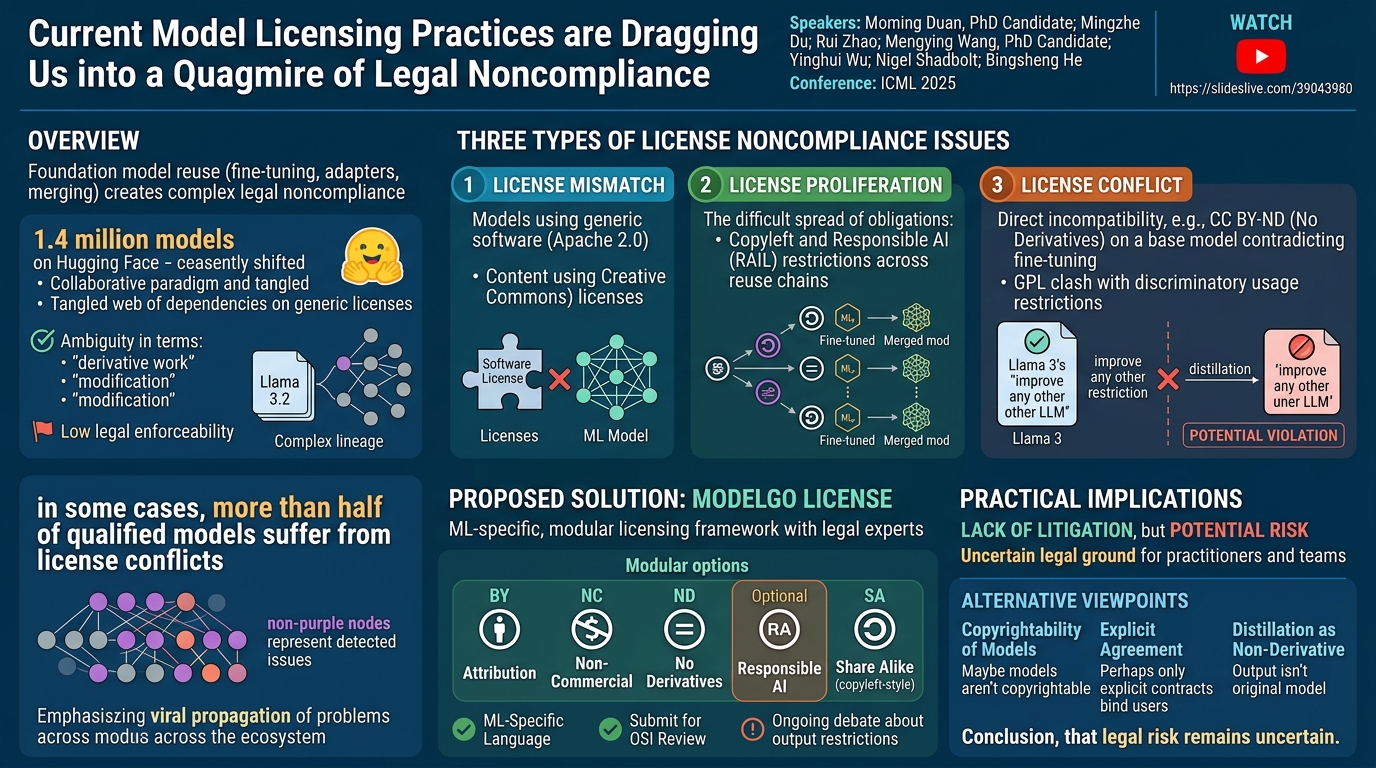
This ease of reuse has led to an explosion in the number of publicly available models. The talk cites a staggering 1.4 million models published on Hugging Face, with fine-tuning and adapter models being the most popular forms of derivation. The complexity doesn't stop at primary reuse; the ecosystem also sees secondary reuse, where models derived from foundation models are themselves combined or further adapted. The speakers illustrate this intricate web with a visualization of model dependencies crawled from Hugging Face, where purple nodes represent models and edges denote reuse relationships. Red and orange clusters signify extensive fine-tuning and adapter reuse, while blue lines indicate model merging, where multiple models contribute to a new creation. A prominent example, Llama 3.2, is shown on the far right of this diagram, exhibiting a complex lineage born from both model merging and secondary fine-tuning.
However, this highly interconnected and collaborative environment introduces a profound challenge: these models are released under diverse licenses, each with its own set of conditions and restrictions. The central problem articulated by the researchers is that these licenses often clash, leading to a "quagmire of legal noncompliance." A critical illustration is drawn from the Llama 3 license, which includes a clause explicitly stating: "You will not use the Llama materials or any output or results of the Llama materials to improve any other large language models." This clause immediately raises questions about common practices like distillation, where knowledge from a larger model (e.g., Llama 3) is transferred to a smaller, more efficient model (e.g., DeepSeek). Such an act, if it "improves" another LLM, could constitute a direct violation, empowering Meta to terminate licenses and pursue legal action. The inherent ambiguity and potential for conflict in this rapidly evolving ecosystem underscore the urgent need for clarity and standardization in AI model licensing.
Key Findings
▶ Watch: Three types of license noncompliance issues identified (2:00)
The core contribution of this research lies in its systematic identification and categorization of pervasive legal noncompliance issues within the machine learning model ecosystem. The speakers assert that these issues are not isolated incidents but rather systemic problems that are difficult to resolve and can propagate across the complex web of model dependencies. They categorize these license-related noncompliance issues into three primary types:
- License Mismatch: This issue arises because many models are released under licenses originally designed for software (e.g., Apache 2.0) or free content (e.g., Creative Commons). These licenses were not specifically drafted with the unique characteristics and usage patterns of machine learning models in mind. The primary risk here is ambiguity; the terms, such as "derivative work," "distribution," or "modification," may not have clear interpretations when applied to models, their weights, training data, or outputs. This lack of clarity undermines their legal enforceability and creates uncertainty for developers attempting to comply.
- License Proliferation: This type of noncompliance relates to the spread of license obligations, particularly those associated with copyleft licenses or similar terms found in responsible AI licenses. Copyleft licenses, by their nature, require that derivative works also be licensed under the same or a compatible license. Similarly, responsible AI (RAIL) licenses often include usage behavior restrictions (e.g., prohibiting discriminatory use or specific harmful applications) that are intended to remain consistent in any derivations. The challenge lies in ensuring that these obligations are correctly identified, understood, and consistently applied across a chain of model reuse, which can quickly become complex and error-prone as models are fine-tuned, merged, or adapted multiple times.
- License Conflict: This is perhaps the most direct form of noncompliance, occurring when the terms of multiple licenses involved in a model's lineage are incompatible. The speakers provide two clear examples:
- A model licensed under CC BY-ND (Creative Commons Attribution-NoDerivatives) explicitly prohibits the sharing of derivative works. If such a model is fine-tuned or merged, the resulting derivative cannot be legally shared, conflicting with the common practice of publishing adapted models.
- A model licensed under the GPL (GNU General Public License), a strong copyleft software license, cannot include discriminatory usage restrictions. If an underlying component or a merged model imposes such restrictions (as might be found in some responsible AI licenses), it would create a direct conflict with the GPL's tenets of freedom and non-discrimination.
The researchers' analysis of the Hugging Face ecosystem revealed that these issues are widespread. They found "numerous issues across most model projects," many of which are "difficult to resolve." Crucially, they noted that license issues can "spread to derivative models, making the problem worse," akin to a viral propagation. The difficulty in identifying all dependencies of a model further complicates matters, potentially leading to "overly optimistic results" regarding compliance levels. Quantitatively, their analysis indicated that "in some cases, more than half of qualified models suffer from license conflicts." The presentation included a visualization (described as "every non-purple node represents a model with detected issues") which graphically depicted the pervasive nature of these conflicts across the model ecosystem. These findings underscore a critical gap in current practices and highlight the urgent need for a more robust and tailored approach to AI model licensing.
Technical Deep Dive
▶ Watch: Proposed solution: The ModelGo license for sharing (3:40)
The technical contribution of this research spans both the identification of compliance issues and the proposal of a novel licensing framework to address them. The methodology for identifying noncompliance involved a systematic crawl of the Hugging Face website to map model dependencies and their associated licenses. This process involved:
- Model Dependency Graph Construction: Creating a directed graph where nodes represent models and edges denote reuse relationships (e.g., fine-tuning, adapter use, merging). The talk specifically mentions crawling to visualize complex lineages, such as that of Llama 3.2.
- License Extraction and Parsing: For each model identified, extracting its declared license terms.
- Noncompliance Detection Logic: Applying a set of rules, likely codified based on legal consultation, to identify the three categories of noncompliance:
- Mismatch: Checking if a model is released under a generic software or content license and flagging the inherent ambiguity for ML contexts.
- Proliferation: Tracing copyleft obligations or responsible AI terms through derivative chains to ensure consistency.
- Conflict: Identifying direct contradictions between license terms in a model's lineage, such as a "no derivatives" clause clashing with an intention to fine-tune, or usage restrictions conflicting with fundamental open-source principles.
The researchers acknowledge the challenge in accurately identifying all dependencies, which can lead to an underestimation of the true extent of noncompliance. This implies a need for more robust metadata standards or automated tools to track model lineage more comprehensively.
To mitigate these widespread issues, the researchers collaborated with a law firm to draft the ModelGo license. This initiative represents a significant technical and legal effort to create a licensing framework specifically tailored for the unique complexities of machine learning models. The design principles of ModelGo aim to provide clarity, flexibility, and enforceability within the ML context:
- ML-Specific Language: Unlike generic software licenses, ModelGo is designed to clearly define terms and obligations relevant to models, their weights, training data, inference outputs, and various forms of reuse (fine-tuning, distillation, merging). This specificity aims to reduce the ambiguity that plagues current practices.
- Modular Options (Similar to Creative Commons): ModelGo offers a set of customizable licensing options, allowing developers to specify their terms with precision:
- Attribution (BY): Requires users to credit the original model creator.
- Non-Commercial (NC): Restricts commercial use of the model or its derivatives.
- No Derivatives (ND): Prohibits the creation and distribution of modified versions of the model. This is a critical option, as its absence or presence directly impacts fine-tuning and merging possibilities.
- Responsible AI (RA): Allows developers to include specific terms related to ethical use, preventing harmful applications or requiring certain safety measures.
- Share Alike (SA): A copyleft-style clause requiring derivative models to be licensed under the same or a compatible ModelGo license.
- Responsible AI as Optional: A key distinction from existing Open RAIL (Responsible AI Licensing) initiatives is that ModelGo treats responsible AI terms as optional. This offers greater flexibility to developers, allowing them to choose whether to impose such restrictions, rather than making them mandatory. This design choice likely reflects a desire to balance ethical considerations with the principles of open access and reuse.
- Mitigation of Legal Noncompliance: By clearly defining license conditions and obligations, ModelGo aims to proactively prevent the types of mismatches, proliferation, and conflicts currently observed. For instance, explicit clauses on distillation or model merging would provide legal certainty where current licenses are silent or ambiguous.
The researchers have submitted several variants of the ModelGo license for review by the Open Source Initiative (OSI). This engagement has sparked debate, particularly concerning whether "imposing restrictions on the model's output violates the spirit of the open source." This highlights a fundamental tension between the traditional open-source ethos of maximal freedom and the emergent need for control over AI model outputs, especially given concerns about misuse or unintended consequences. The ModelGo license represents a significant step towards a more robust and legally sound framework for sharing and reusing AI models, acknowledging the unique challenges of this domain.
Experimental Setup & Results
▶ Watch: Alternative viewpoints on model copyright and licensing (4:20)
The "experimental setup" in this context refers to the methodology employed by the researchers to conduct their noncompliance analysis across the vast ecosystem of machine learning models. While not a traditional experimental setup with controlled variables and treatment groups, it involved a systematic data collection and analysis pipeline:
Data Collection:
The primary data source was the Hugging Face website, a central hub for sharing pre-trained models, datasets, and demos. The researchers developed a crawling mechanism to:
- Identify a large corpus of models (the talk mentions 1.4 million models on Hugging Face).
- Extract metadata associated with each model, crucially including its declared license.
- Map model dependencies and reuse relationships. This involved identifying which models were derived from others through processes like fine-tuning, adapter integration (e.g., LoRA), or model merging. The visualization presented in the talk, with purple nodes representing models and edges indicating reuse, clearly demonstrates the output of this crawling effort. Specific examples like the complex lineage of Llama 3.2 were highlighted.
Analysis Methodology:
Once the data was collected, the researchers applied their defined categories of noncompliance (license mismatch, proliferation, and conflict) to analyze the observed license relationships. This likely involved:
- License Interpretation: Manually or semi-automatically interpreting the terms of various licenses (e.g., Apache 2.0, Creative Commons variants, Llama 3 license, Open RAIL) in the context of ML model reuse.
- Dependency Chain Traversal: Tracing license obligations and restrictions through the dependency graph to detect how terms propagate and potentially conflict.
- Conflict Detection: Implementing logic to identify direct contradictions between license terms in a model's lineage. For instance, if a base model has a "no derivatives" clause, but a derived model is published, a conflict is flagged. Similarly, if a copyleft license clashes with a proprietary or restricted-use license, it's marked as a conflict.
Results & Headline Numbers:
The analysis yielded compelling and concerning results, indicating a pervasive problem:
- Widespread Issues: The researchers found "numerous issues across most model projects" on Hugging Face. This suggests that noncompliance is not an edge case but a systemic challenge impacting a significant portion of the shared AI model ecosystem.
- Difficulty in Resolution: Many detected issues were characterized as "difficult to resolve," highlighting the inherent complexity arising from ambiguous license terms and intricate dependency chains.
- Propagation of Issues: A critical finding was that "license issues can spread to derivative models, making the problem worse." This "viral" nature of noncompliance means that a single problematic license at the base of a dependency chain can affect many subsequent models.
- Underestimation Risk: The researchers acknowledged a limitation: "it's hard to identify all the dependencies of a model which can lead to overly optimistic result." This implies that the true extent of noncompliance might be even greater than what their analysis revealed, as undetected dependencies could harbor further conflicts.
- Quantified Conflicts: A headline number provided was that "in some cases more than half of a qualified models suffer from license conflicts." While the specific definition of "qualified models" or the exact number of models analyzed for this statistic was not detailed in the transcript, this figure underscores the severity of the problem. It suggests that a substantial proportion of models in the ecosystem may be operating under legally dubious conditions.
- Visual Evidence: The talk referenced a visualization (a "finger below visualize license issues across ecosystem, every non-purple node represents a model with detected issues") which visually reinforced the widespread nature of these conflicts, showing many clusters of models plagued by detected license problems.
In summary, while the "experimental setup" was more akin to a large-scale data audit, the results clearly demonstrated that current model licensing practices are indeed dragging the ML community into a "quagmire of legal noncompliance," necessitating a fundamental shift in how models are licensed and reused.
Practical Implications
▶ Watch: Q&A: Current status of license violation litigation (6:00)
The findings presented in this talk carry profound practical implications for a wide array of stakeholders in the AI/ML ecosystem, including practitioners, infrastructure teams, model builders, and deployers. The pervasive nature of license noncompliance introduces significant legal risks and operational complexities that, if unaddressed, could stifle innovation or lead to costly disputes.
For practitioners and model builders, the primary implication is the presence of uncertain legal ground when reusing existing models. The example of the Llama 3 license, which restricts using its outputs to improve other large language models, serves as a stark warning. A developer fine-tuning Llama 3 or distilling its knowledge into another model (like DeepSeek) could unknowingly violate the license, potentially facing termination of their license and legal action from the rights holder. This uncertainty can deter legitimate reuse, as developers become wary of the hidden legal landmines within model licenses. It necessitates a much deeper understanding of license terms, often requiring legal expertise that is typically beyond the scope of a data scientist or ML engineer.
Infrastructure teams and deployers face challenges in managing dependencies and ensuring compliance at scale. With complex model lineages and secondary reuse, tracking the license of every component model and its derivations becomes an arduous task. The "license proliferation" issue means that copyleft-style terms or responsible AI restrictions must be meticulously propagated and respected across an entire ecosystem of deployed models. This demands robust license management tools and processes that can parse licenses, identify potential conflicts, and audit compliance throughout the model lifecycle, from development to production. Without such tools, organizations run the risk of deploying systems that are legally vulnerable.
The talk also illuminates crucial tradeoffs and limitations in the current landscape.
- Flexibility vs. Certainty: The current highly flexible reuse paradigm, while fostering rapid innovation, comes at the cost of legal certainty. The proposed ModelGo license aims to reintroduce certainty by providing ML-specific terms but might introduce friction by requiring more deliberate licensing choices.
- Lack of Litigation: A significant point raised during the Q&A was the current absence of high-profile litigation related to these specific model license violations. While the researchers acknowledge that "currently there is no such case go to the court," they emphasize that the identified issues represent a "potential risk." This means that the legal precedents are yet to be established, making the situation even more precarious. Compliance or non-compliance could heavily depend on jurisdiction and specific case facts, adding another layer of complexity.
- Alternative Viewpoints: The talk thoughtfully presents several alternative legal viewpoints that challenge the premise of strict compliance, highlighting the ongoing legal debate:
- Copyrightability of Models: Some argue that model creators may not hold full copyright of their training data, or that models themselves might not be copyrightable. If a model is not copyrightable, then anyone could freely use it without requiring a license. This viewpoint questions the very foundation of model licensing.
- Explicit Agreement: Another view holds that users are not bound by a model's license or terms of use unless they explicitly agree to them (e.g., by signing a contract). Under this perspective, many "open weights" models could be treated as public domain, effectively nullifying many license restrictions.
- Distillation as Non-Derivative: A third viewpoint posits that model distillation does not create a "derivative work" because the generated outputs are not part of the original model. If this holds, then license terms, even copyleft ones, would not extend to the output of distillation. This could allow practitioners to generate datasets using a licensed model and then train a new model from that dataset, potentially bypassing the original license entirely.
These alternative viewpoints underscore the nascent and evolving nature of AI intellectual property law. While they offer potential avenues for more permissive reuse, they also introduce further uncertainty. The researchers conclude that despite these differing opinions, "the legal risk surrounding model reuse remains uncertain." This necessitates not only technical tools for risk evaluation and monitoring but also stronger collaboration with legal experts and policymakers to forge a clearer and more sustainable legal framework for AI model sharing.
Key Takeaways
- The rapid proliferation of foundation models and extensive reuse practices (fine-tuning, adapters, merging) have created a complex and legally precarious ecosystem.
- Current model licensing practices suffer from three main issues: license mismatch (software/content licenses ill-suited for ML), license proliferation (difficulty in propagating copyleft/responsible AI terms), and license conflict (incompatible terms between models).
- A significant portion of models on platforms like Hugging Face exhibit these noncompliance issues, with "more than half of qualified models" suffering from conflicts in some cases.
- The ModelGo license is proposed as a solution, offering an ML-specific, modular licensing framework (Attribution, Non-Commercial, No Derivatives, Responsible AI, Share Alike) designed to clarify terms and mitigate legal risks.
- Despite widespread noncompliance, there is currently a lack of litigation, indicating that these are primarily potential risks whose legal consequences are yet to be fully tested in court.
- The legal landscape for AI models is highly uncertain, with ongoing debates about model copyrightability, explicit agreement requirements, and whether processes like distillation create derivative works.
About the Speaker(s)
The talk was presented by Mengying Wang, a PhD candidate from Case Western Reserve University. She presented on behalf of the lead author, Moming Duan, who was unable to attend the conference due to visa issues. The research team also includes Mingzhe Du, Rui Zhao, Yinghui Wu, Nigel Shadbolt, and Bingsheng He. Moming Duan is also scheduled to present a VLDB tutorial in London, providing another opportunity for discussion on this critical topic. Their collective work focuses on understanding and addressing the complex legal and ethical challenges emerging from the widespread reuse of AI models.
Reviews
Maya Iyer (Theoretical ML Researcher) — WEAK
This talk identifies a real and underappreciated problem — that model licensing on platforms like Hugging Face is a mess, and that generic software licenses map poorly onto the semantics of model weights, fine-tuning, and distillation — but it does not deliver the intellectual infrastructure needed to actually solve that problem. The empirical audit is descriptive rather than analytic, the proposed ModelGo license is presented without rigorous legal or formal justification for its design choices, and the headline statistic ('more than half of qualified models suffer from license conflicts') is introduced without defining what 'qualified' means or how conflicts were detected. This is closer…
Chen Zhao (Applied ML Researcher & Empiricist) — WEAK
This talk identifies a real and underappreciated problem — license incompatibility and legal noncompliance in the Hugging Face model ecosystem — and proposes the ModelGo license as a structured remedy. The problem framing is sharp and the taxonomy of noncompliance types (mismatch, proliferation, conflict) is useful. But the empirical methodology is underspecified to the point where the headline numbers ('more than half of qualified models suffer from license conflicts') cannot be evaluated or reproduced. The proposed solution raises more legal questions than it answers, and the work sits awkwardly between a legal analysis paper and an ML systems paper without fully satisfying the standards…
→ Top-rated talks at International Conference on Machine Learning 2025
All talks from International Conference on Machine Learning 2025