Position: Generative AI Regulation Can Learn from Social Media Regulation
Ruth Elisabeth Appel (Anthropic)
Overview
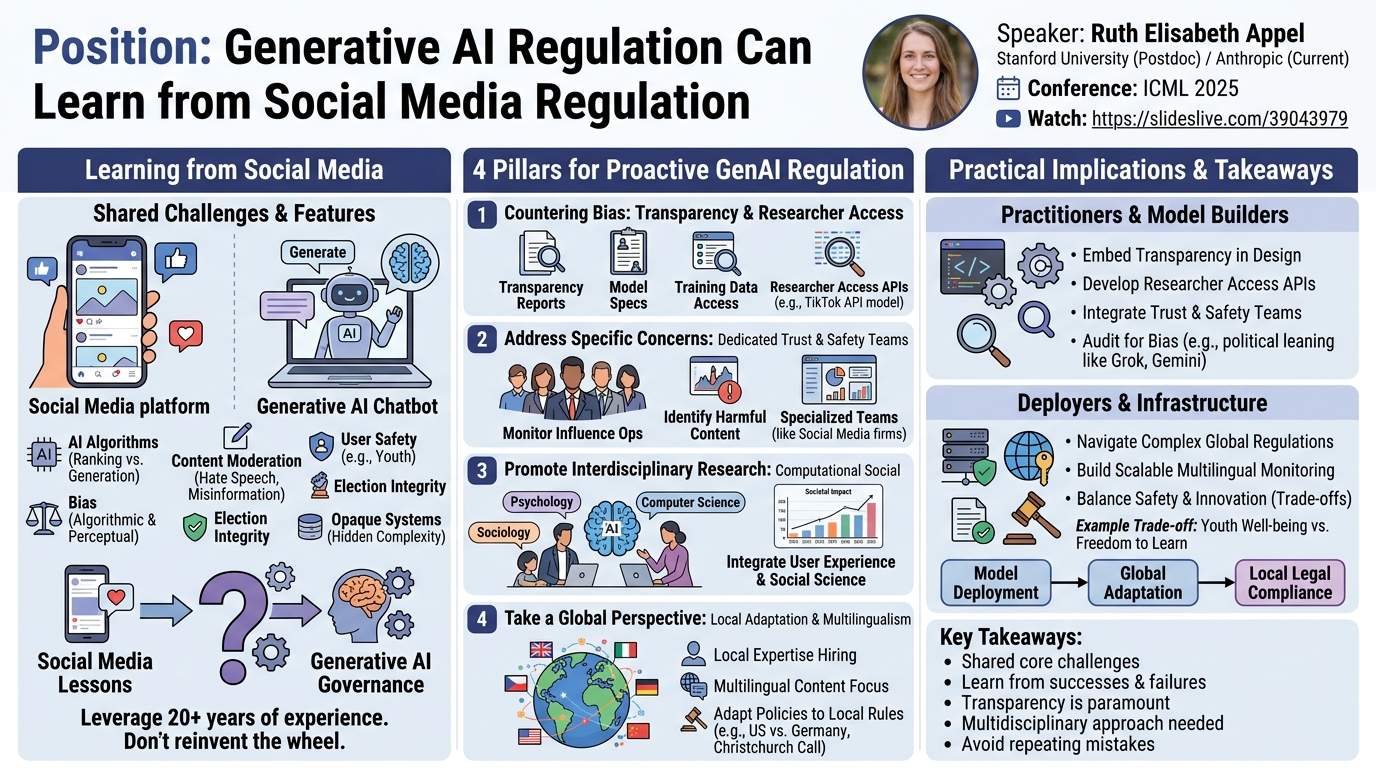
In this thought-provoking talk at ICML 2025, Ruth Elisabeth Appel, a postdoctoral fellow at Stanford University at the time of the research and now with Anthropic, presented a compelling argument for leveraging insights from social media regulation to inform the burgeoning field of generative AI governance. Titled "Generative AI Regulation Can Learn from Social Media Regulation," Appel's paper challenges the prevailing notion that the transformative nature of AI necessitates entirely novel legal frameworks, advocating instead for a pragmatic approach that builds upon existing regulatory precedents and lessons learned from previous technological paradigms. The core of her argument posits that despite their differences, generative AI and social media share fundamental characteristics, particularly concerning societal impact and content governance, that make a comparative analysis not only possible but essential.
Key moments
- 0:00 Introduction and core thesis: Learn from social media regulation
- 2:00 Key similarities between generative AI and social media
- 4:00 Recommendation 1: Countering bias through transparency and access
- 4:40 Recommendation 2: Addressing specific regulatory concerns like elections
- 5:10 Recommendation 3: Promoting multidisciplinary computational social science research
- 5:37 Recommendation 4: Taking a global perspective with local expertise
- 6:10 Addressing counterarguments and lessons from past failures
Position: Generative AI Regulation Can Learn from Social Media Regulation
Speakers: Ruth Elisabeth Appel
Conference: ICML 2025
YouTube: https://slideslive.com/39043979
Overview
In this thought-provoking talk at ICML 2025, Ruth Elisabeth Appel, a postdoctoral fellow at Stanford University at the time of the research and now with Anthropic, presented a compelling argument for leveraging insights from social media regulation to inform the burgeoning field of generative AI governance. Titled "Generative AI Regulation Can Learn from Social Media Regulation," Appel's paper challenges the prevailing notion that the transformative nature of AI necessitates entirely novel legal frameworks, advocating instead for a pragmatic approach that builds upon existing regulatory precedents and lessons learned from previous technological paradigms. The core of her argument posits that despite their differences, generative AI and social media share fundamental characteristics, particularly concerning societal impact and content governance, that make a comparative analysis not only possible but essential.
The talk addresses a critical juncture in the development and deployment of generative AI technologies, which are rapidly integrating into various facets of society. As these models become more powerful and ubiquitous, concerns around issues like political bias, misinformation, and user safety are escalating. Appel highlights concrete examples, such as allegations of right-leaning bias in models like Grok or left-leaning bias in Gemini's initial image generation capabilities, underscoring the urgent need for effective regulatory strategies. By drawing parallels to the two decades of experience with social media platforms, which have grappled with similar challenges like content moderation, election integrity, and youth well-being, Appel proposes a pathway to develop more robust and proactive regulatory measures for generative AI, aiming to prevent the repetition of past mistakes and accelerate the development of more effective governance.
This work is particularly timely given the ongoing global debates about how to best oversee AI, with some advocating for entirely new legislative bodies and others suggesting adaptations of existing laws. Appel’s position offers a nuanced perspective, suggesting that while AI is indeed transformative, its regulatory journey can be significantly informed by the hard-won lessons from social media, particularly in areas where their operational characteristics and societal impacts converge. Her recommendations emphasize not just policy adoption but also methodological shifts, such as promoting interdisciplinary research and fostering a global perspective, essential for navigating the complex landscape of AI ethics and governance.
Background
▶ Watch: Introduction and core thesis: Learn from social media regulation (0:00)
The advent of generative AI has ushered in an era of unprecedented technological capability, with models capable of producing human-like text, images, audio, and code. This rapid advancement has, however, outpaced the development of robust governance frameworks, leading to a complex and often contentious regulatory landscape. The central problem in the ML/systems space, as identified by Appel, is the tendency to view generative AI as an entirely new phenomenon, necessitating a complete re-invention of regulatory approaches. This perspective often overlooks the rich history of technological regulation and the valuable lessons embedded within it.
Prior to the current wave of generative AI, social media platforms occupied a similar position at the forefront of societal and technological change. Over the past two decades, these platforms have evolved from niche online communities to pervasive global infrastructures, profoundly influencing information dissemination, public discourse, and individual well-being. Throughout this evolution, social media companies have faced intense scrutiny and regulatory pressure concerning issues such as political bias, spread of misinformation, hate speech, impact on mental health, and foreign influence operations. Regulatory responses have varied widely, encompassing self-regulation regimes, industry standards, and government interventions, often with mixed results. This historical context provides a wealth of data on what works, what doesn't, and why.
The problem, therefore, is not a lack of regulatory experience, but rather a failure to effectively transfer and adapt this experience to the new domain of generative AI. Appel argues that many of the societal challenges posed by generative AI—such as the potential for algorithmic bias, the difficulties of content moderation at scale, the impact on vulnerable populations, and the complexities of global deployment—are structurally analogous to those encountered with social media. For instance, allegations of political bias in generative models like Grok and Gemini mirror long-standing debates about algorithmic bias and content moderation practices on platforms like Facebook and Twitter. By framing the current regulatory dilemma for generative AI within this historical context, Appel posits that we can avoid "reinventing the wheel" and instead accelerate the development of more effective and nuanced regulatory solutions.
Key Findings
▶ Watch: Recommendation 1: Countering bias through transparency and access (4:00)
Ruth Appel's central argument is that generative AI regulation can and should learn from the extensive experience garnered through social media regulation. She substantiates this position by first establishing key similarities between the two technologies and then outlining four specific, actionable recommendations derived from this comparative analysis.
The first key finding is the identification of significant commonalities between generative AI and social media platforms. Drawing on the work of scholars like Clark and Rafaeli, Appel highlights shared features such as spatial separation (content generated remotely from the user), high interactivity, the ability to record conversations, and personalization features. Both technologies are also characterized by their general-purpose nature, covering a vast array of topics, and critically, both heavily rely on opaque AI algorithms while hiding their underlying complexity from users and regulators alike, making them difficult to scrutinize. A particularly salient shared feature is the presence of content moderation, where developers or platforms make decisions about the content users can access, albeit with varying degrees of visibility and user control. While differences exist—such as generative AI's dialogue-by-default interaction style—the similarities, especially in how they generate, disseminate, and moderate content, are profound enough to warrant drawing direct regulatory lessons.
Building on these similarities, Appel advances four key recommendations for generative AI regulation, each informed by social media's regulatory journey:
- Countering Bias or Perceptions of Bias: This recommendation emphasizes the need for increased transparency and researcher access to platform data and models. Proposed measures include formal transparency requirements and mandating researcher access APIs, drawing a direct parallel to initiatives like the TikTok research API, which provides data to external academics for studying platform impact.
- Addressing Specific Regulatory Concerns: This category encompasses issues like youth well-being and election integrity. Appel suggests requiring AI labs to establish dedicated trust and safety teams and implement robust monitoring systems for influence operations, mirroring the established practices and dedicated teams within social media companies.
- Promoting Computational Social Science Research: To foster a deeper, multidisciplinary understanding of AI's societal impact, Appel advocates for integrating more interdisciplinary expertise, including user experience researchers, into AI development and evaluation. This approach mirrors how social media companies have increasingly engaged computational social scientists to study phenomena like the impact of social media on elections.
- Taking on a More Global Perspective: Recognizing the global reach of AI, this recommendation stresses the importance of incorporating local expertise, hiring internationally, and explicitly focusing on multilingual content. Policy measures should ensure that global employees' insights are valued and that policies are adapted to local regulatory contexts, as seen in the varied content moderation rules across different countries (e.g., US vs. Germany) and multi-stakeholder initiatives like the Christchurch Call against online terrorism.
Appel also directly addresses potential counterarguments. She acknowledges that generative AI and social media are not identical, but asserts that lessons can be drawn from their shared features. She also concedes that social media regulation has seen its share of failures and slow progress, but argues that the goal is to learn from both successes and failures, not to blindly repeat past actions. Finally, while acknowledging the risk of stifling innovation by solely looking to the past, Appel contends that combining historical insights with novel approaches can lead to more effective and innovative future regulation.
Technical Deep Dive
▶ Watch: Recommendation 2: Addressing specific regulatory concerns like elections (4:40)
While the talk primarily focuses on policy and regulatory frameworks, the "technical deep dive" in this context pertains to the inherent features of the technologies themselves and the proposed technical-organizational mechanisms for regulation. Appel's argument hinges on the shared underlying characteristics of generative AI and social media, particularly their algorithmic nature and the systemic challenges they present.
Both generative AI and social media platforms are fundamentally driven by AI algorithms. In social media, these algorithms govern everything from content ranking and personalization to targeted advertising and content moderation. Similarly, generative AI models are complex algorithmic systems designed to generate novel content based on vast training datasets. A critical shared "technical" challenge is the hidden complexity and lack of scrutinability of these algorithms. Users rarely understand why certain content is shown or generated, and even researchers or regulators often struggle to gain transparent insights into their internal workings, training data biases, or decision-making processes. This opacity is a direct technical impedance to accountability and effective regulation.
The concept of content moderation serves as a core technical and operational nexus between the two technologies. In social media, content moderation involves a complex interplay of automated systems (AI algorithms for flagging, filtering) and human moderators, operating under specific policy guidelines to manage user-generated content. For generative AI, content moderation extends to controlling the types of outputs a model can produce, preventing the generation of harmful, biased, or illegal content (e.g., hate speech, misinformation, deepfakes). This involves techniques like safety filters, red-teaming, and guardrail models applied during inference. The technical challenge in both domains is achieving effective, scalable, and fair moderation that balances freedom of expression with safety, without introducing new forms of bias or censorship. Appel implicitly argues that the operational and algorithmic design considerations for building scalable, effective content moderation systems in social media offer valuable blueprints for GenAI.
The recommendations themselves also imply specific technical and systemic designs. For instance, mandating transparency requirements for generative AI models would necessitate developing standardized methods for disclosing training data characteristics, model architectures, evaluation metrics, and perhaps even internal decision pathways. This is a significant technical undertaking, requiring new tools and methodologies for model introspection and interpretability. The call for researcher access APIs is a direct technical specification. Just as the TikTok research API provides structured access to platform data for academic study, a similar API for generative AI companies would need to be designed to allow controlled, ethical access to model outputs, internal states, or interaction logs, facilitating independent auditing for bias, safety, and societal impact. This requires careful consideration of data privacy, security, and the scope of access.
Furthermore, the emphasis on trust and safety teams at AI labs implies the integration of engineering, data science, and social science expertise to build systems that are robust against misuse and harmful outputs. This involves not just policy formulation but also the development of technical tools for monitoring, detection of influence operations, and rapid response mechanisms. The need for a global perspective in content moderation and policy adaptation also has technical implications, requiring systems capable of handling multilingual content, understanding cultural nuances in harmful speech, and adapting moderation rules based on local legal and social contexts, potentially through geo-fenced policy enforcement or localized model fine-tuning.
In essence, while the talk doesn't delve into specific neural network architectures or training regimens, its "technical deep dive" is into the systems-level challenges of deploying powerful AI, the algorithmic opacity that complicates governance, and the technical-organizational solutions (like APIs, specialized teams, and adaptable moderation systems) that can be borrowed from social media to address these challenges in the generative AI domain.
Experimental Setup & Results
▶ Watch: Recommendation 4: Taking a global perspective with local expertise (5:37)
This talk by Ruth Appel is a position paper and a conceptual argument, rather than a presentation of empirical research with an experimental setup and results in the traditional sense. Therefore, there are no specific datasets, baselines, hardware configurations, or headline numbers to report from an experimental methodology.
The content of the talk focuses on a comparative analysis of regulatory challenges and solutions between two distinct technological domains: social media and generative AI. Appel's "findings" are derived from synthesizing existing knowledge, historical precedents in social media regulation, and an analytical comparison of the functional characteristics and societal impacts of both technologies. Her recommendations are policy-oriented proposals informed by this synthesis, rather than outcomes of controlled experiments or benchmarks. The talk's strength lies in its analytical framework and the logical construction of its argument, aiming to guide future policy development rather than present empirical evidence from a specific study.
Practical Implications
▶ Watch: Addressing counterarguments and lessons from past failures (6:10)
The practical implications of Ruth Appel's position are far-reaching, touching upon various stakeholders involved in the development, deployment, and governance of generative AI. For practitioners and model builders within AI labs, the talk suggests a fundamental shift in design philosophy. Instead of solely focusing on performance metrics, developers must proactively consider the societal impact of their models from conception. This means embedding transparency mechanisms directly into model architectures and training pipelines, designing for researcher access APIs that allow external scrutiny, and integrating trust and safety considerations as core engineering requirements, not as afterthoughts. For instance, training data curation should account for potential biases that could manifest as political leaning (e.g., Grok, Gemini), and model outputs should be subjected to rigorous content moderation similar to social media platforms.
For infrastructure teams supporting generative AI deployment, the implications involve building systems that can accommodate these new regulatory demands. This could mean developing secure and privacy-preserving mechanisms for data sharing with researchers, implementing robust monitoring tools to detect misuse or influence operations, and creating flexible content moderation frameworks that can adapt to diverse local regulations. The concept of multilingual content and culturally adapted policies also requires infrastructure capable of handling diverse linguistic inputs and outputs, potentially involving geo-specific model deployments or policy enforcement layers.
Model deployers and platform operators face the challenge of navigating a complex and evolving regulatory landscape. Appel's work highlights the need to understand that regulations will not be uniform globally. Deployers must be prepared to adapt their services, content moderation policies, and even model behaviors to comply with varying legal frameworks, as exemplified by different content moderation rules in the US versus Germany. This necessitates robust legal and policy teams working in conjunction with engineering to ensure compliance while maintaining global product consistency where possible. The youth safety example raised during the Q&A underscores a critical tradeoff: balancing the protection of vulnerable users with ensuring their freedom to learn and explore. This requires nuanced policy design and continuous evaluation, moving beyond simple blanket restrictions.
However, there are also significant tradeoffs and limitations to consider. The call for increased transparency and researcher access, while beneficial for accountability, could raise concerns about intellectual property protection and competitive advantage for AI companies. Implementing comprehensive trust and safety teams and global adaptation strategies represents a substantial financial and resource commitment, potentially burdening smaller AI startups. Furthermore, relying too heavily on social media precedents risks inheriting their past failures or misapplying solutions to scenarios where generative AI's unique characteristics (e.g., its creative and autonomous generation capabilities) truly diverge. The speaker acknowledges this, emphasizing the need to learn from both successes and failures and to combine historical insights with novel approaches, rather than simply replicating past actions. The legal grey zone surrounding the applicability of existing laws like Section 230 of the Communication Decency Act to AI further complicates matters, highlighting the need for careful legal arbitration alongside policy development. Ultimately, the practical implication is a call for a more mature, proactive, and interdisciplinary approach to AI governance, one that is informed by history but not constrained by it.
Key Takeaways
- Leverage Social Media Regulatory Experience: Generative AI regulation can significantly benefit from the two decades of experience in regulating social media, preventing the need to "reinvent the wheel" for similar societal challenges.
- Shared Core Challenges: Both generative AI and social media share critical features like pervasive AI algorithms, content moderation needs, hidden complexity, and broad societal impact, making lessons transferable.
- Four Pillars for Proactive Regulation: Effective GenAI governance should focus on (1) countering bias through transparency and researcher access APIs, (2) addressing specific concerns like youth well-being and election integrity via dedicated trust and safety teams, (3) fostering computational social science research, and (4) adopting a global perspective for policy adaptation.
- Transparency and Access are Paramount: Mandating transparency requirements and providing researcher access to models and data, akin to the TikTok research API, is crucial for external scrutiny and accountability of generative AI.
- Learn from Both Successes and Failures: While social media regulation had its shortcomings (e.g., slow progress, debates around Section 230), the goal is to learn from what went well and what went wrong to develop more effective and adaptable AI policies.
- Multidisciplinary and Global Approach: Effective AI governance requires integrating diverse expertise, including social scientists and user experience researchers, and adapting policies to local contexts and multilingual content to address the technology's global reach and varied impacts.
About the Speaker(s)
Ruth Elisabeth Appel is a distinguished researcher in the field of AI and society. At the time of this presentation, she was a postdoctoral fellow at Stanford University, where much of the research presented in this talk was conducted. She has since taken on a new position at Anthropic, an AI safety and research company, though her presentation at ICML 2025 solely focused on her independent work prior to joining the company. Her expertise lies at the intersection of technology, policy, and societal impact, with a particular focus on how past regulatory experiences can inform the governance of emerging technologies like generative AI.
Reviews
Maya Iyer (Theoretical ML Researcher) — WEAK
A policy position paper that draws structural analogies between social media and generative AI regulation and extracts four governance recommendations. The argument is coherent and the framing is timely, but this is not a technical ML contribution — it is a piece of science policy writing, and it should be evaluated as such. The core analogy is reasonable but underdeveloped; the recommendations are sensible but not rigorously derived; and the claim that regulatory lessons are 'transferable' is asserted rather than demonstrated. For an ICML audience expecting either theoretical results or experimentally rigorous empirical findings, this talk offers neither. A 2 reflects that the underlying…
Chen Zhao (Applied ML Researcher & Empiricist) — WEAK
A position paper arguing that generative AI governance can borrow from social media regulation. The analogy is reasonable and the policy recommendations are sensible, but this is conceptual work with no empirical grounding, no falsifiable claims, and no mechanism by which the argument could be proven wrong. The four recommendations are plausible but underspecified, and the comparative framework relies on surface-level structural similarities rather than evidence that the proposed lessons actually transfer. Worth reading for practitioners new to the policy space, but not a contribution that advances the state of knowledge for researchers already familiar with either domain.
→ Top-rated talks at International Conference on Machine Learning 2025
All talks from International Conference on Machine Learning 2025