Rényi Neural Processes
Xuesong Wang (CSIRO Data61), He Zhao, Edwin V. Bonilla
Overview
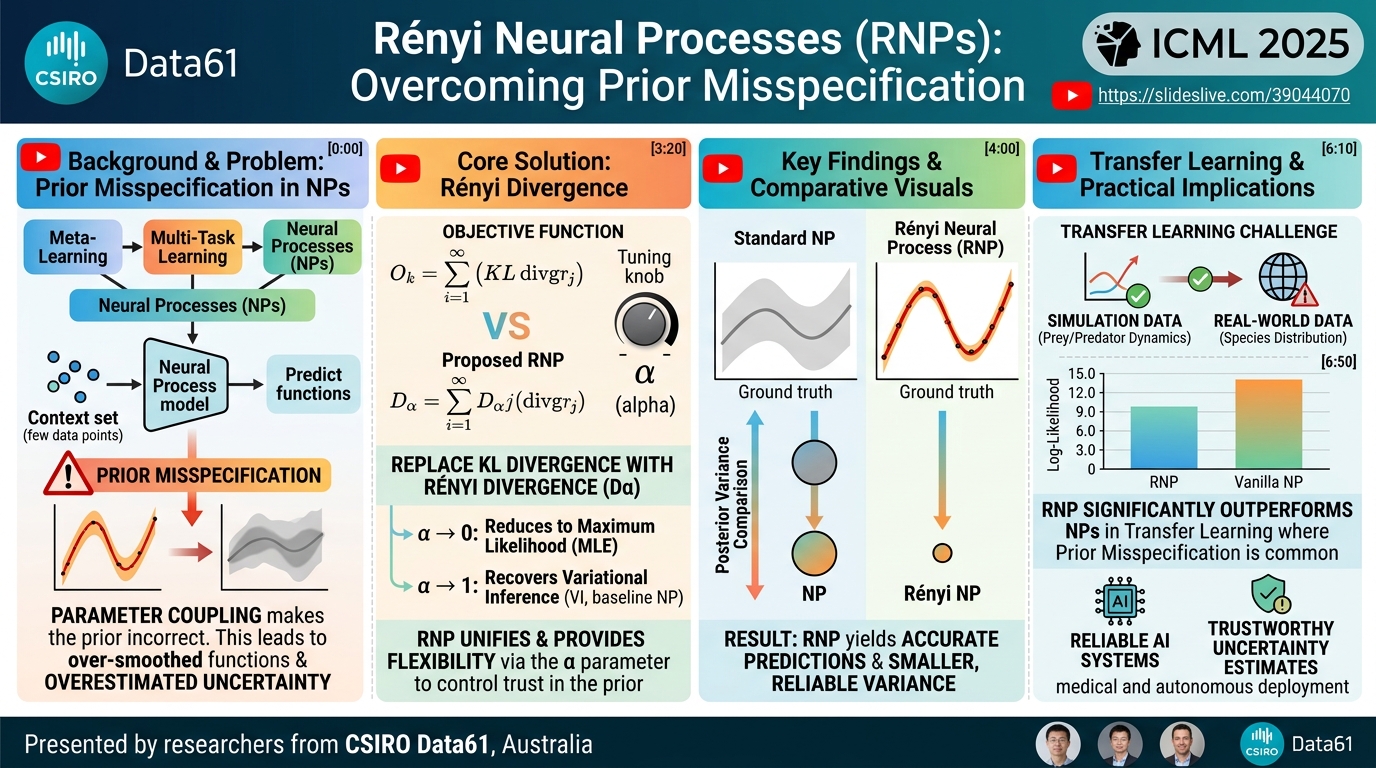
Neural Processes (NPs) represent a powerful paradigm in machine learning, offering a flexible framework for context-based prediction and robust uncertainty estimation. At ICML 2025, Xuesong Wang, along with co-authors He Zhao and Edwin V. Bonilla from CSIRO Data61, presented their work on Rényi Neural Processes (RNPs), a novel approach designed to overcome a critical limitation in conventional NPs: prior misspecification. The core idea behind NPs is to learn a mapping from a set of observed data points (context) to a distribution over unobserved target points, enabling rapid adaptation to new tasks or environments without requiring retraining. This capability is highly valuable across diverse applications such as meta-learning, multi-task learning, retrieval-augmented generation (RAG) for large language models (LLMs), and simulation-to-real transfer learning.
Key moments
- 0:00 Introduction to Neural Processes and their applications
- 2:00 The challenge: prior misspecification in Neural Processes
- 3:20 Visualizing NP's over-smoothed predictions vs. RNP's improvements
- 4:00 Understanding the cause of prior misspecification in NP's objective
- 5:10 Introducing Rényi divergence to control trust in the prior
- 6:10 Rényi Neural Process objective flexibility and recovered baselines
- 6:50 RNP's improved predictions, smaller variance, and transfer learning
Rényi Neural Processes
Speakers: Xuesong Wang, He Zhao, Edwin V. Bonilla
Conference: ICML 2025
YouTube: https://slideslive.com/39044070
Overview
Neural Processes (NPs) represent a powerful paradigm in machine learning, offering a flexible framework for context-based prediction and robust uncertainty estimation. At ICML 2025, Xuesong Wang, along with co-authors He Zhao and Edwin V. Bonilla from CSIRO Data61, presented their work on Rényi Neural Processes (RNPs), a novel approach designed to overcome a critical limitation in conventional NPs: prior misspecification. The core idea behind NPs is to learn a mapping from a set of observed data points (context) to a distribution over unobserved target points, enabling rapid adaptation to new tasks or environments without requiring retraining. This capability is highly valuable across diverse applications such as meta-learning, multi-task learning, retrieval-augmented generation (RAG) for large language models (LLMs), and simulation-to-real transfer learning.
Despite their inherent advantages, standard Neural Processes face a significant challenge in accurately encoding contextual information, particularly due to the reliance on an unobservable, high-dimensional latent variable representing the underlying task or environment. The prior distribution over this latent variable, which is crucial for regularization and uncertainty estimation, is often misspecified. This misspecification leads to suboptimal predictions, characterized by over-smoothed functions and an overestimation of predictive uncertainty. The Rényi Neural Process framework directly addresses this fundamental issue by introducing Rényi divergence into the NP objective function, providing a mechanism to control the degree of trust placed in the potentially misspecified prior. This innovation not only unifies existing NP objectives but also offers enhanced flexibility and significantly improves predictive performance and uncertainty quantification in challenging settings like transfer learning.
This talk is particularly important for researchers and practitioners working with probabilistic models, meta-learning, and systems that require robust uncertainty estimates. By providing a principled way to manage prior misspecification, RNPs pave the way for more reliable, interpretable, and generalizable AI systems. The ability to deploy models quickly to new environments or adapt to new tasks with just a few examples, coupled with accurate uncertainty bounds, is a cornerstone for building truly adaptive and trustworthy machine learning solutions.
Background
▶ Watch: Introduction to Neural Processes and their applications (0:00)
Neural Processes (NPs) emerge from the broader field of meta-learning, aiming to create models that can rapidly adapt to new tasks or environments. Conceptually, an NP operates by learning a function that, given a context set (a few input-output pairs, e.g., pixel locations XC and their values YC), can predict the distribution of output values YT for any new target input XT. This framework is inspired by how humans can quickly generalize from limited examples – for instance, identifying the Sydney Opera House from a few pixels.
The utility of NPs spans several critical machine learning domains. In meta-learning and multi-task learning, NPs allow a model to generalize to novel tasks by conditioning on a small number of examples specific to that task. This contrasts with traditional approaches that might require extensive retraining. The concept also mirrors Retrieval-Augmented Generation (RAG) in LLMs, where different prompts serve as context to manipulate the output distribution, showcasing the power of context-based manipulation. Furthermore, NPs are highly relevant for transfer learning scenarios, such as moving a model trained in a simulation environment to a real-world physical environment, where the differing environment settings become the context. In all these cases, NPs offer the promise of interpretable and robust decision-making through principled uncertainty estimation for unseen tasks.
However, a significant architectural challenge lies in how NPs encode this contextual information. NPs postulate the existence of a latent variable Z that encapsulates all relevant contextual details. A decoder then utilizes this Z along with the target input XT to generate predictions for YT. The inherent difficulty is that Z is typically high-dimensional, its true distribution is exceedingly complex (e.g., representing the "state of the entire Earth"), and critically, it is unobservable. To contend with this, NPs resort to assuming a prior model on Z, parameterized by phi, which is designed to be context-independent.
The core problem, as identified by Wang et al., is that this prior model can be misspecified. Prior misspecification means that the assumed prior distribution can never accurately recover the ground truth distribution of Z, regardless of the chosen parameters phi. This issue arises from the specific architecture and training objective of NPs. The training of NPs typically follows a variational inference approach, where the loss function comprises two main terms: maximizing the log-likelihood of the target data and minimizing the Kullback-Leibler (KL) divergence between a posterior distribution q_phi(Z|C,T) (conditioned on both context C and target T sets) and a prior distribution q_phi(Z|C) (conditioned only on the context C).
The critical assumption within this KL term is that the prior q_phi(Z|C) should regularize the posterior, implying that both the context and target sets originate from the same underlying task. NPs approximate the true, unobservable ground truth posterior with q_phi(Z|C,T) and the true prior with q_phi(Z|C). The problem stems from the second approximation: the prior q_phi(Z|C) can be misspecified because, due to parameter coupling (where phi is shared across both the posterior and prior approximations), the approximated prior is inadvertently drawn closer to the posterior during training, moving it further away from the true, underlying prior distribution. This fundamental flaw leads to tangible negative consequences in NP predictions, manifesting as over-smoothed functions and overestimated variances, thereby diminishing the reliability of uncertainty quantification.
Key Findings
▶ Watch: Visualizing NP's over-smoothed predictions vs. RNP's improvements (3:20)
The research presented on Rényi Neural Processes makes several pivotal contributions to the field of probabilistic machine learning, particularly addressing the limitations of Neural Processes.
Firstly, the talk originally identifies and articulates the issue of prior misspecification as a fundamental problem in standard Neural Processes. This misspecification, arising from the parameter coupling within the variational inference objective, was shown to lead to suboptimal predictive performance characterized by over-smoothed functions and an overestimation of predictive uncertainty (large variances). This diagnosis highlights a critical area for improvement in NP models.
Secondly, the core contribution is the proposal to leverage Rényi divergence as an alternative to the traditional KL divergence within the NP training objective. Rényi divergence, parameterized by a single value alpha, offers a crucial mechanism to control the degree of "trust" placed in the potentially misspecified prior. This parameter alpha allows for a flexible regularization strategy that can adapt to different levels of prior uncertainty or misspecification.
Thirdly, the Rényi Neural Process (RNP) framework demonstrates a remarkable ability to unify commonly used objectives of NPs. Specifically:
- When
alphaapproaches 0, the RNP objective recovers the maximum likelihood estimation (MLE) objective, a common approach in many NP frameworks. - When
alphaapproaches 1, the RNP objective reverts to the standard variational inference (VI) objective, which is the basis for many existing NP baseline models.
This unification demonstrates the RNP's theoretical generality while providing practical flexibility.
Fourthly, experimental results show that RNPs significantly mitigate the drawbacks of prior misspecification. In tasks involving periodic data, RNPs were able to generate functions that more closely followed the ground truth and exhibited much smaller variances compared to vanilla NPs. This implies that RNPs produce more accurate and less overconfident uncertainty estimates. The posterior distribution modeled by RNPs consistently showed a smaller variance, directly countering the overestimation observed in standard NP models.
Finally, in a crucial transfer learning setting, where the model was trained on simulation data and tested on real-world species data (a scenario highly prone to prior misspecification due to domain shift), RNPs significantly outperformed vanilla NPs in terms of log-likelihood. This demonstrates RNP's superior predictive capabilities and robustness when transferring knowledge across environments where the prior model is likely to be mismatched with the target domain. These findings collectively establish Rényi Neural Processes as a more robust, flexible, and accurate framework for context-based predictive modeling.
Technical Deep Dive
▶ Watch: Understanding the cause of prior misspecification in NP's objective (4:00)
The core of the Rényi Neural Process (RNP) lies in its innovative approach to addressing prior misspecification within the probabilistic framework of Neural Processes (NPs). Standard NPs operate on the principle of encoding a context set C = {(XC, YC)} into a latent variable Z, which then, in conjunction with target inputs XT, is used by a decoder to predict the distribution of YT. Mathematically, this involves learning an approximate posterior distribution q(Z|C) and a generative model p(YT|Z, XT). The training objective for NPs is typically a variational lower bound (ELBO), which can be conceptualized as maximizing the expected log-likelihood of the target data while regularizing the latent space via a KL divergence:
L_NP = E_q(Z|C,T) [log P(Y_T|Z, X_T)] - KL(q_phi(Z|C,T) || q_phi(Z|C))
Here, q_phi(Z|C,T) represents the approximate posterior distribution of the latent variable Z given both the context C and target T data, while q_phi(Z|C) is the approximate prior distribution of Z given only the context C. Both are parameterized by phi. The first term encourages accurate predictions, and the second term, the KL divergence, acts as a regularizer, pushing the posterior q_phi(Z|C,T) to be close to the prior q_phi(Z|C).
The crucial issue, as highlighted by the speakers, stems from the parameter coupling within this framework. Both q_phi(Z|C,T) and q_phi(Z|C) share the same parameters phi. The underlying assumption is that q_phi(Z|C,T) should approximate the true ground truth posterior p(Z|C,T), and q_phi(Z|C) should approximate the true ground truth prior p(Z|C). However, during training, the optimization process implicitly forces q_phi(Z|C) to move closer to q_phi(Z|C,T) (which is itself adapting to the data), rather than remaining a faithful approximation of the true, underlying p(Z|C). This dynamic can cause q_phi(Z|C) to become misspecified, meaning it can never truly recover p(Z|C) no matter how phi is chosen from its parameter space. The consequence of this misspecification is that the KL divergence term, which is highly sensitive to its arguments, can hinder effective training and lead to suboptimal predictions, notably over-smoothed functions and inflated uncertainty estimates.
To address this, the Rényi Neural Process replaces the KL divergence with Rényi divergence (D_alpha). The Rényi divergence is a family of divergences parameterized by a single value alpha >= 0. It provides a more flexible measure of discrepancy between two probability distributions P and Q than KL divergence. Its key property is that it allows for explicit control over how much "trust" is placed in the prior Q. The RNP objective can thus be written conceptually as:
L_RNP = E_q(Z|C,T) [log P(Y_T|Z, X_T)] - D_alpha(q_phi(Z|C,T) || q_phi(Z|C))
The parameter alpha governs the behavior of the Rényi divergence:
- Small
alpha(e.g., 0.1): The divergenceD_alpha(P||Q)remains relatively small even whenQis significantly different fromP. This implies a reduced "trust" in the priorQ's ability to accurately representP. In the context of RNP, a smallalphameans the model is less constrained by the potentially misspecified priorq_phi(Z|C). - Large
alpha: The divergenceD_alpha(P||Q)quickly becomes large asQdeviates fromP. This signifies a higher "trust" in the prior, enforcing a stronger regularization effect. - As
alphaapproaches 1: The Rényi divergence recovers the standard KL divergence. This is a crucial property as it shows RNP generalizes the existing NP framework.
This flexibility of alpha allows RNP to unify different NP objectives:
- When
alphatends to 0, the objective effectively reduces to a maximum likelihood estimation (MLE) approach, common in some NP variations that prioritize fitting the data over strong prior regularization. - When
alphatends to 1, the objective recovers the standard variational inference (VI) objective, which is the baseline for many Neural Process models.
By tuning alpha between these extremes, the RNP provides a continuum of regularization strengths, enabling practitioners to find an optimal balance for specific tasks and levels of prior misspecification. This mechanism directly tackles the sensitivity of KL divergence to misspecified priors, allowing the model to make better predictions by effectively modulating the influence of a potentially inaccurate prior.
Experimental Setup & Results
▶ Watch: Rényi Neural Process objective flexibility and recovered baselines (6:10)
The effectiveness of Rényi Neural Processes (RNPs) was demonstrated through a series of experiments designed to highlight its ability to mitigate prior misspecification and improve predictive performance and uncertainty quantification. While specific model architectures (e.g., encoder/decoder networks, number of layers, activation functions) or hardware details (e.g., GPU types) were not explicitly detailed in the talk, the conceptual setup and results provide strong evidence for the RNP framework's advantages.
The first illustrative experiment involved periodic data, a common benchmark for demonstrating function approximation and uncertainty estimation in probabilistic models.
- Setup: A standard NP model and the proposed RNP model were trained on observations from a periodic curve, forming the context set.
- NP Results: With a misspecified prior, the vanilla NP model exhibited over-smoothed predictions and large variances, indicating a lack of fidelity to the underlying function and an overestimation of uncertainty. This visually demonstrated the consequence of prior misspecification.
- RNP Results: In contrast, the RNP framework, with appropriately tuned
alphavalues, was able to generate a much better function that closely followed the ground truth. Critically, it also obtained a significantly smaller variance in its predictions. This visually confirmed RNP's ability to produce more accurate point predictions and tighter, more reliable uncertainty estimates. - Posterior Variance Analysis: Further analysis revealed that when modeling the posterior distribution using a two-dimensional Gaussian, RNPs consistently obtained a much smaller variance compared to the NP model. This directly implied that the prior misspecification in vanilla NPs indeed induces an overestimation of the variance in the posterior distribution, a critical flaw for applications requiring reliable uncertainty quantification.
A more challenging and practically relevant evaluation was conducted in a transfer learning setting, designed to explicitly test RNP's robustness under conditions prone to prior misspecification due to domain shift.
- Training Data: The model was trained on simulation data describing the population dynamics of prey and predator species over time. This dataset represents a controlled environment where the model can learn general patterns.
- Testing Data: The trained model was then applied to a real-world species dataset. This scenario inherently introduces a distributional shift or domain mismatch between the simulated training environment and the real-world testing environment, making the prior model learned from simulation data highly likely to be misspecified for the real-world task.
- Methodology: Crucially, for the testing phase, the model was not retrained. Instead, it was simply conditioned on the new context set provided by the real-world data, demonstrating the rapid adaptation capabilities of Neural Processes.
- Metric: The performance was evaluated using log-likelihood, a standard metric for assessing the quality of probabilistic predictions. Higher log-likelihood indicates better model fit and more accurate predictions of the observed data.
- Results: The RNP model significantly outperformed the vanilla NP in terms of log-likelihood on the real-world testing data. This compelling result underscores RNP's superior predictive capabilities in transfer learning settings, particularly where the prior model is more likely to be misspecified due to domain divergence. It validates the core hypothesis that by intelligently handling prior misspecification, RNPs can achieve better generalization and more robust performance when adapting to new, potentially disparate, environments.
These experimental findings collectively provide strong evidence that Rényi Neural Processes effectively address the identified issue of prior misspecification, leading to more accurate predictions and more reliable uncertainty estimates across various tasks and challenging transfer learning scenarios.
Practical Implications
▶ Watch: RNP's improved predictions, smaller variance, and transfer learning (6:50)
The introduction of Rényi Neural Processes (RNPs) carries significant practical implications for various stakeholders in the AI/ML ecosystem, from model builders to infrastructure teams and deployers. By directly tackling the pervasive issue of prior misspecification in Neural Processes, RNPs offer a path towards more robust, flexible, and trustworthy machine learning systems.
For model builders and researchers, RNP provides a principled and effective method for improving the performance of context-based predictive models. The ability to mitigate over-smoothed predictions and reduce overestimated variances means that the uncertainty estimates provided by RNPs are more reliable. This is crucial for applications where accurate uncertainty quantification is not just a desirable feature but a necessity, such as in medical diagnosis, autonomous systems, financial forecasting, or scientific discovery, where decisions must be made with a clear understanding of confidence levels. The framework's flexibility, through the alpha parameter, empowers researchers to fine-tune the model's regularization strategy, adapting it to different datasets, task complexities, and degrees of prior knowledge. This provides a valuable knob for optimizing model behavior beyond what standard variational inference offers.
For practitioners and deployers seeking to leverage meta-learning, multi-task learning, or transfer learning, RNPs offer enhanced robustness. The demonstrated success in simulation-to-real transfer learning is particularly impactful. Many real-world applications involve training models in controlled, data-rich simulated environments and then deploying them in complex, data-scarce physical environments. The inherent domain shift often leads to performance degradation. RNPs significantly improve the model's ability to adapt to these new environments with minimal examples, reducing the need for costly and time-consuming retraining. This translates to faster deployment cycles, lower operational costs, and more efficient resource utilization. The conceptual similarity to RAG for LLMs also suggests potential applications in making large models more adaptable and context-aware by intelligently handling the "prompt" as a potentially misspecified prior for the desired output distribution.
Infrastructure teams might find value in the increased stability and predictability of RNP models. While the computational overhead of Rényi divergence versus KL divergence was not explicitly detailed, assuming it is manageable, the improved predictive accuracy and more reliable uncertainty bounds can lead to better system performance and fewer unexpected failures in production. The ability to generalize from fewer examples could also reduce the data requirements for fine-tuning or adaptation, potentially easing the burden on data acquisition and management pipelines.
However, there are also tradeoffs and limitations to consider. The primary one is the need to select and tune the alpha parameter. While alpha offers flexibility, finding the optimal value might require additional experimentation or a meta-learning approach to tune alpha itself. This adds a layer of complexity compared to a fixed KL divergence objective. Furthermore, while the talk demonstrates the conceptual benefits, the specific computational implications of implementing Rényi divergence, especially for very large models or high-throughput inference, would need careful evaluation. The theoretical guarantees and practical behavior of Rényi divergence across a broader range of complex, high-dimensional data types and model architectures would also be areas for future exploration. Despite these considerations, the RNP framework represents a significant step forward in making Neural Processes more reliable and broadly applicable for real-world AI challenges.
Key Takeaways
- Prior misspecification is a critical, overlooked issue in conventional Neural Processes (NPs), leading to over-smoothed predictions and an overestimation of predictive uncertainty (large variances).
- Rényi Neural Processes (RNPs) address this by replacing the KL divergence in the NP training objective with Rényi divergence, a more flexible measure of distribution discrepancy.
- The
alphaparameter in Rényi divergence allows explicit control over the "trust" placed in the potentially misspecified prior, offering a continuum between Maximum Likelihood Estimation (MLE) (asalphaapproaches 0) and standard Variational Inference (VI) (asalphaapproaches 1). - RNPs significantly improve predictive accuracy and uncertainty quantification, generating functions that more closely match ground truth and providing much smaller, more reliable variance estimates compared to vanilla NPs.
- In challenging transfer learning scenarios (e.g., simulation-to-real data), RNPs demonstrate superior performance in terms of log-likelihood, highlighting their robustness when the prior model is likely misspecified due to domain shift.
- This framework offers increased flexibility and robustness for context-based predictive models, enhancing their applicability across meta-learning, multi-task learning, and domain adaptation tasks.
About the Speaker(s)
The work on Rényi Neural Processes was presented by Xuesong Wang, who is part of a research team that also includes He Zhao and Edwin V. Bonilla. All speakers are affiliated with CSIRO Data61, a leading data innovation group in Australia. Xuesong Wang delivered the presentation, outlining the problem of prior misspecification in Neural Processes and introducing their novel Rényi Neural Process framework. The research reflects their expertise in developing advanced machine learning methodologies for robust and interpretable AI.
Reviews
Maya Iyer (Theoretical ML Researcher) — SOLID
Rényi Neural Processes is a competent, honest paper that identifies a real failure mode in Neural Process training — prior misspecification induced by parameter coupling — and proposes replacing the KL divergence in the ELBO with Rényi divergence as a corrective. The unification of MLE and VI objectives under a single alpha-parameterized family is a clean theoretical observation, and the transfer learning experiments show a meaningful performance improvement. However, the core technical move is a fairly direct application of known properties of Rényi divergence to an existing framework; the theoretical analysis of why and how much Rényi divergence mitigates misspecification is not…
Chen Zhao (Applied ML Researcher & Empiricist) — WEAK
Rényi Neural Processes proposes a reasonable substitution of KL divergence with Rényi divergence in the Neural Process ELBO to address prior misspecification. The theoretical unification is clean and the motivation is credible. However, the experimental evidence as presented is severely thin: no mention of multiple seeds or error bars, baselines appear limited to 'vanilla NPs' without comparison against other well-established NP variants (AttentiveNP, ConvNP, TNP), no matched-compute analysis, no ablation over alpha values with variance reported, and the two experiments described (periodic data and a single sim-to-real transfer) are insufficient to substantiate broad claims about…
→ Top-rated talks at International Conference on Machine Learning 2025
All talks from International Conference on Machine Learning 2025