SWE-Lancer: Can Frontier LLMs Earn $1 Million from Real-World Freelance Software Engineering?
Samuel Miserendino, Michele Wang, Tejal Patwardhan, Johannes Heidecke
Overview
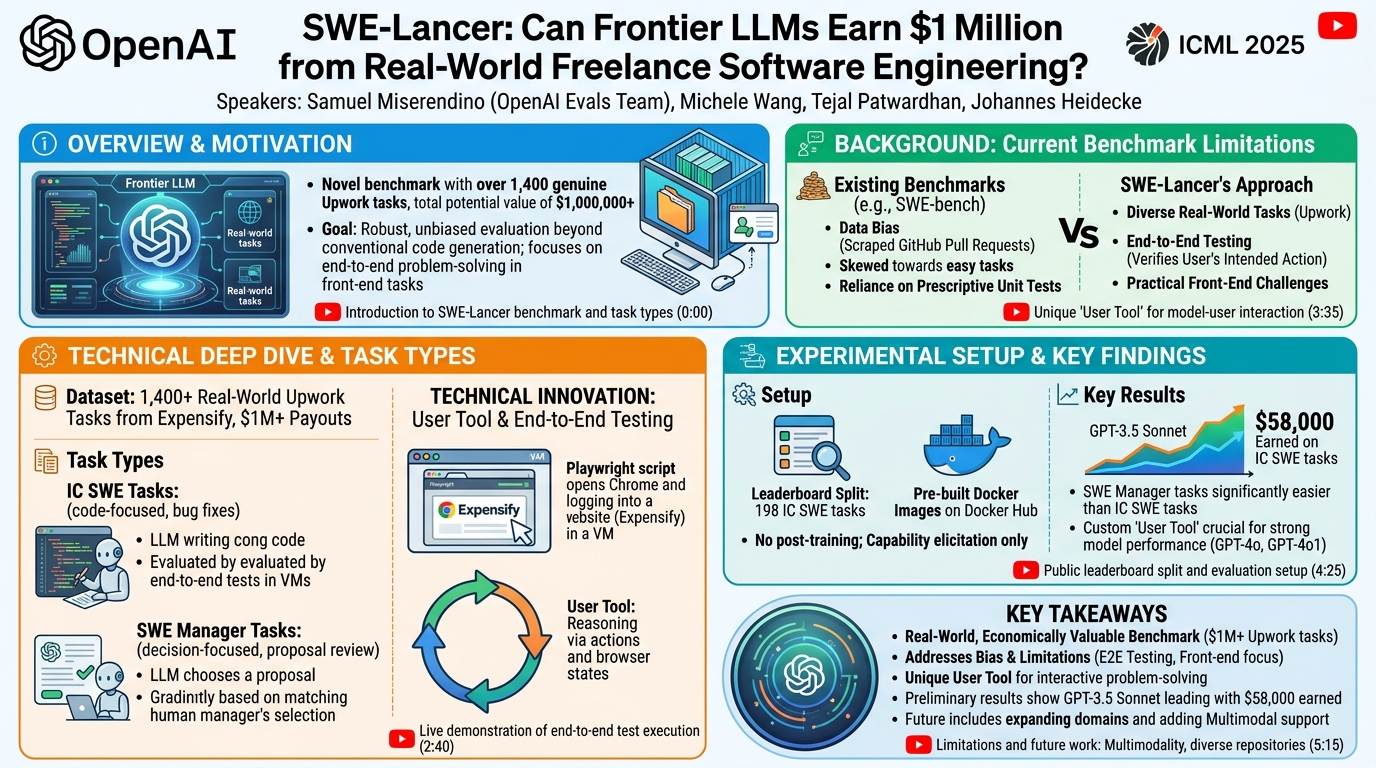
In an era where large language models (LLMs) are increasingly demonstrating advanced reasoning and code generation capabilities, a critical question emerges: how well do these models perform on complex, real-world software engineering tasks that carry tangible economic value? The talk by Samuel Miserendino and co-authors introduces SWE-Lancer, a novel and ambitious programming benchmark designed to answer precisely this question. SWE-Lancer stands apart by directly challenging frontier LLMs to tackle over 1,400 genuine software engineering tasks sourced from Upwork, collectively valued at more than a million dollars in potential payouts. This benchmark moves beyond conventional code generation evaluations by focusing on end-to-end problem-solving within a simulated real-world environment.
Key moments
- 0:00 Introduction to SWE-Lancer benchmark and task types
- 1:30 Advantages: Reduced bias through end-to-end testing
- 2:40 Live demonstration of end-to-end test execution
- 3:35 Unique 'User Tool' for model-user interaction
- 4:00 Key results: Sonnet performance, SWE Manager task ease
- 4:25 Public leaderboard split and evaluation setup
- 5:15 Limitations and future work: Multimodality, diverse repositories
SWE-Lancer: Can Frontier LLMs Earn $1 Million from Real-World Freelance Software Engineering?
Speakers: Samuel Miserendino (OpenAI Evals Team), Michele Wang, Tejal Patwardhan, Johannes Heidecke
Conference: ICML 2025
YouTube: https://slideslive.com/39044113
Overview
In an era where large language models (LLMs) are increasingly demonstrating advanced reasoning and code generation capabilities, a critical question emerges: how well do these models perform on complex, real-world software engineering tasks that carry tangible economic value? The talk by Samuel Miserendino and co-authors introduces SWE-Lancer, a novel and ambitious programming benchmark designed to answer precisely this question. SWE-Lancer stands apart by directly challenging frontier LLMs to tackle over 1,400 genuine software engineering tasks sourced from Upwork, collectively valued at more than a million dollars in potential payouts. This benchmark moves beyond conventional code generation evaluations by focusing on end-to-end problem-solving within a simulated real-world environment.
The core motivation behind SWE-Lancer is to provide a more robust and unbiased evaluation of LLMs' practical software engineering prowess. Unlike many existing benchmarks that rely on scraped GitHub pull requests and unit tests, SWE-Lancer emphasizes diverse front-end tasks and employs comprehensive end-to-end testing methodologies. The dataset encompasses two distinct but complementary types of challenges: IC SWE tasks, where models must write code to fix bugs or implement features, and SWE Manager tasks, which require models to evaluate and select the best proposals from competing solutions. By integrating a unique "user tool" that simulates interaction with a browser environment, SWE-Lancer aims to create a holistic and economically relevant testbed for assessing the true capabilities of advanced AI in software development.
This benchmark is particularly significant because it attempts to containerize a large software engineering company, requiring models to operate effectively as both individual contributors and managerial decision-makers. The shift towards real-world, economically valuable tasks is crucial as traditional benchmarks become saturated, necessitating new evaluations that map more cleanly to the practical applications and business impacts that matter to companies and practitioners. SWE-Lancer offers a glimpse into the future of AI-driven software development, highlighting both the immense potential and the current limitations of frontier LLMs in navigating the complexities of professional software engineering.
Background
▶ Watch: Introduction to SWE-Lancer benchmark and task types (0:00)
The rapid advancements in large language models have spurred a proliferation of benchmarks designed to evaluate their code generation, comprehension, and reasoning abilities. However, the existing landscape of software engineering benchmarks for LLMs, while valuable, often presents significant limitations. A primary concern is the inherent bias in data collection processes. Many prominent benchmarks, such as SWE-bench, frequently source their data by scraping pull requests from platforms like GitHub. While convenient, this approach often leads to a dataset heavily skewed towards tasks that are relatively easy to solve and, crucially, easily testable with unit tests. This creates an artificial environment that may not accurately reflect the diverse and often messy challenges encountered in real-world software development.
Furthermore, the reliance on unit tests as the primary evaluation mechanism in many benchmarks introduces its own set of problems. Unit tests, by their nature, are designed to verify small, isolated units of code, often being overly prescriptive about variable names, internal implementation details, or specific function signatures. This can inadvertently allow LLMs to "hack" the test by generating code that passes the unit tests without necessarily solving the underlying problem in a robust or extensible way. Moreover, unit tests are less flexible and struggle to capture the complex, multi-step user interactions common in modern applications, particularly in front-end development. The speaker explicitly notes that if end-to-end tests work, it means the user's intended action was successful, a level of verification unit tests often cannot provide.
Another critical gap in the existing benchmark ecosystem is the relative neglect of front-end tasks. While there has been a recent surge in interest and new benchmarks addressing front-end and multimodal capabilities, many established code-centric benchmarks still predominantly focus on backend logic, algorithms, or system-level programming. Real-world software engineering, however, involves a significant proportion of front-end development, user interface interactions, and integration with browser environments. The absence of comprehensive evaluations in this domain leaves a blind spot in our understanding of LLMs' full spectrum of software engineering capabilities. SWE-Lancer directly addresses these shortcomings by offering a benchmark that not only reduces data bias and employs robust end-to-end testing but also places a strong emphasis on practical front-end development challenges, using real-world tasks with tangible economic value. The motivation is clear: to move beyond artificial, easily solvable problems towards a more authentic and economically relevant assessment of AI's potential in software engineering.
Key Findings
▶ Watch: Live demonstration of end-to-end test execution (2:40)
The initial evaluations conducted with SWE-Lancer have yielded several illuminating insights into the current capabilities of frontier LLMs on real-world software engineering tasks. While the benchmark is designed for ongoing research and leaderboard submissions, the preliminary results from the paper offer a foundational understanding of model performance.
One of the most notable findings was the performance of GPT-3.5 Sonnet, which, at the time of the evaluations, emerged as the leading model. Specifically, GPT-3.5 Sonnet demonstrated its proficiency by earning a substantial $58,000 on the IC SWE tasks (Individual Contributor Software Engineering tasks). This figure represents the aggregate value of the tasks successfully completed by the model, underscoring its ability to tackle complex coding challenges that would typically be assigned to human freelance engineers. The fact that an LLM could achieve such a significant monetary equivalent highlights the practical utility and economic potential of these models in automated software development.
A surprising and significant finding pertained to the two distinct task categories: IC SWE tasks and SWE Manager tasks. The evaluation revealed that SWE Manager tasks were significantly easier for models to complete compared to IC SWE tasks. This counter-intuitive result suggests that LLMs might currently be more adept at reasoning through and selecting optimal solutions from a set of proposals (a managerial function) than at the intricate, hands-on coding and debugging required for individual contributor tasks. The speaker speculated that this might challenge some preconceived biases about the difficulty of different types of software engineering work when evaluated through an AI lens, emphasizing the value of real-world benchmarks in uncovering unexpected scaling properties and performance characteristics.
Furthermore, the research highlighted the critical role of the user tool in enabling advanced LLMs to perform effectively. Models like GPT-4o and GPT-4o1, when leveraging this custom tool, were able to reason through the provided browser states and user actions, leading to the submission of more comprehensive and accurate solutions. This indicates that the ability to interact with and interpret dynamic environments, even through text-based representations, is a crucial capability for LLMs aiming to succeed in complex software engineering scenarios. The user tool provides a bridge between the model's internal reasoning and the external, interactive nature of front-end development, allowing for a deeper understanding of the problem space and the validation of proposed solutions.
In summary, the key findings from SWE-Lancer point to the emerging economic viability of LLMs in software engineering, with GPT-3.5 Sonnet leading the pack. The distinction in difficulty between IC SWE and Manager tasks offers intriguing insights into model strengths, while the efficacy of the user tool underscores the importance of interactive environmental reasoning for future advancements.
Technical Deep Dive
▶ Watch: Unique 'User Tool' for model-user interaction (3:35)
SWE-Lancer's technical architecture is meticulously designed to create a realistic and robust evaluation environment for LLMs tackling software engineering tasks. The benchmark's foundation is built upon a dataset of over 1,400 real-world software engineering tasks meticulously sourced from Expensify's Upwork page. These tasks collectively represent over $1 million in potential payouts, ensuring their economic relevance and complexity. Each task is generated using the original title and description from the Upwork posting, accompanied by a snapshot of the codebase relevant to the issue.
The dataset is bifurcated into two primary task types, each designed to test distinct facets of an LLM's software engineering capabilities:
- IC SWE Tasks (Individual Contributor Software Engineering): These tasks require the model to directly engage in coding. This includes fixing bugs, implementing new features, or resolving specific technical issues within the codebase. The evaluation of these tasks is conducted via end-to-end tests, which are paramount to SWE-Lancer's design philosophy.
- SWE Manager Tasks: These tasks challenge the model to perform a managerial function. Given a problem statement, the model must review multiple competing proposals (simulating those from human freelancers) and select the best one. The grading for these tasks is based on whether the model's selection matches the proposal ultimately chosen by the human client. The speaker noted the surprising finding that these tasks were significantly easier for models than IC SWE tasks.
A cornerstone of SWE-Lancer's technical innovation is its end-to-end testing methodology, which addresses the limitations of traditional unit tests. For each IC SWE task, a team of over 100 software engineers was hired to write comprehensive end-to-end tests. When an LLM submits its code, this test suite is executed within a virtual machine (VM). The VM environment opens Google Chrome, logs into the relevant website (e.g., Expensify's platform), and then runs a Playwright script. This script simulates a user performing a sequence of actions relevant to the task, such as logging in, sending money, or accepting a payment. If the Playwright script successfully completes the intended user action without errors, the task is considered passed. This approach is significantly more flexible and robust than unit tests, as it verifies the actual functionality and user experience, making it much harder for models to "hack" a pass without genuinely resolving the issue. It also avoids the pitfalls of unit tests being overly prescriptive about implementation details.
The most unique and critical technical component of SWE-Lancer is the user tool. This tool is designed to simulate how a human software engineer might interact with stakeholders or directly with a system to understand and resolve an issue. When the model invokes the user tool, a Playwright script is executed, opening a browser and simulating a user attempting to perform actions related to the task. Crucially, the model does not learn whether its specific invocation of the user tool was "correct" or "relevant" in a prescriptive sense. Instead, it observes the actions the simulated user took and the resulting browser states (presented as a text representation). This feedback loop allows strong models to reason through the information, understand the impact of potential changes, and ultimately submit more comprehensive and accurate solutions. The user tool effectively provides an interactive, dynamic environment for the LLM to explore and validate its understanding of the problem.
Despite its innovative design, SWE-Lancer acknowledges several technical limitations. Firstly, the benchmark currently spans only one company and one repository (Expensify). While this provides a rich and consistent context, expanding to other domains (e.g., machine learning, data science, other front-end frameworks) and diverse codebases would be a valuable future direction. Secondly, the benchmark is currently not multimodal. When the model invokes the user tool, it receives a text representation of the browser state, but it cannot actually view images or videos. This is a significant limitation, as many tasks in the dataset include MP4 videos demonstrating the issue or the requested feature. Adding true multimodal support, allowing models to process visual information, is identified as a key area for future work that could significantly boost model performance. Finally, as with all benchmarks, some inherent noise exists within the tasks and test cases, with varying levels of difficulty and occasional ambiguities. However, the comprehensive end-to-end testing and the focus on real-world scenarios aim to mitigate the impact of such noise and capture meaningful insights into frontier models' capabilities.
Experimental Setup & Results
▶ Watch: Public leaderboard split and evaluation setup (4:25)
The experimental setup for evaluating LLMs on SWE-Lancer is designed for practicality, reproducibility, and a focus on real-world performance. The benchmark leverages a publicly released subset of tasks, termed the leaderboard split, which comprises 198 IC SWE tasks. This specific split was chosen because it is designed to be relatively easy to run on a wide range of infrastructure, addressing a common challenge in the ML community where different teams often use varying splits of benchmarks like SWE-bench due to infrastructure constraints. To further streamline the evaluation process, the developers pre-built all 198 Docker images corresponding to these tasks and uploaded them to Docker Hub. This containerized approach ensures consistency and ease of deployment for anyone wishing to run the benchmark. Instructions for running the evaluation and submitting to the leaderboard are openly available on the project's GitHub repository.
For the initial evaluations presented in the talk and paper, several frontier LLMs were tested. While the talk specifically highlighted GPT-3.5 Sonnet, it also mentioned the involvement of GPT-4o and GPT-4o1. It's crucial to note that for these benchmark evaluations, the speaker explicitly stated that their team, the Evals team at OpenAI, does not perform any post-training or additional training on the models. Instead, they invite external researchers and teams to focus on capability elicitation, which involves developing sophisticated prompting strategies and interaction patterns to maximize the models' performance within the given framework. The custom user tool was designed to be as straightforward as possible for the models to use, minimizing the need for complex prompt engineering just to interact with the environment.
The primary metric for evaluating model performance on SWE-Lancer is dollars earned. This direct economic metric reflects the real-world value of successfully completed tasks. For the IC SWE tasks, this value is tied to the original payout amounts on Upwork. For SWE Manager tasks, where models select proposals, the payout is identical to what a human manager would receive for making the correct selection.
The headline results from these initial experiments were quite significant:
- GPT-3.5 Sonnet emerged as the top performer among the models evaluated at the time. It successfully earned $58,000 specifically from the IC SWE tasks. This demonstrates a substantial capacity to perform complex, value-generating coding work.
- Beyond IC SWE tasks, GPT-3.5 Sonnet also performed even better on the SWE Manager tasks, although an exact dollar figure for this category was not provided in the talk. The finding that Manager tasks were generally easier for models across the board was an unexpected, yet consistent, result.
- While GPT-4o and GPT-4o1 were mentioned, the context suggested that GPT-3.5 Sonnet outperformed them on the IC SWE tasks in these initial runs, highlighting the nuanced performance characteristics of different LLM architectures on specific real-world challenges.
Regarding ablations or detailed comparisons, the talk primarily focused on the comparative performance across different models and the distinct task types (IC SWE vs. Manager). No specific ablations on the user tool's components or the types of end-to-end tests were detailed, but the general observation that strong models leverage the user tool effectively implies its critical role. The cost-effectiveness of running the benchmark was also briefly discussed, with the speaker confirming that it is generally cost-effective to run models and potentially "earn money," though a more detailed analysis on the cost of incorrect model outputs and human intervention thresholds is planned for future publications.
Practical Implications
▶ Watch: Limitations and future work: Multimodality, diverse repositories (5:15)
SWE-Lancer presents a paradigm shift in how we evaluate the practical capabilities of large language models in software engineering, carrying significant implications for various stakeholders in the AI and software development ecosystems.
For practitioners and infrastructure teams, SWE-Lancer offers a more realistic and robust benchmark for assessing LLMs. The shift from synthetic or unit-test-driven evaluations to end-to-end testing on economically valuable, real-world tasks provides a clearer signal of an LLM's readiness for deployment in actual development workflows. Infra teams can leverage the Dockerized evaluation environment and the publicly available leaderboard split to integrate LLM performance metrics into their CI/CD pipelines or model selection processes, ensuring that chosen models can handle the complexities of browser interactions and front-end development. The focus on reducing data bias means that models performing well on SWE-Lancer are more likely to generalize to diverse, unseen software issues.
For model builders and researchers, SWE-Lancer highlights critical areas for future development. The benchmark underscores the importance of LLMs not just generating syntactically correct code, but also demonstrating environmental reasoning and interactive problem-solving. The efficacy of the user tool suggests that future LLM architectures might need to incorporate more sophisticated mechanisms for interpreting dynamic browser states, simulating user interactions, and iteratively refining solutions based on real-time feedback. The observation that managerial tasks were easier than individual contributor tasks also prompts model builders to investigate why this might be the case and how to improve models' performance on complex coding, debugging, and feature implementation challenges. This could lead to specialized LLMs or training methodologies tailored for different roles within a software development team.
However, SWE-Lancer also brings to light important tradeoffs and limitations that practitioners and researchers must consider.
- Scope Limitation: The current version of SWE-Lancer focuses on tasks from a single company and repository (Expensify). While providing depth, this limits the diversity of tech stacks, domains (e.g., machine learning, mobile development, specific backend frameworks), and company-specific conventions. Expanding the benchmark to include a broader array of repositories and problem domains is a crucial next step for assessing generalizability.
- Lack of Multimodality: A significant limitation is the absence of true multimodal input. Models currently receive a text representation of browser states, but cannot view images or MP4 videos, which are often provided with real-world bug reports or feature requests. Incorporating multimodal capabilities would allow LLMs to process visual cues, UI layouts, and dynamic animations, making their understanding of front-end issues far more comprehensive and human-like. This is a clear call to action for multimodal LLM research.
- Cost of Evaluation: While the developers assert the benchmark is cost-effective, running complex end-to-end tests for numerous LLM submissions can still incur significant computational costs, especially if models frequently fail, requiring multiple attempts or longer execution times. Practitioners need to balance the fidelity of real-world evaluation with the operational costs.
- Managerial Task Nuance: The grading for managerial tasks, based on matching a human's selection, could be limited. In real-world scenarios, multiple proposals might be equally valid, or the "best" choice could depend on context not available to the model. Future iterations could explore more nuanced grading for these tasks.
- Human Intervention: The benchmark implicitly suggests scenarios where human intervention might be necessary, particularly when an LLM fails. Understanding the thresholds at which human oversight becomes necessary, and how to integrate LLMs into human-in-the-loop development processes, remains a practical challenge.
Overall, SWE-Lancer pushes the boundaries of LLM evaluation, providing a more rigorous, economically relevant, and realistic testbed. Its practical implications range from guiding model development towards more interactive and environmentally aware AI to providing robust tools for industry to assess and deploy these powerful agents in real-world software engineering contexts, while also clearly outlining the remaining hurdles, particularly in multimodal understanding and domain generalization.
Key Takeaways
- Real-World, Economically Valuable Benchmark: SWE-Lancer is a novel benchmark for evaluating frontier LLMs on over 1,400 real-world software engineering tasks from Upwork, collectively worth over $1 million, emphasizing economic relevance.
- Addresses Bias and Limitations: It overcomes common issues of existing benchmarks by reducing data bias (not scraping GitHub), focusing on diverse front-end tasks, and utilizing robust end-to-end testing instead of prescriptive unit tests.
- Two Task Categories: The benchmark includes IC SWE tasks (code generation/bug fixing) and SWE Manager tasks (proposal review/selection), challenging models in both individual contributor and managerial roles.
- Innovative User Tool: A unique "user tool" simulates interactive stakeholder engagement by allowing models to invoke Playwright scripts, observe browser states, and reason through actions, crucial for complex problem-solving.
- Initial Performance Insights: Early evaluations showed GPT-3.5 Sonnet as the top performer, earning $58,000 on IC SWE tasks. Surprisingly, SWE Manager tasks were found to be significantly easier for LLMs than IC SWE tasks.
- Future Directions: Key areas for improvement include expanding the benchmark to cover more companies and diverse repositories, and crucially, adding multimodal support to allow models to process visual information (images, videos) alongside text.
About the Speaker(s)
Samuel Miserendino is a member of the Evals team at OpenAI. His work focuses on developing and publishing benchmarks that rigorously test the capabilities of large language models, particularly in complex domains like software engineering. The SWE-Lancer benchmark is a testament to his team's commitment to creating robust, real-world evaluations that push the boundaries of AI assessment. Samuel presented the talk at ICML 2025 alongside co-authors Michele Wang, Tejal Patwardhan, and Johannes Heidecke.
Reviews
Maya Iyer (Theoretical ML Researcher) — WEAK
SWE-Lancer is a competently assembled benchmark for evaluating LLMs on real-world freelance software engineering tasks, with some genuinely useful design choices — most notably end-to-end Playwright testing and the inclusion of economically grounded task values. However, the contribution is primarily engineering infrastructure, not research insight. The empirical findings are shallow, the theoretical framing is nonexistent, and the headline result ('GPT-3.5 Sonnet earned $58,000') is a marketing number, not a scientific claim. The work sits at the intersection of benchmark construction and product announcement, and while it may be useful to practitioners, it does not belong at the top of…
Chen Zhao (Applied ML Researcher & Empiricist) — SOLID
SWE-Lancer is a legitimate and motivated benchmark contribution that addresses real problems with existing code evaluation methodology — specifically unit test hackability, GitHub scraping bias, and the neglect of front-end tasks. The end-to-end Playwright testing and economic framing are genuinely interesting design choices. However, as presented, the work has significant gaps that prevent me from rating it higher: single-company scope limits generalizability claims, the model comparisons lack the compute matching and seed counts I'd want before drawing conclusions about relative performance, the 'SWE Manager tasks are easier' finding is reported without the mechanistic follow-up it…
→ Top-rated talks at International Conference on Machine Learning 2025
All talks from International Conference on Machine Learning 2025