Sanity Checking Causal Representation Learning on a Simple Real-World System
Juan L. Gamella, Simon Bing, Jakob Runge
Overview
This talk, presented by Simon Bing and Juan L. Gamella, delves into a fundamental yet often overlooked question within the field of Causal Representation Learning (CRL): Does it actually work on real-world data? CRL is a burgeoning area of machine learning that aims to uncover underlying causal relationships and latent factors from high-dimensional observational data. While promising, the vast majority of CRL algorithms are developed and validated using synthetic datasets, which can meticulously control for various assumptions. The speakers posit that this reliance on synthetic benchmarks might be masking critical challenges that these algorithms face when confronted with the complexities of the real world.
Key moments
- 0:00 Introduction to Causal Representation Learning (CRL)
- 2:00 CRL mostly validated on synthetic, not real, data
- 2:40 Introducing the 'causal chamber' optical experiment
- 4:00 How the chamber provides ground truth for CRL testing
- 4:50 Main result: All tested CRL methods failed
- 5:30 Example of Contrastive CRL (CCRL) method failure
- 6:30 Approach to diagnose why CRL methods failed
Sanity Checking Causal Representation Learning on a Simple Real-World System
Speakers: Juan L. Gamella, Simon Bing, Jakob Runge
Conference: ICML 2025
YouTube: https://slideslive.com/39044023
Overview
This talk, presented by Simon Bing and Juan L. Gamella, delves into a fundamental yet often overlooked question within the field of Causal Representation Learning (CRL): Does it actually work on real-world data? CRL is a burgeoning area of machine learning that aims to uncover underlying causal relationships and latent factors from high-dimensional observational data. While promising, the vast majority of CRL algorithms are developed and validated using synthetic datasets, which can meticulously control for various assumptions. The speakers posit that this reliance on synthetic benchmarks might be masking critical challenges that these algorithms face when confronted with the complexities of the real world.
To address this gap, Gamella, Bing, and their collaborator Jakob Runge designed a simple, physical optical experiment, dubbed the "causal chamber," with a known ground truth for both its underlying causal factors and its mixing transformation. This novel setup allowed them to rigorously test the performance of several state-of-the-art CRL algorithms under controlled, yet real-world, conditions. Their findings reveal a sobering reality: despite their best efforts to ensure fair evaluation, all tested methods failed to recover the ground truth on this simple real system. The primary culprit identified was the ubiquitous presence of measurement noise, a factor often absent or simplified in synthetic benchmarks.
The significance of this work cannot be overstated. It serves as a crucial sanity check for the CRL community, highlighting a critical disconnect between theoretical assumptions and practical realities. By demonstrating the fragility of current CRL methods to common real-world phenomena like sensor noise, the researchers compel a re-evaluation of current validation practices and encourage the development of more robust, noise-aware algorithms. This paper is not just a critique but a call to action, urging the field to move beyond idealized synthetic environments towards more realistic and challenging benchmarks that reflect the messy nature of data in real physical systems.
Background
▶ Watch: Introduction to Causal Representation Learning (CRL) (0:00)
Causal Representation Learning (CRL) operates on a core assumption: high-dimensional observational data is generated by a smaller set of underlying latent causal factors through an unknown mixing transformation. The objective of CRL algorithms is to recover representations that are equivalent to these latent ground truth factors, and in some cases, to also infer the causal model dictating the relationships between these factors, all in an unsupervised fashion. This paradigm holds immense potential for scientific discovery across various domains.
For instance, in biology, researchers might observe protein expressions (high-dimensional data) and seek to understand the underlying gene regulatory networks (latent causal factors) that govern them. The cellular mechanisms represent the unknown mixing transformation. Similarly, in climate science, local station measurements provide observable data, while the true drivers are often unmeasurable climatic modes of variability—emergent phenomena that influence long-term global climate patterns across vast distances. In both scenarios, direct measurement of the latent causal factors and their true causal structure is exceedingly difficult, if not impossible, motivating the need for robust CRL techniques.
The inherent difficulty in acquiring real-world data with known ground truth for these complex systems has led to a thriving ecosystem of synthetic benchmarks for CRL. These benchmarks range from simple simulated processes to sophisticated 3D renderings of physical systems, allowing researchers to precisely control the data-generating process and evaluate their algorithms against a known ground truth. While invaluable for initial development and proof-of-concept, the reliance on purely synthetic data carries a significant risk: algorithms might inadvertently develop implicit assumptions tailored to the idealized conditions of these benchmarks, assumptions that may not hold in the real world.
The central problem identified by the speakers is that no one, to their knowledge, had rigorously tested state-of-the-art CRL algorithms on a simple real physical system for which the ground truth is precisely known. This gap raises a critical question: Are there underlying assumptions embedded in synthetic benchmarks that mask important challenges an algorithm would inevitably encounter in a real-world deployment? This paper directly addresses this question by constructing such a system, providing a much-needed "sanity check" for the field.
Key Findings
▶ Watch: Introducing the 'causal chamber' optical experiment (2:40)
The primary and most striking finding of this research is that, despite meticulous efforts to ensure fair and accurate evaluation, all state-of-the-art Causal Representation Learning (CRL) methods tested failed to recover the ground truth on their simple real-world physical system. This outcome stands in stark contrast to the often-impressive performance reported for these algorithms on synthetic benchmarks.
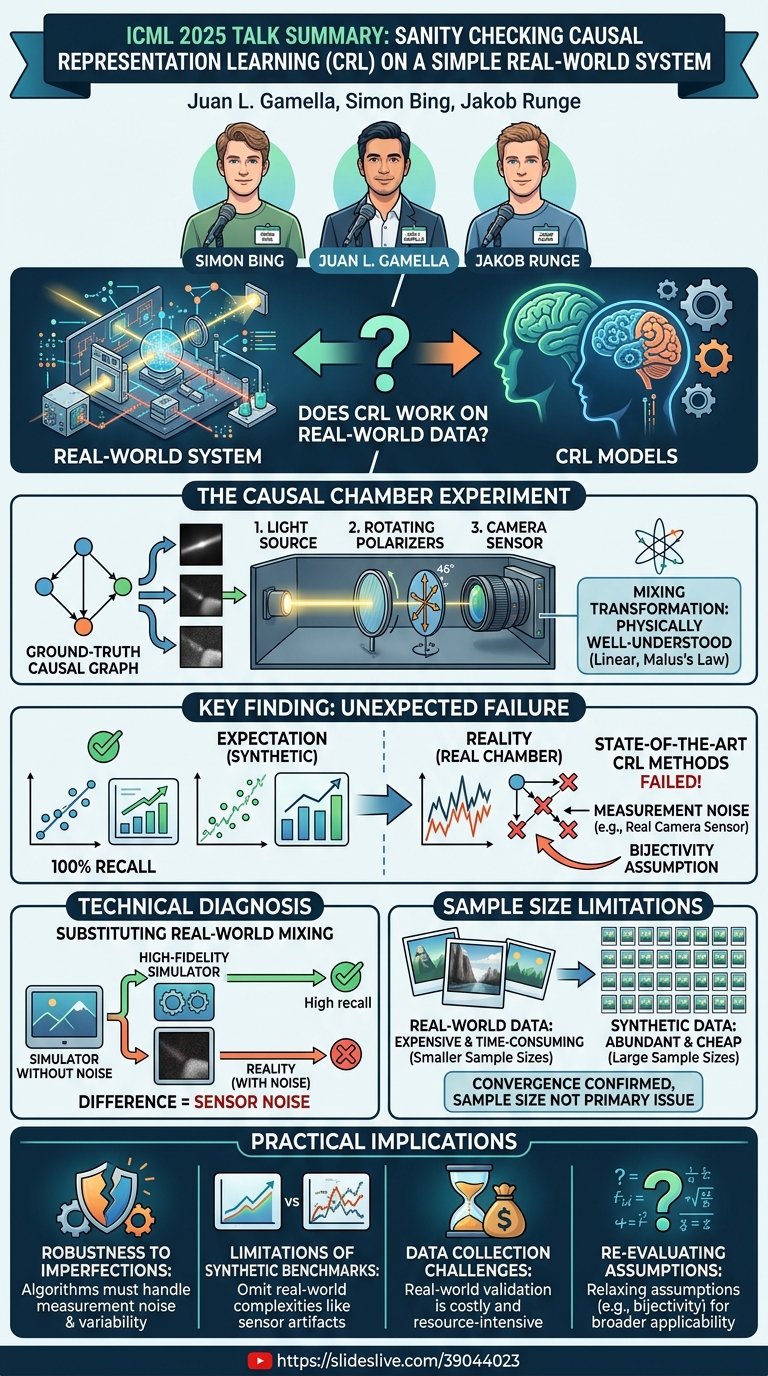
A crucial discovery stemming from this universal failure was the identification of measurement noise as a significant, and often overlooked, impediment to CRL performance in real-world scenarios. Through a systematic diagnostic process involving a high-fidelity simulator, the researchers were able to pinpoint that the presence of noise, specifically from the real camera sensor used in their experimental setup, was the critical factor leading to the algorithms' collapse. For the Contrastive Causal Representation Learning (CCRL) method, for instance, this noise directly violated a core assumption: that the mixing transformation should be a bijection. In a noisy environment, the same set of latent inputs can produce slightly different observed outputs, breaking this one-to-one mapping.
The implications of this finding are profound. Synthetic benchmarks, while useful for controlled experimentation, frequently omit or oversimplify real-world phenomena like measurement noise. This omission creates a false sense of security regarding the robustness of CRL algorithms. The paper demonstrates that an algorithm can perform flawlessly (e.g., 100% recall with few false positives for CCRL) on a synthetic dataset that precisely mimics the underlying causal structure and mixing function, yet completely fail when exposed to the seemingly minor, yet ubiquitous, presence of real sensor noise.
The "causal chamber" experiment, therefore, serves as a vital sanity check rather than a challenging benchmark. The premise is that if an algorithm fails on such a simple system with known, controllable properties, it is highly probable that it will also fail on more complex real-world applications. The paper successfully uncovers a fundamental vulnerability in current CRL methodologies, signaling a need for the community to develop algorithms that are inherently more robust to the unavoidable imperfections of real-world data acquisition.
Technical Deep Dive
▶ Watch: How the chamber provides ground truth for CRL testing (4:00)
At the core of Causal Representation Learning is the idea that observed data, often high-dimensional (e.g., images), can be explained by a much smaller set of latent causal factors that are causally connected. An unknown mixing transformation maps these latent factors to the observed data. The goal is to reverse this process: from the observed data, infer the latent factors and their causal relationships.
The experimental setup, termed the "causal chamber," was meticulously designed to embody these core CRL principles in a simple, physical system with a known ground truth. The chamber consists of:
- A light source: Providing controllable color and brightness.
- Two linear polarizers: Mounted on rotating frames, allowing for precise angular control.
- Light sensors and a camera: Positioned to capture images of the light source as light passes through the polarizers.
In this setup, the inputs to the experiment – the color and brightness of the light source, and the angular positions of the two polarizers – constitute the underlying latent causal factors. These are precisely controlled and known, forming the ground truth. The observed data are the images captured by the camera. The physical system itself, encompassing the light propagation and interaction with the polarizers, acts as the real-world mixing transformation. This transformation is notably simple and well-understood:
- The relationship between light color/brightness and pixel intensities in the camera image is linear.
- The dimming effect of the polarizers on the light reaching the camera strictly follows Malus's Law, a simple physical law discovered over 200 years ago, which describes how the intensity of light transmitted through a polarizer depends on the angle between the light's polarization direction and the axis of the polarizer.
This design allowed the researchers to directly feed the controlled latent causal factors into the physical system, collect the resulting image data, and then input this real-world data into various CRL algorithms. Because the ground truth (latent factors and the mixing transformation) was known, they could directly evaluate the algorithms' capability to recover these factors and, where applicable, the causal graph. The speakers explicitly clarified that their setup primarily tests the validity of CRL assumptions with respect to the mixing transformation, as the latent causal factors themselves were sampled precisely according to the assumptions required by each tested method.
Three representative state-of-the-art CRL methods from different approaches were selected for testing. While the specific names of all three weren't detailed, Contrastive Causal Representation Learning (CCRL) was highlighted. CCRL, beyond recovering underlying causal variables, also promises to infer the causal graph between these variables. For CCRL, the success metric involved comparing the estimated causal graph (where edge weights indicated the frequency of recovery across multiple runs) against the ground truth causal graph.
To diagnose the observed failures, a sophisticated approach was employed: substituting the real-world mixing transformation of the light tunnel with a simulator. This simulator was progressively increased in fidelity, allowing for careful control over various assumptions. The goal was to reach a point where the simulated data was indistinguishable from the real data, even to the algorithms themselves. This diagnostic step proved crucial: while two of the methods still failed on the high-fidelity synthetic data, CCRL performed exceptionally well on the simulated images, achieving approximately 100% recall with only a few false positives in its estimated causal graph, closely matching the ground truth. This stark contrast between CCRL's performance on real vs. simulated data immediately pointed to the subtle differences between the two. The critical difference was identified as measurement noise inherent to the real camera sensor, which was absent in the original simulator. This noise violates CCRL's core assumption of a bijective mixing transformation, where each input maps to a unique output.
Experimental Setup & Results
▶ Watch: Example of Contrastive CRL (CCRL) method failure (5:30)
The experimental platform, the "causal chamber," provided a controlled, real-world environment for testing Causal Representation Learning (CRL) algorithms. The physical setup consisted of a light source, two linear polarizers, and a camera. The inputs, which served as the ground truth latent causal factors, were the precisely controllable color and brightness of the light source, along with the rotational positions of the two polarizers. The outputs, representing the high-dimensional observational data, were the images captured by the camera. The mixing transformation was governed by fundamental physics: a linear relationship for color and pixel intensities, and Malus's Law for the dimming effect of the polarizers.
Three representative, state-of-the-art CRL algorithms, spanning different methodological approaches, were selected for evaluation. To ensure fairness and fidelity, the researchers utilized the original codebases for each method and consulted with their respective authors whenever possible to prevent implementation errors or misconfigurations. The success or failure of each method was assessed using the metrics reported in their original research papers. For CCRL (Contrastive Causal Representation Learning), the key metric involved comparing the algorithm's estimated causal graph (derived from multiple runs, with edge weights indicating recovery frequency) against the known ground truth causal graph of the experimental setup.
The headline result was unambiguous and striking: all three tested CRL methods failed to recover the ground truth when applied to the real-world data collected from the causal chamber. The estimated causal graph from CCRL, for example, bore little resemblance to the known ground truth graph, indicating a clear failure.
To diagnose the root cause of these failures, the researchers employed a clever strategy: they replaced the real physical mixing transformation with a high-fidelity simulator. This simulator was iteratively refined to accurately model the physical optics, eventually producing synthetic images that were visually indistinguishable from the real camera data. When tested on this high-fidelity synthetic data:
- Two of the methods continued to fail, suggesting they could not differentiate between the real and the highly realistic simulated data, and their issues were perhaps deeper than just noise.
- Crucially, CCRL, which had failed on the real data, performed remarkably well on the simulated data. Its estimated causal graph closely matched the ground truth, achieving approximately 100% recall and only a few false positives across various runs.
This stark divergence in CCRL's performance immediately highlighted the subtle yet critical difference between the real and simulated environments. The identified culprit was measurement noise, specifically originating from the real camera sensor. Unlike the idealized simulator (before noise was explicitly added), the real camera introduced inherent variability, meaning that identical latent inputs could produce slightly different observed images. This phenomenon directly violated a core assumption of CCRL—that the mixing transformation should be a bijection (a one-to-one mapping between inputs and outputs)—leading to its failure on real data. The researchers emphasized that such noise is a pervasive characteristic of any real sensing system but is often absent or oversimplified in synthetic benchmarks unless explicitly engineered.
Regarding sample size, the researchers noted that their experiments, due to the practical constraints and cost of collecting real-world data, utilized smaller sample sizes compared to those typically found in synthetic benchmark studies. Collecting "a million images from this thing in a day" was simply not feasible. Despite this, preliminary experiments with varying sample sizes did not show a significant improvement in performance, and convergence of the training processes was confirmed, suggesting that insufficient sample size was not the primary reason for failure.
Practical Implications
▶ Watch: Approach to diagnose why CRL methods failed (6:30)
The findings from the "sanity checking" experiment carry substantial practical implications for researchers, practitioners, infrastructure teams, and anyone involved in building or deploying AI/ML models, particularly those leveraging Causal Representation Learning.
First and foremost, the study underscores the critical need for robustness to real-world imperfections. The revelation that ubiquitous phenomena like measurement noise can completely derail state-of-the-art CRL algorithms is a stark reminder that theoretical elegance and synthetic performance do not automatically translate to practical utility. Practitioners must now consider how their CRL solutions will contend with noisy sensor data, imperfect measurements, and other forms of observational variability that are endemic to real systems. This implies a shift in algorithm design, moving towards methods that are inherently more resilient or that explicitly model and account for noise. For example, algorithms that assume a strictly bijective mixing transformation may need to be re-evaluated or extended to handle noisy, non-bijective mappings.
Secondly, this work exposes a significant limitation of current synthetic benchmarks. While synthetic datasets offer invaluable control and scalability for algorithm development, their often-idealized conditions can create a misleading impression of an algorithm's capabilities. The absence of realistic noise, sensor artifacts, or other unmodeled complexities in many benchmarks means that algorithms validated solely on synthetic data might be brittle and fail unpredictably in deployment. This calls for the development of more sophisticated and realistic benchmarks that deliberately incorporate such real-world challenges. Infrastructure teams should consider building testing environments that include actual hardware components, even simple ones, to introduce realistic noise characteristics.
Thirdly, the paper highlights the trade-offs and limitations associated with real-world data collection. The researchers explicitly mentioned the cost and time involved in gathering data from their simple optical system, leading to smaller sample sizes compared to synthetic experiments. This practical constraint means that scaling real-world validation can be challenging. Model builders need to be aware that while large synthetic datasets might allow for extensive training, the true test of robustness might come from smaller, yet more realistic, real-world datasets. This could also encourage research into data-efficient CRL methods that can learn effectively from limited, noisy real data.
Finally, the study prompts a fundamental re-evaluation of the assumptions underlying CRL. If core assumptions, such as the bijectivity of the mixing function, are easily violated by common real-world phenomena, then the theoretical foundations themselves might need to be revisited or broadened. This could lead to new theoretical frameworks for CRL that explicitly incorporate noise models or relax stringent assumptions, thereby fostering the development of more applicable algorithms. For deployers, this means exercising greater caution when considering CRL solutions for mission-critical applications, ensuring that proposed methods have been rigorously tested against real-world data characteristics, not just synthetic ones. The "causal chamber" offers a paradigm for how such initial sanity checks can be performed.
Key Takeaways
- State-of-the-art Causal Representation Learning (CRL) algorithms failed to recover ground truth on a simple real-world optical system, despite performing well on comparable synthetic data.
- Measurement noise, originating from the real camera sensor, was identified as a primary cause of failure for algorithms like CCRL, as it violates core assumptions such as a bijective mixing transformation.
- Current synthetic benchmarks often lack critical real-world complexities like sensor noise, potentially masking fundamental vulnerabilities in CRL methods.
- The "causal chamber" experiment serves as a crucial sanity check, demonstrating that if an algorithm fails on a simple, known real system, its practical applicability to more complex scenarios is highly questionable.
- The CRL community must prioritize developing algorithms that are robust to real-world imperfections (e.g., noise) and re-evaluate the practical validity of their underlying theoretical assumptions.
- Collecting ground-truth real-world data, even for simple systems, is costly and time-consuming, posing practical challenges for large-scale real-world validation efforts.
About the Speaker(s)
Simon Bing and Juan L. Gamella are researchers who shared first authorship on this paper, demonstrating their collaborative effort in conducting this important work. They presented their findings together, highlighting their deep involvement in the research. Jakob Runge is acknowledged as a key collaborator on the project, contributing to the development and execution of the study. While their specific titles or affiliations were not detailed in the transcript, their expertise lies in the challenging intersection of causal inference and machine learning, particularly in the domain of causal representation learning.
Reviews
Maya Iyer (Theoretical ML Researcher) — SOLID
A careful empirical sanity check demonstrating that current CRL methods fail on a simple, well-characterized real physical system, with measurement noise identified as the proximate cause of failure for at least one method. The contribution is honest, the diagnostic methodology is clever, and the message is genuinely useful for the field. But this is fundamentally a negative empirical result, not a theoretical one — it tells us that assumptions are violated in practice without giving us the machinery to fix them or formal guarantees about when and why failure occurs.
Chen Zhao (Applied ML Researcher & Empiricist) — STRONG ACCEPT
Gamella, Bing, and Runge build a real optical system with known ground truth and show that every tested state-of-the-art CRL algorithm fails on it — not because the system is hard, but because camera sensor noise violates a core assumption (bijectivity of the mixing map) that synthetic benchmarks routinely paper over. The diagnostic methodology — iteratively replacing the real mixing transformation with a simulator of increasing fidelity until the gap in algorithm performance is localized — is clean and replicable. This is the kind of negative result the field needs: not 'the numbers are bad' but 'here is the exact assumption that breaks, here is the data that demonstrates it, here is the…
→ Top-rated talks at International Conference on Machine Learning 2025
All talks from International Conference on Machine Learning 2025