Statistical Collusion by Collectives on Learning Platforms
Etienne Gauthier (PhD Student), Francis Bach, Michael Jordan
Overview
This article delves into the groundbreaking work presented by Etienne Gauthier, Francis Bach, and Michael Jordan at ICML 2025, titled "Statistical Collusion by Collectives on Learning Platforms." The talk meticulously examines how organized groups of users, referred to as "collectives," can strategically pool their data and coordinate their actions to exert significant influence over the behavior of machine learning-driven platforms. The core of their research lies in understanding whether such collectives can obtain robust statistical guarantees on their potential impact, thereby enabling them to anticipate and optimize their strategies.
Key moments
- 0:00 Introduction and real-world examples of collective action
- 2:18 Research question and formal model of collective influence
- 4:10 Assumptions on platform behavior: Bayes optimal classifier
- 5:58 Three main objectives for collective influence
- 6:00 Detailed explanation of Signal Planting objective with example
- 8:00 Strategy and computable lower bound for Signal Planting
Statistical Collusion by Collectives on Learning Platforms
Speakers: Etienne Gauthier, PhD Student; Francis Bach, Professor; Michael Jordan, Professor
Conference: ICML 2025
YouTube: https://slideslive.com/39044109
Overview
This article delves into the groundbreaking work presented by Etienne Gauthier, Francis Bach, and Michael Jordan at ICML 2025, titled "Statistical Collusion by Collectives on Learning Platforms." The talk meticulously examines how organized groups of users, referred to as "collectives," can strategically pool their data and coordinate their actions to exert significant influence over the behavior of machine learning-driven platforms. The core of their research lies in understanding whether such collectives can obtain robust statistical guarantees on their potential impact, thereby enabling them to anticipate and optimize their strategies.
The relevance of this work is underscored by numerous real-world phenomena, where coordinated user actions have demonstrably altered platform dynamics. Gauthier provided compelling examples, including Uber drivers collectively deactivating their apps to create artificial supply shortages and drive up prices, Amazon users collaborating to post fake reviews to manipulate product reputations, and even residents using Waze to falsely report accidents and reroute traffic away from their neighborhoods. A particularly striking example involved the 2016 Dakota Access Pipeline protests, where individuals worldwide geolocated themselves to the Standing Rock Indian Reservation on Facebook to overwhelm tracking signals and obscure protesters' real locations. These instances highlight a growing challenge for platforms and a potent new form of collective action, making Gauthier et al.'s formal analysis critically important for both understanding and potentially mitigating such influences.
The paper introduces a novel theoretical framework to model these interactions, focusing specifically on classification tasks. By providing a rigorous mathematical foundation, the authors enable a deeper understanding of the mechanisms through which collectives can achieve their shared goals. Their findings offer crucial insights into the vulnerability of learning platforms to coordinated data manipulation and underscore the need for more robust algorithmic designs. This research not only illuminates the power of organized user groups but also opens new avenues for studying multi-agent influence in complex, data-driven ecosystems.
Background
▶ Watch: Introduction and real-world examples of collective action (0:00)
The problem of collectives strategizing against learning platforms is a burgeoning area of research situated at the intersection of machine learning, game theory, and algorithmic fairness. It builds upon the broader field of algorithmic collective action, which explores how individuals can coordinate to influence algorithmic outcomes, often in ways that are not immediately obvious or easily counteracted by platform designers. Gauthier explicitly acknowledges the foundational work by Moritz Hardt and co-authors (ICML 2023), indicating that their current research extends and refines these earlier models by introducing a critical new dimension: the collective's ability to obtain statistical guarantees.
Prior work in this domain often focused on the qualitative aspects of collective influence or analyzed specific adversarial attacks from individual agents. However, the unique challenge addressed here is the statistical power derived from the aggregation of data and coordinated action by a group with a shared objective. In the context of modern machine learning systems, which are increasingly deployed in high-stakes environments like content moderation, financial services, and transportation, the integrity of the data stream is paramount. When a significant fraction of the user base can strategically modify their data inputs, it introduces a systemic vulnerability that traditional adversarial robustness techniques, often designed to counter individual malicious actors, may not fully address.
The core problem arises because learning platforms, by their very nature, are designed to adapt and learn from user-generated data. This adaptive capacity, while beneficial for improving service and personalization, simultaneously creates an opening for manipulation. If a collective can understand how the platform's learning algorithm processes and reacts to data, they can reverse-engineer effective strategies. The key innovation of this work is to formalize this process, allowing collectives not just to attempt influence, but to anticipate and guarantee a certain level of impact based on their collective data and size. This shift from ad-hoc manipulation to statistically predictable influence represents a significant advancement in understanding the dynamics between users and platforms in the age of AI.
Key Findings
▶ Watch: Assumptions on platform behavior: Bayes optimal classifier (4:10)
The research by Gauthier, Bach, and Jordan yields several pivotal findings that illuminate the mechanics and predictability of collective influence on learning platforms. At its core, the paper demonstrates that by pooling their data, collectives can indeed obtain statistical guarantees on their potential impact, moving beyond mere speculative attempts at manipulation to a more calculable and strategic form of intervention.
One of the primary contributions is the introduction of a formal model that captures the interaction between a collective and a learning platform, along with the definition of three distinct objectives for collective action:
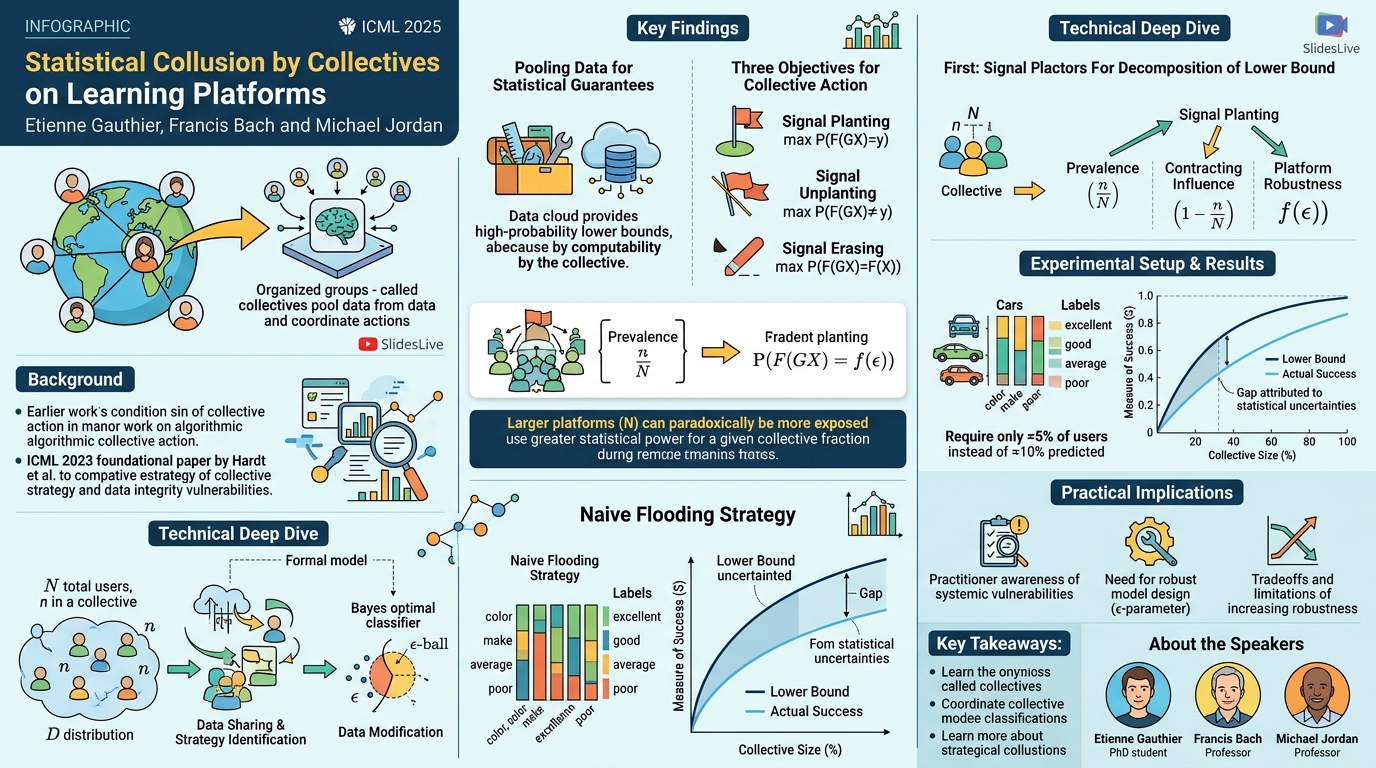
- Signal Planting: The collective aims to maximize the probability that the platform predicts a specific target label y when features have been modified through a function G. This is about establishing a desired association.
- Signal Unplanting: Conversely, the collective seeks to maximize the probability that the platform predicts a label different from y when features have been modified through G. This is about breaking an existing association.
- Signal Erasing: Here, the collective's goal is to make the platform's predictions indifferent to whether features have been modified by G or not. This aims to neutralize the impact of a specific feature transformation.
For each of these objectives, the authors analyze different strategies and, crucially, derive high-probability lower bounds on the collective's measure of success (S). A key insight is that these lower bounds are entirely computable by the collective based on their pooled data. This means a collective can, in theory, anticipate its influence on the platform without needing to observe the platform's internal state or full learning process directly. This computability is a significant advancement, offering a practical framework for collectives to assess their potential efficacy.
Focusing on the signal planting objective and a naive flooding strategy (where collective members simply modify their data to the target (Gx, y)), the paper provides an explicit lower bound. This bound is shown to decompose into three interpretable terms:
- Prevalence: This term quantifies how common the modified feature (
Gx) is within the modified dataset. It scales withn/N, wherenis the collective size andNis the total user population. Intuitively, higher prevalence makes it easier to influence the associated label. - Contracting Influence: This term captures the hindering effect of non-collective individuals. It scales with
(1 - n/N), indicating that a larger proportion of non-collective users can dilute the collective's impact. - Platform Robustness: This is an increasing function of
epsilon, the robustness parameter of the platform's Bayes optimal classifier. A higherepsilon(meaning a more robust platform) naturally makes it harder for the collective to exert influence.
The experimental results further validate these theoretical findings, showing that the derived lower bounds indeed serve as reliable indicators of actual success, albeit with a gap attributed to statistical uncertainties inherent in real-world estimation. Perhaps counter-intuitively, one of the most significant findings is that platforms interacting with large user bases (N) are more exposed to the risk of collective data modification. This is because, for a given fractional size of a collective, a larger N translates to a larger absolute number of collective members (n), granting them greater statistical power and thus more accurate estimations of their impact. This directly contradicts the common intuition that larger platforms are inherently more resilient due to their scale, highlighting a critical vulnerability uncovered by this research.
Technical Deep Dive
▶ Watch: Three main objectives for collective influence (5:58)
The technical foundation of Gauthier et al.'s work rests on a rigorous formal model that delineates the interaction between a collective and a learning platform. The model assumes a total of N consumers, each represented by a feature-label pair (X, Y) drawn independently and identically from an underlying probability distribution D. Among these N consumers, a subset of n individuals forms a collective, united by a shared goal to influence the platform's behavior.
The collective's strategy involves two key phases:
- Data Sharing and Strategy Identification: Collective members pool their original data to identify effective strategies and statistically anticipate their influence. This is where the statistical guarantees come into play, as the collective performs estimations based on its aggregated data.
- Data Modification: Members then modify their data according to the chosen strategy. This modified data is subsequently observed by the platform, alongside the unmodified data from the rest of the population.
The platform's behavior is modeled with a crucial assumption: it uses a Bayes optimal classifier, denoted F, for classification tasks. This classifier is not necessarily Bayes optimal with respect to the observed training distribution directly. Instead, the authors adopt a robustness assumption: the platform's classifier is Bayes optimal with respect to some distribution P that lies within an epsilon-ball of radius epsilon from the empirical training distribution. This epsilon parameter serves as a measure of the platform's robustness, allowing for slight deviations or regularization that prevent overfitting to the exact training data. A larger epsilon implies a more robust platform, less susceptible to minor data perturbations.
The paper formalizes three distinct objectives for the collective, each aiming to manipulate the platform's predictions in a specific way:
- Signal Planting: The collective defines a feature transformation
G(e.g., adding a watermark) and a target labely. Its objective is to maximize the probabilitySthat the platform predictsywhen an inputX'has been modified byG. Formally, the collective maximizesP(F(G(X')) = y), where the probability is taken over the test distribution ofX'. For instance, ifGadds sunglasses to a face andyis "sad," the collective wants the platform to classify all sunglass-wearing faces as sad.
- Signal Unplanting: With a transformation
Gand an original labely, the collective aims to maximizeSsuch that the platform predicts any label other than y for features modified byG. Formally,P(F(G(X')) != y). This objective seeks to break a specific association or misdirect classification.
- Signal Erasing: The most subtle objective, where the collective wants the platform's prediction to be identical regardless of whether
Gis applied. It maximizesSsuch thatP(F(G(X')) = F(X')). This objective aims to nullify the distinguishing effect of the transformationG.
For the signal planting objective, the paper details a "naive flooding strategy" where each collective member i with original data (X_i, Y_i) simply modifies their data to (G(X_i), y_target), where y_target is the collective's desired label. For this strategy, the authors derive a high-probability lower bound on the success measure S. This lower bound is expressed as an empirical probability, P_collective(Q > 0), where Q is a quantity computable solely from the collective's pooled data. This computability is a cornerstone of their findings, as it empowers the collective to estimate its impact.
The quantity Q is further decomposed into three terms, providing crucial interpretability:
- Prevalence Term: This reflects the empirical probability
P(G(X') is prevalent)among the modified data, scaling withn/N. It essentially measures how frequently the transformed feature appears due to the collective's actions. - Contracting Influence Term: This term captures the "dilution" effect from the
N-nnon-collective users, scaling with(1-n/N). It quantifies how much the presence of unmodified data from the majority offsets the collective's efforts. - Platform Robustness Term: This term is an increasing function of
epsilon, the platform's robustness parameter. A higherepsilonmakes the platform less sensitive to the collective's modified data, thus requiring a stronger collective signal to overcome.
The paper also explores other strategies, including those where only features can be modified (not labels) and more adaptive strategies where the collective infers an optimal strategy from its data. Explicit lower bounds and their algorithmic implementations are provided for these scenarios, along with a detailed analysis of how parameters like collective size (n) and total user base (N) influence the collective's power. The finding that larger N paradoxically increases vulnerability for platforms is rooted in the improved statistical power (1/sqrt(n)) gained by collectives when n (as a fraction of N) translates to a larger absolute number of samples.
Experimental Setup & Results
▶ Watch: Detailed explanation of Signal Planting objective with example (6:00)
To empirically validate their theoretical framework and derived lower bounds, the authors conducted a simulation experiment. The chosen domain for this experiment was a simplified model of cars, where each sample represented a car characterized by 18 possible attributes. The platform's task was to classify these cars into one of four possible labels, representing an evaluation: excellent, good, average, or poor.
The collective in this simulation was conceptualized as a lobby group with a specific agenda, advocating for or against certain types of vehicles. This group aimed to manipulate the platform's classification of cars based on a predefined transformation function G. While the specifics of G are detailed in the paper, it was designed to target particular vehicle characteristics, enabling the collective to push the platform towards a desired classification (e.g., making certain car types appear "poor" regardless of their actual attributes).
The core of the experimental results is presented through plots that illustrate the relationship between the size of the collective (as a percentage of the total user base) and the measure of success (S). Separate plots were generated for each of the four possible target labels (excellent, good, average, poor) to demonstrate the consistency of the findings across different objectives.
A critical aspect of these plots is the comparison between the dark blue plot, which represents the theoretically derived lower bound on success, and the light blue curve, which depicts the actual empirical success achieved by the collective in the simulation. For instance, focusing on the panel where the target label was "poor," the results showed that the lower bound consistently held, providing a valid floor for the actual success.
A key quantitative finding from these experiments was related to the collective size required for significant impact. For the "poor" label objective, the lower bound predicted that approximately 10% of users would be needed to exert a significant influence on the platform. However, the simulation revealed that only about 5% of users were actually required to achieve a comparable level of impact. This observed gap between the predicted lower bound and the actual success rate is a crucial insight highlighted by the authors. They attribute this discrepancy primarily to statistical uncertainties. The lower bound, by its nature, is a conservative estimate designed to hold with high probability, accounting for worst-case scenarios and inherent variability in data sampling. This makes the bounds robust but also potentially pessimistic compared to the average-case performance observed in simulations.
Beyond this specific example, the experiments generally demonstrated that the lower bounds provide a reliable, albeit conservative, estimate of a collective's potential influence. The study also explored the influence of various parameters, such as the overall size of the user base (N) and the collective's size (n), reinforcing the theoretical finding that platforms with larger N can paradoxically be more vulnerable due to the increased statistical power afforded to collectives of a fixed fractional size. These results provide concrete evidence for the theoretical claims, grounding the abstract mathematical model in observable simulated outcomes.
Practical Implications
▶ Watch: Strategy and computable lower bound for Signal Planting (8:00)
The findings from "Statistical Collusion by Collectives on Learning Platforms" carry significant practical implications for various stakeholders involved in the design, deployment, and operation of AI/ML systems. The research fundamentally alters how we should perceive user interactions with platforms, moving beyond individual adversarial attacks to the more potent threat of coordinated collective action.
For practitioners and infrastructure teams, the most immediate implication is a heightened awareness of a new class of systemic vulnerabilities. The finding that platforms with larger user bases (N) are more exposed to collective manipulation is particularly counter-intuitive and critical. It suggests that simply scaling up a platform or increasing its user count does not inherently confer greater robustness against this type of influence; in fact, it might exacerbate the problem by providing collectives with more "statistical power" (more samples) to refine their strategies and guarantee their impact. This means infra teams need to consider the potential for coordinated data influxes or strategic data modifications as a serious operational risk, akin to DDoS attacks but operating at the data layer.
For model builders and deployers, the work underscores the necessity of designing more robust algorithms. The paper models platform robustness with an epsilon parameter, indicating that platforms with higher epsilon values (i.e., less prone to overfitting to specific training data distributions) are inherently more resistant to collective influence. This translates into a practical need to implement techniques like robust optimization, adversarial training, or regularization methods that explicitly account for potential shifts in the data distribution caused by collective actions. The challenge lies in developing methods that can distinguish between legitimate, evolving user behavior and malicious, coordinated manipulation. The authors acknowledge that their paper focuses on the collective's perspective, but the broader literature on robustness, particularly from the platform's viewpoint, becomes even more critical in light of these findings.
The research also highlights inherent tradeoffs and limitations. While increased robustness (epsilon) can mitigate collective influence, it might come at the cost of model responsiveness or accuracy to legitimate, diverse user data. A platform that is too rigid might fail to adapt to genuine changes in user preferences or real-world dynamics. Striking the right balance between robustness against manipulation and adaptability to genuine evolution is a complex design challenge. Furthermore, the strategies explored by the collective (e.g., naive flooding) are relatively simple. In reality, collectives might employ more sophisticated, adaptive, or even stealthy strategies, making detection and mitigation even harder. The paper's current model for platform robustness (the epsilon-ball) is a theoretical abstraction; practical robust algorithms are far more complex and varied.
Ultimately, this work serves as a call to action for the ML community to proactively consider multi-agent influence when developing and deploying learning systems. It suggests that future research should not only focus on making models robust to individual outliers or adversarial examples but also to the coordinated, statistically guided actions of groups. This could involve developing new metrics for collective influence, designing detection mechanisms for coordinated data shifts, or exploring game-theoretic approaches where platforms actively adapt their learning rules in response to potential collective strategies.
Key Takeaways
- Collectives of users can strategically share data to anticipate and execute impactful strategies against learning platforms.
- The research provides a formal model for how collectives influence platform behavior, specifically focusing on Bayes optimal classifiers.
- Three distinct objectives for collective action are defined: signal planting, signal unplanting, and signal erasing.
- Crucially, collectives can compute high-probability lower bounds on their success using only their shared data, enabling them to statistically guarantee their impact.
- The collective's influence is decomposed into three interpretable factors: prevalence of modified features, contracting influence from non-collective users, and platform robustness (parameterized by
epsilon). - Counter-intuitively, platforms with larger total user bases (
N) are more susceptible to collective influence due to the increased statistical power (1/sqrt(n)) afforded to collectives of a given fractional size. - The findings highlight the urgent need for more robust ML algorithms and system designs that can withstand coordinated data manipulation, balancing robustness with adaptability.
About the Speaker(s)
Etienne Gauthier is a first-year PhD student whose work on "Statistical Collusion by Collectives on Learning Platforms" was presented at ICML 2025. He conducts his research under the joint supervision of Francis Bach and Michael Jordan.
Francis Bach is a prominent researcher in the field of machine learning, known for his contributions to optimization, sparse methods, and high-dimensional statistics. He is a co-supervisor of Etienne Gauthier's PhD work and a co-author of this paper.
Michael Jordan is a distinguished professor and a foundational figure in machine learning, statistics, and artificial intelligence. His extensive work spans Bayesian nonparametrics, graphical models, and statistical learning theory. He serves as a co-supervisor for Etienne Gauthier's PhD research and is a co-author of this impactful paper.
Reviews
Maya Iyer (Theoretical ML Researcher) — SOLID
Gauthier, Bach, and Jordan formalize the problem of coordinated user manipulation of learning platforms, deriving computable high-probability lower bounds on collective influence under a Bayes-optimal-with-robustness-parameter platform model. The framework is clean, the decomposition into prevalence, contracting influence, and platform robustness is interpretable, and the counter-intuitive scaling result (larger N increases vulnerability for fixed fractional collective size) is a genuine insight. This is honest, well-scoped theoretical work. What keeps it at 3 rather than 4 is that the platform model — a Bayes optimal classifier robust to an epsilon-ball around the empirical distribution —…
Chen Zhao (Applied ML Researcher & Empiricist) — SOLID
Gauthier, Bach, and Jordan present a formal framework for analyzing collective data manipulation on learning platforms, deriving computable high-probability lower bounds on a collective's success under three objectives. The theoretical contribution is coherent and the real-world motivation is well-chosen. However, as described, the experimental validation rests on a single small simulation (cars dataset, 18 attributes, 4 labels), with no mention of multiple seeds, no ablation over the epsilon robustness parameter, and no comparison against alternative collective strategies or platform defenses. The 'paradox of scale' finding is the most interesting empirical claim, but the evidence base…
→ Top-rated talks at International Conference on Machine Learning 2025
All talks from International Conference on Machine Learning 2025