Statistical Query Hardness of Multiclass Linear Classification with Random Classification Noise
Ilias Diakonikolas, Mingchen Ma, Lisheng Ren, Christos Tzamos
Overview
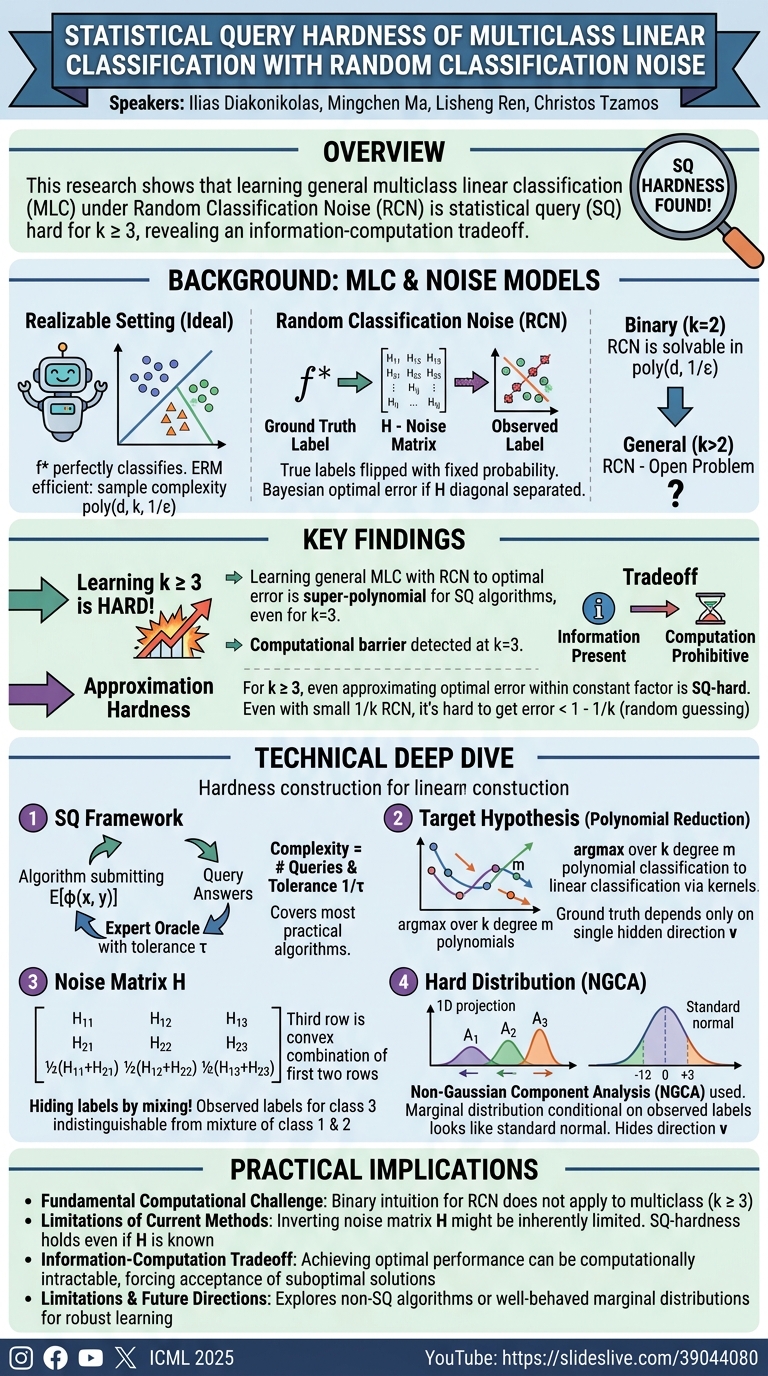
This talk delves into the computational complexity of multiclass linear classification (MLC), a fundamental problem in machine learning, particularly when faced with random classification noise (RCN). Multiclass linear classification extends the familiar binary classification problem of learning halfspaces, where a classifier assigns a label based on which of k vectors yields the highest inner product score with an input example. While straightforward in the ideal "realizable" setting, practical scenarios inevitably involve noisy labels. The speakers, Ilias Diakonikolas, Mingchen Ma, Lisheng Ren, and Christos Tzamos, present compelling evidence that learning general MLC under RCN becomes surprisingly intractable for even a small number of classes, specifically when k is 3 or more.
Key moments
- 0:00 Introduction to Multiclass Linear Classification with noise
- 2:00 Challenges with noisy labels and prior work
- 4:00 Understanding the Random Classification Noise (RCN) model
- 6:00 Main Result: SQ hardness for MLC with RCN (k=3)
- 8:00 Overview of the Statistical Query (SQ) learning framework
- 10:00 High-level idea: Target hypothesis construction for hardness
- 12:00 Key insight: Noise matrix construction for k greater than or equal to 3
Statistical Query Hardness of Multiclass Linear Classification with Random Classification Noise
Speakers: Ilias Diakonikolas, Mingchen Ma, Lisheng Ren, Christos Tzamos
Conference: ICML 2025
YouTube: https://slideslive.com/39044080
Overview
This talk delves into the computational complexity of multiclass linear classification (MLC), a fundamental problem in machine learning, particularly when faced with random classification noise (RCN). Multiclass linear classification extends the familiar binary classification problem of learning halfspaces, where a classifier assigns a label based on which of k vectors yields the highest inner product score with an input example. While straightforward in the ideal "realizable" setting, practical scenarios inevitably involve noisy labels. The speakers, Ilias Diakonikolas, Mingchen Ma, Lisheng Ren, and Christos Tzamos, present compelling evidence that learning general MLC under RCN becomes surprisingly intractable for even a small number of classes, specifically when k is 3 or more.
The core contribution of this work is a rigorous demonstration of statistical query (SQ) hardness for MLC with RCN. This implies that a broad class of algorithms, encompassing many widely used practical learning methods, would require super-polynomial time to achieve optimal classification error. The findings highlight a significant computational barrier and an intriguing information-computation tradeoff that emerges as the number of classes increases from two to three, even under this relatively benign noise model. This research is crucial for understanding the fundamental limits of robust learning algorithms and guiding the design of more effective strategies in real-world, noisy data environments.
Background
▶ Watch: Introduction to Multiclass Linear Classification with noise (0:00)
Multiclass linear classification (MLC) is a cornerstone problem in machine learning, serving as a natural generalization of binary classification, where the goal is to learn a halfspace. In MLC, a classifier is defined by k vectors in a d-dimensional space (Rd). For any given example x, the classifier assigns a score based on the inner product of x with each of these k vectors, ultimately labeling the example with the index corresponding to the highest score. Given sample access to an unknown distribution over labeled examples, the objective is to compute a hypothesis that achieves a small classification error. In the absence of noise, known as the realizable setting, where a ground truth classifier f^* perfectly classifies every example, the problem can be efficiently solved. Specifically, finding a consistent hypothesis can be formulated as a linear program, and the empirical risk minimizer (ERM) is known to solve this problem with a sample complexity of poly(d, k, 1/epsilon) examples.
However, the realizable assumption is often too idealized for practical applications, as label contamination is an unavoidable reality. This necessitates considering learning with noisy labels. Prior research has explored various noise models, but many, such as adversarial label noise or semi-random label noise, have proven too strong for MLC. Under these models, even approximately learning the optimal error in the distribution-free setting is computationally hard, even for the simplest case of k = 2 (learning a single halfspace). These hardness results naturally extend to scenarios with more than two labels.
A more realistic and widely studied noise model is random classification noise (RCN). In this model, a ground truth classifier f^ assigns a true label to each example. This ground truth label is then flipped with a fixed probability, specified by a noise matrix H. Specifically, if the ground truth label is i*, an observer will perceive the label j with probability H<sub>ij</sub>. A key property of RCN is that if the diagonal entries of H are well-separated from its off-diagonal entries, then the ground truth hypothesis f^ achieves the Bayesian optimal error. For the special case of learning a single halfspace (k* = 2) with RCN, it has been established since the 1990s that this problem can be solved in polynomial time in the distribution-free setting. Despite significant theoretical and empirical attention, a polynomial-time algorithm for general multiclass linear classification (MLC) under RCN (i.e., for k > 2) has remained elusive. Existing methods often rely on inverting the noise matrix H during training, leading to a sample complexity that can "blow up" if H is low-rank, a condition that is easily constructible. This open problem forms the crucial backdrop for the current work, which asks whether MLC with RCN can truly be learned efficiently in the distribution-free setting for k > 2.
Key Findings
▶ Watch: Understanding the Random Classification Noise (RCN) model (4:00)
The central finding of this research is a strong theoretical demonstration that, contrary to the k=2 case, learning general multiclass linear classification (MLC) with random classification noise (RCN) is computationally very hard, even when the number of labels is as small as k = 3. This result provides significant evidence against the existence of efficient algorithms for this problem in the distribution-free setting.
Specifically, the authors prove that for k = 3, there exists a carefully constructed noise matrix H—whose diagonal entries are well-separated from the off-diagonal entries, ensuring f^ achieves Bayesian optimal error—such that any statistical query (SQ) learning algorithm attempting to learn the problem with RCN specified by H* to an optimal error must incur a super-polynomial running time. This is a powerful statement, as SQ learning algorithms encompass a vast majority of practical machine learning algorithms. The hardness holds even if the noise matrix H is provided to the algorithm as prior knowledge, indicating an intrinsic difficulty rather than an issue of noise matrix estimation.
This outcome highlights a critical information-computation tradeoff: while the information might be present to learn the optimal classifier, the computational resources required become prohibitive. Crucially, this tradeoff appears abruptly when the number of labels increases from two to three, dramatically changing the computational landscape of the problem.
Beyond achieving optimal error, the research extends to the more relaxed goal of approximate learning. The authors show that with almost the same hardness construction, if the number of labels k is large enough (specifically, k ≥ 3), it is SQ hard to approximate the optimal error within any constant factor. Even more strikingly, for any k ≥ 3, if only a 1/k fraction of RCN is added, it becomes SQ hard to compute a hypothesis with an error smaller than 1 - 1/k, which is the error achieved by randomly guessing the label uniformly. This implies that even a tiny amount of noise can render the problem practically intractable for achieving any non-trivial improvement over random chance when k is large.
Technical Deep Dive
▶ Watch: Main Result: SQ hardness for MLC with RCN (k=3) (6:00)
The core of this work lies in establishing statistical query (SQ) hardness for multiclass linear classification (MLC) with random classification noise (RCN). To achieve this, the authors leverage the statistical query (SQ) learning framework, introduced by Kearns in the early 1990s. This framework provides a robust model for analyzing the computational complexity of learning algorithms. Unlike unrestricted learning algorithms that operate directly on raw samples, an SQ algorithm adaptively submits a sequence of bounded functions, termed statistical queries, to an oracle or "expert." This expert returns a value that is close to the true expectation of the query function over the underlying data distribution, within a specified tolerance. The complexity of an SQ algorithm is measured by two factors: the number of queries it makes and the required tolerance for each query. Intuitively, an algorithm making many queries has poor time complexity. Similarly, an algorithm requiring queries with extremely tiny tolerances effectively needs to draw a vast number of samples to simulate those queries accurately, thus also incurring poor time complexity. Most practical learning algorithms, including gradient descent-based methods, fall within the SQ framework, making SQ-hardness a strong indicator of practical intractability.
The construction of a hard instance for MLC with RCN involves three interconnected components: a target hypothesis, a carefully designed noise matrix, and a hard distribution.
- Target Hypothesis Construction:
The authors observe that if one can solve linear classification, one can also solve **degree m multiclass polynomial classification** using a kernel method. In this problem, the target function is an argmax over k degree m polynomials in Rd. Therefore, by showing a stronger lower bound against the polynomial classification problem, they automatically obtain a hardness result for the linear classification problem. To simplify the construction, they restrict the target polynomials to have a specific form: P(v · x), where P is a one-dimensional polynomial of degree m, and v is a unit vector. This crucial simplification implies that the ground truth label for any example x depends solely on its projection along a single, hidden direction v. This simplifies the construction of the hard distribution, as the focus shifts to designing one-dimensional basis distributions A_j, which represent the distribution of examples x projected onto v, given the ground truth label j.
- Noise Matrix Construction:
The key insight for the noise matrix H comes from the observation that when the number of labels k is at least three, it is possible to construct H such that one row of the matrix can be expressed as a convex combination of the other rows, while simultaneously ensuring that the diagonal entries of H remain well-separated from the off-diagonal entries. For instance, in the special case of k = 3, they provide an example where the last row of H is precisely the average of the first two rows.
Each row of the noise matrix represents the distribution of observed labels conditional on a specific ground truth label. If the marginal distribution of examples is crafted as a mixture of examples from the first two classes (e.g., class 1 and class 2) according to the convex combination coefficients (e.g., 50% from class 1, 50% from class 2), then the distribution of the observed labels becomes indistinguishable from a scenario where the ground truth label is always from the third class. This creates a challenging testing problem: distinguishing whether the ground truth label originates solely from class k (e.g., class 3) or from a mixture of the first k-1 classes (e.g., classes 1 and 2). This inherent ambiguity, disguised by the noise, is central to the hardness result.
- **Hard Distribution Construction (Hiding the Direction v):**
To make the aforementioned testing problem hard, it is essential to "hide" the single direction v along which the ground truth labels are determined. The authors employ a well-known framework called non-Gaussian component analysis (NGCA). Roughly speaking, if a high-dimensional distribution is one-dimensional along a specific direction v (defined by distribution A) but appears as a standard normal distribution along all orthogonal directions, then detecting this direction v becomes SQ hard, provided that the one-dimensional distribution A itself "looks like" a standard normal distribution.
In their setup, to make finding v SQ hard, they ensure that all base distributions A_j (corresponding to each ground truth label) appear very close to a standard normal distribution. This is achieved by carefully choosing each base distribution A_j as a discrete Gaussian with some tiny shifts. Furthermore, the polynomials P are chosen meticulously such that each base distribution A_j exactly corresponds to an instance of MLC. For the k = 3 case, the distributions A1 and A2 are two discrete Gaussians, supported on disjoint intervals. Each interval is dominated by exactly one of the polynomials that define the ground truth label. The critical outcome is that the marginal distribution conditional on each observed label appears very close to a standard normal distribution, effectively obscuring the underlying direction v and making the problem computationally intractable for SQ algorithms.
This intricate interplay between the polynomial classification reduction, the ambiguous noise matrix construction, and the non-Gaussian component analysis allows the authors to formally prove that distinguishing between the two underlying scenarios (labels from class k vs. a mixture of other classes) is SQ-hard, thereby establishing the hardness for MLC with RCN. The same construction logic is extended to demonstrate that even approximating the optimal error within any constant factor becomes SQ hard for k ≥ 3, even with a small 1/k fraction of RCN.
Experimental Setup & Results
▶ Watch: High-level idea: Target hypothesis construction for hardness (10:00)
This talk primarily presents theoretical hardness results rather than empirical experimental findings. Therefore, a traditional "experimental setup and results" section, detailing datasets, baselines, and hardware, does not directly apply in the conventional sense. Instead, the "results" are rigorous mathematical proofs of computational lower bounds within the statistical query (SQ) learning framework.
The core theoretical "setup" involves:
- Problem Definition: Multiclass Linear Classification (MLC) with Random Classification Noise (RCN) in the distribution-free setting.
- Algorithm Class: Restricted to Statistical Query (SQ) algorithms, which represent a broad class of practical learning methods.
- Key Parameters: The number of classes, k, and the dimension of the feature space, d.
- Noise Model: RCN characterized by a noise matrix H, where H<sub>ij</sub> is the probability of observing label j given ground truth label i. A crucial condition for hardness is that the diagonal entries of H are well-separated from the off-diagonal entries, ensuring the ground truth classifier is Bayesian optimal.
The "results" are formally stated as follows:
- Hardness for Optimal Error (k=3): The primary result demonstrates that for k = 3, there exists a specific noise matrix H (satisfying the well-separated diagonal condition) such that any SQ learning algorithm requires super-polynomial running time to learn MLC with RCN to an optimal error. This means the computational complexity grows faster than any polynomial function of d and k.
- Hardness for Approximate Error (k ≥ 3): Extending this, the authors show that for any k ≥ 3, it is SQ hard to approximate the optimal error within any constant factor. This is even true under a mild noise setting: if only a 1/k fraction of RCN is introduced, it is SQ hard to compute a hypothesis with an error rate smaller than 1 - 1/k. The error
1 - 1/kcorresponds to the performance of a classifier that simply guesses labels uniformly at random, implying that even a modest improvement over random guessing becomes computationally intractable under these conditions.
The proofs rely on constructing specific "hard instances" comprising a target hypothesis (based on one-dimensional polynomial classification), a cunningly designed noise matrix (where one row is a convex combination of others), and a hard data distribution (using non-Gaussian component analysis to hide the critical direction v). These constructions rigorously establish the theoretical limits of what SQ algorithms can achieve efficiently for MLC with RCN when k ≥ 3.
Practical Implications
▶ Watch: Key insight: Noise matrix construction for k greater than or equal to 3 (12:00)
The findings presented in this talk carry significant practical implications for machine learning practitioners, infrastructure teams, model builders, and deployers working with multiclass classification problems, especially in the presence of label noise.
Firstly, the research highlights a fundamental computational challenge for multiclass linear classification (MLC) with realistic noise. While learning a single halfspace (k = 2) with random classification noise (RCN) has known polynomial-time solutions, the abrupt emergence of statistical query (SQ) hardness for k ≥ 3 suggests that algorithms that work well for binary problems might not generalize efficiently to multiclass settings under noise. This implies that even for seemingly simple problems with just three classes, the computational landscape changes dramatically. Practitioners should be aware that the intuition derived from binary classification with RCN does not directly extend to multiclass scenarios.
Secondly, the results provide critical insights into the limitations of current algorithmic approaches. Many existing methods for learning with noisy labels implicitly rely on properties that might be broken by the "hard instances" constructed in this work, such as the invertibility or certain structural properties of the noise matrix H. The fact that SQ-hardness holds even when the noise matrix H is known a priori underscores that the difficulty is inherent to the problem's structure, not merely due to estimation challenges. This suggests that algorithms that attempt to "invert" the noise or rely on strong assumptions about its structure might be inherently limited or computationally inefficient for k ≥ 3. Model builders must consider that robust, efficient learning under RCN might require fundamentally different algorithmic paradigms than those currently in widespread use.
Thirdly, the work illuminates a stark information-computation tradeoff. While the information to learn the optimal classifier might theoretically exist (especially if H is known), the computational resources required to extract that information efficiently become prohibitive for SQ algorithms. This means that even with abundant data, achieving optimal or near-optimal performance in noisy multiclass settings can be computationally intractable, forcing practitioners to accept suboptimal solutions or significantly higher computational costs. This tradeoff is crucial for designing practical systems, as it informs the realistic performance ceilings and resource budgets.
Finally, the research points towards critical limitations and future directions. The hardness results are established within the SQ framework, which covers a vast array of practical algorithms but does not technically rule out all possible learning algorithms. However, SQ-hardness is a very strong indicator of practical difficulty. Future work could explore whether there exist non-SQ algorithms that can circumvent these lower bounds, or investigate specific structural assumptions on the data distribution (e.g., beyond the distribution-free setting) that might enable efficient robust learning. For instance, the authors suggest exploring whether computationally efficient algorithms can be designed for label noise robustness when the marginal distribution is "well-behaved." This line of inquiry could lead to new algorithmic developments tailored to specific application contexts where such assumptions hold, offering a path forward for overcoming the identified hardness.
Key Takeaways
- Computational Shift: Learning multiclass linear classification (MLC) with random classification noise (RCN) dramatically shifts in computational complexity from k=2 (polynomial time) to k ≥ 3 (super-polynomial time for SQ algorithms).
- SQ-Hardness: For k ≥ 3, even with a well-behaved noise matrix H (diagonal entries well-separated), achieving optimal classification error for MLC with RCN is statistical query (SQ) hard, implying practical algorithms will struggle.
- Information-Computation Tradeoff: The problem exhibits a strong information-computation tradeoff: while the information might be present, extracting it efficiently is computationally intractable for k ≥ 3.
- Noise Matrix Structure is Key: The hardness is enabled by constructing noise matrices H where one row is a convex combination of others, creating ambiguity that makes distinguishing ground truth classes difficult.
- Non-Gaussian Component Analysis (NGCA): The direction v defining the ground truth labels is hidden using NGCA, making it SQ-hard to detect by ensuring observed label distributions appear close to standard normal.
- Hardness for Approximation: Even approximating the optimal error within any constant factor for MLC with RCN is SQ-hard for k ≥ 3, even with a small 1/k fraction of noise, highlighting the severity of the problem.
About the Speaker(s)
The talk "Statistical Query Hardness of Multiclass Linear Classification with Random Classification Noise" was presented by a team of researchers: Ilias Diakonikolas, Mingchen Ma, Lisheng Ren, and Christos Tzamos. The transcript does not provide specific biographical details or affiliations for each speaker beyond their names.
Reviews
Maya Iyer (Theoretical ML Researcher) — STRONG ACCEPT
A rigorous and technically clean hardness result establishing that multiclass linear classification under random classification noise undergoes a sharp phase transition at k=3: polynomial-time solvable for binary classification, SQ-hard for three or more classes. The construction is well-motivated, the result is non-trivial, and the information-computation gap it reveals addresses a genuine open problem. This is a solid theoretical contribution from a group with a strong track record in computational learning theory. The primary limitation is scope — the SQ framework, while broad, is not exhaustive — but within its domain the result is tight and the technique (leveraging convex-combination…
Chen Zhao (Applied ML Researcher & Empiricist) — STRONG ACCEPT
Diakonikolas, Ma, Ren, and Tzamos prove SQ hardness for multiclass linear classification under random classification noise for k≥3, establishing a sharp phase transition from the well-known polynomial-time solvability at k=2. The technical construction is intricate and the result is genuinely surprising — the hardness holds even when the noise matrix H is provided to the learner, ruling out the obvious 'noise estimation' escape hatch. This is a strong theoretical contribution that resolves (in the negative direction) a long-open question about whether the k=2 RCN algorithm generalizes. The information-computation tradeoff they identify is clean and well-motivated. My only reservations are…
→ Top-rated talks at International Conference on Machine Learning 2025
All talks from International Conference on Machine Learning 2025