Statistical Test for Feature Selection Pipelines by Selective Inference
Tomohiro Shiraishi, Tatsuya Matsukawa, Shuichi Nishino, Ichiro Takeuchi (Nagoya University and RIKEN)
Overview
In the rapidly evolving landscape of AI-driven scientific discovery, the ability to identify truly meaningful patterns amidst vast datasets is paramount. This talk, presented by Ichiro Takeuchi from Nagoya University and RIKEN, Japan, along with his students Tomohiro Shiraishi, Tatsuya Matsukawa, and Shuichi Nishino, addresses a critical challenge in this domain: ensuring the reliability of discoveries made by powerful AI models. Specifically, the presentation introduces a novel framework for conducting statistical tests on feature selection pipelines by leveraging selective inference.
Key moments
- 0:00 Introduction: AI for scientific discovery needs uncertainty quantification
- 2:15 Problem: Selection bias leads to false positive discoveries
- 3:45 Selective inference: Quantifying discovery significance given AI selection
- 5:05 Goal: Selective inference for entire data analysis pipelines
- 6:00 Technical challenge: Handling arbitrary, flexible pipeline designs
- 6:40 Proof of concept: Feature selection pipeline example
- 7:40 Demonstration: Computing p-values for a custom pipeline
- 10:15 Main technical idea: Auto-conditioning for modular pipeline components
Statistical Test for Feature Selection Pipelines by Selective Inference
Speakers: Tomohiro Shiraishi, Tatsuya Matsukawa, Shuichi Nishino, Ichiro Takeuchi
Conference: ICML 2025
YouTube: https://slideslive.com/39044006
Overview
In the rapidly evolving landscape of AI-driven scientific discovery, the ability to identify truly meaningful patterns amidst vast datasets is paramount. This talk, presented by Ichiro Takeuchi from Nagoya University and RIKEN, Japan, along with his students Tomohiro Shiraishi, Tatsuya Matsukawa, and Shuichi Nishino, addresses a critical challenge in this domain: ensuring the reliability of discoveries made by powerful AI models. Specifically, the presentation introduces a novel framework for conducting statistical tests on feature selection pipelines by leveraging selective inference.
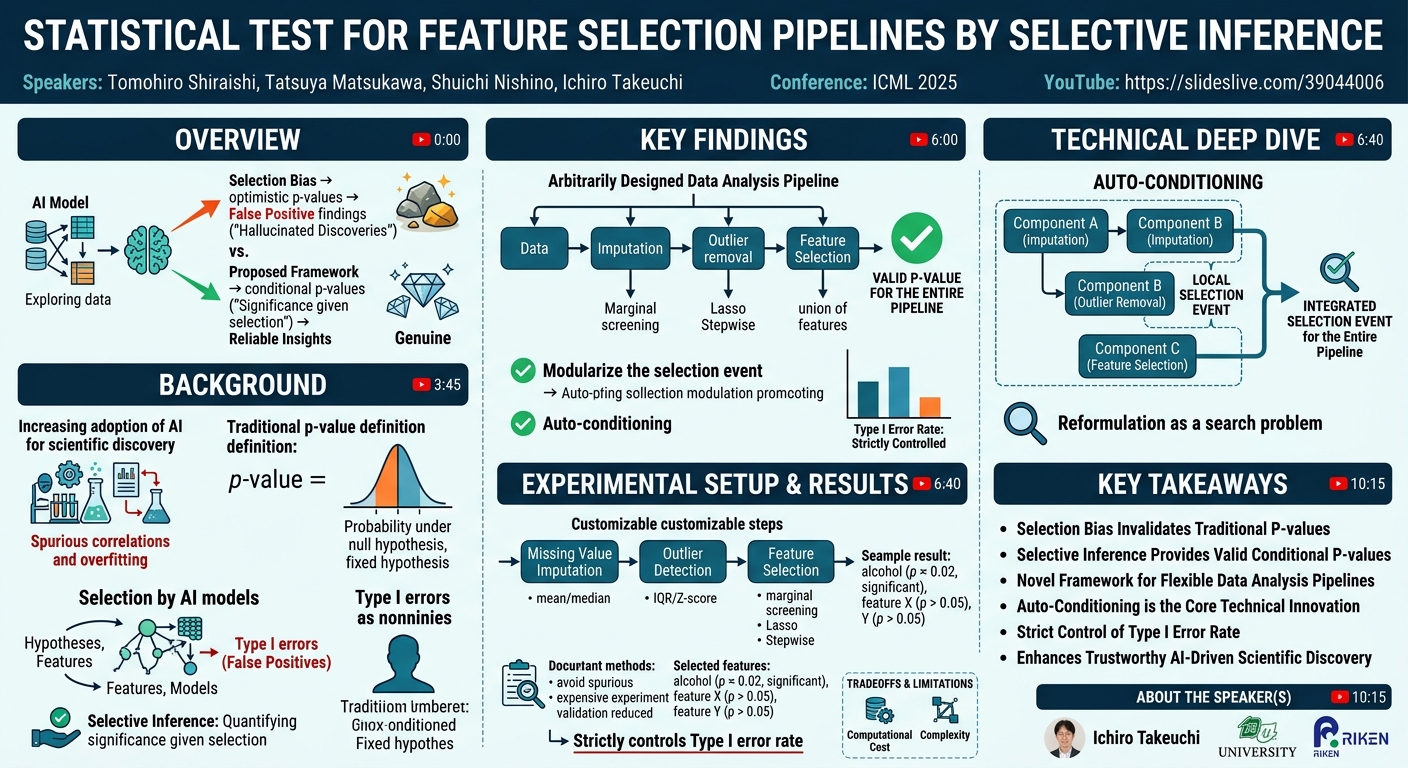
The core problem tackled is the pervasive issue of selection bias in machine learning. When AI models explore numerous possibilities and select the "best" features or patterns, traditional statistical tests (which assume fixed hypotheses) yield optimistic p-values, leading to a high rate of false positive findings or "hallucinated discoveries." This work proposes a robust solution by computing conditional p-values, which quantify the statistical significance of a discovery given that it was selected by the AI pipeline. This approach is crucial for establishing trust and rigor in scientific investigations powered by advanced machine learning techniques, moving beyond mere pattern recognition to verifiable insights.
The significance of this research lies in its ability to extend the well-established framework of selective inference to the highly flexible and often customized data analysis pipelines prevalent in scientific research. By providing a method to rigorously quantify uncertainty even when pipelines are dynamically designed and modified, the authors offer a vital tool for making AI-driven scientific discoveries more reliable and statistically sound. This is a fundamental step towards making AI an even more trustworthy partner in scientific exploration, ensuring that identified "diamonds" are indeed real and not just shiny rocks.
Background
▶ Watch: Introduction: AI for scientific discovery needs uncertainty quantification (0:00)
The increasing adoption of AI and machine learning across scientific disciplines has promised to revolutionize discovery by identifying complex, meaningful patterns in data. From genomics to materials science, AI is expected to accelerate the pace of innovation. However, the very power that makes AI so appealing also introduces a significant challenge: the propensity for spurious correlations and overfitting. Without proper safeguards, AI models can easily find patterns that appear significant but are merely artifacts of noise or specific data characteristics, leading to hallucinated discoveries that lack true generalizability or scientific validity.
To counter this, uncertainty quantification is essential. Among various measures, p-values have long served as a standard indicator of statistical significance in the scientific community. Traditionally, a p-value represents the probability of observing data as extreme as, or more extreme than, the observed data, assuming the null hypothesis is true. A small p-value suggests that the observed result is unlikely under the null hypothesis, leading to its rejection.
However, a fundamental mismatch arises when applying traditional p-value calculations to discoveries made by machine learning models. ML algorithms inherently involve a process of selection: they explore a vast hypothesis space, evaluate numerous features or models, and then select the one that appears most promising. This iterative exploration and selection process introduces a profound selection bias. If this bias is ignored, the resulting p-values become optimistic, meaning they are artificially low, leading to an inflated rate of Type I errors (false positives). In the analogy presented in the talk, an AI might identify something that "looks like a diamond" but is, in fact, just a shiny rock, precisely because it was selected from many possibilities.
This problem necessitates a paradigm shift in how statistical significance is assessed. Instead of asking "how surprising is the discovery?", the pertinent question becomes "how surprising is the discovery given that it was selected by AI?". This is precisely what conditional p-values aim to quantify. The framework of selective inference is a well-established statistical methodology designed to compute such conditional p-values, thereby correcting for the selection bias inherent in data-driven discovery processes. While selective inference has theoretical foundations, its practical application to the highly flexible, customized, and often ad-hoc data analysis pipelines common in scientific research presents a significant technical hurdle, which this work endeavors to overcome.
Key Findings
▶ Watch: Selective inference: Quantifying discovery significance given AI selection (3:45)
The central contribution of this research is the development of a novel selective inference framework specifically tailored for data analysis pipelines, with a particular focus on feature selection pipelines. This framework directly addresses the critical need for reliable uncertainty quantification in AI-driven scientific discovery, where traditional statistical methods fall short due to the inherent selection bias of machine learning models.
A primary finding is the ability to compute statistically valid p-values for pipeline outputs, even when the pipelines themselves are arbitrarily designed by researchers. Unlike prior work that might assume fixed or pre-specified analytical procedures, this framework accommodates the reality that data analysis pipelines are often constructed and modified dynamically, with choices regarding missing value imputation, outlier removal, feature selection algorithms, and hyperparameter tuning being highly flexible. The authors demonstrate that their approach can handle any combination of components, algorithms, and configurations, providing a valid p-value for the entire pipeline.
The technical cornerstone of this achievement is a concept termed auto-conditioning. The authors reformulate the complex computation of selective p-values as a "certain type of search problem." The core idea behind auto-conditioning is to modularize the selection event associated with each individual component within a pipeline. Just as auto-differentiation in neural networks automatically computes derivatives for complex compositions of layers, auto-conditioning automatically integrates the selection events from each pipeline component to define the comprehensive selection event for the entire pipeline. This modular approach allows for the dynamic construction and modification of pipelines without invalidating the statistical guarantees.
Crucially, the numerical results presented indicate that this selective inference framework can strictly control the Type I error rate for any pipeline configuration. This is a profound statistical guarantee, meaning that the framework effectively prevents the proliferation of false positive discoveries that plague analyses relying on naive p-values in exploratory ML contexts. As a proof of concept, the framework was demonstrated on feature selection pipelines combining various methods for missing value imputation (e.g., mean, median, mode), outlier removal (e.g., IQR-based, Z-score), and feature selection (e.g., marginal screening, Lasso, stepwise feature selection). The ability to identify genuinely significant features, such as "alcohol" in a demo dataset, while correctly assigning high p-values to other selected but non-significant features, underscores the practical utility and robustness of this approach. Furthermore, the development of a modeling language for defining these pipelines facilitates their practical application, allowing researchers to specify complex workflows and obtain corrected p-values with relative ease.
Technical Deep Dive
▶ Watch: Technical challenge: Handling arbitrary, flexible pipeline designs (6:00)
The technical heart of this work lies in extending selective inference to the domain of complex, flexible data analysis pipelines. Selective inference is a statistical framework designed to provide valid p-values for hypotheses that are formulated after inspecting the data and making data-dependent choices. This is crucial in machine learning, where selection bias arises because algorithms explore a vast space of possibilities (e.g., features, models, hyperparameters) and then "select" the most promising outcome. Traditional p-values, which assume that hypotheses are fixed a priori, become invalid in such scenarios, leading to an inflated rate of false discoveries.
The authors' approach addresses this by computing a conditional p-value, defined as the probability of observing something as extreme as the observed discovery, given that the discovery was generated by a specific AI or data analysis pipeline. Mathematically, this involves conditioning on the selection event, which is the set of all data realizations that would lead to the same discovery being selected by the pipeline.
The primary technical challenge is adapting selective inference to data analysis pipelines that are highly customized, dynamic, and not fixed in advance. A typical pipeline might involve sequential steps:
- Data Collection: Gathering raw data.
- Data Processing: Steps like data cleaning, missing value imputation (e.g., using mean, median, or more sophisticated methods), and outlier removal (e.g., based on interquartile range or Z-scores).
- Feature Engineering: Creating new features or transforming existing ones.
- Learning and Evaluation: Training models and assessing their performance.
- Analysis and Discovery: Interpreting results and identifying significant patterns, often through feature selection.
The flexibility of these pipelines—researchers can choose any combination of algorithms, hyperparameter settings, and even the order of operations—makes defining the overall selection event a formidable task.
The key technical innovation introduced is auto-conditioning. This concept provides a modular and automated way to construct the selection event for an entire pipeline. The idea is analogous to auto-differentiation in neural networks. In auto-differentiation, each layer in a neural network is associated with its local derivative computation. By chaining these local derivatives, the derivative of the entire complex network can be computed automatically. Similarly, in auto-conditioning:
- Each component of the data analysis pipeline (e.g., a specific missing value imputation method, an outlier removal algorithm, or a feature selection technique like Lasso or stepwise feature selection) is associated with its own local selection event. This local event describes the conditions under which that particular component makes its specific data-dependent choice.
- These local selection events are designed to be modular.
- When components are combined to form a complex pipeline, the framework automatically integrates these modular local selection events. This integration defines the comprehensive selection event for the entire pipeline.
The authors state that they reformulate the selective p-value computation as a "problem of a certain type of search problem." While the specifics of this search problem are left for a poster session, the implication is that this reformulation allows for the efficient and rigorous computation of the conditional probability space, even for arbitrarily complex pipelines. This approach means that researchers are not constrained to simple, pre-defined pipelines but can explore and iterate on their analysis workflows while maintaining statistical validity. The framework can even incorporate decisions made during hyperparameter tuning (e.g., via cross-validation) into the conditioning, further enhancing its practical utility. By offering a modeling language to define these pipelines, the technical complexity is abstracted, allowing researchers to focus on their scientific questions rather than the intricacies of conditional probability spaces.
Experimental Setup & Results
▶ Watch: Proof of concept: Feature selection pipeline example (6:40)
The experimental validation of the proposed selective inference framework for feature selection pipelines focused on demonstrating its ability to control the Type I error rate and provide meaningful statistical significance in dynamically constructed analytical workflows. While the talk did not delve into extensive quantitative benchmarks with multiple datasets or comparisons against numerous baselines, it provided a clear conceptual demonstration and a crucial statistical guarantee.
Experimental Setup:
The authors used a benchmark dataset for their demonstration, though the specific name was not explicitly stated. Based on the mention of "alcohol" as a selected feature, it is likely a well-known dataset such as the Wine dataset or similar.
The core of the demonstration involved constructing a flexible feature selection pipeline composed of several customizable stages:
- Missing Value Imputation: Researchers could choose from various methods (e.g., mean, median, mode imputation).
- Outlier Detection and Removal: Different techniques for identifying and handling outliers could be selected (e.g., methods based on interquartile range or Z-scores).
- Feature Selection: A range of feature selection algorithms were available, including:
- Marginal screening: Selecting features based on individual correlation or association with the target variable.
- Lasso (Least Absolute Shrinkage and Selection Operator): A regression analysis method that performs both variable selection and regularization to enhance the prediction accuracy and interpretability of the statistical model.
- Stepwise feature selection: An iterative method that adds or removes features based on a specified criterion (e.g., p-value).
The demonstration highlighted the framework's capability to handle arbitrary combinations of these components. For instance, a pipeline could involve imputation, then outlier removal, followed by marginal screening, potentially augmented by Lasso, and finally, a union of features selected by different methods. The framework was designed to accommodate not just the choice of algorithms but also the hyperparameter configurations of these algorithms, even when chosen via methods like cross-validation.
Results:
The primary qualitative result was the successful computation of a selective p-value for features selected by an arbitrarily constructed pipeline. In a live demo, a pipeline was executed, and it selected three features. For one of these features, "alcohol," the framework computed a selective p-value of approximately 0.02. This indicated that, even after accounting for the selection process of the entire pipeline, the "alcohol" feature was deemed statistically significant at a conventional alpha level (e.g., 0.05). The implication is that the other two selected features, though chosen by the pipeline, did not pass the rigorous selective inference test and were thus not considered statistically significant, effectively preventing a "hallucinated discovery."
The most critical quantitative result, though presented as a general statement rather than specific numerical benchmarks, is that the framework can strictly control the Type I error rate for any pipeline configuration. This is a fundamental statistical guarantee. It means that if a researcher sets an alpha level (e.g., 0.05), the probability of falsely declaring a feature significant (a Type I error) will not exceed that alpha level, regardless of how complex or customized the feature selection pipeline is. This stands in stark contrast to naive p-value calculations, which would invariably lead to inflated Type I errors due to selection bias.
While the talk did not provide details on computational overhead, specific dataset sizes, or hardware specifications (e.g., GPU types, processing times), the emphasis was clearly on the statistical validity and flexibility of the method. The success in controlling the Type I error rate for arbitrary pipelines is a significant theoretical and practical advancement, enabling more reliable scientific discovery with machine learning.
Practical Implications
▶ Watch: Main technical idea: Auto-conditioning for modular pipeline components (10:15)
The framework for selective inference in data analysis pipelines presents profound practical implications for a wide array of stakeholders in the AI/ML and scientific research communities. Its core value lies in enhancing the reliability and trustworthiness of discoveries made using machine learning, particularly in scientific contexts where the stakes for false positives are high.
For practitioners and scientists engaged in data-driven discovery, this framework offers a crucial tool to differentiate genuine insights from spurious correlations or overfitting artifacts. No longer must researchers be overly concerned that their powerful AI models are merely "finding shiny rocks" that look like diamonds. By providing statistically valid p-values that account for the entire data analysis pipeline, the framework empowers scientists to have greater confidence in their findings, reducing the risk of pursuing costly or misleading research directions based on "hallucinated discoveries." This is especially vital in fields like genomics, drug discovery, or materials science, where experimental validation is expensive and time-consuming.
For ML infrastructure teams and model builders, the ability to validate complex, iterative workflows is invaluable. Modern ML development often involves significant experimentation with different data preprocessing steps, feature engineering techniques, and model selection strategies. This framework allows these teams to conduct such explorations without sacrificing statistical rigor. It enables them to build more robust and interpretable models by ensuring that the selected features are truly significant, rather than being an artifact of the selection process itself. The modeling language developed alongside the framework further facilitates its adoption, allowing for the systematic definition and execution of complex pipelines with integrated statistical validation.
The framework also sheds light on critical tradeoffs and limitations:
- Computational Cost: While not explicitly detailed in the talk, selective inference methods are generally more computationally intensive than naive statistical tests, as they involve characterizing complex selection events. This might imply longer processing times for very large datasets or extremely intricate pipelines, requiring careful consideration for real-time or high-throughput applications.
- Complexity of Definition: Although the "auto-conditioning" simplifies the integration of selection events, users still need to accurately define their pipeline components and choices within the provided modeling language. Mispecifying a component or a decision point could potentially invalidate the selective inference.
- Scope: As presented, the proof of concept focuses specifically on feature selection pipelines. While the underlying principles of auto-conditioning may be extensible, applying this framework to other types of complex ML pipelines (e.g., model selection, hyperparameter optimization across different model families) would likely require further research and development.
- Interpretability vs. Automation: The framework provides a statistical guarantee, but understanding why certain features were selected by the pipeline and why they are significant (or not) still requires human expertise and domain knowledge. The tool quantifies uncertainty, but doesn't replace the need for careful scientific interpretation.
In essence, this work represents a significant step towards bridging the gap between the powerful exploratory capabilities of AI and the rigorous demands of statistical validity in scientific discovery. It moves beyond simply finding patterns to confirming their genuine significance, providing a robust foundation for more reliable and impactful AI-driven research.
Key Takeaways
- Selection Bias Invalidates Traditional P-values: Machine learning models, by exploring many possibilities and selecting the best, introduce selection bias, making traditional p-values (which assume a priori hypotheses) overly optimistic and leading to a high rate of false positive discoveries.
- Selective Inference Provides Valid Conditional P-values: The framework of selective inference is essential for uncertainty quantification in ML, calculating conditional p-values that quantify significance given that a discovery was selected by an AI pipeline.
- Novel Framework for Flexible Data Analysis Pipelines: This research extends selective inference to arbitrarily designed data analysis pipelines, allowing researchers to combine various components (e.g., missing value imputation, outlier removal, feature selection) without sacrificing statistical rigor.
- Auto-Conditioning is the Core Technical Innovation: The key is auto-conditioning, which modularizes the selection event of each pipeline component and automatically integrates them to define the comprehensive selection event for the entire pipeline, analogous to auto-differentiation.
- Strict Control of Type I Error Rate: The framework guarantees strict control of the Type I error rate (false positive rate) for any pipeline configuration, ensuring that scientific discoveries made with AI are statistically reliable.
- Enhances Trustworthy AI-Driven Scientific Discovery: By providing a robust method to validate findings, this work significantly improves the trustworthiness and reliability of AI in scientific research, helping scientists avoid "hallucinated discoveries."
About the Speaker(s)
The talk was presented by Ichiro Takeuchi, a distinguished researcher affiliated with Nagoya University and RIKEN in Japan. His work focuses on the intersection of machine learning and statistical inference, particularly in developing methods for reliable data analysis. The research presented is a collaborative effort with his students, Tomohiro Shiraishi, Tatsuya Matsukawa, and Shuichi Nishino, highlighting a strong academic mentorship in cutting-edge machine learning research.
Reviews
Maya Iyer (Theoretical ML Researcher) — SOLID
A technically credible extension of selective inference to modular feature selection pipelines, with a clean analogy between auto-differentiation and auto-conditioning as the organizing idea. The Type I error control guarantee is real and useful. However, based on this article, the contribution reads as a solid engineering of known machinery rather than a conceptual breakthrough: the underlying selective inference theory is classical (Lee et al., Fithian et al., Tibshirani et al.'s polyhedral lemma work), and the main novelty is a compositional bookkeeping scheme for selection events. The proofs and computational details are deferred to a poster, which prevents me from assessing whether…
Chen Zhao (Applied ML Researcher & Empiricist) — SOLID
Shiraishi et al. introduce a selective inference framework for arbitrary feature selection pipelines via a modular 'auto-conditioning' mechanism. The core statistical guarantee — valid conditional p-values under arbitrary pipeline composition — is a real and non-trivial contribution to the intersection of ML and post-selection inference. The analogy to auto-differentiation is conceptually clean and the modular design is genuinely appealing. However, the experimental evidence presented is thin to the point of being illustrative rather than validating: a single dataset, no comparison against naive p-value inflation, no power analysis, no runtime characterization, and no exploration of…
→ Top-rated talks at International Conference on Machine Learning 2025
All talks from International Conference on Machine Learning 2025