Suitability Filter: A Statistical Framework for Classifier Evaluation in Real-World Deployment Settings
Angéline Pouget, Mohammad Yaghini, Stephan Rabanser, Nicolas Papernot
Overview
In the rapidly evolving landscape of machine learning, deploying models into production environments presents a unique set of challenges, particularly when the operational data distribution differs from the training or evaluation data. Mohammad Yaghini, alongside collaborators Angéline Pouget, Stephan Rabanser, and Nicolas Papernot, presented a compelling solution to this pervasive problem at ICML 2025 with their work on the Suitability Filter. This talk addresses a fundamental question for any company looking to utilize a pre-trained model: "Is this model suitable for my specific user data?" The core issue arises because model providers typically offer performance guarantees based on their own evaluation datasets, which may not translate directly to a user's potentially different data distribution, especially when that user data is unlabeled.
Key moments
- 0:00 Introduction: The model suitability problem
- 0:50 Formalizing the problem: Provider vs. user data
- 1:30 Defining 'suitability' within their framework
- 1:55 Introducing the Suitability Filter mechanism
- 2:40 Formal guarantees and delta-calibration requirement
- 3:40 Practical strategy for maintaining calibration over time
- 4:20 Empirical results: Effectiveness and bounded false positives
- 4:50 Conclusion: Suitability filters as computational model cards
Suitability Filter: A Statistical Framework for Classifier Evaluation in Real-World Deployment Settings
Speakers: Angéline Pouget, Mohammad Yaghini, Stephan Rabanser, Nicolas Papernot
Conference: ICML 2025
YouTube: https://slideslive.com/39044105
Overview
In the rapidly evolving landscape of machine learning, deploying models into production environments presents a unique set of challenges, particularly when the operational data distribution differs from the training or evaluation data. Mohammad Yaghini, alongside collaborators Angéline Pouget, Stephan Rabanser, and Nicolas Papernot, presented a compelling solution to this pervasive problem at ICML 2025 with their work on the Suitability Filter. This talk addresses a fundamental question for any company looking to utilize a pre-trained model: "Is this model suitable for my specific user data?" The core issue arises because model providers typically offer performance guarantees based on their own evaluation datasets, which may not translate directly to a user's potentially different data distribution, especially when that user data is unlabeled.
The Suitability Filter introduces a robust statistical framework designed to provide formal, end-to-end guarantees regarding a model's performance on a user's unlabeled data. This framework shifts the onus of establishing suitability from the user, who lacks labels, back to the model provider, who possesses the necessary training and validation insights. By leveraging techniques from uncertainty estimation and hypothesis testing, the proposed method offers a practical and effective mechanism for evaluating and maintaining classifier reliability in real-world deployment scenarios, bridging a critical gap in the MLOps pipeline.
This work is particularly important because it directly tackles the problem of domain shift and generalization gap in deployment. Traditional evaluation metrics, while crucial during development, often fail to predict real-world performance when the model encounters data from a different geographical region, time period, or demographic than it was originally trained on. The Suitability Filter provides a principled, data-driven approach to quantify this risk and ensure that deployed models meet essential performance criteria, thereby fostering trust and enabling more responsible and effective AI adoption across diverse applications.
Background
▶ Watch: Introduction: The model suitability problem (0:00)
The typical machine learning classification pipeline involves several stages: data preparation, model training, evaluation on a separate validation or test set, and iterative refinement until satisfactory performance is achieved. Once a model meets internal benchmarks, it's deemed ready for deployment. At this stage, the primary objective is to minimize the generalization gap between the performance observed on the training data and that on the validation data. However, the real-world deployment environment often introduces unforeseen challenges. A critical issue is domain shift, where the data distribution encountered during inference differs significantly from the distribution the model was trained and validated on.
Consider, for instance, a model trained on aerial photographs from North America. When this model is deployed for a user in Europe, the underlying data distribution — due to differences in geography, climate, or infrastructure — might change. The performance guarantees established during the evaluation phase on North American data may not necessarily hold true for European data. The problem is compounded by the fact that the end-user typically possesses only unlabeled data. They require a reasonably accurate model but lack the ground truth labels to conduct a comprehensive evaluation themselves. Currently, model providers might suggest a trial, asking the user to label a subset of their data, which is often impractical or costly.
This scenario highlights a significant gap in current ML systems: how to robustly assess the suitability of a pre-trained model for a new, unlabeled target distribution without incurring the overhead of extensive manual labeling. While existing research in areas like uncertainty estimation, out-of-distribution detection, and model calibration provides foundational tools for understanding model behavior, none directly offer a statistical framework for making a definitive "suitable" or "unsuitable" decision with formal guarantees on unlabeled target data. The Suitability Filter aims to remedy this by providing a robust, statistically sound method to bridge the trust gap between model providers and users in the face of real-world domain shifts.
Key Findings
▶ Watch: Defining 'suitability' within their framework (1:30)
The research presented on the Suitability Filter introduces a novel and robust statistical framework that significantly advances the evaluation of machine learning classifiers in real-world deployment settings. The key findings and contributions are multifaceted, addressing both theoretical guarantees and practical applicability:
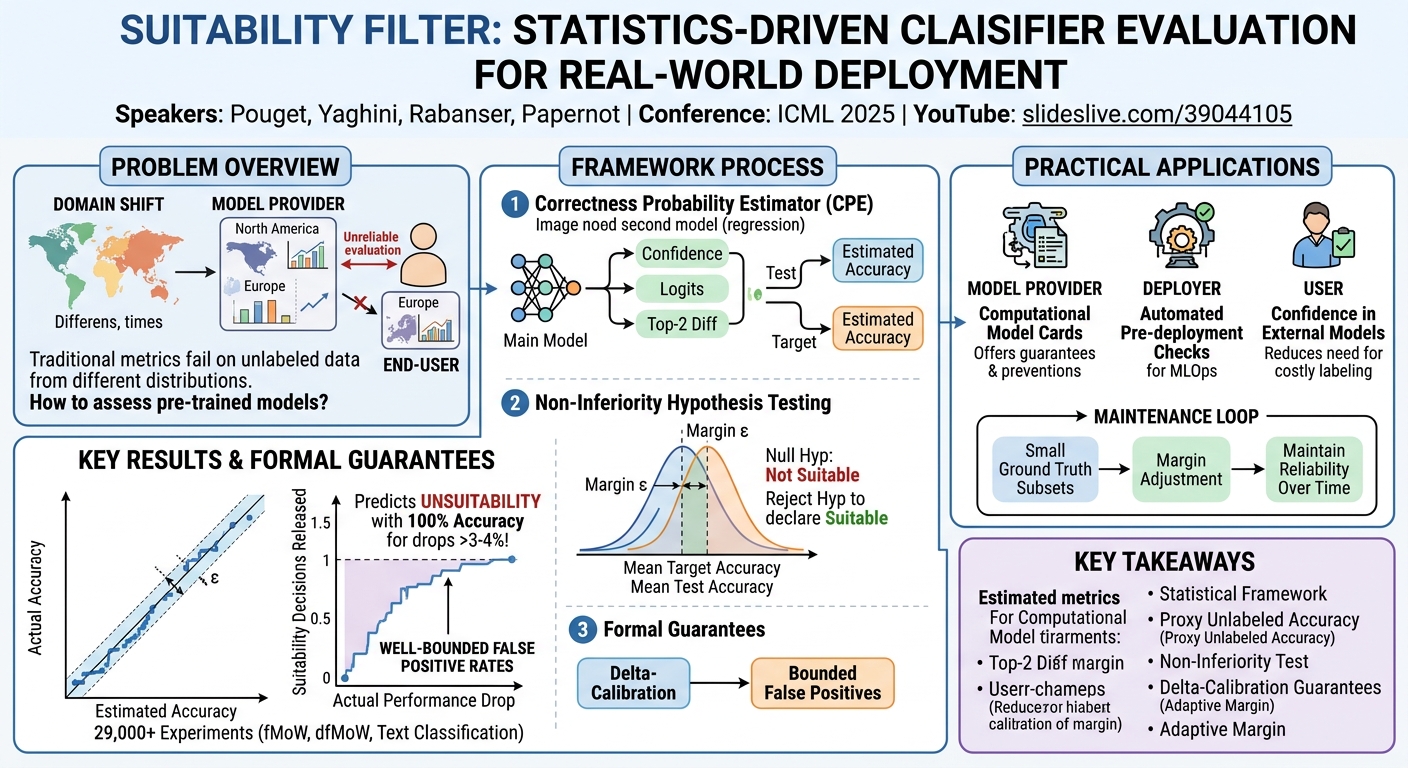
- Robust Suitability Guarantees on Unlabeled Data: The primary contribution is a framework that provides formal, end-to-end guarantees about a model's suitability for a user's data distribution, even when that data is entirely unlabeled. This is achieved by defining suitability as the estimated accuracy on user data falling within a specified margin of the model provider's test data accuracy.
- Introduction of the Correctness Probability Estimator (CPE): A crucial component of the framework is the Correctness Probability Estimator, a regressor trained on a hold-out set from the provider's data. This CPE is designed to predict the accuracy of the main classification model on individual input samples, serving as a proxy for actual accuracy in the absence of labels.
- Leveraging Non-Inferiority Hypothesis Testing: The framework employs a non-inferiority test to make suitability decisions. This statistical test is designed to reject the null hypothesis that the model is not suitable (i.e., its target accuracy is significantly less than the provider's test accuracy). This design ensures bounded end-to-end false suitability positive rates, providing strong statistical confidence in the suitability decisions.
- Formal Guarantees through Delta-Calibration: The authors demonstrate that if the CPE is delta-calibrated on both the source (provider's) and target (user's) distributions, then the system can formally guarantee a bounded false positive rate for suitability decisions. This provides a theoretical underpinning for the reliability of the Suitability Filter.
- Practical Calibration Maintenance via Margin Adjustment: Recognizing that calibration can degrade over time or with significant domain shift, the framework includes a practical mechanism for maintaining the CPE's reliability. By periodically collecting small subsets of ground truth labels from the target domain, the model provider can measure miscalibration using a calibration plot and dynamically adjust the suitability margin, ensuring the guarantees hold over time.
- Empirical Effectiveness Across Diverse Tasks: The Suitability Filter's effectiveness was rigorously validated through an extensive meta-analysis involving over 29,000 experiments across a wide range of datasets and tasks. These included computer vision tasks from the Functional Map of the World Wilds dataset, as well as various text classification tasks like sentiment analysis and civil comments. The results showed that for performance deteriorations exceeding 3-4% between user and test accuracy, the system could predict unsuitability with 100% accuracy, while consistently maintaining well-bounded false positive rates.
In essence, the Suitability Filter provides a robust, statistically grounded, and practically deployable solution for a critical problem in real-world ML, allowing model providers to offer quantifiable guarantees and users to deploy models with confidence, even in the presence of unlabeled target data and domain shift.
Technical Deep Dive
▶ Watch: Formal guarantees and delta-calibration requirement (2:40)
The Suitability Filter addresses the challenge of evaluating a pre-trained classifier's performance on an unlabeled user dataset (D_target) when the model provider only has guarantees from its own labeled dataset (D_test). The core idea is to proxy the accuracy on D_target and compare it statistically to the accuracy on D_test.
Problem Formulation and Suitability Definition
Let's formally define the problem:
- Model Provider: Possesses a labeled dataset split into D_train (for training the classifier) and D_test (for evaluating it).
- Model User: Possesses an unlabeled dataset D_target and seeks a classification model.
- Goal: Determine if the classification model, trained by the provider, is "suitable" for the user's D_target, given the provider's reported accuracy on D_test.
The paper defines suitability quite simply: a model is deemed suitable if its estimated accuracy on the user's data (D_target) is within a specified margin (ε) of its accuracy on the model provider's test data (D_test). Mathematically, this can be expressed as:
Estimated_Accuracy(D_target) ≥ Accuracy(D_test) - ε
The central challenge is that Estimated_Accuracy(D_target) cannot be directly computed without labels. The framework's ingenuity lies in how it proxies this unknown quantity.
The Correctness Probability Estimator (CPE)
To proxy accuracy on unlabeled user data, the Suitability Filter introduces the Correctness Probability Estimator (CPE), denoted as C. This is a separate regressor, typically a logistic regression model, trained on a hold-out set from the provider's D_train. Its purpose is to estimate the probability that the main classification model will correctly classify a given input sample.
The CPE is trained using signals well-known from the uncertainty estimation literature. These signals include:
- Confidence of the model: The maximum softmax probability output by the main classifier.
- Difference between the top two confidences: A measure of how distinct the top prediction is from the next best alternative.
- Logit alternatives: Raw outputs from the final layer of the main classifier before the softmax function, which can carry more information about uncertainty.
Once trained, the CPE is applied to two sets of data:
- Provider's D_test: This yields a subset of estimated accuracies for the provider's known distribution.
- User's D_target: This yields a subset of estimated accuracies for the user's unlabeled distribution.
These estimated accuracies, rather than direct label-based accuracies, form the basis for the suitability decision.
Non-Inferiority Hypothesis Testing
With the estimated accuracies from the CPE for both D_test and D_target, the framework moves to a statistical hypothesis test to make a robust suitability decision. The authors employ a non-inferiority test. This type of test is designed to determine if a new treatment (or in this case, performance on D_target) is "not unacceptably worse" than a standard treatment (performance on D_test).
The null hypothesis (H₀) for the non-inferiority test is that the model is not suitable. Specifically, it states that the target mean accuracy is actually less than the provider's test accuracy by at least the margin ε.
H₀: Mean_Estimated_Accuracy(D_target) < Mean_Accuracy(D_test) - ε
The goal is to reject this null hypothesis to establish suitability. Rejecting H₀ means there is sufficient statistical evidence to conclude that the model's performance on D_target is not unacceptably worse than on D_test, thereby establishing suitability. A key benefit of this approach is that it inherently ensures bounded end-to-end false suitability positive rates, meaning the system has a controlled probability of incorrectly declaring an unsuitable model as suitable.
Formal Guarantees through Delta-Calibration
To provide formal guarantees for the bounded false positive rate, the framework relies on the concept of delta-calibration. Calibration, in the context of probability estimators, means that if an estimator predicts a probability p for an event, then that event should occur approximately p percentage of the time across all instances where p was predicted. For example, if the CPE estimates a 65% probability of correctness, then among all samples where it made this estimate, roughly 65% should indeed be correctly classified by the main model.
The requirement for formal guarantees is that the CPE C must be delta-calibrated on both the source distribution (D_train/D_test) and the target distribution (D_target). The delta here refers to the maximum acceptable deviation from perfect calibration. The authors present a lemma demonstrating that if the CPE is delta-calibrated, then with an appropriately adjusted margin, a bounded false positive rate for the end-to-end suitability system can be guaranteed.
Estimating these delta values in practice can be challenging, especially for the target distribution, which is unlabeled and potentially subject to drift. While the source distribution's calibration can be controlled by the model provider, the target miscalibration remains a significant hurdle.
Practical Calibration Maintenance: Margin Adjustment
Recognizing the practical difficulties of ensuring perfect and static calibration, especially on a dynamic target distribution, the Suitability Filter incorporates a mechanism for ongoing calibration maintenance. This mechanism draws lessons from quality assurance literature.
The proposed solution involves the model provider routinely collecting a small subset of ground truth labels from the target domain over time. This small labeled subset allows for an empirical assessment of the CPE's calibration on the target data. This is typically visualized using a calibration plot, where the x-axis represents the ground truth accuracy (or event frequency) for various confidence bins, and the y-axis represents the CPE's estimated accuracy for those same bins. Any deviation from the ideal y=x line indicates miscalibration.
By measuring the degree of miscalibration on this small labeled subset, the model provider can then dynamically adjust the margin (ε) used in the non-inferiority test. This adaptive margin tuning ensures that the CPE remains reliable and that the formal guarantees of bounded false positive rates are maintained over the model's deployment lifetime, even as the target distribution potentially evolves. This iterative feedback loop is crucial for the long-term robustness and trustworthiness of the Suitability Filter in dynamic real-world environments.
Experimental Setup & Results
▶ Watch: Practical strategy for maintaining calibration over time (3:40)
The Suitability Filter framework was subjected to extensive empirical validation, demonstrating its effectiveness across a broad spectrum of machine learning tasks and datasets. The experiments were designed to simulate real-world deployment scenarios involving domain shift and the need for robust suitability assessments on unlabeled user data.
The scale of the evaluation was impressive, with aggregated results derived from over 29,000 experiments. This meta-analysis approach allowed the researchers to establish the generalizability and robustness of their framework across diverse conditions.
Datasets and Tasks
The experiments spanned various machine learning domains, encompassing both computer vision and natural language processing tasks:
- Computer Vision: A significant portion of the evaluation utilized the Functional Map of the World Wilds dataset. This dataset is known for its diverse geographical coverage and often presents challenges related to domain generalization, making it an ideal candidate for testing suitability in the presence of visual domain shifts.
- Text Classification: The framework was also applied to several text-based classification tasks. Specific examples mentioned include sentiment analysis and the civil comments dataset, which involves classifying online comments for toxicity. These tasks introduce different types of domain shifts, such as variations in language usage, slang, or topic prevalence.
The broad range of tasks and datasets underscores the versatility of the Suitability Filter, indicating its potential applicability across various AI/ML applications.
Metrics and Evaluation
The primary metrics used to evaluate the Suitability Filter's performance focused on its ability to correctly identify unsuitable models and to control false positive rates:
- Difference between User and Test Accuracy (x-axis in plots): This metric quantifies the actual performance degradation when the model is applied to the user's data compared to the provider's test data. This serves as the ground truth for evaluating the filter's predictions.
- Percentage of Suitability Decisions Released (y-axis in plots): This metric represents the proportion of instances where the Suitability Filter declared the model as suitable.
- False Positive Rate (FPR): Crucially, the system tracks the rate at which it incorrectly declares an unsuitable model as suitable. The framework is designed to bound this rate formally.
Headline Results
The empirical results unequivocally demonstrated the effectiveness of the Suitability Filter:
- High Accuracy in Predicting Unsuitability: For scenarios where the performance deterioration (the difference between user accuracy and test accuracy) was greater than 3-4%, the Suitability Filter was able to predict unsuitability with 100% accuracy. This is a critical finding, as it indicates the system's strong ability to reliably flag models that would perform poorly in deployment.
- Well-Bounded False Positive Rates: The experiments consistently showed that the false positive rates for suitability decisions were well-bounded. This confirms the theoretical guarantees provided by the framework, giving practitioners confidence that the filter will not frequently make erroneous "suitable" declarations.
While specific model architectures (e.g., specific ResNet variants, BERT models) and their parameter counts or throughput numbers were not explicitly detailed in the transcript, the comprehensive nature of the "29000 experiments" suggests a thorough evaluation across various model complexities and task types. The emphasis was on the generalizability of the statistical framework itself rather than on optimizing a single model's performance. The results indicate that the Suitability Filter functions effectively irrespective of the underlying model, as long as the Correctness Probability Estimator can be adequately trained and calibrated.
Practical Implications
▶ Watch: Conclusion: Suitability filters as computational model cards (4:50)
The Suitability Filter framework carries profound practical implications for various stakeholders in the machine learning ecosystem, from model developers and infrastructure teams to end-users deploying AI solutions. It addresses a critical pain point in the real-world adoption and responsible deployment of ML models.
For Model Providers and Builders
The framework positions the model provider as the primary guarantor of suitability, shifting the onus from the user. This is a significant paradigm shift. Instead of merely providing performance metrics on their internal test sets, providers can now offer robust, statistically backed suitability guarantees for a user's specific, unlabeled data distribution. This effectively transforms the model provider's offering into a "computational model card" – a dynamic, data-driven assessment of a model's fitness for purpose. This capability can enhance trust, differentiate offerings, and facilitate broader adoption of pre-trained models. It provides a structured way for providers to understand and communicate the limits of their model's generalization.
For Infrastructure Teams and Deployers
For infrastructure teams responsible for deploying and monitoring ML models, the Suitability Filter offers a practical and easy-to-deploy solution for pre-deployment checks. Integrating this filter into MLOps pipelines can automate a crucial step in risk assessment. Before a model goes live in a new environment or for a new user, the filter can quickly ascertain its suitability without requiring extensive manual labeling or complex domain adaptation efforts. This reduces the operational burden and potential costs associated with deploying unsuitable models, which can lead to poor user experience, inaccurate decisions, and resource wastage. The periodic margin adjustment mechanism provides a clear, actionable protocol for maintaining model reliability over time, ensuring that guarantees hold even as data distributions drift.
For Model Users and Businesses
For end-users or businesses looking to integrate AI, the Suitability Filter offers a powerful tool to gain confidence in deploying external models. The ability to assess a model's accuracy on their own unlabeled data, backed by formal statistical guarantees, significantly mitigates the risk of deploying an ill-suited model. This reduces the need for costly and time-consuming manual labeling efforts for initial evaluation or trial periods. It empowers users to make informed decisions about model adoption, fostering greater trust in AI solutions and accelerating their integration into various applications.
Tradeoffs and Limitations
While highly beneficial, the Suitability Filter does come with certain tradeoffs and considerations:
- Requirement for Unlabeled User Data: The framework fundamentally requires the user to provide their unlabeled data (D_target) to the model provider (or an intermediary system) for the suitability assessment. This might raise data privacy or transfer concerns in some highly regulated environments.
- Periodic Ground Truth Collection: The mechanism for maintaining calibration over time necessitates the routine collection of small subsets of ground truth labels from the target domain. While "small," this still represents an operational overhead and requires a process for obtaining these labels. The frequency and size of these subsets would need to be tuned based on the expected rate of domain drift and the criticality of the application.
- Correctness Probability Estimator (CPE) Reliability: The entire framework's robustness hinges on the quality and calibration of the CPE. Training a well-calibrated CPE, especially one that generalizes across different types of domain shift, is a non-trivial task. While the authors leverage established uncertainty estimation techniques, ensuring its delta-calibration on the target domain remains a practical challenge that requires careful monitoring.
- Defined Margin (ε): The suitability definition relies on a pre-defined margin ε. Choosing an appropriate ε requires domain expertise and understanding of acceptable performance degradation.
Despite these considerations, the Suitability Filter represents a significant step forward in making ML deployments more reliable, transparent, and trustworthy, offering a principled approach to a long-standing challenge in the field.
Key Takeaways
- The Suitability Filter provides a robust statistical framework for evaluating pre-trained classifier suitability on unlabeled user data, addressing a critical gap in real-world ML deployment.
- It formally defines suitability as the estimated accuracy on user data being within a margin of the model provider's test data accuracy, offering end-to-end guarantees on false positive rates.
- A central component is the Correctness Probability Estimator (CPE), a regressor trained on provider data to proxy the main classifier's accuracy on individual input samples.
- The framework leverages non-inferiority hypothesis testing to make statistically sound suitability decisions, ensuring bounded false suitability positive rates.
- Practical reliability is maintained through a margin adjustment mechanism, which uses small, periodically collected ground truth labels from the target domain to re-calibrate and ensure guarantees hold over time.
- Empirical validation across 29,000 experiments on diverse datasets (e.g., Functional Map of the World Wilds, civil comments) demonstrates high effectiveness, predicting unsuitability with 100% accuracy for performance drops >3-4%.
- This approach effectively shifts the onus of suitability assessment from the user to the model provider, enabling more confident and responsible deployment of AI models in the presence of domain shift.
About the Speaker(s)
The talk was primarily delivered by Mohammad Yaghini, who is also a key collaborator on the research. Mohammad Yaghini, along with Stephan Rabanser, were noted to be on the job market, indicating their contributions and expertise in this cutting-edge area of machine learning research. The first author of the paper is Angéline Pouget, and the work was conducted under the guidance of their advisor, Nicolas Papernot. Together, this team has developed a significant contribution to the field of trustworthy and deployable AI, focusing on the practical challenges of generalization and model evaluation in real-world scenarios. Their collective work highlights a strong foundation in statistical methods and their application to machine learning systems.
Reviews
Maya Iyer (Theoretical ML Researcher) — SOLID
A competent and honest application of established statistical machinery — non-inferiority testing, calibration theory, uncertainty estimation — to the practically important problem of evaluating pre-trained classifiers on unlabeled target data. The framework is sensible and the empirical validation is unusually broad. But the theoretical contribution is thinner than the presentation suggests: the core ideas are recombinations of known tools, the delta-calibration condition essentially assumes away the hardest part of the problem, and the 100% unsuitability detection claim at a 3-4% threshold is the kind of headline number that deserves more careful scrutiny. Solid applied work that will be…
Chen Zhao (Applied ML Researcher & Empiricist) — SOLID
Pouget et al. introduce a principled statistical framework for deciding whether a pre-trained classifier is 'suitable' for an unlabeled target distribution, formalized as a non-inferiority test over outputs from a Correctness Probability Estimator. The problem framing is clean and the theoretical grounding (delta-calibration, bounded FPR) is legitimate. The 29,000-experiment meta-analysis is a real asset. But the write-up as presented raises enough methodological questions — about CPE calibration assumptions, baseline comparisons, and the operationalization of the 100% unsuitability detection claim — that I'd want to see the full paper before upgrading this to a strong accept. This is…
→ Top-rated talks at International Conference on Machine Learning 2025
All talks from International Conference on Machine Learning 2025