The Future of Social Media: An Optimistic Take
Jon Bell (Designer · Arbiter)
Kawaiicon 2025 (Kawaiicon III) · Day 1 · Main Stage
Overview
In his Kawaiicon talk, "The Future of Social Media: An Optimistic Take," Jon Bell, a designer and former member of Twitter's Trust and Safety team, challenges the pervasive cynicism surrounding the current state of social media. While acknowledging the widespread dissatisfaction and the platforms' myriad issues—from rampant abuse and misinformation to algorithms that prioritize engagement over quality—Bell asserts that a significantly better future is not only possible but within reach. His core argument is that the stagnation we observe is less about technical impossibility and more about a "failure of imagination" within the industry, particularly among proprietary platforms.
Key moments
- 0:40 The problem with closed social media protocols
- 2:09 Lessons from shipping filters at Twitter
- 3:58 Improving search and advanced blocking features
- 6:40 Content tagging: empowering users to improve algorithms
- 10:00 Customizable algorithms via natural language settings
- 12:00 Reimagining social feeds with RSS and content curators
- 16:20 A plausible growth story for a better social app
- 19:59 Open source ensures a better, universally improved social future
The Future of Social Media: An Optimistic Take
Speakers: Jon Bell, Designer, Arbiter
Conference: Kawaiicon
YouTube: https://www.youtube.com/watch?v=8sCGbbyx01M
Overview
In his Kawaiicon talk, "The Future of Social Media: An Optimistic Take," Jon Bell, a designer and former member of Twitter's Trust and Safety team, challenges the pervasive cynicism surrounding the current state of social media. While acknowledging the widespread dissatisfaction and the platforms' myriad issues—from rampant abuse and misinformation to algorithms that prioritize engagement over quality—Bell asserts that a significantly better future is not only possible but within reach. His core argument is that the stagnation we observe is less about technical impossibility and more about a "failure of imagination" within the industry, particularly among proprietary platforms.
Bell draws upon his insider experience at Twitter to dissect the fundamental flaws of existing social media models, which he likens to "roads that only work for a certain type of car" due to their closed protocols. He proposes a series of actionable, technically feasible solutions rooted in open standards, user empowerment, and intelligent content filtering. This article will delve into Bell's vision, exploring how features like user-driven content tagging, highly customizable algorithms, and deep integration of open protocols like RSS can transform social media from a source of frustration into a genuinely valuable and user-centric experience.
The talk is particularly relevant in an era dominated by concerns over digital well-being, platform accountability, and the spread of harmful content. Bell's optimistic perspective, grounded in practical design and existing technological capabilities, offers a refreshing counter-narrative to the prevailing doom-scrolling mentality. It suggests that by embracing decentralization, empowering users with granular control, and fostering a collaborative approach to content curation, we can build social networks that truly serve their communities rather than merely optimizing for corporate metrics.
Background
▶ Watch: The problem with closed social media protocols (0:40)
Jon Bell's perspective is uniquely informed by his tenure on the Trust and Safety team at Twitter, where he directly confronted the grim realities of online abuse, harassment, and the spread of harmful content. This experience led him to reject the fatalistic notion that "the internet is horrible" and there's "nothing we can do about it." Instead, he became convinced that many of social media's most intractable problems are solvable through scientific, design-led approaches, much like how historical public health crises, such as the 1854 Broad Street cholera outbreak, were resolved by identifying and addressing root causes rather than dismissing them as intractable.
Bell recounts the arduous internal battles at Twitter to implement what are now considered table stakes features for user safety and control. He highlights the significant effort required to ship basic functionalities like muting words and notification filters, which were initially met with resistance but proved crucial in mitigating user suffering. His "white whale" project, the ability for users to remove replies to their own posts, took three years to implement, indicative of the deep-seated philosophical and technical challenges within large, established platforms. These experiences underscore the difficulty of driving meaningful change within systems designed primarily for engagement metrics, often at the expense of user well-being.
The fundamental issue, as Bell frames it, lies in the proprietary, closed protocols that underpin most mainstream social media. Unlike open systems such as email, where different clients and providers can interoperate, platforms like Twitter, Threads, and Blue Sky operate as isolated "roads" for specific "cars," preventing seamless interaction and fostering vendor lock-in. This fragmentation not only limits user choice but also stifles innovation in how content is curated and consumed. Furthermore, Bell emphasizes the inherent "stupidity" of current algorithms, which largely base their logic on superficial metrics like views and text content, failing to grasp the nuanced human context, quality, or intent behind posts. This algorithmic blindness contributes directly to the proliferation of low-quality content, engagement bait, and misinformation, as the system struggles to differentiate between genuine interaction and manufactured outrage.
Key Findings
▶ Watch: Improving search and advanced blocking features (3:58)
Jon Bell's talk unveils a series of key findings and proposed solutions that collectively paint an optimistic picture for the future of social media. These are not speculative technologies but rather design principles and architectural approaches that are either already available in nascent forms or are technically feasible today.
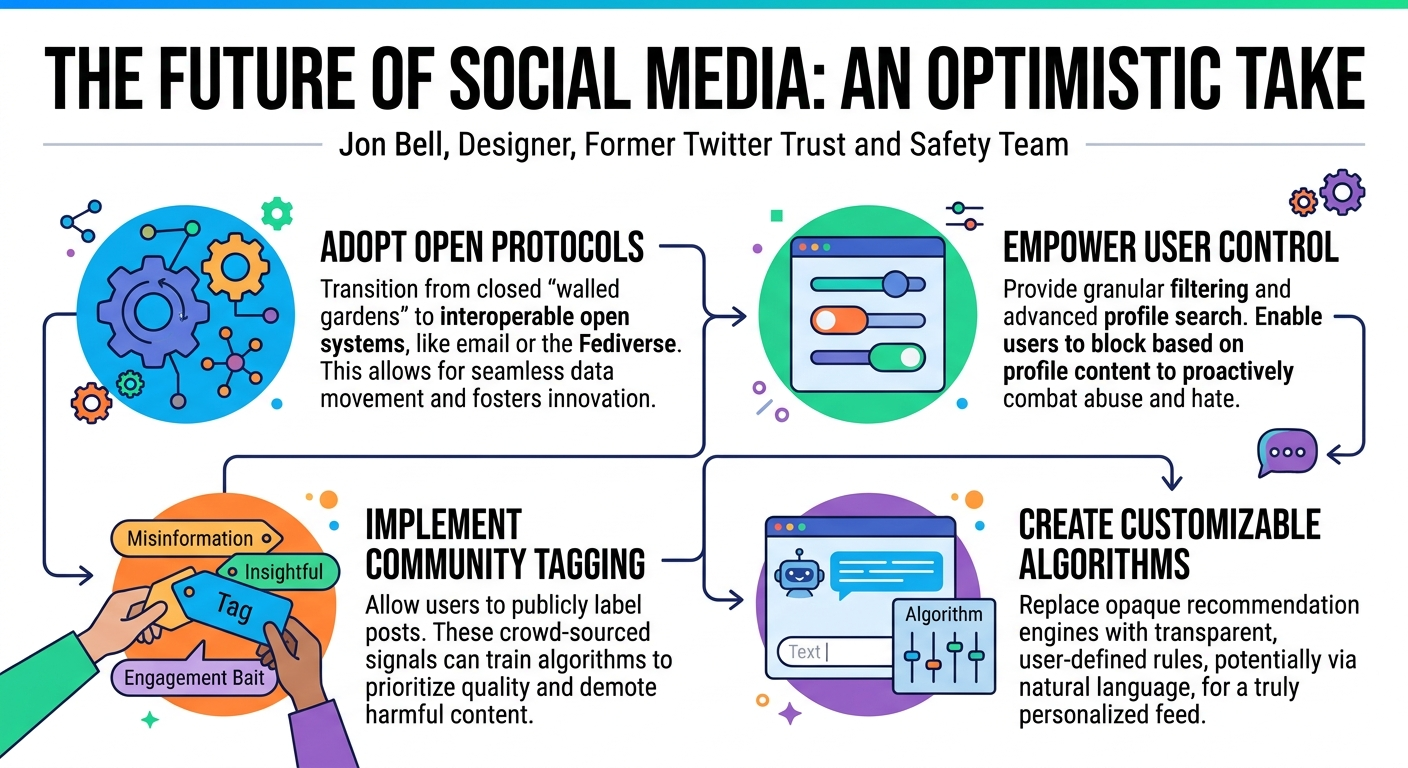
Firstly, Bell champions the adoption of open protocols, contrasting the walled gardens of current platforms with the interoperability of email. This foundational shift would allow users to move between different social clients and services while maintaining their social graph and data, fostering a more competitive and innovative ecosystem.
Secondly, a significant finding revolves around enhanced user filtering and control. Building on the hard-won battles for basic features like muting words and notification filters, Bell advocates for more sophisticated, profile-based filtering. He highlights the low-hanging fruit of allowing users to search people's profiles for specific interests (e.g., "autism Wellington," "board game enthusiast") and, crucially, to block or ignore users based on what they say in their profile. This feature would empower users to proactively shield themselves from hateful ideologies (e.g., "all lives matter," "proud turf") without having to engage with harmful content first, scaling anti-abuse efforts beyond reactive blocking.
Thirdly, Bell introduces the powerful concept of user-driven content tagging and labeling. He reveals that a proposal for this feature existed within Twitter as early as 2012 but was never shipped. This system would allow users to explicitly label content as a "lie," "conspiracy theory," "link bait," "engagement bait," or conversely, as "insightful," "thoughtful," or "high quality." The algorithm would then incorporate these crowd-sourced tags, not as definitive truth, but as strong signals. For instance, if 64 people tag a post as "flat earth theory" and only one as "fight the power," the algorithm can infer its likely nature. Moreover, the tags from trusted individuals within a user's network would carry more weight, allowing for a more nuanced and personalized content filtering. This system would revolutionize search, enabling queries like "insightful articles written by women in Wellington this month," yielding far more relevant results than current keyword-based searches.
Fourthly, Bell argues for truly customizable algorithms. Instead of users passively trying to "talk to the algorithm gods" through their interactions, he envisions a direct, explicit control panel, potentially even a chatbot interface, where users can dictate their content preferences. Users could specify rules like, "On Tuesday I only want to see taco content," or "On Thursday it's puppies and cats in an alternating feed." This level of granular control would allow platforms to deliver a "perfectly sticky" feed because it genuinely caters to the user's desires, transforming engagement from an addiction-driven metric into a measure of user satisfaction.
Finally, Bell emphasizes the critical role of aggregation, specifically through RSS integration. He questions why RSS, a widely adopted open standard for content syndication, never fully integrated into social media. His vision includes a social profile that easily displays and allows following of a friend's various RSS feeds (e.g., their blog, band page, side projects). More profoundly, it suggests that RSS content, even from creators without a direct social media presence, could flow into users' timelines and be subject to community tagging. This would dramatically increase discoverability for high-quality content, rewarding thoughtful creation over algorithmic manipulation and making services like Linktree obsolete by baking content aggregation directly into the social experience.
Technical Deep Dive
▶ Watch: Customizable algorithms via natural language settings (10:00)
The technical feasibility of Jon Bell's optimistic vision for social media hinges on leveraging existing open standards and re-imagining platform architecture with user control at its core. The proposed solutions are not reliant on breakthrough AI but rather on intelligent data structuring, robust filtering mechanisms, and a commitment to open protocols.
The foundation of Bell's vision is the widespread adoption of open protocols, epitomized by the Fediverse. Platforms like Mastodon and Blue Sky already demonstrate the viability of decentralized social networking, where instances can interoperate using open standards like ActivityPub. This move away from monolithic, proprietary platforms to a federated network is crucial. It means that features developed by one client or instance can, in principle, benefit the entire ecosystem, fostering innovation and preventing vendor lock-in.
The first set of concrete features revolves around profile-based search and filtering. Implementing universal profile search requires robust indexing of user-generated profile data. This would involve a backend system that parses and stores keywords, phrases, and potentially structured metadata from user bios, allowing for efficient querying. For filtering, a user's client (or the federated server they use) would implement a rule-based engine that compares incoming content or user profiles against a user's defined block/ignore list. This list could contain explicit keywords (e.g., "all lives matter," "proud turf") or even more complex patterns. When a new user's profile matches a rule, their content could be automatically hidden or flagged. This processing would ideally occur client-side or at the edge of the federated network to preserve user privacy and distribute computational load.
The concept of user-driven content tagging is perhaps the most transformative technical proposal. Each piece of content (e.g., a post, an article linked via RSS) would be associated with a mutable set of tags contributed by users.
- Data Model: A post object would include an array or dictionary of tags, potentially with associated user IDs and timestamps. For instance:
{"post_id": "xyz", "content": "...", "tags": [{"label": "lie", "user_id": "u1"}, {"label": "conspiracy_theory", "user_id": "u2"}, {"label": "insightful", "user_id": "u3"}]}. - Algorithmic Integration: The social media algorithm would evolve from a purely engagement-driven model to one that incorporates these tags as semantic signals.
- Consensus Weighting: If a significant number of users (e.g., 64 people) tag content as "flat earth theory," this tag gains a higher weight than an outlier tag like "fight the power." This could be implemented using statistical methods or simple majority voting.
- Social Graph Influence: Tags from users explicitly followed or deemed trustworthy by the recipient would be given higher priority. This requires modeling the social graph and assigning trust scores or weights based on user relationships. If "the people that you follow are all calling it a conspiracy theory," that signal would strongly influence whether you see it.
- Dynamic Filtering: Users could configure their feed to explicitly filter out content tagged as "spam," "engagement bait," or "low quality." This is a more sophisticated form of the existing mute keyword functionality, applied to content categories rather than just specific words.
- Search Enhancement: Tagging transforms search from basic keyword matching to semantic search. A query like "articles about board games" could be fulfilled by searching for content tagged "article" and "board game," leading to far more relevant results. Bell's example, "insightful articles written by women in Wellington this month," highlights the potential for multi-faceted, high-precision search by combining semantic tags with traditional metadata (author, location, time).
Customizable algorithms represent a paradigm shift from opaque, black-box recommendations to transparent, user-controlled content delivery.
- Interface: Bell suggests a direct settings panel (an "algorithm" section) or even a chatbot interface. The chatbot would parse natural language requests (e.g., "On Tuesday I only want to see taco content") into structured rules.
- Rule Engine: The backend would be a sophisticated rule engine where users define explicit content preferences ("more of X," "less of Y," "dial down Z"). These rules would take precedence over, or heavily influence, the platform's general recommendation logic. The system would dynamically adjust the content presented in a user's feed based on these real-time, explicit directives. While Bell notes this was possible even before LLMs (Large Language Models), their advent makes the natural language interface even more feasible.
Finally, RSS aggregation is presented as a straightforward technical integration that unlocks significant value.
- Profile Integration: User profiles would include a section to list and link to their various RSS feeds (blogs, podcasts, side projects). This would be a simple extension of the user profile data model to include an array of RSS URLs.
- Timeline Integration: The core technical challenge is integrating RSS content seamlessly into a user's social timeline. This would involve a feed aggregator service that periodically fetches content from subscribed RSS feeds, converts it into a standardized social media post format, and then distributes it to the timelines of followers.
- Tagging RSS Content: Crucially, this aggregated RSS content would also be subject to user-driven tagging, allowing the community to curate and vouch for the quality of external content, even if its original creator is not directly on the social network. This mechanism empowers "floating URLs on the internet" to gain visibility and community endorsement, directly challenging the gatekeeping role of centralized platforms.
In essence, Bell's technical vision relies on a modular, open architecture where user intent and community curation become primary drivers, moving beyond the simplistic engagement loops that define current social media.
Demo / Proof of Concept
▶ Watch: Reimagining social feeds with RSS and content curators (12:00)
While Jon Bell's talk did not feature a live coding demonstration or a functional application, it presented compelling conceptual mockups and a detailed "cynicism check" narrative that served as a powerful proof of concept for the feasibility of his ideas. These visual and narrative demonstrations illustrated how his proposed features would look and function in a real-world social media environment.
The mockups provided concrete examples of the user experience:
- Profile Search: A visual representation of searching for specific terms like "autism Wellington" or "board game enthusiast" directly within user profiles, yielding precise results that current platforms often fail to deliver. This highlighted the immediate utility of indexing profile content.
- Content Tagging Interface: A user interface showing how one could label a tweet or post as "This is a lie," "This is a conspiracy theory," "This is link bait," or "This is engagement bait." The mockups also showed how aggregated tags (e.g., 64 people saying "flat earth theory") would visually signal content quality or veracity.
- Customizable Algorithm Settings: A screenshot of a "settings" menu with a prominent "Algorithm" section, allowing users to explicitly state preferences like "Here are the things that you say you want more of," "Here are the things that you want less of," and "Here are the things maybe dial it down a little bit." This was further extended with a conceptual chatbot interface where a user could type commands such as "On Tuesday I only want to see taco content" or "On Thursday it's puppies and cats in an alternating feed," demonstrating a radically intuitive approach to content curation.
- RSS Aggregation in Profiles and Timelines: The mockups showcased a user profile (specifically Robin Sloan's) displaying a "side projects" section with easily followable RSS feeds for his blog, band, and other endeavors. Another mockup illustrated how content from "Robin Sloan's main newsletter" (an RSS feed) would seamlessly appear in a user's timeline, complete with options for tagging, just like native posts.
The most elaborate "proof of concept" was Bell's "cynicism check," a narrative outlining the hypothetical, step-by-step evolution of a Mastodon client from a simple app to a revolutionary social media experience. This narrative served to dismantle the belief that these ideas are utopian:
- Small Beginnings: Two developers create a basic Mastodon client.
- Basic Enhancements: They add profile search and profile-based blocking/ignoring, features Bell asserts he "could do this tonight."
- Introducing Tagging: The app incorporates content tagging. Initially, it's largely ignored by the small user base.
- Early Adopter Impact: A "pioneering nerd" discovers the power of tagging "engagement bait," drastically improving their feed. Their followers benefit too.
- Viral Adoption: Word spreads that tagging leads to a superior experience. Bell notes that Blue Sky already implements a version of this, demonstrating existing traction.
- Scaling Benefits: Even with "a couple hundred people that are tagging" (a minority, as 99% of people wouldn't tag, similar to Wikipedia editors), the collective effort significantly improves search and discovery for all users.
- New Influencers: Users gain followers not just for creating content, but for being "great taggers" (e.g., a "medical expert" tagging "truth and lie"), creating a new form of influence that combats disinformation.
- Algorithmic Superiority: The algorithm, now informed by rich user tags, becomes "objectively better than Meta and X."
- Full Customization: Customizable algorithms (like the chatbot example) are integrated, further enhancing user control.
- RSS Integration: Finally, RSS aggregation is added, making Linktree obsolete by deeply integrating external content.
- Ecosystem Impact: Even if such an app were acquired by a giant like Meta, its open-source nature and the imitation of its features would ultimately improve "all of social media," leading to a collective win.
This narrative effectively demonstrates that the proposed changes are not only technically viable but also follow a plausible path of adoption and impact, starting small and scaling through user benefits and network effects.
Defensive Implications
▶ Watch: Open source ensures a better, universally improved social future (19:59)
Jon Bell's proposals, while framed optimistically, carry profound defensive implications for both individual users and the broader social media ecosystem. These "defenses" are not about traditional cybersecurity vulnerabilities but rather about building resilience against psychological manipulation, misinformation, abuse, and the erosion of content quality that plague current platforms.
For Individual Users:
- Empowered Self-Defense: Users gain unprecedented control over their online experience. Profile-based blocking allows individuals to proactively filter out known sources of hate speech or harassment based on self-identification, reducing exposure to harmful content before it impacts them. This scales anti-hate efforts beyond manual, reactive blocking.
- Personalized Information Hygiene: Customizable algorithms mean users can explicitly define what they want to see, effectively building a personalized firewall against content that makes them "angry" or "stupid" (as Bell notes, current algorithms often inadvertently do). This shifts the burden from constant vigilance to upfront configuration, promoting better digital well-being.
- Active Contribution to Safety: By tagging content as "lie," "spam," or "engagement bait," users become active participants in a collective defense mechanism. Their contributions help improve the algorithmic filters for themselves and the wider community, fostering a sense of agency and shared responsibility in maintaining a healthier online environment.
For Social Media Platforms (especially those embracing open protocols):
- Improved Trust and Safety at Scale: User-driven tagging provides a distributed, crowd-sourced moderation layer. This significantly reduces the burden on centralized trust and safety teams, who currently struggle to keep pace with the volume and nuance of harmful content. A consensus-based tagging system (e.g., 64 people identifying a "flat earth theory" post) is a powerful signal that can automate content demotion or removal more effectively than traditional methods.
- Enhanced Content Quality and Authenticity: By explicitly penalizing "link bait" and "engagement bait" through user tagging, platforms can incentivize the creation of thoughtful, high-quality content. This fundamentally changes the reward structure, making the algorithm a tool for curation rather than manipulation, leading to a more valuable and less toxic content ecosystem.
- Resilience Against Disinformation: The ability for "medical experts" or other trusted individuals to gain influence by "tagging content as truth and lie" creates a powerful counter-mechanism against disinformation. This builds a reputation system around factual accuracy and informed curation, rather than virality, making it harder for false narratives to spread unchecked.
- Sustainable Engagement: Bell argues that a "perfectly sticky" feed is one where users genuinely want to see everything because it's tailored to them, not one designed to exploit psychological vulnerabilities for engagement. This leads to a more sustainable and positive form of user retention, moving away from the "rage-bait" cycles that currently define many platforms.
- Decentralized Security: By operating on open protocols like the Fediverse, the entire social media landscape becomes more resilient. No single point of failure or malicious actor can compromise the entire system, as different instances can implement their own filtering and moderation policies, fostering a diverse and robust ecosystem.
For Content Creators:
- Protection Against Algorithmic Obscurity: Creators of high-quality content, particularly those operating outside traditional social media (e.g., via personal blogs and RSS feeds), gain a defensive mechanism against being ignored by platform algorithms. User tagging and RSS integration ensure that valuable content can be discovered and promoted based on merit, not just platform-specific virality metrics.
- New Avenues for Reputation Building: The rise of "great taggers" as influencers creates a new defensive layer against low-quality content. Individuals can build reputations for curating accurate or insightful information, guiding others towards trustworthy sources and away from noise.
In essence, Bell's vision proposes a shift from reactive damage control to proactive, user-centric defense, empowering the community to collectively build a more secure, trustworthy, and ultimately more enjoyable online environment.
Key Takeaways
- Failure of Imagination, Not Technology: The current state of social media is a result of a lack of innovative thinking and adherence to closed, proprietary systems, rather than an inherent impossibility of building better platforms.
- Empower Users with Granular Control: Providing users with advanced filtering capabilities, such as blocking based on profile content and highly customizable algorithms, is crucial for combating abuse, misinformation, and low-quality content.
- Community-Driven Content Curation is Essential: Implementing user-driven content tagging allows the collective intelligence of the network to label and filter content, transforming algorithms from opaque manipulators into transparent, quality-aware curators.
- Embrace Open Protocols and Aggregation: Integrating open standards like RSS and building on federated architectures (e.g., Fediverse) can break down walled gardens, promote interoperability, and empower creators and users beyond platform-specific limitations.
- Technically Feasible Today: All proposed solutions—profile search, content tagging, customizable algorithms, and RSS integration—are based on existing technologies and design principles, requiring only the will to implement them.
- A New Era of Social Media: The transition to these user-centric, open systems will be as transformative as the shift from radio to television, fundamentally redefining how we interact with and consume online content for the better.
About the Speaker(s)
Jon Bell is introduced as a Designer and Arbiter, bringing a unique blend of creative problem-solving and deep understanding of digital systems. Crucially, Bell highlights his past experience working at Twitter, specifically on the Trust and Safety team. This background provides him with invaluable insider knowledge, allowing him to speak with authority on the challenges and internal dynamics of large social media platforms. He states that he "knows where the bodies are buried," indicating a comprehensive understanding of why certain features succeeded or failed and the systemic limitations that hinder progress. Despite presenting an "optimistic take," Bell self-identifies as a "grumpy person" regarding the current state of social media, underscoring his passion for improving the user experience and his commitment to tackling the industry's most pressing issues through design and open innovation.
Reviews
Dr. Zero (Offensive Security Researcher) — SOLID
A well-intentioned design talk from someone with real platform experience, but the 'solutions' are either already shipping elsewhere, technically hand-wavy, or ignore why these features failed politically the first time. It's a good conference-filler for a general audience but won't teach security practitioners or protocol designers anything they don't already know.
Heather Calloway (CISO) — WEAK
A well-intentioned design talk that mistakes feature ideation for strategy. Bell identifies real problems but offers solutions that ignore the business model incentives, regulatory landscape, and institutional accountability structures that actually explain why social media works the way it does. Not useful for security or policy leadership.