From Plug to Pwn
Kylie McDevitt (Founder · InfoSect)
Kawaiicon 2025 (Kawaiicon III) · Day 2 · Main Stage
Overview
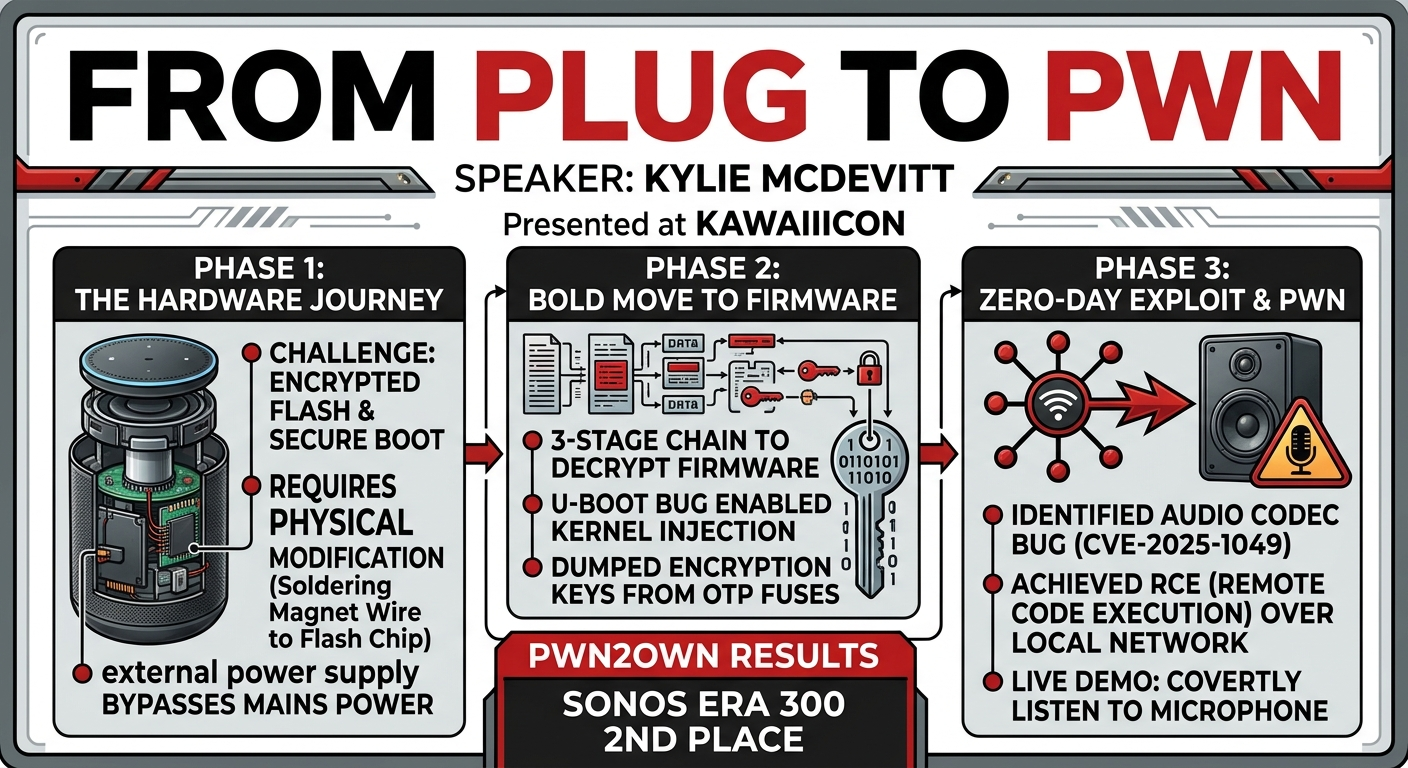
In this compelling talk, Kylie McDevitt, founder of InfoSect, takes the audience on a detailed journey through the intricate process of compromising a high-end consumer smart device: the Sonos Era 300 speaker. The presentation centers around InfoSect’s successful participation in the prestigious Pwn2Own competition, specifically the embedded devices category. McDevitt meticulously outlines the challenges and triumphs encountered in exploiting a device designed with robust security features, from the initial hurdles of firmware acquisition to the ultimate achievement of a remote code execution (RCE) zero-day.
Key moments
- 0:00 Introduction to Sonos hack and Pwn2Own competition
- 2:00 Pwn2Own competition challenges: registration, patches, draw
- 5:36 Sonos firmware acquisition: the hardest challenge
- 8:45 Hardware access: UART, flash chip soldering, power bypass
- 10:05 Three bugs used to decrypt firmware and gain root
- 11:30 The Pwn2Own zero-day: audio codec vulnerability (CVE)
- 12:15 Live demo: exploiting the Sonos smart speaker
- 13:20 Post-exploitation capabilities: microphone control, data exfiltration
From Plug to Pwn
Speakers: Kylie McDevitt, Founder, InfoSect
Conference: Kawaiicon
YouTube: https://www.youtube.com/watch?v=8gU5BOyMp_U
Overview
In this compelling talk, Kylie McDevitt, founder of InfoSect, takes the audience on a detailed journey through the intricate process of compromising a high-end consumer smart device: the Sonos Era 300 speaker. The presentation centers around InfoSect’s successful participation in the prestigious Pwn2Own competition, specifically the embedded devices category. McDevitt meticulously outlines the challenges and triumphs encountered in exploiting a device designed with robust security features, from the initial hurdles of firmware acquisition to the ultimate achievement of a remote code execution (RCE) zero-day.
The talk highlights InfoSect's deep expertise in embedded security, demonstrating their capability to pull apart complex devices, identify vulnerabilities, and craft sophisticated exploits. Their success at Pwn2Own, particularly being the second team to achieve a full exploit chain on the Sonos Era 300, underscores the critical importance of continuous security research on widely adopted consumer technologies. This research not only validates the security posture of modern smart devices but also provides invaluable insights for both manufacturers and end-users on potential attack vectors and defensive strategies.
The implications of such vulnerabilities are significant, as demonstrated by the live demo where a compromised Sonos speaker could be covertly used to listen to private conversations. This presentation serves as a potent reminder that even premium, ostensibly secure devices are not immune to determined attackers, emphasizing the need for vigilance in both product development and consumer usage.
Background
▶ Watch: Introduction to Sonos hack and Pwn2Own competition (0:00)
The journey to compromising the Sonos Era 300 began with InfoSect’s long-standing aspiration to compete in Pwn2Own, widely regarded as the premier exploit competition globally. Pwn2Own challenges researchers to find and exploit zero-day vulnerabilities in various categories of devices, nominated by vendors themselves. Success in the competition yields cash prizes, "Master of Pwn" points, and significant industry recognition. InfoSect, specializing in embedded security for over a decade, saw this as the ultimate test of their skills in firmware analysis, bug hunting, and exploit development.
The reality of competing, however, presented numerous logistical and technical hurdles. Initial registration drama highlighted a potential barrier for new competitors, requiring indirect outreach to secure a spot. More critically, the notorious patch race phenomenon meant that a week before the competition, vendors often release security updates, sometimes patching researchers' meticulously prepared exploits. InfoSect experienced this firsthand when their "really nice" exploit for the Synology TC500 camera was patched, forcing them to resort to a less reliable, brute-force method that averaged 40 minutes per attempt and ultimately failed. The draw order also proved to be a significant factor, as only the first team to exploit a device receives the full prize and points, with subsequent unique exploits receiving diminishing returns. InfoSect faced tough odds, being drawn third for the Sonos (out of four competitors) and eleventh for the Lorax IP camera (out of twelve), illustrating the high-stakes, competitive nature of the event.
The selection of the Sonos Era 300 was strategic. Despite its high cost ($600-$700) and inherent security, its firmware was notoriously difficult to acquire, leading to fewer competitors (only four submissions compared to twelve for the Lorax camera). Prior research on older Sonos devices, including work by Senactive, Blasty, NCC Group, and Orange SAI, consistently highlighted firmware extraction as the most challenging initial step. These previous write-ups detailed various clever bypasses, including secure boot bypasses, which provided a crucial starting point for InfoSect. Specifically, the NCC Group's write-up for the Sonos Era 100 served as a foundational reference, though adaptations were necessary for the newer Era 300 model. The core problem remained: without the firmware, vulnerability research is severely hampered, and the Sonos Era 300 was designed with encrypted flash, secure boot enabled, and encryption keys stored in one-time programmable (OTP) fuses, making direct firmware dumping impossible without prior compromise.
Key Findings
▶ Watch: Sonos firmware acquisition: the hardest challenge (5:36)
InfoSect's primary contribution was a sophisticated, multi-stage exploit chain that successfully bypassed the robust security measures of the Sonos Era 300, culminating in a remote code execution zero-day. This accomplishment allowed them to become the second team to successfully pwn the device at Pwn2Own, despite being drawn third.
The firmware extraction process, identified as the hardest step, involved a three-part exploit chain:
- U-Boot Misconfiguration: An initial vulnerability in the U-Boot bootloader allowed InfoSect to specify and install custom environment variables. This was achieved through in-system programming of the flash chip while the device was powered, granting control over the device's boot process.
- Kernel Header Offset Bug: Leveraging the ability to manipulate the boot sequence, InfoSect identified a bug related to the kernel header offset. This allowed them to inject a custom init file system immediately after the kernel header, which, when loaded, provided full system control and a root shell on the device. Crucially, while this provided a shell, it did not yet grant access to the encrypted firmware itself, as their own file system was being loaded.
- Secure Boot Bootloader Bug: The final and most critical step in firmware extraction involved a bug in the AMLogic bootloader, which was responsible for the device's secure boot process. Exploiting this vulnerability allowed InfoSect to achieve trusted context, enabling them to dump the encryption keys directly from the one-time programmable (OTP) fuses. A significant finding was that these keys are often persistent across firmware updates, providing a lasting foothold for decryption.
Once the firmware was successfully decrypted and analyzed, InfoSect proceeded to identify a zero-day vulnerability suitable for the Pwn2Own competition's requirement of an unauthenticated, local network exploit to gain a system shell. This led to the discovery of an audio codec bug, which was assigned CVE-2025-1049. This specific vulnerability was leveraged to groom the heap and achieve remote code execution, demonstrating the ability to take full control of the device from the local network without prior authentication.
At Pwn2Own, InfoSect's efforts translated into tangible results:
- Sonos Era 300: Successfully exploited, earning them second place.
- Synology TC500 Camera: Failed due to a pre-competition patch and an unreliable brute-force backup exploit.
- Lorax IP Camera: Successfully exploited, but a collision with another team on the same bug meant a significantly reduced payout and points, being the eleventh team to attempt it.
Technical Deep Dive
▶ Watch: Three bugs used to decrypt firmware and gain root (10:05)
The technical heart of InfoSect's success lay in their meticulous approach to firmware extraction and subsequent zero-day exploitation. The initial phase required significant physical interaction with the Sonos Era 300 hardware. The device was carefully disassembled, revealing key components. UART pins were identified and connected, allowing the researchers to observe U-Boot console logs during boot-up, providing critical insights into the device's operational sequence, though without interactive control.
The most delicate physical task involved in-system programming of the flash chip. InfoSect's embedded specialist, Cody, meticulously soldered incredibly fine magnetic wires onto the flash chip, a process that reportedly took up to five attempts to achieve stable connections. This setup enabled direct, low-level interaction with the flash memory while the device was running. A crucial safety measure was to bypass the device's standard mains power supply, instead powering it from an external low-voltage power source. This mitigated the significant electrical hazards associated with mains power, which had previously caused a researcher, Ramy, to sustain a blister from touching a fully charged capacitor.
With physical access established, InfoSect executed their multi-stage firmware extraction exploit:
- U-Boot Misconfiguration: The first step exploited a misconfiguration within the U-Boot bootloader. By manipulating the flash chip via in-system programming, InfoSect was able to inject and modify custom environment variables. This allowed them to alter the boot sequence, effectively gaining control over how the device initialized its operating system. This is a common target in embedded security, as U-Boot often presents an early attack surface.
- Kernel Header Offset Bug: Building on U-Boot control, a specific vulnerability related to the kernel header offset was leveraged. This bug allowed InfoSect to strategically place a custom init file system immediately after the legitimate kernel header. When the modified boot process initiated, it loaded this custom file system, granting the researchers a root shell on the device. However, this shell was within their injected environment, meaning they still couldn't access the original, encrypted Sonos firmware.
- Secure Boot Bootloader Bug (AMLogic): The final and most complex stage for firmware acquisition involved a vulnerability in the AMLogic bootloader, which managed the device's secure boot process. By exploiting this bug, InfoSect elevated their privileges to trusted context. This critical step enabled them to bypass the secure boot protections and directly access the hardware where the encryption keys were stored – the one-time programmable (OTP) fuses. Dumping these keys was the ultimate prize, as they allowed for the full decryption of the Sonos firmware. A key insight was that these keys are generally static and do not change with firmware updates, providing a persistent method for future analysis.
With the firmware decrypted, InfoSect could finally perform comprehensive vulnerability research. Their goal for Pwn2Own was an unauthenticated remote code execution on the local network. This led to the discovery of an audio codec bug, which was assigned CVE-2025-1049. This bug allowed them to manipulate the heap structure, a technique known as "heap grooming," to achieve arbitrary code execution. The exploit was designed to be triggered over the local network (either Wi-Fi or Ethernet), requiring no prior authentication. The choice of an audio codec bug is particularly ironic given the device's primary function. The successful execution of this exploit resulted in gaining a system shell, running under the context of the Anacappa binary, which is the main application binary on the Sonos speaker.
Demo / Proof of Concept
▶ Watch: The Pwn2Own zero-day: audio codec vulnerability (CVE) (11:30)
Kylie McDevitt performed a live demonstration of the exploit, showcasing the full impact of their research on the Sonos Era 300. The setup involved the physical speaker connected via Ethernet to her laptop, emphasizing the unauthenticated, local network nature of the attack.
The demonstration began with McDevitt confirming she had no prior access or credentials to the device, only network connectivity. Upon executing the exploit script, the audience immediately heard a distinct sound emanating from the Sonos speaker. This sound was not an arbitrary effect but a crucial part of the attack: it represented the heap grooming process, where specific audio data was fed to the vulnerable audio codec to manipulate the device's memory layout, preparing it for the final payload. This audible feedback served as a clear indicator that the exploit was actively running and interacting with the device's core functions.
After a tense moment of anticipation, the exploit successfully delivered a root shell on the Sonos speaker. McDevitt displayed the shell prompt, confirming that the attacker was operating with high privileges, running as the Anacappa user—the context of the device's main application binary. To further illustrate the severity of this compromise, she highlighted the potential for malicious activities:
- Covert Surveillance: The Sonos Era 300 features a built-in microphone for voice control. With root access, an attacker could surreptitiously activate this microphone, listening to conversations within a home or office without the user's knowledge.
- Malware Installation: The shell allows for the installation of arbitrary malware, transforming the smart speaker into a persistent backdoor or part of a botnet.
- Data Exfiltration: Compromised audio data or other sensitive information could be covertly sent to an attacker-controlled server.
To conclude the demonstration on a lighter note, after exiting the root shell, McDevitt played a snippet of Rick Astley's "Never Gonna Give You Up" through the now-controlled speaker, a humorous nod to the unexpected control achieved over the device. This live demonstration powerfully underscored the real-world implications of such vulnerabilities in widely deployed smart home devices.
Defensive Implications
▶ Watch: Post-exploitation capabilities: microphone control, data exfiltration (13:20)
The findings from InfoSect's research on the Sonos Era 300 offer crucial insights for both device manufacturers and end-users, highlighting areas where defensive strategies must be strengthened.
For Sonos (the vendor), the immediate implication is the need to patch CVE-2025-1049, the audio codec bug, to prevent unauthenticated remote code execution. Beyond this specific vulnerability, the exploit chain reveals several deeper architectural weaknesses that warrant review:
- U-Boot Configuration: The misconfiguration allowing custom environment variables through in-system programming points to a need for more robust integrity checks and lockdown mechanisms within the U-Boot bootloader, especially concerning writable flash regions.
- Kernel Header Handling: The kernel header offset bug indicates a potential flaw in how the bootloader validates or parses kernel images, suggesting a need for stricter validation of kernel metadata and loaded image integrity.
- Secure Boot Implementation: While secure boot was enabled, the vulnerability in the AMLogic bootloader that allowed dumping keys from OTP fuses represents a critical bypass. Manufacturers must ensure their secure boot implementations are truly tamper-proof, extending protection to the hardware-level storage of cryptographic keys. Regular, independent security audits of bootloader code are essential.
- Physical Tamper Resistance: The success of physical attacks necessitates an evaluation of physical security measures, including anti-tampering features for flash chips and other critical components.
For device owners and network defenders, the implications are equally significant:
- Network Segmentation: Smart speakers and other IoT devices should ideally be isolated on a separate VLAN (Virtual Local Area Network). This prevents a compromised IoT device from being used as a pivot point to attack more sensitive systems on the main network.
- Physical Security: While remote exploits are concerning, the initial firmware extraction often requires physical access. Users should be mindful of who has physical access to their smart devices, especially in shared or public environments.
- Prompt Updates: While InfoSect's exploit targeted an unpatched zero-day, keeping all smart devices updated with the latest firmware is a fundamental defense against known vulnerabilities.
- Privacy Awareness: The ability to covertly activate a microphone on a device like the Sonos Era 300 underscores the privacy risks associated with smart speakers. Users should be aware of the capabilities of their devices and consider their placement in sensitive areas. If a device has a microphone, understand its privacy settings and physical mute options.
- Assume Compromise: Given the persistent nature of encryption keys once dumped, it's prudent to assume that highly sought-after devices like the Sonos Era 300 could remain targets even after initial patches, as the fundamental key acquisition method might remain viable across updates.
Ultimately, this research serves as a stark reminder that even high-end, seemingly secure embedded devices require continuous scrutiny. A multi-layered defense strategy, combining robust hardware security, secure software development practices, and informed user vigilance, is paramount in mitigating the risks posed by sophisticated attackers.
Key Takeaways
- Firmware Extraction is Key: Acquiring and decrypting firmware is often the most challenging and critical initial step in exploiting secure embedded devices, as demonstrated by Sonos's use of encrypted flash, secure boot, and OTP fuses.
- Multi-Stage Exploits are Common: Compromising highly secure devices frequently requires a chain of multiple distinct vulnerabilities, progressing from physical access to U-Boot manipulation, kernel control, secure boot bypass, and finally, a zero-day for remote code execution.
- Pwn2Own Challenges Extend Beyond Technical Skill: Competition dynamics like patch races, registration difficulties, and draw order significantly impact success, requiring strategic planning and resilience alongside technical prowess.
- Even "Secure" Devices Have Vulnerabilities: High-end, expensive devices like the Sonos Era 300, despite robust security features, are not impenetrable and can harbor zero-day vulnerabilities exploitable by determined researchers.
- Smart Speakers Pose Significant Privacy Risks: A compromised smart speaker can be weaponized for covert surveillance, allowing attackers to remotely activate microphones and listen to private conversations without detection.
- Encryption Key Persistence: Once obtained, hardware-derived encryption keys (e.g., from OTP fuses) may remain valid across multiple firmware updates, providing a lasting foothold for attackers.
About the Speaker(s)
Kylie McDevitt is the Founder of InfoSect, a company that specializes in embedded security. With over 12 to 13 years of experience, InfoSect focuses on the intricate world of hardware and firmware, dedicating their expertise to pulling apart devices, analyzing firmware, discovering vulnerabilities, and writing sophisticated exploits. Their work is driven by a passion for understanding the security posture of embedded systems and a long-standing ambition to compete in prestigious exploit competitions like Pwn2Own, which they successfully achieved. The team at InfoSect includes embedded specialists like "Cody," who meticulously handled delicate physical tasks such as soldering magnetic wires onto flash chips, and researchers like "Ramy," contributing to the overall research effort.
Reviews
Dr. Zero (Offensive Security Researcher) — STRONG ACCEPT
This is a proper Pwn2Own war story with real technical meat: a three-stage exploit chain from physical flash programming through secure boot bypass to a heap-groom RCE. McDevitt shows the actual work — the soldering, the bootloader bugs, the OTP key dump — not just the final shell pop. Loses a star because the RCE itself (CVE-2025-1049) gets hand-waved as 'audio codec bug' without the vuln class or exploitation details that would make this a 5.
Heather Calloway (CISO) — STRONG ACCEPT
This is required reading for anyone managing IoT risk in enterprise or executive environments. A full exploit chain against a premium consumer device with a microphone—firmware extraction through secure boot bypass to unauthenticated RCE—demonstrates that price point and vendor reputation are not proxies for security. The covert surveillance angle is the board-level concern.