Sponsored Keynote: Evolving the Kubernetes User Experience - Andrew Randall
Andrew Randall
KubeCon + CloudNativeCon Europe 2025 · Sponsored Keynote
Overview
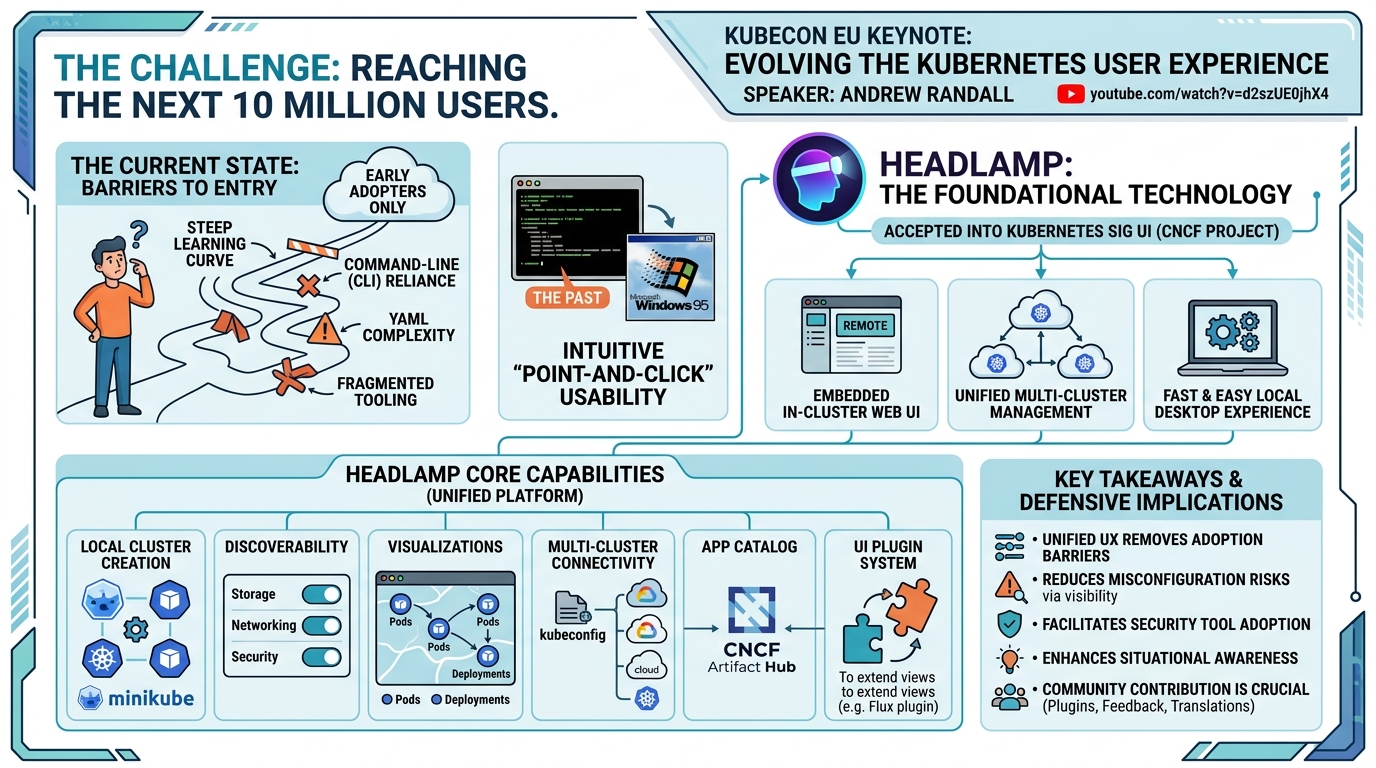
In this thought-provoking keynote, Andrew Randall addresses a critical challenge facing the Kubernetes ecosystem: how to broaden its appeal beyond early adopters and reach the "next 10 million cloud-native users." While celebrating the remarkable growth from a few hundred enthusiasts at the first KubeCon London to nearly 10 million developers today, Randall emphasizes that future growth hinges on significantly improving the user experience. He argues that the current state of Kubernetes, characterized by a steep learning curve and fragmented tooling, is a barrier to mass adoption.
Key moments
- 0:00 Challenges onboarding next 10 million Kubernetes users
- 2:15 The vision for a modern Kubernetes user experience
- 2:50 Three key components for improved Kubernetes UX
- 3:30 Headlamp project accepted into Kubernetes SIG UI
- 4:00 Demonstrating easy local cluster creation and management
- 4:45 Managing add-ons and extending UI with plugins
- 5:45 Call to action: contribute to Headlamp's future
Sponsored Keynote: Evolving the Kubernetes User Experience
Speakers: Andrew Randall
Conference: KubeCon EU
YouTube: https://www.youtube.com/watch?v=d2szUE0jhX4
Overview
In this thought-provoking keynote, Andrew Randall addresses a critical challenge facing the Kubernetes ecosystem: how to broaden its appeal beyond early adopters and reach the "next 10 million cloud-native users." While celebrating the remarkable growth from a few hundred enthusiasts at the first KubeCon London to nearly 10 million developers today, Randall emphasizes that future growth hinges on significantly improving the user experience. He argues that the current state of Kubernetes, characterized by a steep learning curve and fragmented tooling, is a barrier to mass adoption.
The talk proposes a unified vision for a modern Kubernetes user experience, drawing parallels to how Windows 95 catalyzed PC and internet adoption through intuitive design. Randall posits that a cohesive, easy-to-use interface, combining a next-generation dashboard, multi-cluster management, and a local desktop experience, is essential for onboarding new users, including students, Windows server admins, and "normal folks" who expect technology to "just work." He introduces the Headlamp project as the foundational technology to realize this vision, highlighting its recent acceptance into the Kubernetes project under SIG UI.
This keynote is highly significant for the Kubernetes community as it directly confronts the complexity often cited as a major hurdle for new users and organizations. By advocating for a streamlined, intuitive, and integrated user interface, Randall aims to unlock a new era of adoption, making the power of cloud-native development accessible to a far wider audience. The emphasis on community collaboration for developing plugins and providing feedback underscores the collective effort required to transform the Kubernetes user journey from daunting to delightful.
Background
▶ Watch: Challenges onboarding next 10 million Kubernetes users (0:00)
The journey of Kubernetes, from its nascent stages to becoming the ubiquitous orchestrator of cloud-native applications, has been nothing short of remarkable. However, as Andrew Randall highlighted, this success has primarily been driven by "early adopters" – a community of technically proficient individuals comfortable with command-line interfaces, intricate configurations, and a diverse ecosystem of specialized tools. While this flourishing ecosystem is a strength, it has also inadvertently created a significant barrier to entry for a broader audience.
Randall points out the fundamental issue: there isn't a single, simple "Kubernetes app" to install. Unlike traditional software, new users cannot simply apt get or brew install Kubernetes. Instead, they are immediately confronted with a complex landscape. The typical user journey begins with a command-line interface (CLI), quickly diving into the depths of YAML configuration files. For novices, witnessing experts fluidly type commands like kubectl get po (or kget getpo as he playfully abbreviates) can be intimidating, creating a perception of exclusivity and high technical overhead.
Beyond the initial setup, the complexity compounds with the hundreds of add-on projects for crucial functionalities like storage, networking, and security. Each of these components often comes with its own installation process, configuration paradigms, and user experience, leading to a fragmented and inconsistent developer workflow. This constant context switching between different tools and interfaces not only impacts developer productivity but also results in a "confusing and sometimes daunting user experience."
To illustrate the potential for mass adoption through simplified user interfaces, Randall draws a compelling analogy to Windows 95. Thirty years ago, Windows 95 was not just an operating system; it was a catalyst for the widespread adoption of personal computers and the internet. Its success stemmed from prioritizing "point-and-click usability" and an "everything working out of the box" philosophy over the command-line interfaces and handcrafted configuration files prevalent in earlier computing eras. This historical precedent serves as a powerful argument for why Kubernetes, if it aims to onboard the "next 10 million users," must evolve its user experience to be equally intuitive and accessible. The problem, therefore, is not a lack of capability within Kubernetes, but a deficit in its out-of-the-box usability and discoverability for the uninitiated.
Key Findings
▶ Watch: Three key components for improved Kubernetes UX (2:50)
Andrew Randall's keynote outlines a clear vision and identifies a foundational technology to address the current Kubernetes user experience challenges. His key findings and proposed solutions revolve around three core tenets for a future-proof, accessible Kubernetes UX:
- An Embedded In-Cluster Web UI: Building on the role of existing dashboards, Randall emphasizes the continued need for a web-based interface that runs within the cluster, providing a visual overview and management capabilities. This allows for remote access and a centralized point of interaction.
- A Unified Multi-Cluster Management Application: As organizations increasingly deploy workloads across multiple clusters, often spanning different cloud providers or on-premises environments, the need for a single, cohesive tool to manage these distributed deployments becomes paramount. This application would abstract away the complexities of interacting with disparate clusters.
- A Fast and Easy-to-Use Desktop Experience for Beginners: To lower the barrier to entry for new learners and developers, Randall advocates for an out-of-the-box desktop application that allows users to quickly get started with and learn Kubernetes locally on their machines. This provides an immediate, low-friction environment for experimentation and development.
The most significant "finding" presented by Randall is the realization that these three components – the next-gen dashboard, the multi-cluster management app, and the Kubernetes desktop experience – should not be disparate applications, but rather one unified platform. This integration promises to eliminate context switching and provide a seamless user journey from local development to multi-cloud deployment.
Crucially, Randall identifies the Headlamp project as the foundational technology already within the CNCF ecosystem that possesses the core capabilities required to build this unified user experience. He announced the significant milestone that Headlamp has been accepted into the Kubernetes project under SIG UI, with its GitHub repository move completed just the day before the talk. This acceptance signifies the community's recognition of Headlamp's potential and its alignment with the project's future direction. Headlamp, therefore, is presented not just as a tool, but as the community-driven platform to deliver an "incredible Kubernetes web and desktop experience" and unlock the next level of cloud-native adoption.
Technical Deep Dive
▶ Watch: Headlamp project accepted into Kubernetes SIG UI (3:30)
The technical core of Andrew Randall's vision for an evolved Kubernetes user experience lies squarely with the Headlamp project. As the designated foundational technology, Headlamp is designed to serve as the single, unified application that encompasses the in-cluster web UI, multi-cluster management, and local desktop experience. Its architecture and features are geared towards simplifying complex Kubernetes operations and improving discoverability.
Headlamp's capabilities, as demonstrated and described, are comprehensive:
- Local Cluster Creation and Management: For beginners and local development, Headlamp provides a streamlined process to create a Kubernetes cluster directly on a user's laptop. The demonstration showed this being done using minikube, a popular tool for running single-node Kubernetes clusters locally. Once created, Headlamp offers a clear overview of the cluster's status and its running workloads, such as pods and deployments. Users can easily navigate, inspect, and even edit the details of these resources directly within the UI, eliminating the need for extensive CLI commands or manual YAML manipulation.
- Discoverability of Core Settings: A key aspect of Headlamp's design is its emphasis on discoverability. The UI organizes critical cluster settings for "storage, networking, security, and more" in a clearly accessible manner, typically presented as a side navigation pane. This structured presentation helps users quickly find and understand configuration options that might otherwise be buried in documentation or require specialized CLI knowledge.
- Multi-Cluster Connectivity via kubeconfig: For managing existing and distributed Kubernetes environments, Headlamp supports importing kubeconfig files. This standard Kubernetes configuration mechanism allows users to connect to multiple clusters, potentially spanning different cloud providers (as demonstrated with an Azure cluster) or on-premises infrastructure. Once connected, Headlamp provides a unified interface to view and manage resources across these diverse environments.
- Visualizations and Object Relationships: To enhance understanding of complex cluster states, Headlamp offers intuitive visualizations. The talk specifically highlighted a "map view" which graphically depicts the relationships between key Kubernetes objects at a glance. This visual representation can significantly aid in debugging, understanding dependencies, and gaining a holistic view of the application landscape, allowing users to "click in to see all the details."
- Integrated App Catalog and Plugin System: Headlamp integrates directly with the CNCF Artifact Hub, a community repository for cloud-native artifacts. This integration allows Headlamp to present an "app catalog" of available solutions and add-on components, enabling users to install tools like a "manager" with "just a click." Beyond pre-packaged applications, Headlamp also leverages Artifact Hub for publishing and installing UI plugins. These plugins allow for extensive customization, adding new top-level items or modifying existing UI elements to provide specialized views or functionalities. The demonstration of a Flux plugin showcased how an entirely new, Flux-specific view could be immediately added to the Headlamp interface, illustrating the extensibility and adaptability of the platform.
In essence, Headlamp functions as a sophisticated abstraction layer, providing a graphical, intuitive, and extensible interface over the raw Kubernetes API. By leveraging existing community standards like kubeconfig and integrating with crucial ecosystem components like Artifact Hub, it aims to provide a consistent and powerful user experience that scales from a single local cluster to complex multi-cloud deployments, all while reducing the reliance on command-line expertise and intricate YAML knowledge.
Demo / Proof of Concept
▶ Watch: Managing add-ons and extending UI with plugins (4:45)
The keynote included a compelling demonstration of the envisioned Kubernetes user experience, showcasing Headlamp's capabilities as a unified desktop application. The demonstration highlighted several key functionalities, illustrating how new users could get started quickly and how experienced users could manage complex, multi-cluster environments with greater ease.
The demo began with the installation of the new Kubernetes desktop app (Headlamp). The first action was to create a local Kubernetes cluster directly on the laptop. The user simply gave the cluster a name, and Headlamp orchestrated its creation using minikube. Upon successful creation, the interface immediately presented a "nice overview of the cluster," allowing the user to quickly see running workloads, such as pods and deployments. The demonstration showed the ability to "dig into and even edit those details" directly within the graphical interface, emphasizing the reduction in reliance on manual YAML editing or complex CLI commands. A crucial aspect highlighted was the organized display of "settings for storage, networking, security, and more" down the side, emphasizing easy access and, critically, discoverability.
Next, the demo transitioned to managing existing clusters. The user imported a kubeconfig file that pointed to three distinct clusters located in different cloud environments. The demonstration specifically focused on one cluster hosted in Azure. Headlamp then presented a "really nice visualization" through its "map view," which showed the relationships between key Kubernetes objects at a glance. This visual representation allows users to intuitively understand the architecture and dependencies within their cluster, with the ability to "click in to see all the details" of any object.
A significant part of the demonstration involved the App Catalog. This catalog was shown to be integrated with the CNCF Artifact Hub, providing a direct link to a vast repository of community-maintained solutions. The user was able to browse available add-ons and, with "just a click," install a component like a "manager," which was then shown to be "installed and running." This showcased the simplified process for extending cluster functionality without manual installation steps.
Finally, the demo illustrated Headlamp's extensibility through UI plugins. The user demonstrated installing a Flux plugin, also sourced from Artifact Hub. Immediately after installation, a "Flux specific view" appeared as an "extra top-level item" in the UI. This demonstrated how Headlamp allows for deep customization, enabling vendors and the community to extend the interface with specialized tools and views, tailoring the user experience to specific workflows or cloud-native projects.
Overall, the demonstration effectively served as a proof of concept for Randall's vision, illustrating how Headlamp could provide a cohesive, intuitive, and extensible user interface for Kubernetes, from local development to multi-cloud management, significantly lowering the barrier to entry and improving developer productivity.
Defensive Implications
▶ Watch: Call to action: contribute to Headlamp's future (5:45)
Andrew Randall's keynote primarily focuses on improving the Kubernetes user experience and driving mass adoption, rather than directly addressing security vulnerabilities or defensive strategies. Therefore, the talk does not delve into specific CVEs, attack vectors, or security tools in detail. However, an improved user experience, as championed by Headlamp, can have several indirect but significant positive defensive implications for Kubernetes environments.
Firstly, enhanced discoverability of security settings is a crucial benefit. The demo explicitly showed "settings for storage, networking, security, and more" being "nicely organized for easy access and crucially discoverability." In complex Kubernetes environments, critical security configurations – such as network policies, role-based access control (RBAC) settings, secret management, and admission controllers – can often be obscure or require deep CLI expertise to manage. A well-designed graphical interface like Headlamp can make these settings more visible and easier to configure correctly, thereby reducing the likelihood of misconfigurations, which are a common source of security vulnerabilities.
Secondly, a more intuitive user interface can help reduce human error during deployment and management. When users, especially beginners, are less intimidated by the complexity of Kubernetes and are guided through configuration processes, they are less likely to make mistakes that could inadvertently expose services, grant excessive permissions, or leave sensitive data unprotected. By abstracting some of the low-level YAML complexities, Headlamp can promote the adoption of best practices by making them the default or easiest path.
Thirdly, the integration with the CNCF Artifact Hub for an "App Catalog" can facilitate the secure deployment of security-related add-ons. If security tools, such as admission controllers, vulnerability scanners, or compliance checkers, are easily discoverable and installable with "just a click" from a trusted community repository, organizations are more likely to adopt and maintain these crucial defensive components. This lowers the friction for implementing a stronger security posture.
Finally, the "map view" and other visualizations offered by Headlamp can provide better situational awareness for operations and security teams. Understanding the relationships between different Kubernetes objects, identifying running workloads, and visualizing network configurations can aid in detecting anomalous behavior, investigating security incidents, and ensuring that security policies are being correctly applied across the cluster. While not a security tool itself, improved visibility can be a powerful aid in defensive operations.
In summary, while Headlamp is not a security product, its mission to simplify the Kubernetes user experience can indirectly contribute to a stronger defensive posture by making security configurations more accessible, reducing misconfiguration risks, facilitating the adoption of security tools, and enhancing operational visibility.
Key Takeaways
- Current Kubernetes UX is a Barrier to Mass Adoption: The existing user experience, characterized by a steep learning curve, command-line reliance, YAML complexity, and fragmented tooling, hinders Kubernetes from reaching the "next 10 million cloud-native users."
- A Unified UX is Essential for Future Growth: To unlock mass adoption, Kubernetes needs a "beautiful, easy to use, modern UX" that integrates an in-cluster web UI, multi-cluster management, and a local desktop experience into a single, cohesive application, akin to how Windows 95 revolutionized PC usage.
- Headlamp is the Foundational Technology: The Headlamp project, already part of the CNCF, has been identified as the core platform to build this unified Kubernetes user experience and has recently been accepted into the Kubernetes project under SIG UI.
- Headlamp Simplifies Core Kubernetes Operations: It provides capabilities for creating local clusters (e.g., with minikube), managing workloads, connecting to existing multi-cloud clusters via kubeconfig, offering intuitive visualizations like a "map view," and making critical settings (storage, networking, security) easily discoverable.
- Extensibility through Artifact Hub Integration: Headlamp integrates with the CNCF Artifact Hub for an "app catalog" to easily install add-ons and supports a robust UI plugin system, allowing for deep customization and the addition of specialized views (e.g., a Flux plugin) to cater to diverse user needs and tools.
- Community Contribution is Crucial: Realizing the full vision for Headlamp and the future Kubernetes UX requires broad community engagement, including developing plugins for cloud-native tools, adding language translations, and providing continuous feedback.
About the Speaker(s)
Andrew Randall is a prominent figure in the cloud-native community, having been present at the very first KubeCon in London. His long-standing involvement and perspective on the evolution of Kubernetes position him as a thoughtful advocate for its future direction. As a keynote speaker at KubeCon EU, Randall shared his insights and vision for making Kubernetes more accessible and user-friendly to a global audience, emphasizing the importance of a streamlined user experience for the platform's continued growth and broader adoption.
Reviews
Dr. Zero (Offensive Security Researcher) — STRONG ACCEPT
This keynote from Andrew Randall effectively articulates the critical need to simplify the Kubernetes user experience for broader mass adoption, moving beyond its early technical adopters. He proposes a unified vision for a modern UX, centered around the Headlamp project, which he announced has been accepted into Kubernetes SIG UI. The talk delivers a clear strategic direction, backed by a compelling demonstration of Headlamp's capabilities, showcasing how it can streamline operations from local development to multi-cloud management. While the core problem of K8s complexity isn't new, the concrete solution, its community integration, and the actionable insights presented are highly…
Heather Calloway (CISO) — STRONG ACCEPT
Andrew Randall's keynote on evolving the Kubernetes user experience, while not a security talk, addresses a critical friction point that has significant indirect implications for security and governance. By advocating for a unified, intuitive interface like Headlamp, the talk identifies a path to reduce misconfigurations, improve the discoverability of essential security settings, and lower the barrier to adopting security-enhancing add-ons. It's a well-structured argument for institutional realism, acknowledging that complexity is a significant barrier to both adoption and secure operation.