Enabling Unstructured Sparse Acceleration on Structured Sparse Accelerators
Geonhwa Jeong, Po-An Tsai, Abhimanyu Rajeshkumar Bambhaniya, Stephen W. Keckler, Tushar Krishna
Conference on Machine Learning and Systems 2025 · Day 2 · Session 3: Quantization and Sparsity
Overview
This article delves into the innovative work presented at MLSys 2025 by Geonhwa Jeong and collaborators, focusing on a novel method called Testy (Tensor Approximation via Structured Decomposition). The talk addresses a critical challenge in modern AI: efficiently executing unstructured sparse Deep Neural Networks (DNNs) on structured sparse hardware accelerators. As DNN models continue to grow in size and complexity, sparsity has emerged as a crucial technique for model compression and accelerating inference. However, a significant gap exists between the often unstructured sparsity patterns found in highly optimized DNNs and the fixed, structured sparsity patterns that hardware accelerators typically support for efficiency. This research introduces a systematic approach to bridge this divide, enabling model developers to maintain high accuracy with unstructured sparsity while allowing hardware to leverage its cost-effective structured sparsity support. The implications are profound, promising substantial performance and energy efficiency gains for deploying large-scale sparse DNNs without the need for repetitive, model-specific hardware re-pruning and fine-tuning.
Key moments
- 0:00 Introduction and the challenge of sparse acceleration.
- 0:50 The tension between DNN model and hardware sparsity.
- 1:30 Introducing Testy: Tensor approximation via structured decomposition.
- 2:00 Testy example: First 2:4 structured decomposition step.
- 2:30 Sequential Testy: Multiple 2:4 steps and performance impact.
- 3:00 Optimizing Testy with different ratios (e.g., 1:4) for efficiency.
- 3:20 Achieving full non-zero coverage with 2:4 + 2:8 Testy.
- 3:45 Testy's effectiveness based on original matrix density.
Enabling Unstructured Sparse Acceleration on Structured Sparse Accelerators
Speakers: Geonhwa Jeong, Research Scientist, Meta; Po-An Tsai; Abhimanyu Rajeshkumar Bambhaniya; Stephen W. Keckler; Tushar Krishna
Conference: MLSys 2025
YouTube: https://www.youtube.com/watch?v=None
Overview
This article delves into the innovative work presented at MLSys 2025 by Geonhwa Jeong and collaborators, focusing on a novel method called Testy (Tensor Approximation via Structured Decomposition). The talk addresses a critical challenge in modern AI: efficiently executing unstructured sparse Deep Neural Networks (DNNs) on structured sparse hardware accelerators. As DNN models continue to grow in size and complexity, sparsity has emerged as a crucial technique for model compression and accelerating inference. However, a significant gap exists between the often unstructured sparsity patterns found in highly optimized DNNs and the fixed, structured sparsity patterns that hardware accelerators typically support for efficiency. This research introduces a systematic approach to bridge this divide, enabling model developers to maintain high accuracy with unstructured sparsity while allowing hardware to leverage its cost-effective structured sparsity support. The implications are profound, promising substantial performance and energy efficiency gains for deploying large-scale sparse DNNs without the need for repetitive, model-specific hardware re-pruning and fine-tuning.
The core of the problem lies in the inherent tension between DNN model developers, who prioritize maximal accuracy and density reduction through unstructured sparsity, and hardware designers, who opt for structured sparsity due to its lower implementation cost and higher regularity. Testy offers a solution by providing an unstructured sparse abstraction that can be mapped onto structured sparse hardware. By decomposing unstructured sparse tensors into a series of structured sparse components, this method allows for the efficient utilization of existing accelerators like Nvidia's sparse tensor cores or flexible N:M sparse hardware like Vegeta. The talk highlights how this approach not only simplifies the deployment of sparse models but also unlocks significant energy-delay product (EDP) reductions and speedups, demonstrating a practical path forward for the widespread adoption of sparse computing in AI systems.
Background
▶ Watch: Introduction and the challenge of sparse acceleration. (0:00)
The rapid advancement of Deep Neural Networks (DNNs) has led to models that are increasingly wider and deeper, characterized by an astronomical number of parameters. This growth trajectory, while enabling unprecedented capabilities, comes with substantial computational and memory demands. To mitigate these resource requirements, various model compression techniques have been explored, with quantization and sparsity being among the most prominent. While quantization reduces the precision of model parameters, sparsity focuses on eliminating redundant computations by identifying and zeroing out less important weights or activations.
The hardware landscape for accelerating DNN computations has evolved to support these compression techniques, but not without its own set of trade-offs.
- Dense accelerators, such as Google TPUs, are highly optimized for dense matrix multiplications. They excel at workloads with high data regularity, offering low overhead. However, their fundamental design means they cannot intrinsically leverage the zeros present in sparse matrices, leading to wasted computations when processing sparse data.
- Unstructured sparse accelerators represent the ideal from a model compression perspective. They are designed to exploit any zero within a matrix, offering the highest potential speedup by skipping all redundant computations. This allows for targeting lower regularity data. However, the hardware overhead associated with managing and processing arbitrary sparse patterns – including complex indexing, irregular memory access, and increased control logic – is significantly higher, making them more expensive to design and implement.
- In response to the cost and complexity of unstructured sparsity, the industry has largely converged on structured sparsity. This approach strikes a compromise, offering a balance between hardware efficiency and computational savings. Examples include 2:4 sparsity, prominently featured in Nvidia Ampere GPUs' sparse tensor cores, where for every four elements, at least two must be zero. More flexible variants, like flexible N:M sparsity (e.g., supported by architectures like Vegeta), allow for varying degrees of sparsity within a block. While structured sparsity significantly reduces hardware overhead compared to unstructured approaches, it introduces a new challenge: existing unstructured sparse DNN models must be adapted to these specific structured patterns.
This adaptation typically involves a burdensome process of pruning and fine-tuning the model. If a model developer has an unstructured sparse model, deploying it on an Nvidia Ampere GPU with 2:4 sparsity support would necessitate re-pruning the model to conform to the 2:4 pattern and then fine-tuning it to recover any lost accuracy. The same applies if deploying on a flexible N:M sparse hardware or even a fixed 1:4 sparse hardware. This repetitive cycle of pruning and fine-tuning for each specific hardware target creates a significant bottleneck and a fundamental tension:
- DNN model developers strive for the highest possible model accuracy with the lowest possible density, naturally gravitating towards unstructured sparsity for its maximal flexibility in zeroing out parameters.
- Hardware developers aim for cost-effective and efficient accelerators, finding structured sparsity much cheaper to implement due to its predictable data access patterns and simpler control logic.
The motivation behind this work is to mitigate this gap. The goal is to provide an unstructured sparse abstraction that allows DNN model developers to continue using unstructured sparsity for optimal model accuracy and compression, while simultaneously enabling these models to run efficiently on existing and future structured sparse accelerators. This is achieved through a novel structured sparse decomposition technique, which forms the foundation of the proposed method.
Key Findings
▶ Watch: Introducing Testy: Tensor approximation via structured decomposition. (1:30)
The talk introduces Testy (Tensor Approximation via Structured Decomposition) as a groundbreaking method designed to bridge the chasm between the flexibility of unstructured sparse DNNs and the efficiency of structured sparse hardware. The core finding is that any sparse tensor, regardless of its original unstructured pattern, can be effectively approximated as a series of structured sparse tensors. This decomposition allows unstructured sparse models to be executed on structured sparse accelerators, unlocking their inherent performance benefits without demanding a re-engineering of the model's sparsity pattern.
A critical contribution is the demonstration of how Testy can be systematically applied to accelerate DNNs. Recognizing that a one-size-fits-all Testy configuration is insufficient given the fluctuating sparsity patterns across different layers of a DNN, the researchers developed Tester. This accompanying framework is a sophisticated, systematic approach that employs heuristics to identify the optimal Testy configuration for each specific tensor or layer within a DNN. Tester's primary objective is to maximize computational improvement while rigorously preserving the quality and accuracy of the model, thereby offering an automated solution to the complex trade-offs involved in sparse computation.
The empirical evaluation of Testy on real-world DNNs yielded highly promising results, underscoring its practical viability and significant performance potential:
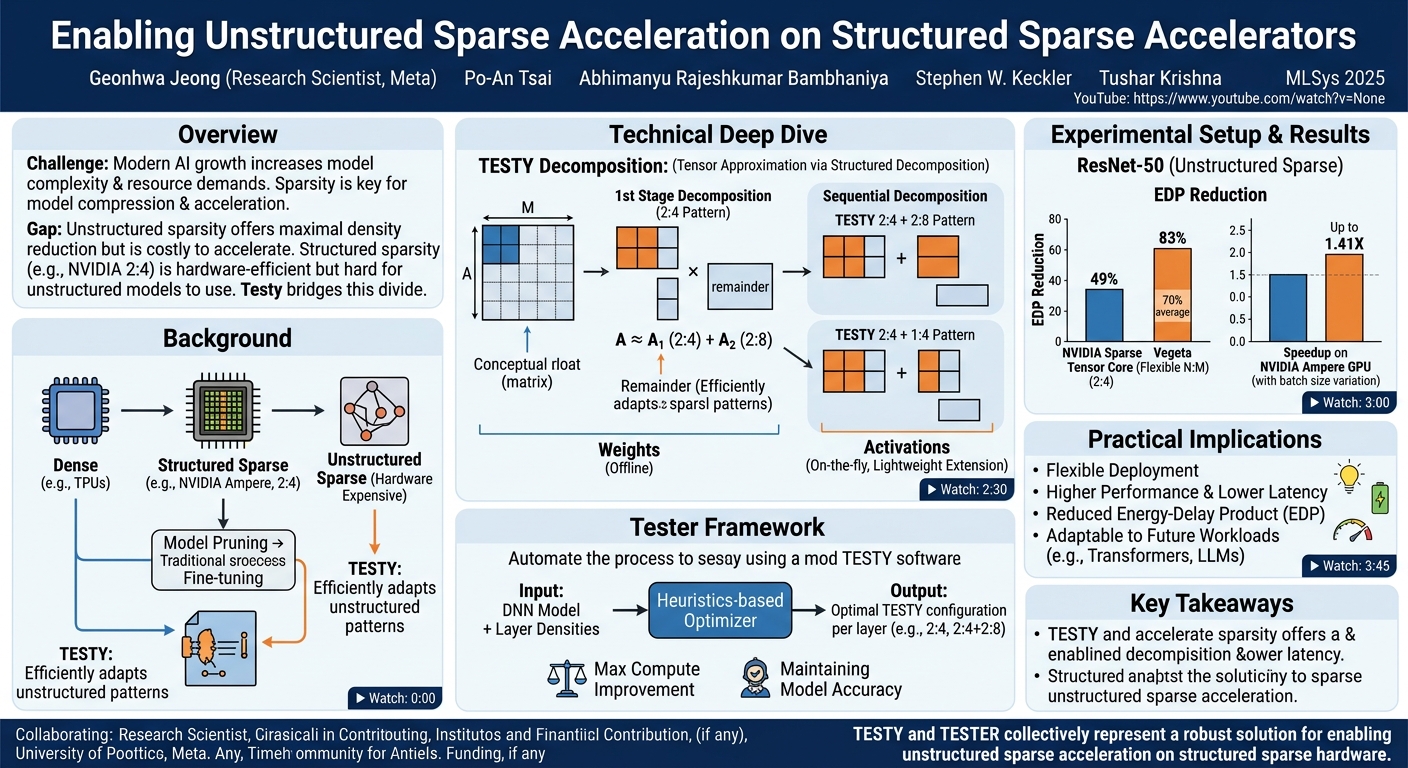
- For hardware supporting Nvidia sparse tensor cores (specifically with 2:4 sparsity), Testy achieved a remarkable 49% reduction in Energy Delay Product (EDP). EDP is a crucial metric that combines energy consumption and execution time, reflecting overall efficiency.
- When applied to hardware with flexible N:M sparsity support, such as Vegeta, Testy demonstrated an even more impressive 83% EDP reduction, highlighting its adaptability and effectiveness across different structured sparsity paradigms.
- Beyond efficiency metrics, direct performance measurements on an existing Nvidia Ampere GPU (which features 2:4 sparse tensor cores) showed a tangible speedup of up to 1.41X. This speedup varied depending on factors like batch size, but consistently demonstrated the ability of Testy to leverage current hardware capabilities for unstructured sparse workloads.
Furthermore, the research proposes a "simple architecture extension and data flow" that can be integrated into existing structured accelerators. This extension is designed to efficiently support the sequential application of Testy series, particularly for activations, which must be processed on-the-fly. This finding suggests that Testy is not only a software-level optimization but also has a lightweight hardware component that can further enhance its efficiency without significant architectural overhauls. Overall, Testy and Tester collectively represent a robust solution for enabling unstructured sparse acceleration on structured sparse hardware, offering a practical pathway to more efficient and powerful AI systems.
Technical Deep Dive
▶ Watch: Sequential Testy: Multiple 2:4 steps and performance impact. (2:30)
The core innovation of this work lies in Testy (Tensor Approximation via Structured Decomposition), a method that systematically decomposes an unstructured sparse tensor into a series of structured sparse tensors. This allows the execution of unstructured sparse computations on hardware designed for structured sparsity. To illustrate Testy, let's consider a simplified example using an 8-element vector A = [1, 3, 0, 0, 2, 5, 4, 1]. The sum of its non-zero elements is 16, and it contains 6 non-zero elements. If we were to perform a dense matrix multiplication with this vector (e.g., A * B), all operations would be performed, representing 100% effective multiply-accumulate (MAC) operations. This serves as our baseline.
Testy's approach involves sequentially extracting the largest elements within consecutive blocks, adhering to specific structured sparsity patterns. Let's explore several configurations:
1. First-Stage Decomposition (Testy 2:4 Configuration):
The initial step is to apply a 2:4 sparsity pattern. This means that from every consecutive block of four elements, we extract the two largest non-zero elements.
- For the first block
[1, 3, 0, 0], the largest two elements are1and3. - For the second block
[2, 5, 4, 1], the largest two elements are5and4.
This yields a new structured sparse vector, let's call it A1_2:4 = [1, 3, 0, 0, 0, 5, 4, 0].
The remainder vector R1 is A - A1_2:4 = [0, 0, 0, 0, 2, 0, 0, 1].
If we approximate A solely as A1_2:4, we cover 4 out of the original 6 non-zeros (1, 3, 5, 4). In terms of magnitude, this approximation covers 81% of the original sum (1+3+5+4 = 13 out of 16). By skipping the computations for the zeros and the dropped non-zeros, we can achieve a 50% performance improvement (since we process 4 out of 8 elements in each block, effectively halving the work). This is the simplest Testy configuration, but it comes at the cost of losing some non-zeros, potentially impacting accuracy.
2. Sequential Decomposition for Higher Non-Zero Coverage:
To recover the dropped non-zeros and improve accuracy, Testy allows for sequential application of further decomposition stages on the remainder R1.
- Option A: Testy 2:4 + 2:4 Configuration:
We can apply another 2:4 decomposition to R1 = [0, 0, 0, 0, 2, 0, 0, 1].
- The first block
[0, 0, 0, 0]yields no elements. - The second block
[2, 0, 0, 1]yields2and1.
This gives us A2_2:4 = [0, 0, 0, 0, 2, 0, 0, 1].
The new remainder R2 would be all zeros, meaning we have covered all original non-zeros.
If we approximate A as A1_2:4 + A2_2:4, we perform two separate structured sparse matrix multiplications: (A1_2:4 B) + (A2_2:4 B). Each of these multiplications would still take 50% of the computations of the dense baseline. Therefore, while we achieve 100% non-zero coverage, we get no performance improvement over the dense baseline (50% + 50% = 100% computations).
- Option B: Testy 2:4 + 1:4 Configuration:
Instead of another 2:4, what if we apply 1:4 sparsity to R1? This means extracting the single largest element from each 4-element block.
- From
[0, 0, 0, 0], nothing is extracted. - From
[2, 0, 0, 1], only2is extracted (assuming2 > 1or a specific tie-breaking rule). The1is lost.
This yields A2_1:4 = [0, 0, 0, 0, 2, 0, 0, 0].
If we approximate A as A1_2:4 + A2_1:4, we lose one non-zero (1). However, the second stage (1:4) would only require 25% of the computations of a dense operation (1 out of 4 elements processed). Thus, the total computation would be 50% (for A1) + 25% (for A2) = 75% of baseline, resulting in a 25% performance improvement while losing only one non-zero.
- Option C: Testy 2:4 + 2:8 Configuration:
A more flexible approach is to apply 2:8 sparsity to R1. This means extracting the two largest elements from the entire 8-element vector R1.
- From
R1 = [0, 0, 0, 0, 2, 0, 0, 1], the largest two elements are2and1.
This yields A2_2:8 = [0, 0, 0, 0, 2, 0, 0, 1].
If we approximate A as A1_2:4 + A2_2:8, we again achieve 100% non-zero coverage. The first stage (2:4) takes 50% computation. The second stage (2:8) takes 25% computation (2 out of 8 elements). Total computation: 50% + 25% = 75% of baseline, resulting in a 25% performance improvement. This configuration demonstrates the benefit of Testy: covering all non-zeros while still reducing computation.
Adaptive Configuration and Tester Framework:
The optimal Testy configuration is highly dependent on the original density of the tensor.
- For inherently sparse matrices (e.g., less than 20% density), an aggressive Testy approximation like a single 2:4 decomposition can be highly effective, potentially losing only about 5% of non-zeros while gaining significant speedup.
- For denser matrices, more conservative, multi-stage approximations are necessary, such as 2:4 + 2:8 or even 2:4 + 2:8 + 2:16, to minimize the loss of non-zeros.
The challenge is that DNNs exhibit highly fluctuating layer-wise sparsity. For instance, unstructured sparse ResNet-50 shows density varying wildly from 20% to 99% across different layers. This variability precludes the use of a single, network-wide Testy configuration. This motivates the development of Tester, a framework that systematically determines the right Testy configuration for each specific tensor (e.g., weight matrix or activation tensor) within a DNN. Tester utilizes heuristics and a systematic approach to find the optimal balance between maximizing compute improvement and maintaining model quality (accuracy). While the detailed mechanisms of Tester are elaborated in the paper, its role is crucial in making Testy practical for complex DNNs.
Hardware Support and Overhead:
For weights, which are static, the Testy decomposition can be performed offline, incurring no runtime overhead during inference. However, for activations, which are dynamic and generated during runtime, the approximation must be applied on-the-fly. The researchers propose a "simple architecture extension and data flow" to existing structured accelerators to efficiently handle this. This extension, described as "pretty lightweight," could involve specialized hardware units for extracting elements according to the chosen structured patterns, or it could be handled by general-purpose CUDA cores. The paper provides architectural details on how this can be implemented to minimize runtime overhead for activations.
In essence, Testy offers a powerful conceptual framework for mapping unstructured sparsity to structured hardware, while Tester provides the practical means to apply this framework adaptively across a complex DNN, ensuring both performance gains and model fidelity.
Experimental Setup & Results
▶ Watch: Optimizing Testy with different ratios (e.g., 1:4) for efficiency. (3:00)
The effectiveness of the Testy method and the Tester framework was rigorously evaluated using a representative deep learning model and targeting both existing and proposed structured sparse hardware accelerators.
Model and Sparsity:
The primary model used for validation was an unstructured sparse ResNet-50. ResNet-50 is a widely used benchmark in computer vision, and its unstructured sparse variant provides a realistic testbed for the proposed techniques, especially given its observed fluctuating layer-wise sparsity (ranging from 20% to 99% density).
Hardware Targets and Baselines:
The evaluation considered two main categories of structured sparse accelerators:
- Nvidia sparse tensor core: This refers to the specialized hardware found in GPUs like the Nvidia Ampere generation, which natively supports 2:4 sparsity. This is a critical target as these GPUs are widely deployed.
- Vegeta: This represents an accelerator architecture designed to support flexible N:M sparsity. Flexible N:M sparsity offers more adaptability than fixed 2:4 patterns, making it an interesting target to showcase Testy's broader applicability.
For a comprehensive comparison, the researchers ensured that the baselines included:
- Dense accelerators: To show the improvement over traditional, non-sparse computation.
- Structured sparse accelerators: To demonstrate how Testy enhances the utilization of existing structured sparse hardware for unstructured sparse models.
- Unstructured sparse accelerators: To provide an upper bound on potential performance, acknowledging the higher hardware cost of fully unstructured support. This allows for a fair assessment of Testy's efficiency gains relative to the ideal scenario.
Metrics:
The primary metric for evaluating the efficiency of Testy was Energy Delay Product (EDP) reduction. EDP is a composite metric that multiplies energy consumption by delay (execution time), providing a holistic measure of computational efficiency. A lower EDP signifies a more efficient system. Additionally, direct speedup factors were measured on existing hardware.
Headline Results:
The experimental results demonstrated significant improvements across the board, validating the efficacy of Testy:
- EDP Reduction with Nvidia Sparse Tensor Core: When leveraging the 2:4 sparsity support of Nvidia sparse tensor cores, Testy achieved a substantial 49% reduction in EDP. This highlights Testy's ability to effectively map unstructured sparse workloads onto widely available hardware, leading to considerable energy and time savings.
- EDP Reduction with Flexible N:M Sparsity (Vegeta): For accelerators supporting more flexible N:M sparsity, such as Vegeta, Testy delivered an even more impressive 83% EDP reduction. This result underscores Testy's adaptability and its potential to maximize efficiency on hardware designed for broader structured sparsity patterns. The average EDP reduction across various configurations and models was reported as 70% on average.
- Direct Speedup on Nvidia Ampere GPU: Beyond EDP, practical performance gains were observed on actual hardware. Utilizing the 2:4 sparse tensor cores in an Nvidia Ampere GPU, Testy was able to achieve an acceleration of up to 1.41X speedup. The talk noted that this speedup could vary depending on the batch size, a common characteristic of GPU workloads where larger batch sizes often allow for better utilization and higher throughput.
While the talk did not delve into specific ablations of Testy's components or the detailed heuristics of the Tester framework, the reported results clearly indicate that the systematic selection of Testy configurations by Tester is effective in achieving significant performance and energy efficiency improvements while maintaining model quality. The robust evaluation across different hardware targets and metrics provides strong evidence for the practical viability and impact of this research.
Practical Implications
▶ Watch: Testy's effectiveness based on original matrix density. (3:45)
The introduction of Testy and the Tester framework carries significant practical implications for various stakeholders in the AI/ML ecosystem, from model developers to infrastructure teams and hardware designers.
For Practitioners and Model Builders:
The most immediate benefit for model developers is the newfound flexibility in designing and deploying sparse DNNs. Historically, achieving optimal sparsity for accuracy often led to unstructured patterns, which were then difficult to deploy efficiently on existing structured sparse hardware without tedious and repetitive re-pruning and fine-tuning. Testy liberates model builders from this constraint. They can now focus on achieving the highest possible model accuracy and compression using unstructured sparsity, confident that Testy can translate these models into an efficient format for structured sparse accelerators. This drastically reduces the development cycle and overhead associated with hardware-specific model adaptation, allowing for faster iteration and deployment of state-of-the-art sparse models.
For Infrastructure Teams and Deployers:
Infrastructure teams responsible for deploying and managing AI workloads stand to gain substantial efficiencies. By enabling unstructured sparse models to run effectively on existing structured sparse hardware (e.g., Nvidia Ampere GPUs with 2:4 sparse tensor cores), Testy maximizes the utilization and return on investment of current hardware infrastructure. There's no longer a need to wait for specialized unstructured sparse accelerators, which are often more expensive and complex. This means that existing GPU clusters can immediately benefit from the acceleration of a broader range of sparse models, leading to higher throughput, lower latency, and reduced operational costs (especially through the significant EDP reductions).
Tradeoffs and Limitations:
While Testy offers compelling advantages, it's crucial to acknowledge the inherent tradeoffs:
- Accuracy vs. Performance: Testy, being an approximation method, introduces a controlled tradeoff. Aggressive configurations might offer higher speedups but could potentially drop more non-zeros, impacting model accuracy. Conversely, conservative configurations preserve more non-zeros but yield less performance gain. The Tester framework is designed precisely to navigate this tradeoff, optimizing for maximum compute improvement while maintaining model quality.
- Overhead for Activations: For weights, the Testy decomposition is an offline process, incurring no runtime overhead. However, for activations, the decomposition must occur on-the-fly. The proposed "simple architecture extension" aims to make this process lightweight. Without such an extension, performing this decomposition on general-purpose CUDA cores could introduce some runtime overhead, potentially offsetting some of the performance gains, especially for highly latency-sensitive applications or smaller batch sizes. Careful system-level integration and optimization would be necessary here.
Future Directions and Broader Applicability:
The talk also hints at the broader impact and future potential of Testy. The speaker mentioned follow-up work extending this idea to accelerate transformer inference and training for 2:4 activation sparsity, which is highly relevant given the dominance of Large Language Models (LLMs). Furthermore, the extension of this idea to leverage quantization alongside sparsification indicates a path towards even greater model compression and efficiency. This suggests that Testy is not a narrow solution but a foundational technique that can be combined with other model compression strategies to create highly optimized and efficient AI systems across various domains.
In summary, Testy provides a pragmatic and powerful solution to a long-standing challenge in sparse AI computing. It bridges the gap between model development and hardware realities, enabling efficient deployment of advanced sparse DNNs on readily available hardware, thereby accelerating the adoption and impact of AI across industries.
Key Takeaways
- Testy (Tensor Approximation via Structured Decomposition) is a novel method that allows unstructured sparse tensors to be efficiently processed by structured sparse hardware accelerators.
- It works by decomposing any unstructured sparse tensor into a series of structured sparse components, enabling compatibility with hardware like Nvidia's 2:4 sparse tensor cores or flexible N:M accelerators like Vegeta.
- The Tester framework is crucial for practical application, systematically finding the optimal Testy configuration for each layer of a DNN to maximize compute improvement while maintaining model accuracy.
- Testy achieves significant efficiency gains, including up to 83% Energy Delay Product (EDP) reduction with flexible N:M sparse hardware (Vegeta) and 49% EDP reduction with Nvidia sparse tensor cores.
- Practical performance measurements show up to 1.41X speedup on existing Nvidia Ampere GPUs, demonstrating its ability to leverage current hardware.
- The method offers a lightweight approach for hardware support, with offline processing for weights and a simple, proposed architectural extension for on-the-fly activation decomposition.
About the Speaker(s)
The primary speaker for this presentation was Geonhwa Jeong, who introduced himself as a Research Scientist at Meta. The work presented, "Enabling Unstructured Sparse Acceleration on Structured Sparse Accelerators," was conducted during his time as a student at Georgia Tech, in collaboration with Nvidia. The research reflects a collaborative effort, with Po-An Tsai, Abhimanyu Rajeshkumar Bambhaniya, Stephen W. Keckler, and Tushar Krishna also credited as speakers and contributors to this significant work.
Reviews
Simon Wisk (Open Source Developer & AI Tooling Expert) — SOLID
Testy is a legitimate piece of systems research solving a real deployment problem — unstructured sparse models don't fit cleanly onto structured sparse hardware, and every re-pruning cycle is wasted engineering time. The decomposition idea is clever and the EDP numbers are meaningful. But this article is a summary of a paper, not a window into a shipped system, and it reads that way. The implementation details that would let you actually evaluate or reproduce this — how Tester's heuristics work, what the 'simple architecture extension' concretely does, what the accuracy degradation curve looks like — are consistently deferred to 'the paper.' For a conference talk, that might be fine. As a…
Jensen Hitch (AI Compute Platform CEO) — SOLID
Testy is a well-scoped, honest piece of engineering work that addresses a real structural mismatch between unstructured sparse models and structured sparse hardware. The decomposition idea is clean, the Tester framework is a reasonable automation layer, and the EDP results on Nvidia Ampere and Vegeta are credible. But this is a point solution — it fills a known gap rather than opening a new design space. The system implications stop at the layer boundary, deployment realities for LLM-scale inference are mostly gestured at rather than addressed, and the 1.41X speedup on real hardware against an 83% EDP simulation claim is a gap that demands explanation. Solid conference work. Not a platform…
→ Top-rated talks at Conference on Machine Learning and Systems 2025
All talks from Conference on Machine Learning and Systems 2025