SwiftVI: Time-Efficient Planning and Learning with MDPs
Kasper Overgaard Mortensen (Aarhus University), Konstantinos Skitsas, Andreas Pavlogiannis, Davide Mottin, Panagiotis Karras
Conference on Machine Learning and Systems 2025 · Day 3 · Session 6: Edge and Cloud Systems
Overview
In the realm of artificial intelligence and machine learning, particularly within reinforcement learning and autonomous systems, the ability to plan and make optimal decisions in complex, uncertain environments is paramount. This talk introduces SwiftVI, a novel approach designed to significantly enhance the efficiency of Value Iteration (VI), a foundational algorithm for solving Markov Decision Processes (MDPs). Presented by Kasper Overgaard Mortensen from Aarhus University, SwiftVI is a collaborative effort with the University of Copenhagen, building upon master's research exploring efficient value iteration techniques. The core motivation behind SwiftVI stems from the inherent scalability challenges of traditional Value Iteration when confronted with MDPs characterized by vast state-action spaces.
Key moments
- 0:00 Introduction to Swift VI and MDP problem
- 0:35 Understanding Value Iteration for MDPs
- 0:45 Scaling challenges of classical Value Iteration
- 1:00 Swift VI's core idea: monotonic upper bound
- 1:15 Efficiency gains using max heaps
- 1:45 Performance results: Swift VI vs. baselines
- 2:00 Applying Swift VI to learning in unknown MDPs
- 2:20 Conclusion and further resources
SwiftVI: Time-Efficient Planning and Learning with MDPs
Speakers: Kasper Overgaard Mortensen, PhD Student, Aarhus University; Konstantinos Skitsas; Andreas Pavlogiannis; Davide Mottin; Panagiotis Karras
Conference: MLSys 2025
YouTube: https://www.youtube.com/watch?v=None
Overview
In the realm of artificial intelligence and machine learning, particularly within reinforcement learning and autonomous systems, the ability to plan and make optimal decisions in complex, uncertain environments is paramount. This talk introduces SwiftVI, a novel approach designed to significantly enhance the efficiency of Value Iteration (VI), a foundational algorithm for solving Markov Decision Processes (MDPs). Presented by Kasper Overgaard Mortensen from Aarhus University, SwiftVI is a collaborative effort with the University of Copenhagen, building upon master's research exploring efficient value iteration techniques. The core motivation behind SwiftVI stems from the inherent scalability challenges of traditional Value Iteration when confronted with MDPs characterized by vast state-action spaces.
The relevance of SwiftVI is underscored by its potential to unlock more sophisticated and responsive AI systems. Imagine an autonomous vacuum cleaner, low on battery, needing to navigate back to its charging station. This seemingly simple task becomes complex when the environment is uncertain, and the cleaner must develop a robust strategy regardless of its current location. Such a problem is elegantly modeled as an MDP, where Value Iteration is typically employed to derive an optimal policy. However, as environments grow in complexity—featuring numerous possible actions per state or actions that can lead to many different subsequent states—the computational burden of Value Iteration can become prohibitive, hindering its practical deployment in real-time or resource-constrained applications.
SwiftVI directly addresses these limitations by introducing a mechanism to selectively update state-action values, thereby reducing the computational overhead per iteration. By leveraging a crucial insight—the existence of a monotonic upper bound for the value function—SwiftVI can often avoid exhaustively evaluating all possible actions within a state. This innovation promises to make the process of planning and learning optimal policies substantially faster, opening doors for more dynamic and adaptable AI agents in diverse applications, from robotics and autonomous navigation to network routing and resource management.
Background
▶ Watch: Introduction to Swift VI and MDP problem (0:00)
The foundation of decision-making in stochastic environments is often rooted in Markov Decision Processes (MDPs). An MDP provides a mathematical framework for modeling sequential decision-making where outcomes are partly random and partly under the control of a decision-maker. It consists of a set of states, a set of actions, transition probabilities between states given an action, and rewards received for taking actions in specific states. The ultimate goal in an MDP is to find an optimal policy, which is a strategy that dictates the best action to take in each state to maximize the expected cumulative reward over time.
A classical and widely used algorithm for solving MDPs and finding such optimal policies is Value Iteration (VI). Value Iteration works by iteratively refining an estimate of the value function, which quantifies the expected future reward from being in a particular state and acting optimally thereafter. The algorithm proceeds by repeatedly applying the Bellman optimality operator, updating the value of each state based on the maximum expected value achievable from its successor states. This iterative process continues until the value function converges to its optimal form, from which the optimal policy can be readily derived.
Despite its theoretical elegance and widespread applicability, Value Iteration faces significant scalability challenges when applied to real-world problems. Mortensen highlights two primary bottlenecks:
- Large Action Spaces: When a state offers a multitude of possible actions, each iteration of Value Iteration requires evaluating the expected value for every single action in every state. As the number of actions grows, the computational cost per iteration increases linearly, making convergence slow for high-dimensional action spaces.
- High Branching Factors: Similarly, if a single action can lead to many different successor states with various probabilities, calculating the expected value for that action involves summing over a large number of potential outcomes. This also contributes to the computational burden, especially in complex, uncertain environments.
Furthermore, the initial conditions of Value Iteration can impact its convergence speed. Often, the value function is initialized randomly, and while convergence is guaranteed, the time to reach an optimal policy can vary significantly based on the "luck" of the initial guess. These issues collectively limit the practical utility of traditional Value Iteration for large-scale MDPs, prompting the need for more efficient alternatives like SwiftVI.
Key Findings
▶ Watch: Scaling challenges of classical Value Iteration (0:45)
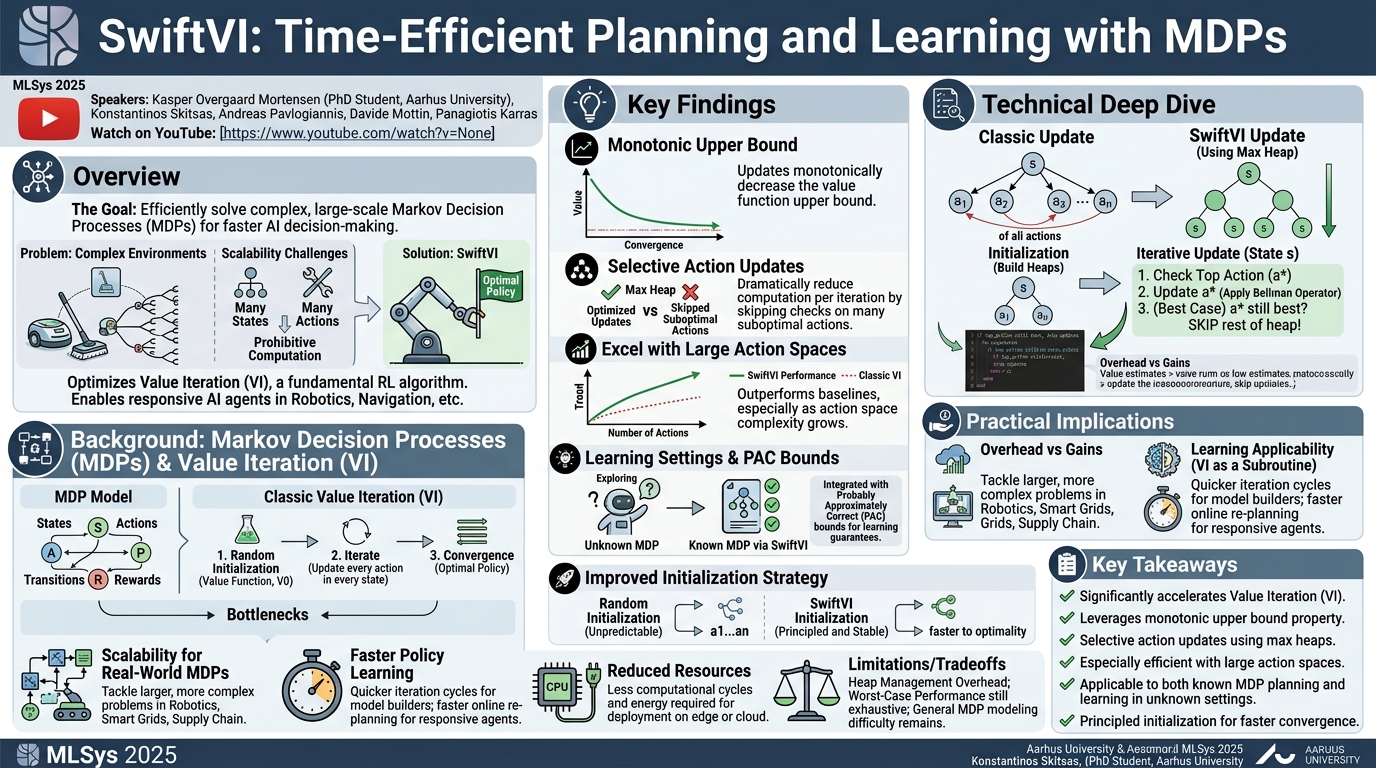
SwiftVI introduces a significant advancement in the efficiency of Value Iteration (VI), a cornerstone algorithm for solving Markov Decision Processes (MDPs). The primary contribution of SwiftVI is its ability to accelerate the convergence of VI by selectively updating action values within each state, rather than exhaustively evaluating all actions. This efficiency gain is achieved by leveraging a novel insight: the existence of a monotonic upper bound for the value function.
The key findings and contributions of SwiftVI can be summarized as follows:
- Monotonic Upper Bound: SwiftVI establishes that an upper bound exists for the value function, and crucially, all updates performed during Value Iteration are guaranteed to decrease this upper bound in a monotonic fashion. This monotonic convergence property is fundamental to the algorithm's efficiency.
- Selective Action Updates: By exploiting this monotonic behavior, SwiftVI can dramatically reduce the computational effort per iteration. For each state, instead of checking every action, it can often identify the optimal action more quickly. This is particularly effective in scenarios where the value function is already approaching optimality, allowing the algorithm to skip evaluating many suboptimal actions.
- Performance with Large Action Spaces: Experimental observations, as indicated by "a lot of plots" presented in the talk, demonstrate that SwiftVI performs "quite well" compared to other baselines that aim for similar efficiency improvements. A notable finding is its superior behavior "as the number of actions increases," directly addressing one of the major scalability bottlenecks of traditional VI.
- Applicability to Learning Settings: Beyond planning in known MDPs, SwiftVI's core mechanism is also applicable to learning settings where the MDP's transitions and rewards are initially unknown and must be discovered through exploration. Since Value Iteration often serves as a subroutine in many model-free reinforcement learning algorithms, SwiftVI can readily replace it, maintaining the benefits of efficient policy improvement during the learning process.
- Integration with PAC Bounds: For learning in unknown MDPs, many approaches rely on Probably Approximately Correct (PAC) bounds to ensure learning guarantees. SwiftVI's inherent upper bound can be integrated with these PAC bounds, allowing it to maintain the necessary theoretical guarantees for monotonic convergence towards an optimal solution, even in exploratory learning scenarios.
- Improved Initialization Strategy: The method offers a "descriptive way of actually choosing this initial value" for the value function, based on the established upper bound. This contrasts with common practices of random initialization, which can lead to unpredictable convergence times. A more principled initialization contributes to greater stability and potentially faster convergence from the outset.
In essence, SwiftVI transforms Value Iteration from a brute-force, exhaustive search into a more intelligent, targeted update process, making it a more viable solution for complex, large-scale decision-making problems in AI and ML.
Technical Deep Dive
▶ Watch: Efficiency gains using max heaps (1:15)
The technical ingenuity of SwiftVI lies in its method for optimizing the core update step of Value Iteration (VI), particularly in environments with large state and action spaces. Traditional VI, at each iteration, updates the value of a state $s$ by computing:
$V_{k+1}(s) = \max_{a \in A(s)} \left( R(s,a) + \gamma \sum_{s' \in S} P(s'|s,a) V_k(s') \right)$
where $A(s)$ is the set of actions available in state $s$, $R(s,a)$ is the immediate reward, $\gamma$ is the discount factor, and $P(s'|s,a)$ is the transition probability to state $s'$ after taking action $a$ in state $s$. The computational bottleneck arises from the need to iterate over all actions $a \in A(s)$ for every state $s$.
SwiftVI introduces an optimization based on two core ideas:
- Existence of a Monotonic Upper Bound: The paper claims and leverages the existence of an upper bound for the value function. Crucially, it guarantees that all updates performed within the SwiftVI framework will monotonically decrease this value function. This means that as iterations progress, the estimated values for states (and actions) will either stay the same or decrease, never increasing. This property is key to enabling selective updates.
- Exploiting Monotonicity with Max Heaps: For each state $s$, the value $V(s)$ is defined as the value of the best action in that state. To efficiently find this best action and manage updates, SwiftVI proposes storing the current estimated values for all actions available in state $s$ in a max heap. A max heap is a data structure that allows for very fast retrieval of the maximum element (the best action in this context) and efficient updates.
Here's how the mechanism works:
- Initialization: For each state, a max heap is constructed, containing the initial estimated values for all actions originating from that state.
- Iterative Update: During each iteration of Value Iteration, for a given state $s$:
- The algorithm inspects the top of the max heap for state $s$. This element represents the action $a^*$ that currently has the highest estimated value.
- It then calculates the new estimated value for this action $a^$ using the standard Bellman update equation: $Q_{k+1}(s,a^) = R(s,a^) + \gamma \sum_{s' \in S} P(s'|s,a^) V_k(s')$.
- Because of the monotonic decrease guarantee, if the updated value for $a^$ remains at the top of the heap (i.e., it's still the best action, or its value has decreased but no other action's value has surpassed it), then SwiftVI knows for certain* that no other action in that state can possibly have a higher value. This is because all values are monotonically decreasing, so if the current best action is still the best after its update (or has decreased but remains superior), no other action could have suddenly become better.
- In this "best case" scenario, only one action (the one at the top of the heap) needs to be fully re-evaluated and updated for that state in that iteration. All other actions can be skipped.
- Worst-Case Scenario: In the worst case, particularly during early iterations when values are still far from optimal, updating the top action might cause another action to become the new best. In such situations, the heap structure would require further inspection or updates, potentially leading back to evaluating more actions. However, Mortensen argues that "over time as we improve the value function, this becomes more and more likely" to hit the best case of only updating one action. When initialized poorly, more updates are needed, but the trend is towards the efficient single-action update.
- Overhead: The approach introduces some overhead: the initial construction of heaps for each state. However, the expectation is that this overhead is "negligible based on the actual runtime improvement we can get for skipping a lot of the states."
Applicability to Learning Settings:
SwiftVI's utility extends beyond scenarios where the MDP model (transitions and rewards) is fully known. In learning settings, where an agent must explore an unknown environment to build a model or learn a policy directly, Value Iteration is frequently employed as a subroutine within algorithms like model-based reinforcement learning (e.g., in planning phases of Dyna-Q or similar approaches). By substituting standard VI with SwiftVI in these subroutines, the learning process can be significantly accelerated. The talk also emphasizes that SwiftVI's upper bound can be integrated with PAC (Probably Approximately Correct) bounds commonly used in learning theory, thus maintaining crucial theoretical guarantees for convergence and optimality even in exploratory contexts. This makes SwiftVI a versatile tool for both planning and adaptive learning in dynamic environments.
Experimental Setup & Results
▶ Watch: Performance results: Swift VI vs. baselines (1:45)
While the talk did not delve into specific numerical results or detailed experimental setups, it provided crucial qualitative insights into SwiftVI's performance and comparative advantages. Mortensen referenced "a lot of plots" and stated that the method "seems to be quite good, also compared to other baselines that do similar things." This suggests that the research involved empirical validation against existing state-of-the-art or standard approaches for accelerating Value Iteration.
The most significant headline finding highlighted was SwiftVI's strong performance as the number of actions increases. This directly addresses one of the primary scalability challenges of traditional Value Iteration. In environments where states offer a large number of choices (e.g., complex robotic control, fine-grained navigation, high-dimensional parameter tuning), SwiftVI's ability to selectively update actions rather than exhaustively checking all of them translates into substantial speedups.
The talk alluded to a simple application scenario: an autonomous vacuum cleaner navigating a 2D plane to a charging station. While this example is illustrative, it represents a common class of problems in robotics and logistics where planning in a grid-like or continuous space with many possible movement or interaction choices is necessary. The implication is that for such environments, SwiftVI offers a more efficient path to deriving optimal navigation policies.
Regarding baselines, the speaker mentioned comparisons to "other baselines that do similar things," implying that the evaluation included other methods designed to optimize or approximate Value Iteration for efficiency. Without specific names, it's hard to detail, but this confirms a comparative assessment was part of the research.
The absence of specific datasets, hardware configurations, or concrete speedup factors in the verbal presentation means a detailed breakdown of experimental results is not possible from the transcript alone. However, the clear assertion of "quite good" performance, especially under increasing action complexity, positions SwiftVI as a promising technique for practical application where such conditions are prevalent. The implication is that the gains are sufficiently compelling to warrant its consideration over standard VI or other acceleration techniques in these challenging scenarios.
Practical Implications
▶ Watch: Conclusion and further resources (2:20)
SwiftVI offers several significant practical implications for practitioners, infrastructure teams, model builders, and those involved in deploying AI/ML systems, particularly in domains relying on sequential decision-making under uncertainty.
- Enhanced Scalability for Real-World MDPs: The most direct implication is the ability to tackle larger and more complex Markov Decision Processes (MDPs). Many real-world problems, from robotics and autonomous vehicles to smart grids and supply chain optimization, can be modeled as MDPs but are often intractable due to immense state-action spaces. SwiftVI's efficiency gains, especially with a high number of actions per state, make it a more viable solution for these complex scenarios, allowing for the development of more sophisticated and granular policies.
- Faster Policy Learning and Deployment: For model builders and deployers, faster Value Iteration translates directly into quicker policy learning and iteration cycles. In development, this means engineers can experiment with different MDP formulations or reward structures more rapidly. In deployment, it could enable quicker adaptation to changing environments or online re-planning in dynamic systems, leading to more responsive and intelligent agents.
- Improved Stability and Robustness of Value Iteration: The talk highlights a common issue with traditional VI: the sensitivity of convergence speed to the initial value function, often chosen randomly. SwiftVI's "descriptive way of actually choosing this initial value" based on its established upper bound provides a more principled and potentially more stable starting point. This can lead to more predictable and reliable convergence, reducing the "fiddly" nature often associated with getting MDPs right.
- Broader Applicability to Model-Free Learning: Infrastructure teams and model builders working on reinforcement learning (RL) systems can benefit from SwiftVI's direct applicability to learning settings. Many model-free RL algorithms implicitly or explicitly use value iteration-like updates. By making the underlying VI subroutine more efficient, SwiftVI can accelerate the policy improvement steps in these broader RL contexts, contributing to faster training times for agents exploring unknown environments.
- Reduced Computational Resources: Faster convergence often implies fewer computational cycles, which can translate into lower energy consumption and reduced hardware requirements. This is a crucial consideration for deploying AI on edge devices or in large-scale cloud environments where computational costs are significant.
Tradeoffs and Limitations:
- Overhead of Heap Management: SwiftVI introduces the overhead of building and maintaining a max heap for each state. While the speaker claims this is "negligible" compared to the gains, for extremely simple MDPs or those with very few actions per state, this overhead might slightly outweigh the benefits. However, its primary advantage lies in scenarios where the number of actions is large.
- Worst-Case Performance: While SwiftVI offers significant average-case improvements, the worst-case scenario still involves evaluating all actions in a state, similar to traditional VI. This might occur more frequently in the early stages of iteration when value estimates are far from optimal.
- General MDP Modeling Challenges Remain: As highlighted in the Q&A, designing effective MDPs is inherently challenging. "Small changes to an MDP can have an impact on also the runtime of value iteration." SwiftVI improves the solution method for a given MDP, but it doesn't alleviate the fundamental difficulty of accurately modeling a real-world problem as an MDP, defining appropriate states, actions, rewards, and transition probabilities. Practitioners still need careful domain expertise to construct useful MDPs.
- Complexity of Implementation: While conceptually elegant, implementing SwiftVI with efficient heap management across a potentially vast number of states requires careful engineering, especially for parallel or distributed computation.
Despite these considerations, SwiftVI represents a valuable step forward in making Value Iteration a more practical and performant tool for a wider array of AI and ML applications, particularly those characterized by complex decision spaces.
Key Takeaways
- SwiftVI enhances the efficiency of Value Iteration (VI), a core algorithm for solving Markov Decision Processes (MDPs), by significantly reducing the computational cost per iteration.
- The method leverages the existence of a monotonic upper bound for the value function, guaranteeing that value updates will consistently decrease towards the optimal solution.
- By storing action values in max heaps for each state, SwiftVI can often perform selective action updates, avoiding the need to evaluate all actions in every iteration, especially as the solution approaches optimality.
- SwiftVI demonstrates strong performance gains, particularly for MDPs with a large number of actions per state, addressing a critical scalability bottleneck of traditional VI.
- The approach is versatile, applicable to both planning in known MDPs and policy improvement in model-free reinforcement learning settings, where VI is used as a subroutine.
- It offers a more descriptive and potentially robust initial value function selection strategy compared to random initialization, which can lead to more stable and faster convergence.
About the Speaker(s)
The talk on SwiftVI was presented by Kasper Overgaard Mortensen, a PhD Student from Aarhus University. The project itself is a collaborative effort between Aarhus University and the University of Copenhagen. Mortensen noted that the work expands upon the master's thesis of his co-author, Emil, who explored efficient methods for value iteration. The full list of co-authors includes Konstantinos Skitsas, Andreas Pavlogiannis, Davide Mottin, and Panagiotis Karras, indicating a broad collaborative research endeavor across these institutions. Their collective work focuses on advancing fundamental algorithms in reinforcement learning and decision-making under uncertainty, with a particular emphasis on improving the computational efficiency and scalability of these methods for practical applications.
Reviews
Simon Wisk (Open Source Developer & AI Tooling Expert) — WEAK
SwiftVI presents a genuinely interesting algorithmic idea — using max heaps to exploit monotonic upper bounds and do selective action updates in Value Iteration — but the talk as described here is too thin to be useful. No concrete numbers, no reproducible setup, no code, and the experimental section amounts to 'we have a lot of plots and it seems quite good.' The core insight is real, but I can't tell if this is a 10% speedup or 10x, and the write-up reads like it was generated from an abstract rather than distilled from watching someone explain a system they built.
Jensen Hitch (AI Compute Platform CEO) — WEAK
SwiftVI is a competent algorithmic improvement to Value Iteration for MDPs — using max heaps and monotonic upper bounds to reduce per-iteration action evaluations. The theoretical contribution is real and the insight is clean. But this talk operates entirely within the planning algorithm layer and never reasons about the system it runs on, the infrastructure it deploys to, or what changes at any scale that actually matters for production AI. It's a well-executed point improvement on a narrow subroutine, presented without any honest reckoning of where MDP-based planning sits in the modern AI stack.
→ Top-rated talks at Conference on Machine Learning and Systems 2025
All talks from Conference on Machine Learning and Systems 2025