Panel: From Code to Defense: Why Developers Are the New Security Leaders
Vabhov (Founder and CEO · Append)
Nullcon Goa 2025 · Panel
Overview
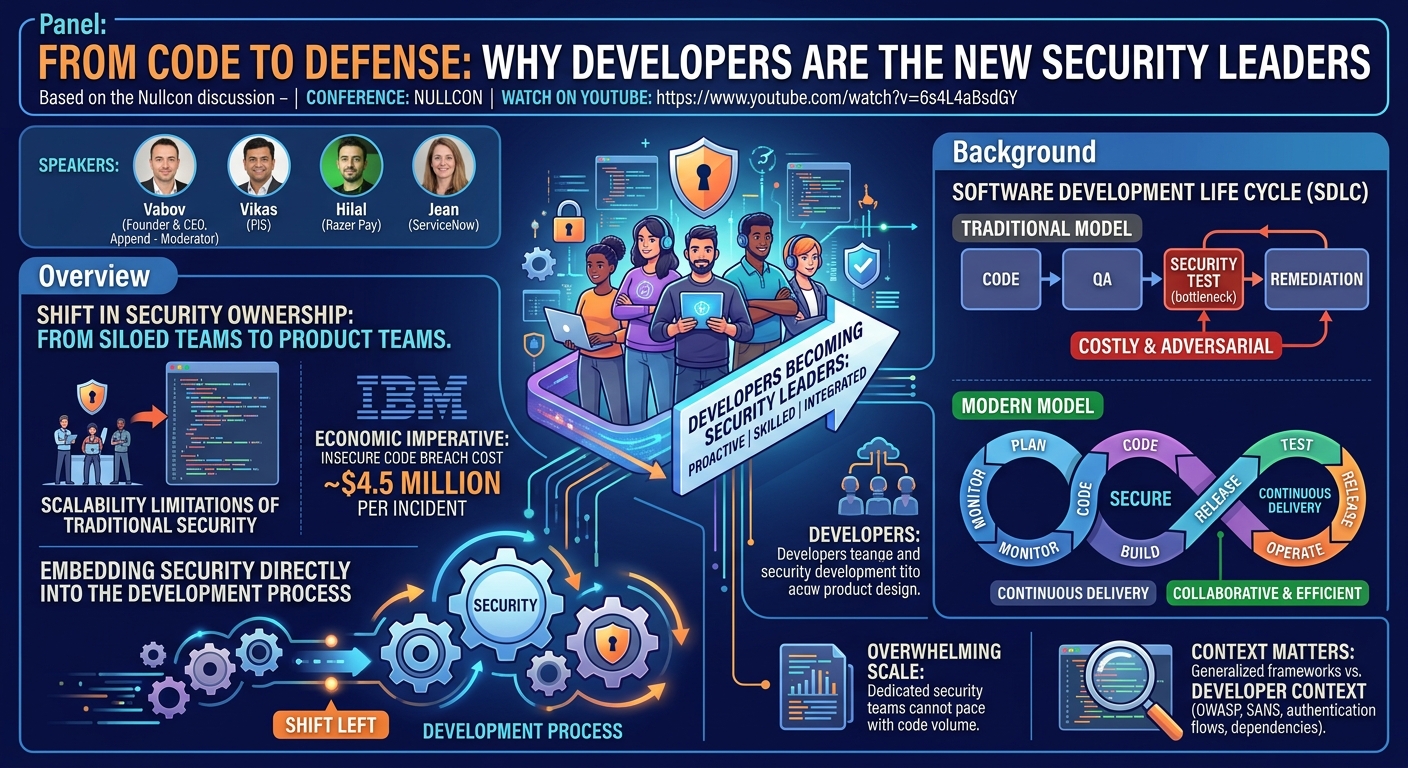
This Nullcon panel discussion, "From Code to Defense: Why Developers Are the New Security Leaders," delves into the critical and evolving role of software developers in the realm of cybersecurity. Moderated by Vabhov, Founder and CEO of Append, the panel features industry experts Vikas from FIS, Hilal from Razer Pay, and Jean from ServiceNow. The central theme revolves around the paradigm shift in security ownership, moving aggressively from traditional, siloed security teams to the product development teams themselves.
Key moments
- 0:00 Introduction: Developers as new security leaders
- 1:00 Vikas: Organizational shift to embedding security early
- 3:00 Vikas: DevSecOps teams bridge security and development
- 5:00 Hilal: Scaling security requires shifting responsibility
- 7:00 Hilal: Developers understand dependencies for comprehensive security
Panel: From Code to Defense: Why Developers Are the New Security Leaders
Speakers: Vabhov (Founder & CEO, Append), Vikas (FIS), Hilal (Razer Pay), Jean (ServiceNow)
Conference: Nullcon
YouTube: https://www.youtube.com/watch?v=6s4L4aBsdGY
Overview
This Nullcon panel discussion, "From Code to Defense: Why Developers Are the New Security Leaders," delves into the critical and evolving role of software developers in the realm of cybersecurity. Moderated by Vabhov, Founder and CEO of Append, the panel features industry experts Vikas from FIS, Hilal from Razer Pay, and Jean from ServiceNow. The central theme revolves around the paradigm shift in security ownership, moving aggressively from traditional, siloed security teams to the product development teams themselves.
The discussion highlights the staggering financial implications of insecure code, citing an IBM report that estimates a security breach due to such vulnerabilities costs approximately $4.5 million per incident. This economic imperative, coupled with the inherent scalability limitations of dedicated security teams in modern agile development environments, necessitates a fundamental change in how organizations approach software security. The panelists collectively argue that embedding security directly into the development process, often termed "shift left," is not merely a best practice but an indispensable strategy for building resilient and secure products in today's rapidly evolving threat landscape.
The talk underscores that in an era of continuous delivery and rapid innovation, developers must transcend their traditional roles as mere coders to become proactive security leaders. This transformation requires a blend of technical expertise, a shift in organizational mindset, and the strategic implementation of integrated tooling and empathetic collaboration between security and development functions. The panel explores the catalysts for this shift, the challenges developers face, effective training methodologies, the impact of tool fatigue, and the nascent role of AI/ML in shaping future security responsibilities.
Background
▶ Watch: Introduction: Developers as new security leaders (0:00)
The traditional model of software development often relegated security to a late-stage activity within the Software Development Life Cycle (SDLC). Developers would write code, which would then be passed to quality assurance (QA) and subsequently to a separate security team for testing. Any vulnerabilities identified would be "thrown back" to developers for remediation, creating a costly, time-consuming, and often adversarial feedback loop. This waterfall-like approach to security proved increasingly untenable with the advent of Agile methodologies and the demand for rapid, continuous delivery of software features.
The core problem, as articulated by the panelists, is one of scale and context. Dedicated security teams, no matter how skilled, simply cannot keep pace with the sheer volume and complexity of code being produced by large development organizations. Hilal from Razer Pay emphasizes that security teams "cannot be like these massive resources, massive teams that can look after every aspect of security within the product." This limitation necessitates a fundamental redistribution of security responsibility. Furthermore, security frameworks like OWASP Top 10 or SANS 25 provide valuable best practices but often lack the specific context of individual applications, which only the development teams truly possess. Developers understand the "sources and sinks," authentication and authorization flows, and crucial dependencies of their applications in a way that generalized security guidelines cannot fully encompass.
The financial cost of this traditional, reactive security posture is significant. The IBM report mentioned by Vabhov underscores that insecure code is a direct driver of substantial financial loss, making proactive security an economic imperative rather than just a technical one. Jean from ServiceNow highlights a pervasive mindset issue: developers, while inherently wanting to build secure products, often "just don't know how to do it" due to inadequate security education in academic settings and the intense pressure to meet deadlines. The concept of a "security review" often becomes a dreaded bottleneck, perceived as slowing down development rather than an integrated part of the process. This historical context of siloed teams, reactive security, and a lack of embedded knowledge forms the backdrop against which the "shift left" movement gains its critical importance.
Key Findings
▶ Watch: Vikas: Organizational shift to embedding security early (1:00)
The panel discussion yielded several key findings that collectively underscore the transformative shift in software security:
- Shift Left is Imperative for Scalable Security: The consensus across all panelists is that embedding security early and continuously in the development lifecycle is the only viable strategy to scale security operations. Traditional security teams cannot keep up with the pace of modern development, making developer ownership of security essential.
- Developers as Security Leaders: The talk posits that developers are indeed the "new security leaders." This isn't just about writing secure code but actively participating in threat modeling, secure design, and integrating security checks throughout the CI/CD pipeline. Vikas notes that modern DevSecOps teams are emerging, where individuals learn both development and security as primary disciplines.
- Empathy and Collaboration are Foundational: Jean from ServiceNow powerfully stresses the need for empathy between security and development teams. Security professionals must understand developer pressures and context, while developers need to grasp the real-world impact of vulnerabilities. This mutual understanding fosters a collaborative environment where security isn't a bottleneck but a shared mission.
- Security as an Engineering Discipline: Security should be treated with the same rigor as other engineering concerns like reliability, scalability, and resilience. This means designing for recovery, understanding acceptable levels of risk, and integrating security considerations from the architectural phase, rather than applying them as an afterthought.
- Contextualized Vulnerability Management: Generic security reports (e.g., from static analysis tools) often generate high numbers of findings, including false positives, which erode developer trust. The panel emphasizes the need to prioritize vulnerabilities based on the specific application context, compensating controls, and actual exploitability, rather than just theoretical severity.
- Automation is Key to Overcoming Tool Fatigue: Hilal from Razer Pay details the real problem of tool fatigue among developers when faced with numerous, often poorly integrated, or unreliable security tools. The solution lies in robust automation within the CI/CD pipeline, reducing manual intervention and providing immediate, validated feedback, thereby making security more efficient and less burdensome.
- AI/ML: Promise and Peril: While Large Language Models (LLMs) and AI have potential applications in risk scoring and analysis, Jean and Vikas caution against their use for generating production-ready code due to the potential for introducing widespread, difficult-to-detect vulnerabilities. The technology is not yet mature enough for such critical applications.
- Security is a Continuum, Not an Absolute State: The notion of 100% secure code is a myth. Security practices and threats constantly evolve (e.g., TLS 1.0 vs. modern standards). Organizations must accept a certain level of risk and continuously adapt their secure coding practices and tooling to the changing landscape.
Technical Deep Dive
▶ Watch: Vikas: DevSecOps teams bridge security and development (3:00)
The shift towards developers as security leaders necessitates a profound transformation in technical practices, embedding security across the entire development lifecycle. This section explores the technical underpinnings and strategies discussed by the panelists.
At the heart of this transformation is the concept of DevSecOps. Vikas from FIS describes the emergence of dedicated DevSecOps teams, where individuals are trained in both development and security from the outset. This contrasts sharply with traditional models where coders focused solely on functionality and security teams performed later-stage assessments. The goal is to build secure code inherently, rather than patching it post-development. This involves integrating security from the initial design phase, a process often guided by threat modeling and secure architecture analysis. Hilal stresses the importance of planning for security, understanding an application's dependencies (third-party, internal, runtime), and designing appropriate security controls, including strong authentication, encryption, and robust logging capabilities.
Central to implementing shift left is the integration of security tooling directly into CI/CD (Continuous Integration/Continuous Deployment) pipelines. Hilal elaborates on the necessity of autonomous CI/CD pipelines that incorporate security checks for continuous deployment. This ensures that security is a continuous process, not a gate. The discussion touched upon various categories of security tools:
- Static Application Security Testing (SAST): Tools that analyze source code, bytecode, or binary code for security vulnerabilities without executing the application. While powerful, SAST tools often generate a high number of findings, including false positives, which can overwhelm developers and lead to tool fatigue. Jean emphasizes the need for contextual understanding: a vulnerability identified by a SAST tool might not be exploitable in a specific application context due to compensating controls like multiple layers of services or firewalls. This necessitates a move from raw severity scores to a prioritized view based on actual risk.
- Software Composition Analysis (SCA): Tools that identify open-source components and their known vulnerabilities (e.g., CVEs). While not explicitly named, the discussion around third-party dependencies implies the use of such tools.
- Dynamic Application Security Testing (DAST): Tools that test a running application for vulnerabilities by simulating attacks. Hilal advocates for dynamic testing, chaos engineering, and runtime analysis to uncover issues that static analysis might miss, especially those related to how applications interact with their environment and users.
- Secrets Management: The panel discusses the automation of detecting and managing hardcoded secrets in code, eliminating manual processes that are prone to error.
- Sensitive Data/PII Detection: Automation is also applied to identifying and managing Personally Identifiable Information (PII) or other sensitive data within the codebase, ensuring compliance and data protection.
The challenge of tool fatigue is a significant technical hurdle. Hilal recounts an experience with a Software Composition Analysis or Static Code Analysis vendor whose sandboxing feature, designed to validate vulnerabilities, failed to work for a year. Such experiences undermine developer trust and adoption. To combat this, the panelists suggest:
- Quality over Quantity: Focusing on a few high-quality, effective tools.
- Fine-tuning: Customizing tools to reduce irrelevant findings and false positives. Hilal describes how fine-tuning and automation in SAST tooling drastically reduced false positives, leading to issues that were "no longer non-validated," thus reducing friction with developers.
- Automation: Automating tool execution and result analysis as much as possible, removing the burden from developers. The ideal scenario, as Jean describes, is for security tests to run upon code commit, much like a compiler error, providing immediate, actionable feedback to developers on how to fix issues without blocking their workflow unnecessarily.
The emerging role of AI/ML in secure development was also discussed. While Jean cautions against using generative AI for production code generation due to the risk of introducing subtle, widespread vulnerabilities, he highlights its potential in other areas. Service Now, for instance, uses its own LLMs to risk score code produced by developers, helping determine the level of security testing required. This intelligent prioritization can make security efforts more efficient and targeted. Vikas suggests that AI could eventually aid in creating large, pre-tested, secure code libraries for common functionalities, reducing the need for every developer to "reinvent the wheel" securely.
Ultimately, the technical deep dive reveals a vision where security is not an external audit but an intrinsic property of the software development process, enabled by intelligent tooling, continuous automation, and a deep, contextual understanding shared by both developers and security professionals.
Demo / Proof of Concept
▶ Watch: Hilal: Scaling security requires shifting responsibility (5:00)
As this was a panel discussion, no live demonstration or proof of concept was presented. The format focused on expert opinions, experiences, and strategic insights into the evolving landscape of software security and developer responsibilities.
Defensive Implications
▶ Watch: Hilal: Developers understand dependencies for comprehensive security (7:00)
The insights from the panel provide a clear roadmap for organizations aiming to strengthen their security posture by empowering developers. Implementing these defensive implications requires both strategic shifts and practical, technical adjustments.
For Organizations and Security Leaders:
- Embrace Shift Left Holistically: Organizations must fundamentally integrate security into every phase of the SDLC, starting from design and architecture. This involves conducting threat modeling and secure architecture analysis early, ensuring security is "baked in" rather than "bolted on."
- Invest in DevSecOps Teams and Culture: Create or evolve teams that blend development and security expertise. This means training developers in secure coding practices and, crucially, training security professionals in development methodologies and application context. As Jean notes, "security is an engineering discipline" and should be treated as such, similar to resilience and reliability.
- Foster Empathy and Collaboration: Break down silos between security and development teams. Encourage direct, human-to-human communication. Security teams should understand developer pressures and provide contextual, actionable feedback, while developers should grasp the real-world impact of vulnerabilities. This mutual understanding is vital for a unified mission.
- Prioritize Contextual Risk: Move beyond generic vulnerability counts. Implement processes to evaluate and prioritize security findings based on actual application context, compensating controls (e.g., ephemeral instances, network segmentation, multiple layers of services), and the likelihood of exploitation. A "severity one" vulnerability on paper might be a "priority four" in a specific, well-defended environment.
- Automate Security Tooling within CI/CD: Integrate SAST, SCA, DAST, secrets management, and sensitive data detection tools directly into CI/CD pipelines. The goal is to make security checks autonomous, providing immediate feedback to developers, similar to how compile errors are handled. This reduces manual effort, speeds up remediation, and combats tool fatigue.
- Fine-tune and Optimize Tools Relentlessly: Continuously refine security tools to reduce false positives and ensure their relevance to the specific codebase. An unreliable tool that generates excessive noise quickly loses credibility with developers. Focus on quality and usability over the sheer number of tools.
- Exercise Caution with AI/ML for Code Generation: While AI/ML can assist in risk scoring, analysis, or generating test cases, organizations should be extremely cautious about using Large Language Models (LLMs) to generate production code directly. The risk of introducing subtle, widespread vulnerabilities that are difficult to detect with current tools is significant.
- Promote Continuous Learning: Acknowledge that security is a continuum and threats evolve. Establish ongoing training programs for developers on the latest secure coding practices and for security professionals on modern development techniques and programming languages.
- Secure Design Principles: Implement secure design principles from the outset. This includes planning for robust authentication and authorization, ensuring data security through encryption, and incorporating comprehensive logging capabilities for effective monitoring and incident response.
For Individual Developers:
- Proactive Security Ownership: View security as an inherent part of your development responsibility, not an external requirement. Engage in secure coding practices from the start.
- Understand Impact: Learn about the real-world consequences of insecure code—data breaches, financial losses, reputational damage, and impact on users' lives. This emotional connection can be a powerful motivator.
- Seek Security Knowledge: Actively learn secure coding patterns, common vulnerabilities, and how to use security tools effectively. Don't wait for security teams to "catch" your mistakes.
For Security Professionals:
- Develop Empathy and Contextual Knowledge: Learn about the development process, the pressures developers face, and the specific architecture and dependencies of the applications you're securing. This enables more effective and collaborative engagement.
- Be a Facilitator, Not a Gatekeeper: Shift from a role of identifying flaws to enabling developers to build securely. Provide clear, actionable, and contextualized guidance, and help fine-tune tools for better developer experience.
- Automate and Educate: Leverage automation to scale security efforts and free up time for deeper analysis and developer education.
By adopting these defensive implications, organizations can transform their security posture from a reactive, bottlenecked function into an integrated, proactive, and resilient component of their software delivery pipeline.
Key Takeaways
- Shift Left is Non-Negotiable: Embedding security early in the SDLC and making it an inherent part of the development process is the only way to achieve scalable and effective security in modern agile environments, moving beyond traditional, late-stage security reviews.
- Developers are the New Security Leaders: The responsibility for security must shift to developers, fostering a DevSecOps culture where coding and security expertise are integrated. This requires continuous training and a deep understanding of application context.
- Empathy and Collaboration Drive Success: Bridging the gap between security and development teams through mutual understanding and empathy is crucial. Security professionals must understand developer pressures, and developers must grasp the real-world impact of vulnerabilities.
- Automation Combats Tool Fatigue: Extensive automation of security tooling within CI/CD pipelines is essential to reduce manual effort, provide immediate feedback, and prevent developers from being overwhelmed by disparate, noisy, or unreliable security tools.
- Contextual Risk Prioritization is Key: Generic vulnerability reports are insufficient. Security findings must be prioritized based on the specific application context, compensating controls, and actual exploitability to ensure efficient and impactful remediation efforts.
- AI/ML Requires Prudent Application: While LLMs and AI can assist in areas like risk scoring and analysis, caution is advised when using them for direct code generation in production environments due to the potential for introducing widespread, hard-to-detect vulnerabilities.
About the Speaker(s)
The panel featured a diverse group of security and development leaders:
- Vabhov: The moderator of the discussion, Vabhov is the Founder and CEO of Append, a company focused on enhancing software development practices.
- Vikas: Representing FIS, Vikas shared insights into how his organization has evolved its approach to security ownership, particularly emphasizing the shift towards new DevSecOps teams and embedding security from the ground up.
- Hilal: From Razer Pay, Hilal provided a perspective from a large product company, discussing the catalysts for shifting security responsibilities to developers and strategies for tackling the exhaustiveness of security standards and tool fatigue.
- Jean: Associated with ServiceNow, Jean is a known proponent of product security. His contributions focused on the psychological and cultural obstacles developers face, the importance of empathy, and the strategic use of training and tooling to foster a secure development mindset.
Reviews
Dr. Zero (Offensive Security Researcher) — WEAK
A panel-lane talk that recycles DevSecOps orthodoxy without adding data, specificity, or hard-won operational detail. The speakers say the right words but never go deep enough to make any of them useful to someone who isn't already a believer.
Heather Calloway (CISO) — WEAK
A well-intentioned panel on DevSecOps that covers the right terrain but never gets past the surface. Familiar framing, no new evidence, and defensive implications that read like a vendor playbook rather than earned organizational insight.