The Limit Is the Sky… (Or Not)?
Antonio Nappa (Application Analysis Team Leader · Zimperium)
RE//verse 2026 · Day 1 · Coral Ballroom A
Overview
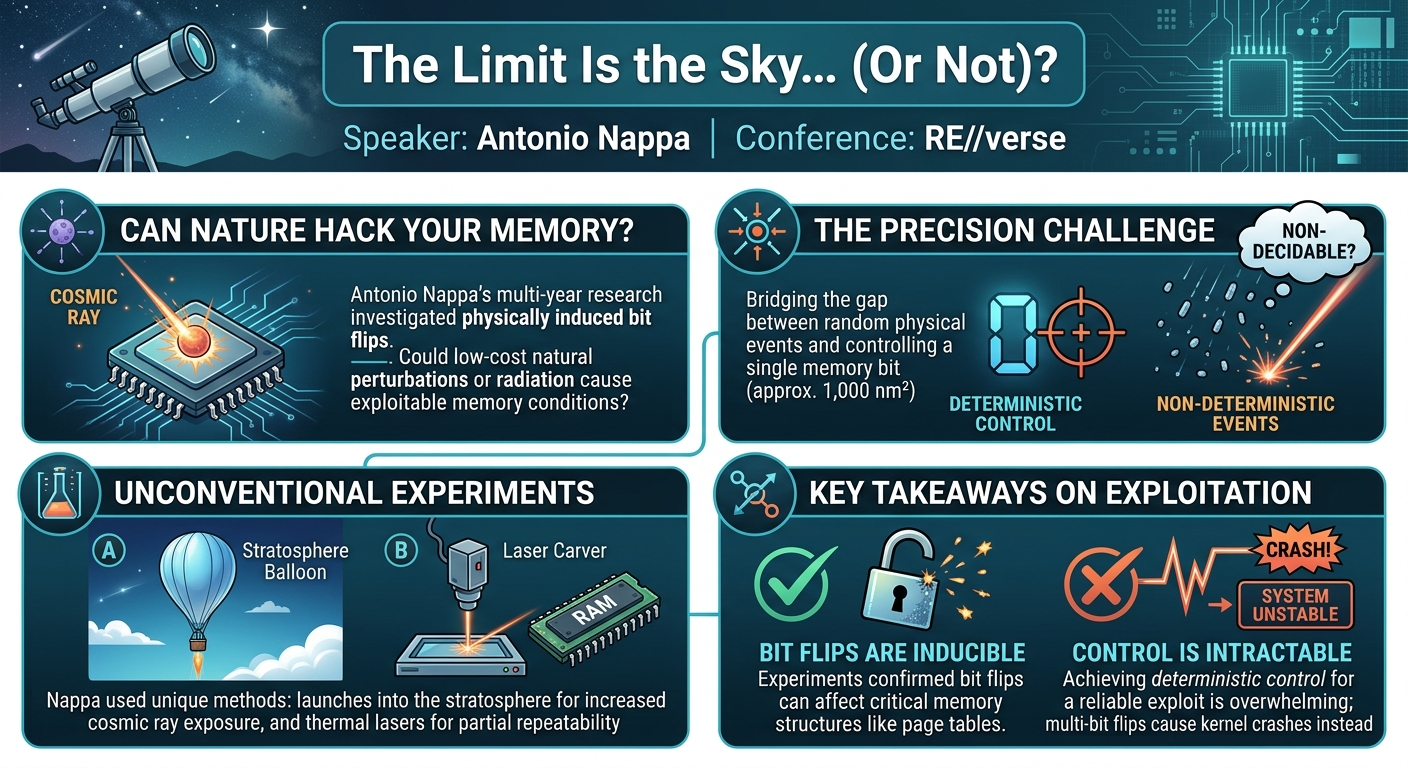
In a captivating and ambitious presentation at RE//verse, Antonio Nappa, Application Analysis Team Leader at Zimperium, unveiled five years of dedicated research into the realm of physically induced bit flips. His talk, "The Limit Is the Sky… (Or Not)?", explored the audacious premise of whether natural radiation and other low-cost physical perturbations could reliably cause exploitable conditions in computer memory. What began as an inquiry into seemingly "crazy" ideas—inspired by academic papers, a pandemic, and even access to a nuclear facility—evolved into a profound exploration of the boundaries between determinism and non-determinism in hardware security.
Key moments
- 0:00 Introduction: The 'crazy' idea and motivation
- 4:26 Bridging determinism and non-determinism for bit flips
- 8:36 Avionics: Real-world cosmic ray software patch incident
- 22:15 First experiment: Nuclear facility with Cesium/Cobalt
- 26:15 Laser machine tests: Partial repeatability, kernel crashes
- 33:00 Stratosphere balloon launches for cosmic ray exposure
- 41:15 Call for help: Mapping cosmic ray bit flips
- 42:30 Q&A: How to target a specific bit for exploitation?
The Limit Is the Sky… (Or Not)?
Speakers: Antonio Nappa, Application Analysis Team Leader, Zimperium
Conference: RE//verse
YouTube: https://www.youtube.com/watch?v=UKGH_YOPo2Y
Overview
In a captivating and ambitious presentation at RE//verse, Antonio Nappa, Application Analysis Team Leader at Zimperium, unveiled five years of dedicated research into the realm of physically induced bit flips. His talk, "The Limit Is the Sky… (Or Not)?", explored the audacious premise of whether natural radiation and other low-cost physical perturbations could reliably cause exploitable conditions in computer memory. What began as an inquiry into seemingly "crazy" ideas—inspired by academic papers, a pandemic, and even access to a nuclear facility—evolved into a profound exploration of the boundaries between determinism and non-determinism in hardware security.
Nappa's journey was fueled by real-world incidents, such as the inexplicable vote count discrepancy in Belgian elections attributed to cosmic rays, and the infamous $1 million cost of the San Bernardino iPhone exploit. The central question driving his research was whether a similar, device-tampering-free outcome could be achieved for significantly less money, using physical phenomena to induce targeted bit flips. This pursuit led him through a series of increasingly complex and unconventional experiments, from exposing devices to radioactive isotopes in a military facility to launching computing equipment into the stratosphere, all in a bid to weaponize the seemingly random forces of nature.
The talk ultimately details the immense difficulty in achieving precise, exploitable bit flips through non-deterministic physical means. While bit flips are demonstrably possible, controlling them to target specific memory structures for a reliable exploit remains an almost intractable problem. Nappa's work serves as a stark reminder of the physical vulnerabilities underlying our digital world, the relentless pursuit of novel attack vectors, and the critical importance of robust defensive measures like Error-Correcting Code (ECC) memory, especially as silicon features continue to shrink and new computational paradigms like quantum computing emerge.
Background
▶ Watch: Introduction: The 'crazy' idea and motivation (0:00)
The motivation for Nappa's extensive research stems from a blend of real-world anomalies and high-stakes security challenges. One significant incident was the 2003 Belgian election, where a vote count error—specifically, the number of votes exceeding the number of voters—was ultimately attributed to a cosmic ray incident. While seemingly outlandish, the statistical characteristics of the error, where a nibble was a multiple of two, lent some plausibility to the cosmic ray hypothesis. This event highlighted the potential for non-deterministic physical phenomena to impact critical systems.
A more direct inspiration for Nappa's work was the San Bernardino iPhone unlocking incident, which reportedly cost the FBI over $1 million. The high cost was primarily due to the need to extract data without tampering with the device, preserving its integrity. Nappa pondered whether a cheaper, non-tampering method could achieve a similar outcome by inducing targeted memory corruption. This led to the core challenge: bridging the vast gap between the non-deterministic nature of cosmic ray interactions and the deterministic control required to flip a single bit within a memory cell, which measures approximately 1,000 square nanometers. He likened the difficulty to the SETI@home project, which processed 12 billion signals over 27 years to find only 100 meaningful results, emphasizing the astronomical odds of precise, targeted manipulation.
Prior academic and industry work provided a foundational context. Nappa referenced a DEF CON talk on bit squatting for DNS hijacking and the ICSA 2014 paper, which laid groundwork for experimental studies in this domain. He also noted the ongoing research into the disposition of bits in memory, a crucial factor for understanding how physical perturbations might manifest. The physics behind cosmic ray interactions is well-understood: high-energy particles hitting Earth's atmosphere generate secondary particles—alpha (helium nuclei), beta (protons or electrons), and gamma (high-energy photons). While these particles themselves might not directly alter memory, they can interact with chip materials to generate charges that flip bit states, a process known as a Single Event Upset (SEU). The brief DRAM refresh cycle (typically every 64 milliseconds) creates a narrow window for such attacks, underscoring the timing challenges. The avionics industry, well aware of these issues, employs specialized materials, shielding, and magnetoresistive RAMs (MRAMs) in satellites and aircraft to mitigate random failures, yet incidents like the Tampa flight disruption attributed to solar radiation, leading to a software rollback, still occur. This illustrates the persistent, complex interplay between hardware vulnerabilities and software mitigations in the face of environmental factors.
Key Findings
▶ Watch: Avionics: Real-world cosmic ray software patch incident (8:36)
Antonio Nappa's five-year research yielded several critical findings, primarily highlighting the immense practical difficulties in weaponizing non-deterministic physical phenomena for targeted memory exploitation. The central discovery is that while bit flips are indeed inducible by natural radiation and other physical perturbations, achieving the precision necessary for a reliable, exploitable outcome remains an exceptionally challenging, almost "non-decidable" problem.
First, Nappa demonstrated that basic physical perturbations can induce bit flips. In an early experiment at a nuclear facility, an IBM T41p laptop from 2002 exhibited bit flips when exposed to low-energy radioactive isotopes like Cesium or Cobalt. However, a more modern Raspberry Pi 4 with 8GB of RAM showed zero response, suggesting that contemporary hardware, potentially due to packaging or material composition, can be more resilient to low-energy sources.
Second, using a low-cost laser carver (costing around $200), Nappa achieved partial repeatability in inducing bit flips. By employing blue light at its heaviest energy setting, a thermal reaction was generated on the RAM chip. He successfully ported a Rowhammer proof-of-concept exploit from x86 to ARM architecture and, after approximately 500 tests, was able to get the "page table exploit half rolling" on a specific Raspberry Pi. However, this success was marred by a critical limitation: the lack of precision. The laser invariably flipped multiple bits, leading to kernel crashes and system instability rather than a clean, exploitable state. This led to a conjecture that targeting the edges or corners of the chip might allow the package to absorb some thermal radiation, potentially leading to a more localized, single-bit flip. However, direct central shots consistently resulted in system crashes.
Third, the ambitious stratosphere balloon experiment further corroborated these findings. A Raspberry Pi 4B, along with Android phones and an iPhone, was sent to high altitudes to expose it to increased cosmic ray flux. After a single successful recovery from three launches (the others failed due to parachute issues), the logs revealed similar outcomes to the laser experiments: approximately 400-500 attempts over a 4-hour trip resulted in hits to the page table, but again, multiple unintended bit flips caused system instability. Notably, the iPhone was the only mobile device that survived the extreme conditions, while the Android phones shut down.
In essence, Nappa's research confirms the theoretical possibility of physically induced bit flips and even partial success in hitting critical memory structures like page tables. However, the practical challenge of achieving deterministic control over a single bit flip for a reliable exploit, without causing broader system corruption, proved to be overwhelmingly difficult across all experimental methodologies. The precision required is akin to hitting a specific atom with a golf ball from miles away, making reliable weaponization of these phenomena currently unfeasible for complex exploits.
Technical Deep Dive
▶ Watch: Laser machine tests: Partial repeatability, kernel crashes (26:15)
Antonio Nappa's research delves into the intricate technical challenges of manipulating single bits of memory through physical means, a problem he categorizes as both physically and computationally non-decidable. At the core is the attempt to bridge the gap between non-deterministic physical events and deterministic control over a memory bit, which occupies a mere 1,000 square nanometers.
The variables influencing bit flips are manifold. Chip manufacturers adhere to strict recommendations regarding materials to prevent autonomous bit flips. For instance, the use of borophosphosilicate was abandoned in favor of borophosphosilicate due to the boron's tendency to generate secondary reactions. External factors like the trajectory of incoming particles are inherently random. However, Nappa identified several predictable variables from literature: consistent cosmic ray flux above 5,000 meters, known chip sizes, statistical bit flip rates per gigabyte, and the probability of hitting the page table (around 30% for a 64-bit address space, as per Rowhammer research).
The mechanism for inducing bit flips often involves high-energy neutrons. These are typically generated in a controlled environment by accelerating a proton or electron to strike a target material, such as magnesium beryllium. This collision produces heavy neutrons, which, upon hitting the silicon of the target chip, cause two primary effects: recoil (where a silicon atom is displaced) and spallation (where a silicon nucleus breaks apart). Both processes can generate localized charge or discharge, altering the state of a memory cell. The effectiveness of this process is highly energy-dependent, with reactions typically requiring energies beyond 70 megaelectron volts (MeV). The continuous shrinking of transistor sizes due to Moore's Law theoretically increases susceptibility, as smaller features are more easily perturbed.
Nappa's approach to weaponizing these phenomena leveraged concepts from Rowhammer attacks. Rowhammer exploits a defect where repeatedly accessing adjacent memory rows can cause bit flips in a target row. The key is to "spray" the target memory structure (e.g., the page table) across memory, increasing the statistical probability that a random bit flip will occur in a critical location. By flipping a bit in a page table entry, an attacker could remap a virtual address to a different physical address, potentially gaining control over kernel memory or injecting shellcode. Nappa specifically ported an existing Rowhammer proof-of-concept from x86 to ARM to target his Raspberry Pi devices, noting that ARM page tables offer "a few extra bits to play with."
The experimental setup for the laser carver involved a consumer-grade device, chosen for its affordability. Nappa used its blue light setting, which delivers the "heaviest energy," inducing a thermal reaction on the RAM chip. While this method successfully caused bit flips and even partial activation of the ARM-ported Rowhammer exploit on the page table, the lack of precision was a critical hurdle. The thermal radiation spread too widely, causing multiple unintended bit flips that inevitably crashed the kernel. His "conjecture" of targeting the chip's edges or corners aimed to use the package material as a moderator, hoping to achieve a more localized effect, but this proved difficult to validate for precise control.
The stratosphere balloon experiment, while novel, faced similar technical limitations. The payload, including the Raspberry Pi 4B and multiple mobile phones, was designed to be extremely light for helium lift. A custom circuit was included for starting and restarting the devices. The challenge was not just inducing flips but detecting them; for user-space applications on mobile phones, memory allocation limits were a constraint. The subsequent failures of parachute components in repeated launches underscored the engineering complexities of even seemingly simple experiments in extreme environments. Ultimately, despite the varied and ambitious technical approaches, the core problem of achieving deterministic, single-bit control through non-deterministic physical means remained unsolved.
Demo / Proof of Concept
▶ Watch: Stratosphere balloon launches for cosmic ray exposure (33:00)
Antonio Nappa's research involved several distinct "proofs of concept" or experimental phases, each designed to test the feasibility of inducing and exploiting bit flips through physical perturbations.
- Nuclear Facility Experiment:
Nappa's initial foray involved gaining access to a military facility equipped for testing and calibrating radioactivity. He brought an IBM T41p laptop (circa 2002) and a modern Raspberry Pi 4 with 8GB of RAM. The devices were exposed to low-emission radioactive isotopes, specifically Cesium and Cobalt.
- Result: The IBM T41p laptop demonstrably experienced bit flips, confirming that older hardware is susceptible to even low-energy radiation. However, the Raspberry Pi 4 showed zero response despite being exposed, suggesting that modern packaging or material composition might offer greater resilience to these specific low-energy sources. Nappa did not attempt a full exploit here, focusing on mere flip detection.
- Laser Carver Experiment:
Recognizing the danger and inaccessibility of nuclear materials, Nappa turned to a more affordable and controllable method: a laser carver, costing approximately $200. This device allowed for targeted thermal perturbations.
- Methodology: Nappa ported a Rowhammer proof-of-concept exploit from x86 to ARM architecture, specifically targeting the Raspberry Pi 4. He used the laser carver's blue light setting, which delivers the highest energy, to create a thermal reaction on the RAM chip. Tests were conducted with around 500 attempts.
- Result: This experiment achieved "partial repeatability." With precise room temperature control and by finding the "right spot on the chip," Nappa could get the "page table exploit half rolling." This meant he was able to induce bit flips within the page table structure, which is critical for memory remapping. However, the lack of precision was a significant hurdle: the laser's thermal effect invariably flipped multiple bits, not just the intended single bit. This collateral damage caused the kernel to crash, preventing a stable, exploitable state. A video demonstrated a central laser shot immediately crashing the system. Nappa's most advanced result was "finding my own modified page table," indicating a successful flip in the page table, but the system still "stuck" due to unintended multiple flips. He conjectured that shooting at the edge or corner of the chip might allow the package to absorb some thermal radiation, leading to a more localized effect, but this was difficult to prove.
- Stratosphere Balloon Experiment:
Driven by the desire to test cosmic ray effects directly and cheaply, Nappa launched a custom payload into the stratosphere.
- Payload: A Raspberry Pi 4B, a custom circuit for starting/restarting, three Android phones running flip detection apps, and an iPhone. A detailed 70-item checklist was followed for preparation.
- Methodology: The payload was lifted by a helium balloon, ascending to high altitudes where cosmic ray flux is significantly higher. The devices were configured to run bit flip detection and, for the Raspberry Pi, the ARM-ported Rowhammer exploit.
- Result: The first launch was a success, with the payload recovered after a 4-hour flight. Analysis of the logs revealed approximately 400-500 attempts to induce flips. Similar to the laser experiment, Nappa observed "we hit the pitch table, but we also hit something else," again indicating multiple, uncontrolled bit flips leading to system instability. The iPhone was the only mobile device that remained operational throughout the mission, with the Android phones shutting down. Subsequent launches failed due to parachute malfunctions, underscoring the extreme difficulty and unreliability of such field experiments.
Across all these demonstrations, the consistent outcome was the ability to induce bit flips and even affect critical memory structures. However, the elusive goal of achieving deterministic control over a single, targeted bit flip for a stable, exploitable condition remained out of reach, primarily due to the inherent non-deterministic nature of the physical perturbations and the lack of fine-grained spatial precision.
Defensive Implications
▶ Watch: Q&A: How to target a specific bit for exploitation? (42:30)
Antonio Nappa's research, while demonstrating the immense difficulty of weaponizing physical bit flips for targeted exploitation, carries significant defensive implications, particularly as hardware scales down and new computational paradigms emerge.
The most straightforward and often-cited defense against random bit flips, whether from cosmic rays or other sources, is the use of Error-Correcting Code (ECC) memory. As Nappa highlighted, "If you are doing low-level development, drivers, kernels, you should listen to Linus [Torvalds] and use ECC memory." ECC memory can detect and correct single-bit errors and detect multi-bit errors, significantly improving system reliability and resilience to SEUs. This is a standard in critical systems like servers, avionics, and space applications, but less common in consumer-grade devices where cost is a primary driver.
The trend of shrinking silicon feature sizes, driven by Moore's Law, means that transistors and memory cells are becoming smaller and more densely packed. This increases their susceptibility to physical perturbations. Nappa noted that "the sizes are getting smaller and smaller and we are somehow getting back into the old times where the errors were just generated within the machine." This implies that future micro-architectural errors might not require the extreme precision Nappa sought; even less precise physical attacks could lead to denial-of-service or other impactful, albeit less controllable, outcomes. Defenders need to consider that the attack surface from physical phenomena might broaden, even if precise exploitation remains difficult.
For emerging and critical technologies, the implications are even more profound:
- Quantum Computation: Nappa specifically mentioned that in quantum computation, "it would be very easy to mess up a measurement with this kind of technology." While quantum error correction mechanisms exist, the question remains: "how are you making sure that you are not affected by anything coming from outside?" This highlights the need for a holistic security approach that considers the physical environment of quantum devices.
- Machine Learning and AI: The talk brought up an anecdote where a radioactive material placed next to a video card during machine learning model training corrupted the results. Projects like Google's AlphaFold, which uses AI for protein folding in drug discovery, are incredibly sensitive to data integrity. Nappa's rhetorical question, "Did they use ECC RAM when they did it? How they are actually making sure that this process is, you know, completely fine end-to-end," underscores a critical vulnerability. Corruption in training data or model weights due to physical bit flips could lead to flawed scientific discoveries or unsafe drug designs.
Finally, Nappa's ongoing work includes exploring defensive mechanisms within RISC-V architecture, an open standard Instruction Set Architecture. Its open nature might allow for the design and implementation of novel, integrated error correction or detection mechanisms directly into the architecture, providing a new avenue for resilience against these physical threats.
In summary, defenders must recognize that while precise, exploitable physical bit flips are currently difficult, the underlying vulnerability is real and growing with technological advancement. Implementing ECC memory where possible, considering environmental factors for critical infrastructure, and researching robust error correction at architectural levels are crucial steps to safeguard against both random and potentially targeted physical perturbations.
Key Takeaways
- Physical Bit Flips are Real but Difficult to Control: Natural radiation (cosmic rays) and low-cost physical perturbations (lasers, radioactive isotopes) can induce bit flips in computer memory. However, achieving deterministic control over a single, specific bit for a reliable exploit without causing system instability remains an extremely challenging problem, akin to a "non-decidable" task.
- Precision is the Primary Hurdle for Exploitation: Experiments with both low-energy radiation and thermal lasers demonstrated that while bit flips could be induced and even affect critical structures like page tables, the lack of spatial precision invariably led to multiple unintended flips, resulting in kernel crashes and denial of service rather than a stable, exploitable state.
- Hardware Evolution Affects Susceptibility: Older hardware (e.g., IBM T41p) showed susceptibility to low-energy radiation, while modern devices (Raspberry Pi 4) were more resilient to the same low-energy sources. However, the shrinking size of silicon features (Moore's Law) generally increases susceptibility to micro-architectural errors, potentially broadening the scope of impactful, less precise physical attacks in the future.
- ECC Memory is a Critical Defense: For any system requiring high data integrity, especially in critical applications like avionics, servers, quantum computing, or AI for scientific discovery (e.g., AlphaFold), the use of Error-Correcting Code (ECC) memory is strongly recommended to mitigate random bit flips from physical phenomena.
- Emerging Technologies Face Unique Risks: Quantum computers and advanced AI models are particularly vulnerable to physical perturbations. While they may have their own error correction, their sensitivity to environmental factors necessitates a comprehensive physical security strategy to ensure the integrity of their computations and results.
- Community Data Collection is Key for Statistical Understanding: The speaker has launched a SETI@home-like project, inviting users to run a tool that allocates 512MB of RAM to statistically map cosmic ray induced bit flips, emphasizing the need for large datasets to better understand and predict these non-deterministic events.
About the Speaker(s)
Antonio Nappa is the Application Analysis Team Leader at Zimperium, a mobile security company. He is a recognized expert in vulnerability research and the author of the book "Fuzzing Against the Machine," which focuses on vulnerability research using tools like QEMU emulation and AFL. Prior to Zimperium, Antonio was involved in designing privacy-preserving telemetry at Brave. He also leads the "fast society initiative and academy," dedicated to educating people in vulnerability research. A veteran of the cybersecurity community, Nappa was a participant in the DEF CON 16 finals back in 2008, showcasing his long-standing engagement with cutting-edge security challenges. His diverse background, spanning from low-level systems to privacy-preserving design, informs his unique approach to security research, as evidenced by his ambitious multi-year investigation into physical bit flips.
Reviews
Dr. Zero (Offensive Security Researcher) — STRONG ACCEPT
Nappa spent five years strapping Raspberry Pis to weather balloons and cooking RAM with a $200 laser carver just to see if he could weaponize physical bit flips. He failed to get deterministic control, but his failure is exactly why this talk is brilliant. It's unhinged, honest experimental research that tests the actual boundaries of budget fault injection instead of just theorizing on a whiteboard.
Heather Calloway (CISO) — SOLID
This is extreme-edge hardware research, not a strategy talk, so it isn't required viewing for your leadership team. However, it delivers a highly useful conclusion for risk leaders: we do not need to model threat actors using lasers or cosmic rays to exploit our enterprise fleets.