The Future of Threat Detection and Response
Mike Horn (SVP & General Manager, Security Products · Splunk (a Cisco company)), Tom Gillis (SVP & General Manager, Infrastructure and Security Group · Cisco)
RSA Conference 2025 · Day 3 · West Stage · Keynote
Overview
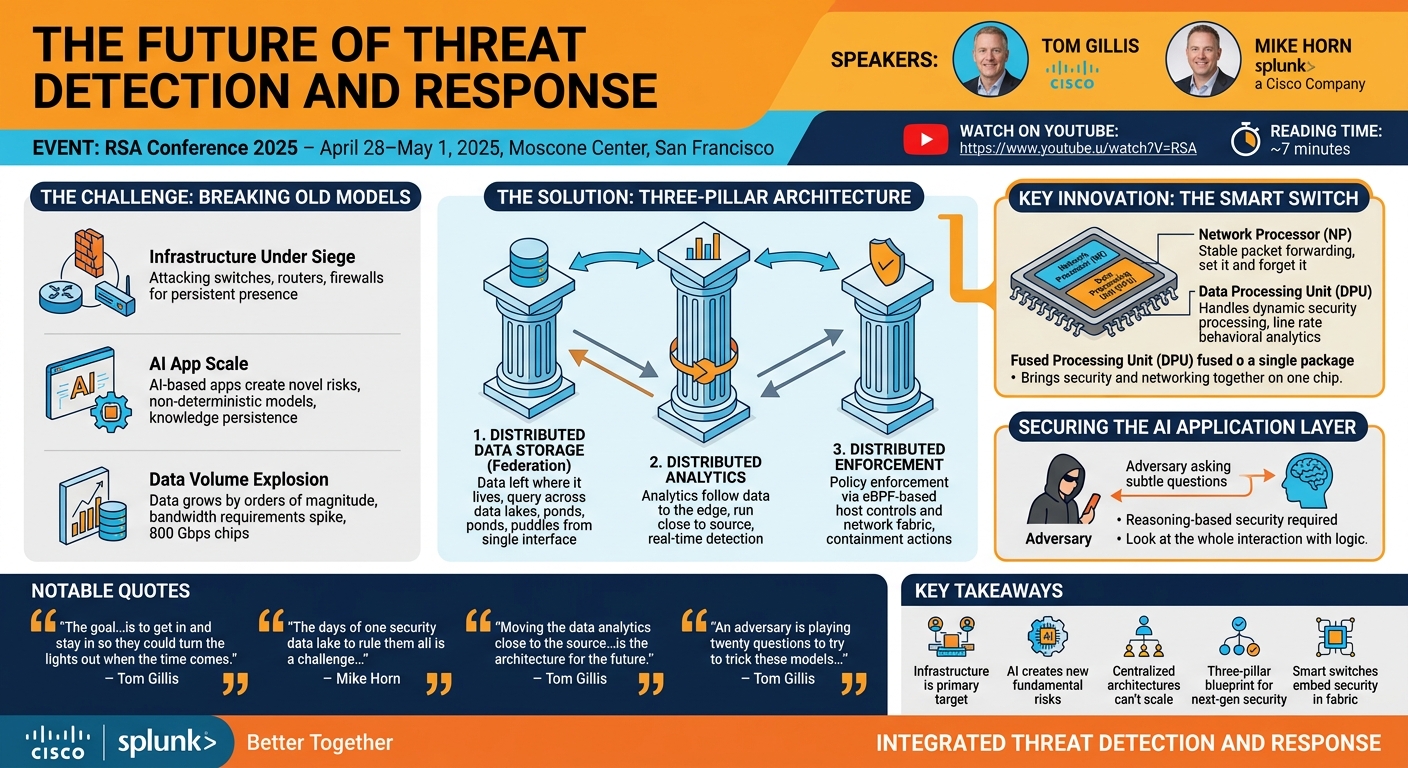
Cisco's Tom Gillis and Splunk's Mike Horn argue that the traditional centralized security architecture is fundamentally inadequate for an AI-driven world where attack surfaces are expanding and data volumes are growing by orders of magnitude. They introduce a three-pillar blueprint — distributed data storage, distributed analytics, and distributed enforcement — as the foundation for a new security architecture. At the heart of that architecture sits a new class of device they call the "smart switch," fusing network and security processing on a single chip. ---
Key moments
- 1:34 Nation-states now targeting routers and switches to disable infrastructure
- 2:24 AI model layer 'knows all secrets' — new security frontier
- 6:16 East-west traffic data is 1,000x what SIEMs can ingest
- 6:30 Single-data-lake era over; federated distributed architecture now required
- 9:45 eBPF and mesh firewalls enable micro-policy at process level
- 10:11 Smart switch with dual network-plus-DPU security processor introduced
- 13:21 Log4j still actively exploited five years after disclosure
- 16:45 AI elevates tier-1 SOC analysts to tier-3 performance
The Future of Threat Detection and Response
Speakers: Tom Gillis (Cisco) · Mike Horn (Splunk, a Cisco Company)
Event: RSA Conference 2025 — April 28–May 1, 2025, Moscone Center, San Francisco
Watch on YouTube: https://www.youtube.com/watch?v=9OTKkOrPoR0
Reading time: ~7 minutes
TL;DR
Cisco's Tom Gillis and Splunk's Mike Horn argue that the traditional centralized security architecture is fundamentally inadequate for an AI-driven world where attack surfaces are expanding and data volumes are growing by orders of magnitude. They introduce a three-pillar blueprint — distributed data storage, distributed analytics, and distributed enforcement — as the foundation for a new security architecture. At the heart of that architecture sits a new class of device they call the "smart switch," fusing network and security processing on a single chip.
Introduction
The RSA Conference has never lacked for predictions about escalating threats, but when Tom Gillis, Cisco's General Manager for Infrastructure and Security, and Mike Horn, General Manager for Security Products at Splunk, took the West Stage in 2025, they made a more pointed claim: this year's threat landscape is qualitatively different, not just incrementally worse. Two macro forces — the active targeting of network infrastructure itself and the arrival of AI-scale applications — have broken the assumptions on which current security architectures were built. Their joint keynote, the first major collaboration since Cisco's acquisition of Splunk, laid out the case for why a new blueprint is not optional but urgent.
A New Class of Target: Infrastructure Under Siege
For years, the security industry focused on protecting data — credit card numbers, intellectual property, personal health records. Gillis opened by challenging that frame directly: attackers have shifted their sights from data theft to persistent presence inside the infrastructure that runs critical services.
▶ Watch: Infrastructure under attack (0:40)
"Switches, routers, firewalls themselves are being attacked, and the goal of the attackers is not to steal credit card information," Gillis told the audience. "The goal of the attackers is to get in and stay in so they could turn the lights out when the time comes." The implication is stark: nation-state adversaries and sophisticated criminal groups are pre-positioning inside network fabric for a future moment of disruption, not immediately monetizing their access. Security, Gillis argued, has always mattered — but in 2025 it matters at a different order of magnitude.
Why AI Applications Break the Old Security Model
The second major trend Gillis identified is the transformation of application architecture driven by artificial intelligence. A traditional application has three layers: presentation, application logic, and data. AI-based applications introduce a fourth — the model — and that model creates two novel security challenges.
▶ Watch: AI and the new application security challenge (2:00)
First, models do not forget. Once a model has ingested sensitive data as part of training or inference context, that knowledge persists indefinitely. Second, models are non-deterministic: a sufficiently crafty adversary can probe them with seemingly innocuous questions, gradually extracting secrets through a process Gillis compared to the game of Twenty Questions. "An adversary is playing twenty questions to try to trick these models into revealing those secrets," he explained, "and we need to be able to look at this with logic, with reasoning."
Compound this with raw scale: Cisco now builds chips for AI factories running at 800 gigabits per second, and GPU-parallel processing means bandwidth requirements will continue to grow with every iteration of Moore's Law. The data volumes that modern AI applications generate, consume, and require security wrapping around are, in Gillis's estimate, "an order of magnitude greater" than what current architectures were designed to handle.
Three Pillars of the New Architecture
Horn and Gillis structured their proposed solution around three interdependent pillars, each addressing a specific limitation of the centralized model.
▶ Watch: Introducing the three-pillar architecture (4:30)
Distributed Data Storage. The "one security data lake to rule them all" paradigm is collapsing under its own weight. Moving data between cloud service providers is expensive and cumbersome, and the volume of telemetry required for granular threat detection — particularly process-level visibility into east-west traffic — is three orders of magnitude larger than firewall log data. Horn introduced the concept of federation: rather than ingesting everything into a central lake, security teams should leave data where it lives and query across it from a single interface. The result is a hierarchy of "data lakes, data ponds, and data puddles" — a phrase that drew audible laughter from the audience — all accessible through a unified analytics layer.
Distributed Analytics. Analytics must follow data, not the reverse. As AI-driven applications push compute and data to the edge, Horn argued, security analytics need to run close to the source rather than waiting for centralized aggregation. This shift enables real-time detection at the point of origin, rather than relying on delayed ingestion into a central SIEM.
Distributed Enforcement. Insight without action is incomplete. The third pillar covers how policy enforcement — containment actions, micro-segmentation, east-west traffic controls — can be distributed across the infrastructure to match the speed and granularity of detection. Gillis described two key enforcement surfaces: the host, via eBPF-based controls embedded directly into operating system kernels, and the network fabric itself.
The Smart Switch: Security and Network on One Chip
The most technically detailed section of the keynote centered on what Gillis called the "smart switch" — a device combining a traditional network processor with a Data Processing Unit (DPU) in a single package.
▶ Watch: The smart switch explained (10:00)
The premise is simple but consequential: network processors and security processors operate on fundamentally different update cadences. A network processor should be stable for years; operators want to "set it and forget it." Security algorithms, by contrast, need to adapt constantly as the threat landscape evolves. The DPU handles security processing — identifying friend from foe in east-west traffic, applying behavioral analytics at line rate — while the network processor handles packet forwarding at full speed. Together, they bring security and networking together "in a way that it's really never been done before," Gillis said.
The economic and operational appeal is considerable. Rather than deploying dedicated security appliances at every network segment, organizations can embed security intelligence into the switching fabric they already rely on, running analysis at the point where traffic is most visible and lateral movement is most detectable.
Securing the AI Application Layer
Gillis returned to the model-security challenge near the close of the talk, illustrating why traditional transaction-by-transaction inspection fails against AI-based threats.
▶ Watch: AI application security and twenty questions (12:00)
In a conventional application, each question-answer pair can be evaluated in isolation. In an AI application, context accumulates across a conversation, and an attacker who understands this can probe incrementally — asking benign questions individually, but collectively triangulating sensitive information. The security control required is not simply content filtering but reasoning: does this sequence of interactions, viewed holistically, make sense? The solution demands what Gillis described as "logic and reasoning" applied across the session rather than at the individual transaction level.
Notable Quotes
"The goal of the attackers is to get in and stay in so they could turn the lights out when the time comes." — Tom Gillis
"The days of one security data lake to rule them all is a challenge in terms of just the volume and when you think about the distribution of data." — Mike Horn
"Moving the data analytics close to the source of the data — this is the architecture for the future." — Tom Gillis
"An adversary is playing twenty questions to try to trick these models into revealing those secrets, and we need to be able to look at this with logic, with reasoning." — Tom Gillis
Key Takeaways
- Infrastructure is now a primary target. Nation-state actors are compromising switches, routers, and firewalls to establish persistent footholds, shifting the stakes from data theft to potential infrastructure disruption.
- AI applications create fundamentally new security risks. The non-deterministic, memory-retentive nature of AI models requires reasoning-based security controls, not just transactional inspection.
- Centralized architectures cannot scale. The data volumes required for full-fidelity east-west visibility are three orders of magnitude larger than current firewall log ingestion — making federated, distributed architectures a practical necessity.
- The three-pillar blueprint — distributed data storage (federation), distributed analytics, and distributed enforcement — provides a structured framework for the next generation of security architecture.
- Smart switches represent a new enforcement paradigm, embedding security intelligence directly into network fabric via DPU co-processors, enabling real-time behavioral detection without dedicated appliance overhead.
- The Cisco-Splunk combination is positioned as a natural expression of this architecture, with Cisco's infrastructure depth and Splunk's analytics heritage converging around a shared blueprint.
Reviews
Dr. Zero (Offensive Security Researcher) — SOLID
Cisco and Splunk's first joint keynote since the acquisition makes a technically serious case for distributed security architecture — the smart switch concept in particular is genuinely interesting hardware-level thinking. The post-acquisition positioning is visible but does not overwhelm the substance; Gillis and Horn actually have something to say about why centralized architectures are structurally inadequate for AI-scale data volumes.
Heather Calloway (CISO) — SOLID
Cisco and Splunk argue that infrastructure itself must become the security enforcement plane — distributed data collection, distributed analytics, distributed enforcement, with a 'smart switch' that combines networking and a dedicated security processing unit. Nation-state actors are targeting infrastructure for persistence, not just data.