Silicon and Statecraft: Tech, Venture Capital, and the National Interest
Chris Inglis (Former U.S. National Cyber Director, MITRE Trustee · MITRE), Mitch Herckis (Global Head of Government Affairs · Wiz), Matthew Cronin (Senior National Security Advisor · Andreessen Horowitz)
RSA Conference 2025 · Day 1 · Policy · Policy & Government
Overview
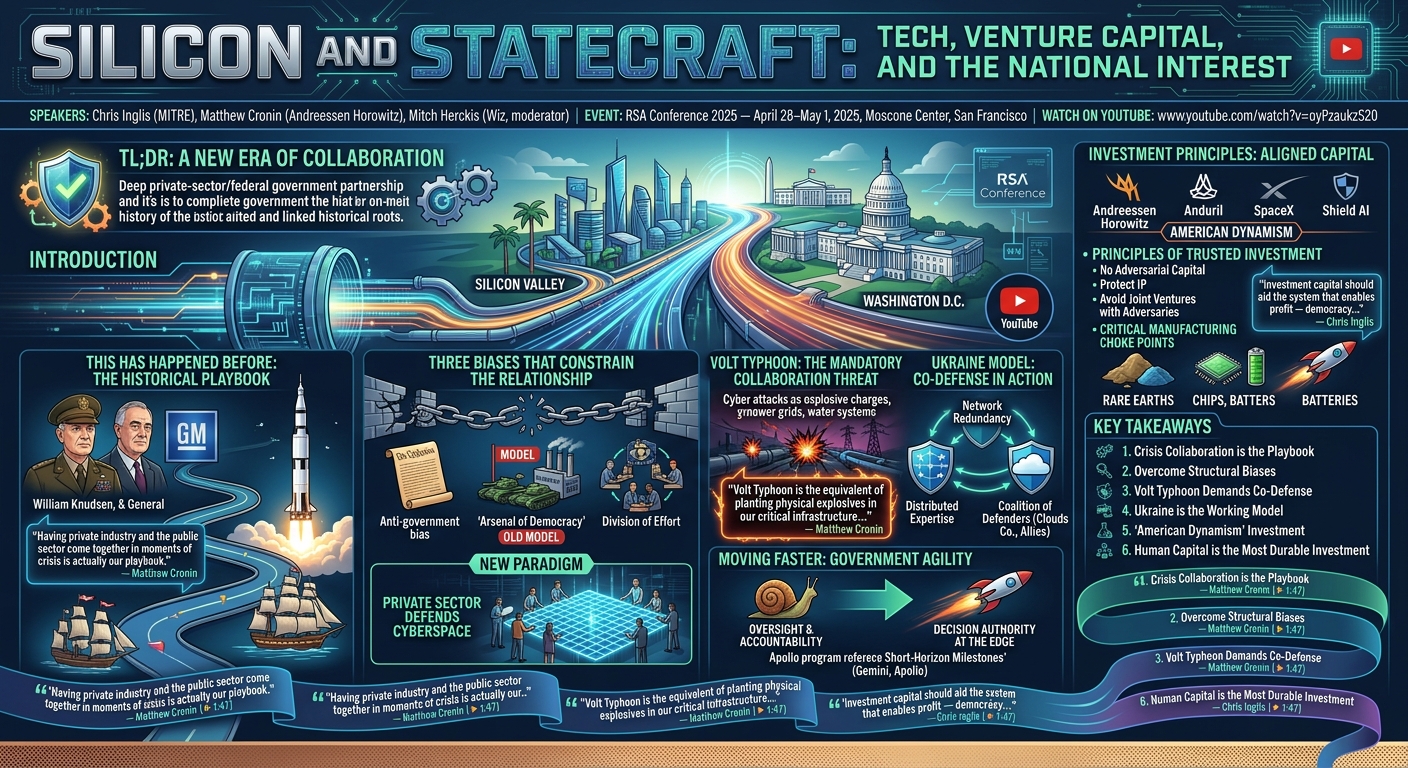
The United States has entered a new era of deep collaboration between the private sector and the federal government — one with clear historical precedent in World War II and the Space Race, and clear urgency in the face of China's comprehensive national power advantage. At RSA 2025, former National Cyber Director Chris Inglis and Andreessen Horowitz senior national security advisor Matthew Cronin argued that this partnership is not optional, that Silicon Valley's long-standing instinct to keep its distance from Washington has become a liability, and that the model for success already exists — it just needs to be rebuilt for the digital age. ---
Key moments
- 4:35 WWII GM CEO-to-general precedent shows private-public crisis partnership is America's playbook
- 6:35 Three structural biases have blocked deep cybersecurity public-private collaboration
- 7:41 Paradigm shift: private sector now defends cyberspace, not just builds it
- 8:36 NotPetya exposed shared infrastructure dependency: DoD logistics paralyzed by private-sector attack
- 14:55 Volt Typhoon equated to PLA planting physical explosives in U.S. infrastructure
- 13:21 China dominates five manufacturing choke points requiring urgent private capital investment
- 18:18 Andreessen Horowitz's American Dynamism thesis: capital aligned with national security needs
- 26:37 Finland's preschool-level media literacy and stockpiling offered as societal resilience model
Silicon and Statecraft: Tech, Venture Capital, and the National Interest
Speakers: Chris Inglis (MITRE), Matthew Cronin (Andreessen Horowitz), Mitch Herckis (Wiz, moderator)
Event: RSA Conference 2025 — April 28–May 1, 2025, Moscone Center, San Francisco
Watch on YouTube: https://www.youtube.com/watch?v=uyPzaukzS20
Reading time: ~9 minutes
TL;DR
The United States has entered a new era of deep collaboration between the private sector and the federal government — one with clear historical precedent in World War II and the Space Race, and clear urgency in the face of China's comprehensive national power advantage. At RSA 2025, former National Cyber Director Chris Inglis and Andreessen Horowitz senior national security advisor Matthew Cronin argued that this partnership is not optional, that Silicon Valley's long-standing instinct to keep its distance from Washington has become a liability, and that the model for success already exists — it just needs to be rebuilt for the digital age.
Introduction
For much of Silicon Valley's history, proximity to the federal government was seen as a business risk rather than an asset. The cultural DNA of the technology industry — forged in the counterculture of the 1960s, the libertarian individualism of the 1980s, and the dot-com era's faith in market solutions over public-sector ones — ran against deep collaboration with Washington. Google reportedly did not hire its first lobbyist until it had already become a verb.
That distance has collapsed — dramatically and rapidly. And at RSA Conference 2025, a conversation between Chris Inglis, the first Senate-confirmed National Cyber Director and now a MITRE Trustee, and Matthew Cronin, Senior National Security Advisor at Andreessen Horowitz, made the case that this collapse is not only necessary but historically familiar. Moderated by Mitch Herckis, Global Head of Government Affairs at Wiz, the session traced the arc from the American Revolution to Volt Typhoon — and argued that getting this partnership right is the defining challenge of the current era.
This Has Happened Before: The Historical Playbook
Matt Cronin opened the session by challenging the implicit assumption in the constant media coverage of Silicon Valley's new relationship with Washington — that this collaboration is novel, perhaps alarming, and without precedent.
"Rather than being something, an aberration that's never happened before, having private industry and the public sector come together in moments of crisis is actually our playbook," Cronin said. ▶ Watch: Historical precedent for public-private collaboration (1:46) The American Revolution, World War II, the Cold War, the Space Race — each of these crises activated the same fundamental pattern: private capital, expertise, and industrial capacity mobilizing alongside government authority and unique intelligence to face a common threat.
Cronin's most pointed historical example involved a question he posed to the audience: he described an immigrant CEO of the country's most successful automotive company, invited to the White House by the president to reform government procurement and manufacturing, who subsequently became a three-star general. The audience guessed Elon Musk. Cronin was describing William Knudsen, GM's CEO in 1940, who did exactly that for FDR — and whose efforts were, in Cronin's assessment, a significant reason the United States won World War II. ▶ Watch: The William Knudsen parallel (3:25)
The point was not partisan. Whether the collaboration is driven by a Democratic or Republican administration, the logic is the same: the United States' adversaries — particularly authoritarian states like China — have all instruments of national power at their immediate disposal. The US has no equivalent mechanism natively. Its answer must be voluntary, meritocratic, and trust-based.
Three Biases That Have Shaped — and Constrained — the Relationship
Chris Inglis, drawing on his decades in national security and the intelligence community, offered a more structural analysis. He identified three deep-seated biases embedded in the American psyche that have both shaped and limited public-private collaboration in cybersecurity.
The first is an anti-government bias baked into the founding documents: the Declaration of Independence and Constitution were designed to enable the private sector and constrain government power. ▶ Watch: Anti-government bias and the founding documents (5:39)
The second is the "arsenal of democracy" model: in past crises, the private sector supplied the material and technology, while the government owned, operated, and deployed it. That model worked for manufacturing tanks and aircraft. It has broken down in cyberspace, where the private sector now not only builds the infrastructure but operates it, defends it, and — increasingly — is the target of attacks. "Private sector now not simply innovates, deploys, sustains, but defends cyberspace," Inglis said. ▶ Watch: Who defends cyberspace now (6:16)
The third bias is treating the relationship as a division of effort — you handle A, I'll handle B — rather than a shared problem. Inglis illustrated this with a 2017 example: when NotPetya struck, it was framed as a Russian cyberattack on Ukraine that happened to hit Maersk and FedEx. But the US Department of Defense, had it needed to mobilize resources to Europe at that moment, could not have done so — because its logistics depend on the same private-sector critical infrastructure that NotPetya had just disrupted. "We're all in common dependent on the same infrastructure." ▶ Watch: NotPetya and shared dependence (6:53)
Volt Typhoon and the Threat That Makes Collaboration Mandatory
Cronin elevated the urgency with a direct account of what US intelligence agencies have testified about Chinese cyber operations. Senior officials — including the heads of CISA, the FBI, NSA, and Cyber Command — have collectively testified that China has pre-positioned capabilities in US critical infrastructure: water systems, power grids, emergency services, oil and gas pipelines, and transportation networks. The purpose, in Cronin's framing, is not espionage but preparation for potential mass casualty events.
"Volt Typhoon is the equivalent of [China] planting physical explosives in our critical infrastructure by the People's Liberation Army," Cronin said. ▶ Watch: Volt Typhoon framing (13:19) No single private company can detect, attribute, or evict a nation-state actor operating across critical infrastructure at that scale. Only a combination of government intelligence and private-sector operational access can close the OODA loop — observe, orient, decide, and act — fast enough to matter.
Inglis reinforced this with the Ukraine model as an exemplar of what successful co-defense looks like. Ukraine's cyber resilience against Russian attacks relied on three elements: network segmentation and redundancy, world-class expertise distributed across the ecosystem, and a coalition of co-defenders — including private companies, allied governments, and cloud providers — who made the calculation that to defeat one, an attacker would have to defeat all. ▶ Watch: Ukraine's cyber defense model (16:08)
Investment Principles: What "Aligned" Capital Looks Like
The conversation shifted in the second half to the venture capital dimension — what it means for investors like Andreessen Horowitz to factor national interest into investment decisions, and what principles should govern the flow of capital into strategically important technology.
Cronin was direct about Andreessen Horowitz's approach: the firm has avoided investments in China and Russia — not because of legal requirements but because of capital controls, IP theft risk, and the fundamental incompatibility of those markets with the interests of a technology firm operating in democratic societies. The firm has instead concentrated on what it calls "American Dynamism" — investments in companies like Anduril, SpaceX, Saronic, and Shield AI that directly address national security and critical industrial needs. ▶ Watch: American Dynamism investment philosophy (20:07)
Inglis offered a values-based framework for evaluating investment alignment: the core principle is that investment capital should aid the system that enables profit — democracy, rule of law, free markets — rather than undermine it. He referenced what he called "Principles of Trusted Investment": no capital from adversarial governments, no IP giveaways to entities that will strip and reverse-engineer technology, no joint ventures that require compromising core intellectual property.
Cronin identified specific choke points where private capital is most urgently needed: rare earth refining, legacy semiconductor manufacturing, battery production, and pharmaceutical active pharmaceutical ingredient (API) manufacturing — all areas where China has established dominant positions that create strategic vulnerabilities. ▶ Watch: Manufacturing choke points (14:55)
Moving Faster: The Government Side of the Equation
The final section of the discussion addressed a familiar frustration: the government moves too slowly to adopt technology that could materially improve its cybersecurity posture. Inglis acknowledged the complaint but pushed back on the framing.
Attackers, he noted, operate without permissions or review processes. Defenders — whether in government or large enterprises — are constrained by oversight and accountability requirements that slow adoption. The answer is not to remove those constraints but to push more decision-making authority to the edge, where operators have direct situational awareness, while maintaining accountability at the center. ▶ Watch: Seeding initiative to the edge (22:36)
Cronin cited two examples of government moving fast when it chose to: the FBI's rapid adoption of new investigative tools, and the Apollo program's model of flattening management structures, embracing failure, and setting aggressive short-horizon milestones (Redstone, Gemini, Apollo) within a long-term strategic context. "When the government decides that something is important enough, it can move very quickly," Cronin said. ▶ Watch: Apollo program model for government agility (23:14)
Both speakers agreed that the single most durable investment the US can make is in human capital — specifically, in critical thinking skills that allow people to evaluate information, resist manipulation, and operate effectively in contested information environments. Inglis pointed to Finland as a model: a country that teaches media literacy and critical thinking from preschool, stockpiles essential supplies, and has built societal resilience as a deliberate national strategy.
Notable Quotes
"Having private industry and the public sector come together in moments of crisis is actually our playbook."
— Matthew Cronin, Andreessen Horowitz ▶ 1:47
"Private sector now not simply innovates, deploys, sustains — but defends cyberspace."
— Chris Inglis, MITRE ▶ 6:16
"If you've got one end of a saltwater crocodile and I've got the other end, why the hell wouldn't we collaborate to do something about that?"
— Chris Inglis, MITRE ▶ 8:38
"Volt Typhoon is the equivalent of planting physical explosives in our critical infrastructure by the People's Liberation Army."
— Matthew Cronin, Andreessen Horowitz ▶ 13:19
"You want to be so helpful that they can't imagine life without us."
— Chris Inglis, MITRE ▶ 16:26
Key Takeaways
- Public-private collaboration in crisis is America's historical playbook, not a novel or alarming development. The William Knudsen/WWII precedent shows how deep cooperation between private industry and government can be decisive — and bipartisan.
- Three structural biases — anti-government, arsenal-of-democracy, and division-of-effort — have historically limited the depth of collaboration in cybersecurity. All three need to be consciously overcome.
- Volt Typhoon represents a categorical threat that no private company can address alone. China's pre-positioning in critical infrastructure requires a co-defense model that combines government intelligence with private-sector operational access.
- Ukraine's cyber defense is the working model: network redundancy, distributed expertise, and a coalition of co-defenders who raise the cost of attack beyond what any adversary is willing to pay.
- "American Dynamism" investing — capital directed at companies rebuilding US defense industrial base, critical manufacturing, and cybersecurity infrastructure — represents a concrete mechanism for aligning private capital with national interest.
- Human capital is the most durable investment. Critical thinking skills, media literacy, and the ability to operate in contested information environments are the foundational layer beneath all technology solutions — and they take a generation to build.
Reviews
Dr. Zero (Offensive Security Researcher) — SOLID
Inglis and Cronin make the historical case for public-private cyber collaboration with genuine intellectual depth — the William Knudsen parallel is not a rhetorical trick, it's an accurate account of how the U.S. has mobilized private industrial capacity in past crises. The Volt Typhoon threat framing is credible because both speakers understand the actual intelligence. Strong content held back by a slightly unfocused second half that drifts into VC portfolio philosophy.
Heather Calloway (CISO) — STRONG ACCEPT
Chris Inglis and Matthew Cronin of Andreessen Horowitz argue that US public-private partnership in cybersecurity has historical precedent — World War II's William Knudsen is the parallel — and that Volt Typhoon's prepositioning in civilian critical infrastructure makes deep collaboration not optional. Three structural biases have historically constrained the partnership; all three need to be overcome.