Vulnerable Sweden
Lucas Lundgren (Offensive Security Specialist and Penetration Tester), Vincent
SEC-T 2026 · Day 2 · Main hall
Overview
In their compelling SEC-T talk, "Vulnerable Sweden," Lucas Lundgren and Vincent Vukovic expose the alarming state of cybersecurity within Sweden's public sector and its extensive supply chain. The presentation reveals a landscape deeply compromised by leaked credentials, pervasive information-stealing malware, and readily exploitable vulnerabilities. This research, based entirely on publicly available data and conducted without any active hacking, underscores a critical national security concern, particularly given Sweden's rapid digitalization.
Key moments
- 3:00 Research scope: 400 public sector, 200 IT suppliers
- 5:45 All municipalities have 420,000+ leaky credentials
- 14:50 Visualizing supplier dependencies and attack surface
- 18:00 Thousands of critical vulnerabilities in exposed services
- 24:40 Security is a human problem, not just technical
- 42:00 Lack of consequences for poor security is the problem
- 44:30 Moderator: hybrid warfare, take this seriously
Vulnerable Sweden
Speakers: Lucas Lundgren (Offensive Security Specialist and Penetration Tester), Vincent Vukovic (CISO)
Conference: SEC-T
YouTube: https://www.youtube.com/watch?v=_GfN5e6ndVE
Overview
In their compelling SEC-T talk, "Vulnerable Sweden," Lucas Lundgren and Vincent Vukovic expose the alarming state of cybersecurity within Sweden's public sector and its extensive supply chain. The presentation reveals a landscape deeply compromised by leaked credentials, pervasive information-stealing malware, and readily exploitable vulnerabilities. This research, based entirely on publicly available data and conducted without any active hacking, underscores a critical national security concern, particularly given Sweden's rapid digitalization.
The speakers, seasoned security professionals with decades of combined experience, highlight that the public sector's reliance on technology, often managed by third-party suppliers, creates a vast attack surface. Their findings illustrate how easily attackers can gain access not through sophisticated exploits, but by simply leveraging existing breaches and neglecting fundamental security hygiene. The talk serves as a stark warning, urging a fundamental shift in how public bodies and their partners approach security, moving beyond mere compliance to proactive defense and addressing systemic human and technical vulnerabilities.
Why this talk matters extends beyond Sweden's borders. It presents a case study applicable to any modern, digitized nation-state. The interconnectedness of public services, critical infrastructure, and a sprawling network of suppliers creates a "blast radius" where a single compromise can cascade through vital systems. Lundgren and Vukovic's research not only unearths the extent of this compromise but also provides actionable insights for defenders, emphasizing the urgent need for a cultural and strategic overhaul in cybersecurity practices.
Background
▶ Watch: Research scope: 400 public sector, 200 IT suppliers (3:00)
Sweden has long been lauded for its advanced digitalization efforts, integrating technology deeply into its public sector. This includes a vast ecosystem of over 2,000 public sector organizations, encompassing municipalities, regions (responsible for healthcare and public transport), universities (critical for research and strategic services), agencies (like Trafikverket for infrastructure), and publicly owned companies. Supporting this intricate web are over 300,000 suppliers, a significant portion of Sweden's private sector. While this digital transformation has brought efficiency, it has also inadvertently created a complex and often vulnerable attack surface.
The core problem, as articulated by Lundgren and Vukovic, stems from several factors. Many municipalities, particularly smaller ones, operate with "tiniest budgets" for security, lacking the necessary staff and competency to address modern threats. This budgetary constraint often leads to the neglect of security fundamentals and the accumulation of technical debt (or teknikskuld as it's known in Sweden). Furthermore, a prevalent issue is the widespread practice among employees of reusing work email addresses for personal online services. When these personal services suffer breaches, the work credentials become compromised, creating an easy entry point for attackers.
The research methodology employed by Lundgren and Vukovic is crucial to understanding their findings. They explicitly state that "nothing of what we will show you required an attack" and that their work is "based on publicly available data." This data was sourced from four primary categories:
- Leaked Credentials: Emails, passwords, and hashes obtained from known data breaches across various online services.
- Infected Employees and Devices: Data from info stealer malware logs, indicating compromised systems within public sector organizations and their suppliers.
- Exposed Internet Assets: Identification of publicly accessible services with known, unpatched vulnerabilities.
- Supplier Blast Radius: Mapping the extensive dependencies and relationships between public sector organizations and their IT suppliers to understand the potential cascading effects of a single breach.
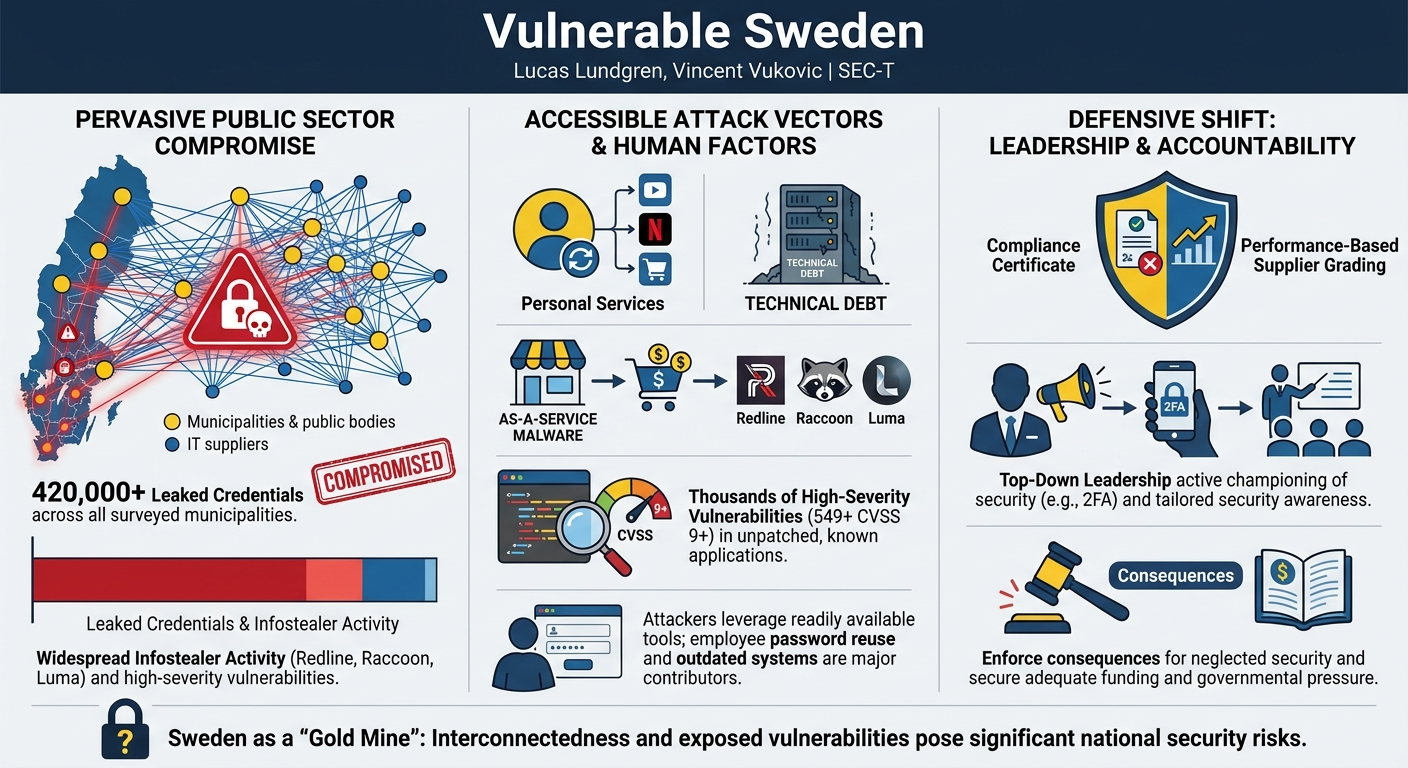
Their investigation focused on a significant, albeit partial, slice of this ecosystem: approximately 400 public sector organizations and 200 IT suppliers. This subset alone revealed nearly 677,000 breach records and a dense network of dependencies, visually represented as a graph where yellow nodes denote public sector entities, blue nodes are suppliers, and connecting lines signify trust relationships. This foundational work demonstrates that the security posture of Sweden's public sector is not merely theoretical but demonstrably compromised through easily accessible, open-source intelligence.
Key Findings
▶ Watch: Visualizing supplier dependencies and attack surface (14:50)
The research unveiled a pervasive and deeply concerning level of compromise across the Swedish public sector. The sheer volume of exposed data and vulnerabilities paints a grim picture, with all surveyed entities showing significant security deficiencies.
Municipalities: The Foundation of Vulnerability
Out of 290 municipalities, the team examined 248, and every single one was found to have leaky credentials. This amounted to a staggering 420,000 leaked credential records. Beyond simple leaks, municipalities also showed significant info stealer signals, with 173 employee stealer signals and 7,000 employee info stealer records spanning from 2007 to 2026. These records often contained clear text passwords, such as "password," "sommar20" (summer 20), and "skola123" (school 123), highlighting a severe lack of basic password hygiene. A peculiar finding was the password "the hatch," linked to 119 municipalities and 26 suppliers across 699 leaks, strongly suggesting a shared, vulnerable third-party, non-EU school software. The case of Alv og Brønnøy municipality was highlighted, showing 474 employees, 8,272 leaked credentials, and 70 mapped third-party supplier relationships, with attackers noted to have accessed sds.alvoro.sds through infostealer logs.
Beyond Municipalities: Regions, Universities, and Agencies
The pervasive issues extended to other critical public sector bodies:
- Regions: Responsible for healthcare and public transport, regions like Västra Götaland (one of the largest) and Region Skåne were found to have thousands of suppliers and significant exposure. Västra Götaland, for instance, had 86 IT suppliers within the research's scope, out of over a thousand total, demonstrating a vast attack surface through its supply chain.
- Universities: Key institutions like Chalmers and Umeå Universitet were identified as highly exposed. Universities are not only vital for research but also sell services to other public sector organizations, making their compromise particularly impactful.
- Agencies: Major agencies such as Trafikverket (infrastructure), Arbetsförmedlingen (employment), Försäkringskassan (social insurance), and Lantmäteriet (land surveying) also demonstrated widespread credential exposure and infostealer activity.
Common Breach Sources and the "Log In" Mentality
The sources of leaked credentials were diverse, often stemming from employees reusing work emails for personal accounts. Top breach sources included Apollo (travel bookings), Conva, Dropbox (often considered shadow IT), SoundCloud, Trello (project management), and surprisingly, Under Armour, Ketout Pro, and Movie Box Pro. This reinforces the speakers' assertion that "you don't hack, you just log in," as a vast repository of valid credentials exists from past breaches, ready to be exploited.
The Supplier Blast Radius: A Critical Weak Link
The research heavily emphasized the supplier blast radius, illustrating how a breach in one supplier can impact numerous public sector entities. The median municipality has 23 IT suppliers, while larger regions can have over a thousand. The investigation identified 33 suppliers with employee infostealer signals, affecting 2,156 employees. Furthermore, 97 suppliers were found to serve 50 public bodies, creating extensive downstream dependencies. A single, unnamed "major" supplier was noted to have leaked credentials, malware running in its network, and exposed vulnerabilities easily detectable online, highlighting the severe risk posed by critical third-party providers.
Widespread Vulnerabilities
Beyond credential leaks and malware, the research uncovered 3,606 vulnerability findings on exposed services. A significant portion, 549, carried a CVSS score of 9 or higher, indicating critical severity. These high-severity vulnerabilities directly affected 57 public bodies, with 34 public body IPs hosting at least one such finding. A single university alone harbored 579 findings, 136 of which had a CVSS score of 9 or higher. The talk concluded that with 394 public bodies, 200 suppliers, and 10,452 dependencies, Sweden is indeed "a gold mine for attackers."
Technical Deep Dive
▶ Watch: Thousands of critical vulnerabilities in exposed services (18:00)
The technical aspects of the compromise highlighted in "Vulnerable Sweden" revolve around two primary vectors: sophisticated info stealer malware and a wide array of high-severity exposed vulnerabilities. The speakers stressed that these attack vectors are often accessible to attackers without requiring advanced technical prowess, thanks to the "as-a-service" model and publicly known weaknesses.
Info Stealer Malware: Ransomware-as-a-Service (RaaS)
The research identified specific families of info stealer malware prevalent in the compromised networks:
- Redline: A highly active info stealer known for harvesting credentials, credit card information, and other sensitive data from browsers and local files.
- Raccoon (v2): Another prominent info stealer that collects system information, browser data (cookies, passwords), cryptocurrency wallet data, and more. It is often distributed via phishing campaigns and malvertising.
- Luma: A newer, yet highly effective, info stealer designed to exfiltrate a wide range of sensitive data from compromised systems.
Lucas and Vincent underscored that these are not merely generic viruses but often "paid ransomware" or "info stealer as a service" offerings. This Ransomware-as-a-Service (RaaS) or Malware-as-a-Service (MaaS) model democratizes cybercrime, allowing individuals or organized crime groups without deep technical knowledge to "purchase access to malware, deploy it, and then... reap the benefits, sell it." This means that many of the observed infections are likely part of targeted attacks, orchestrated by professional cybercriminals leveraging readily available tools and infrastructure, including rented command-and-control (C2) servers. The info stealer data, often obtained from law enforcement takedowns of C2 servers or shared with antivirus companies, provided concrete evidence of these compromises.
Pervasive and Critical Vulnerabilities
The analysis of exposed services revealed a troubling number of critical vulnerabilities, many with CVSS scores of 9 or higher. While specific CVE numbers were anonymized to prevent direct targeting, the classes of vulnerabilities are highly indicative of severe risk:
- Memory Corruption: These vulnerabilities can lead to unpredictable program behavior, often a precursor to more severe exploits.
- Remote Code Execution (RCE): The ability for an attacker to execute arbitrary code on a server. This is one of the most critical vulnerability types, offering full control over a compromised system. The speakers noted two distinct RCE classes, one directly allowing code execution and another stemming from memory corruption.
- Database Injection (SQL Injection): This allows attackers to interact directly with the backend database, enabling them to extract sensitive information, modify data, or even execute commands on the database server.
- Authentication Bypass: Flaws that allow attackers to circumvent authentication mechanisms, gaining unauthorized access to accounts or services without valid credentials. This can lead to "complete takeover of accounts."
- Path Traversal: Vulnerabilities that permit attackers to access files and directories outside of the intended web root directory, potentially leading to the disclosure of sensitive system files.
- Cross-Site Scripting (XSS): A common web vulnerability that allows attackers to inject malicious scripts into web pages viewed by other users, often used for session hijacking or defacement. The speakers noted "everybody's got it."
- Single Sign-On Bypass: Specific to environments utilizing SSO, these flaws allow bypassing the SSO mechanism itself, potentially granting access without a valid account.
- Sandbox Escape: Critical for containerized or virtualized environments (e.g., "J Aquarium"), these vulnerabilities allow an attacker to break out of a restricted sandbox environment and gain access to the underlying host system.
Many of these vulnerabilities were not newly discovered through active fuzzing but were "known vulnerabilities in known applications." This implies that public sector organizations and their suppliers are running outdated software versions with publicly documented flaws that remain unpatched. The age of some vulnerabilities mentioned (though dates were not fully specified in the transcript, the implication was "old") further compounds this issue, suggesting a systemic failure in patch management and lifecycle security. The accumulation of such widespread, high-severity vulnerabilities, combined with the presence of active info stealers and leaked credentials, creates a highly exploitable environment.
Demo / Proof of Concept
▶ Watch: Lack of consequences for poor security is the problem (42:00)
While Lucas Lundgren and Vincent Vukovic's presentation did not feature a live technical demonstration of an exploit or a proof-of-concept hack, it did include a powerful visual representation of their findings. The speakers utilized a network graph to illustrate the intricate web of dependencies between public sector organizations (represented by yellow nodes) and their IT suppliers (blue nodes). The lines connecting these nodes visually depicted the "relationships, which imply trust" between entities.
This visualization served as a critical "proof of concept" for their research, demonstrating the interconnectedness and the potential "supplier blast radius" that a single compromise could unleash. By mapping these relationships with the associated data points – such as leaked credentials, infostealer signals, and identified vulnerabilities – the speakers effectively showcased the systemic nature of the problem without resorting to active penetration testing. Their methodology was strictly limited to publicly available data, reinforcing the ease with which this level of insight can be obtained by threat actors.
Defensive Implications
▶ Watch: Moderator: hybrid warfare, take this seriously (44:30)
The "Vulnerable Sweden" talk concluded not with a sense of doom, but with a powerful call to action, offering critical defensive implications for public sector organizations and their suppliers. The speakers acknowledged that traditional advice like "change passwords," "remove viruses," and "patch" often falls short, emphasizing the need for a more systemic and holistic approach.
1. Shift Beyond Compliance: Performance-Based Supplier Grading
A central tenet of their recommendations is to move beyond mere compliance certifications like ISO 27001 and GDPR. Lucas Lundgren asserted that ISO 27001, while a standard, is often "a piece of paper" that doesn't guarantee security. Instead, public sector bodies must start ranking and grading their suppliers based on their actual security posture and historical performance. This involves assessing real-world indicators like past breach records (e.g., "23,000 leaked records") and evidence of active malware infections, rather than solely relying on certifications. This shift would provide a genuine incentive for suppliers to invest in robust security, as "the hacker's not going to look at the ISO 27001 and say, 'Oh, I'm not going to hack them.'"
2. Address Technical Debt (Teknikskuld) and Prioritize Remediation
The pervasive presence of old, unpatched software and known vulnerabilities highlights a significant issue with technical debt. Organizations need to actively "clean up what we in Sweden so nicely call teknikskuld," which encompasses legacy systems and neglected security configurations. This requires dedicated effort and resources to systematically identify and mitigate risks from outdated technology.
3. Top-Down Governmental and Leadership Involvement
Both speakers stressed that change must come "from the top." Governmental involvement is crucial to "put pressures on the municipalities and allow them some budget" and provide the necessary competence. Leaders, particularly, must embody security principles. Vincent Vukovic stated that "this is not a mainly technical problem to be fixed. This is a human problem," emphasizing the need for top management to be involved and for employees to receive relevant information. Lucas added, "Barn gör inte som man säger, dom gör som man gör" (Kids don't do as you say, they do what you do), urging leaders to be the first to adopt security measures like two-factor authentication (2FA), learn the friction, and then teach their teams.
4. Continuous and Tailored Security Awareness
Security cannot be a one-time effort. It needs to be "ongoing and looping" because "the attacks changes" and new threats like AI emerge. Furthermore, security awareness training must be tailored to specific roles and the information employees have access to, rather than generic campaigns. This makes the training more relevant and effective, addressing the "human factor" that contributes significantly to breaches (e.g., password reuse).
5. Implement Consequences for Neglected Security
A critical missing piece, as highlighted by an audience question and agreed upon by the speakers, is the lack of consequences for poor security. Vincent Vukovic argued that "there's not really any consequences" for organizations with poor security posture. The idea of naming and shaming suppliers or public bodies that fail security audits was proposed as a necessary incentive. Lucas added that consequences should fall "on the correct person" at the leadership level, not on "Jim the intern," stressing that leaders are responsible for trickling down secure practices.
6. Financial Justification and Budget Allocation
To convince decision-makers, especially in budget-constrained municipalities, the conversation needs to shift from technical jargon (e.g., CVSS scores) to financial impact. Lucas suggested using "scare tactics" by quantifying the potential costs of a breach (e.g., "2.8 million for the first three months"). Emphasizing the political fallout and loss of mandate for leaders can also be effective in securing budgets for security initiatives. Legislation that mandates security investments at the municipal board level was also proposed.
7. Addressing the Cybersecurity Talent Gap
Vincent Vukovic pointed out that even with budget and top-level support, a significant challenge remains: "where do we find these people?" The shortage of skilled cybersecurity professionals is a global issue, and events like SEC-T play a vital role in fostering interest and developing talent to help these vulnerable organizations.
8. Start Small and Prioritize
For overwhelmed smaller organizations, the advice is not to do everything at once but to "do one important thing, one important change." This pragmatic approach can at least mitigate some risks and build momentum for further improvements.
The talk concluded with a call for collective effort, including public campaigns and the potential for a "volunteer cyber civil defense core" to assist municipalities, underscoring that the fight against cyber threats in Sweden requires a comprehensive, multi-faceted strategy.
Key Takeaways
- Pervasive Compromise: Sweden's public sector and its extensive supply chain are deeply compromised, with all surveyed municipalities showing leaky credentials (420,000 records) and widespread infostealer activity.
- Accessible Attack Vectors: Attackers leverage readily available tools and data, including "as-a-service" info stealers like Redline, Raccoon, and Luma, and thousands of high-severity vulnerabilities (549 with CVSS 9+) in unpatched, known applications.
- Human Factor and Technical Debt: Employee password reuse for personal services and accumulated technical debt (outdated software, neglected security) are major contributors to the widespread vulnerabilities, exacerbated by insufficient budgets and generic security awareness.
- Beyond Compliance: Current security certifications (e.g., ISO 27001) are insufficient. A critical shift is needed towards performance-based supplier grading and continuous, role-specific security education.
- Top-Down Leadership and Accountability: Effective change requires strong governmental pressure, adequate funding, and leaders who actively champion security practices (e.g., 2FA adoption) and enforce consequences for neglected security.
- Sweden as a "Gold Mine": With 394 public bodies, 200 suppliers, and over 10,000 dependencies, the interconnectedness and exposed vulnerabilities make Sweden a highly attractive target for cyber adversaries, posing significant national security risks.
About the Speaker(s)
Lucas Lundgren is an Offensive Security Specialist and Penetration Tester with over 30 years of experience in the field. His extensive career includes working for major technology companies like Microsoft and Apple, where he specialized in "breaking things." Lundgren is known for his direct and pragmatic approach to cybersecurity, often employing "scare tactics" to highlight the real-world impact of security vulnerabilities.
Vincent Vukovic is a security professional whose day job involves CISO (Chief Information Security Officer) work. He describes himself as "firmly rooted in the actual weeds of security," having started in the field around the age of 10. Vukovic emphasizes the human aspect of cybersecurity, advocating for top-down leadership involvement and tailored security awareness programs to address what he identifies as primarily a human problem, not just a technical one.
Reviews
Dr. Zero (Offensive Security Researcher) — WEAK
Lundgren and Vukovic did the OSINT grunt work to prove what we already know: the public sector is running on duct tape and reused passwords. It's a solid reality check that maps the Swedish supply chain blast radius using nothing but infostealer logs and exposed CVEs. You won't learn a new exploit technique here, but it's a competent blueprint for demonstrating systemic risk.
Heather Calloway (CISO) — MUST SEE
This is a devastating, OSINT-based mapping of Sweden's public sector supply chain that proves our current approach to third-party risk is fundamentally broken. By correlating infostealer logs across hundreds of IT suppliers, the speakers demonstrate how paper compliance like ISO 27001 masks systemic exposure. This is mandatory viewing for any leadership team operating a sprawling vendor ecosystem.