SOC Humor: How to Use Memes and Chaos to Improve Detection
Tyler Moody
ShmooCon XX (Final) · Day 1 · One Track Mind
Overview
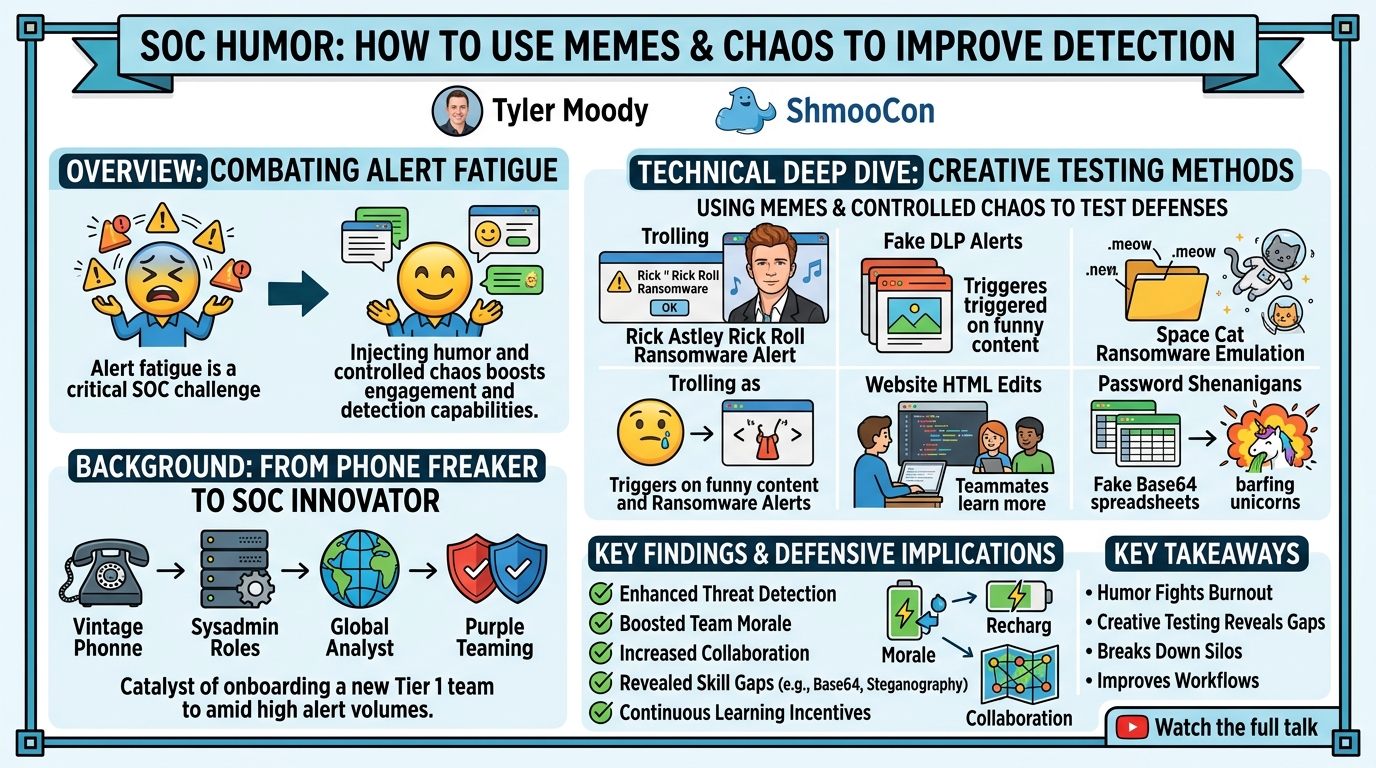
In the demanding world of cybersecurity operations, alert fatigue stands as a pervasive and critical challenge, threatening the efficacy of even the most sophisticated Security Operations Centers (SOCs). Tyler Moody's ShmooCon talk, "SOC Humor: How to Use Memes and Chaos to Improve Detection," addresses this very issue head-on, proposing an unconventional yet highly effective approach: injecting humor and controlled chaos into defensive security testing. Moody, a seasoned security analyst, argues that by leveraging creative, often humorous, attack simulations and meme-based alerts, SOC teams can combat burnout, enhance engagement, and ultimately sharpen their detection capabilities against real-world threats.
Key moments
- 0:00 Speaker introduction and talk overview
- 2:00 Addressing alert fatigue with humor and chaos
- 3:15 Using meme-based alerts for engagement and testing
- 4:30 Methodology: adding controlled chaos and trolling teams
- 6:00 Practical examples: website HTML and fake password trolling
- 6:30 Creative testing: steganography and long file paths
- 8:45 Incorporating humor into DLP and PHI alert testing
SOC Humor: How to Use Memes and Chaos to Improve Detection
Speakers: Tyler Moody
Conference: ShmooCon
YouTube: https://www.youtube.com/watch?v=wXbnUm88IJw
Overview
In the demanding world of cybersecurity operations, alert fatigue stands as a pervasive and critical challenge, threatening the efficacy of even the most sophisticated Security Operations Centers (SOCs). Tyler Moody's ShmooCon talk, "SOC Humor: How to Use Memes and Chaos to Improve Detection," addresses this very issue head-on, proposing an unconventional yet highly effective approach: injecting humor and controlled chaos into defensive security testing. Moody, a seasoned security analyst, argues that by leveraging creative, often humorous, attack simulations and meme-based alerts, SOC teams can combat burnout, enhance engagement, and ultimately sharpen their detection capabilities against real-world threats.
The talk provides a compelling case for moving beyond traditional, often monotonous, security exercises. Moody demonstrates how strategic "trolling" and light-hearted disruption can not only reveal critical blind spots in security tooling and workflows but also foster a more collaborative and resilient team culture. This methodology is particularly relevant for new or struggling SOC teams, where breaking down information silos and promoting shared knowledge is paramount. By making security testing an engaging, even entertaining, experience, Moody illustrates how organizations can transform a source of frustration into an opportunity for growth and improved security posture.
Moody's presentation is a call to action for defenders to embrace creativity and a playful adversarial mindset. It highlights that effective security is not solely about advanced technology but also about human factors: team morale, continuous learning, and an environment that encourages proactive engagement. In an industry often characterized by high stakes and intense pressure, this talk offers a refreshing perspective, proving that a touch of humor and controlled chaos can be a powerful antidote to the inherent challenges of modern cybersecurity.
Background
▶ Watch: Speaker introduction and talk overview (0:00)
The modern Security Operations Center (SOC) faces an relentless barrage of alerts daily, stemming from a multitude of security tools, network devices, and endpoints. This alert overload, combined with the often repetitive nature of incident response, frequently leads to alert fatigue—a state where security analysts become desensitized to warnings, increasing the likelihood of legitimate threats being overlooked or mishandled. The consequences extend beyond missed incidents, contributing significantly to analyst burnout, high turnover rates, and a general decline in morale within SOC teams. Traditional training and testing methodologies, while foundational, often fail to address the psychological toll of this constant vigilance or to fully engage analysts in a way that truly sharpens their skills and fosters a proactive mindset.
Tyler Moody, with over a decade of experience spanning IT and information security, recognized these systemic issues. His journey from a "90s phone freaker" to a global security analyst, encompassing roles from sysadmin to ISO management and defensive security testing, provided him with a unique perspective on both offensive and defensive security paradigms. Specializing in emulation, purple teaming, password auditing, and building real-world testing frameworks, Moody developed a philosophy centered on "unconventional defensive methods by offensive means." This background primed him to challenge the status quo and seek innovative solutions to entrenched problems like alert fatigue.
The specific catalyst for the methodologies presented in this talk arose during Moody's experience onboarding a new Tier 1 SOC team. This transition was marked by significant operational chaos—a high volume of alerts, continuous deployments of new detection rules, and an urgent need for tuning existing systems. Rather than succumbing to the overwhelming nature of this environment, Moody chose to amplify the chaos in a controlled manner, injecting humor and creative "trolling" into his testing regimen. His hypothesis was that by disrupting the monotony and introducing unexpected elements, he could not only stress-test the systems and the team's capabilities but also transform a potentially demoralizing situation into an engaging, learning-rich experience. This approach aimed to break down information silos, promote shared knowledge, and ultimately build a more resilient and cohesive security team.
Key Findings
▶ Watch: Using meme-based alerts for engagement and testing (3:15)
Tyler Moody's unconventional approach to SOC operations yielded several significant findings, demonstrating the tangible benefits of integrating humor and controlled chaos into security testing and team engagement:
- Enhanced Detection Capabilities: The primary finding was a measurable improvement in threat detection. By introducing bizarre and unexpected attack simulations, Moody's team was forced to scrutinize alerts more closely, leading to the identification and remediation of previously overlooked blind spots in their XDR (Extended Detection and Response) and DLP (Data Loss Prevention) configurations. For instance, creative payloads and ridiculously long file paths specifically tested the limits of existing rules and logging.
- Boosted Team Engagement and Morale: Humor proved to be a powerful antidote to alert fatigue. Meme-based alerts and playful attack scenarios broke the monotony of routine operations, fostering a more attentive and engaged SOC team. This shift from a reactive, often tedious, workflow to an interactive, game-like challenge significantly improved morale and reduced the psychological burden of constant vigilance.
- Breakdown of Information Silos: The collaborative nature of deciphering humorous or unusual alerts encouraged cross-functional communication and knowledge sharing. Analysts who might not typically interact began discussing unusual findings, leading to a more inclusive environment where collective intelligence was leveraged to solve novel problems. Moody observed that even simple actions like editing website HTML prompted teammates to learn new skills collaboratively.
- Improved Alert Response Workflows: The unpredictable nature of the "trolling" exercises forced the SOC to refine their incident response playbooks and accelerate their analysis. When faced with a ransomware alert ending in
.meowor an email detailing "smurfitis," analysts had to quickly assess the situation, determine its legitimacy (or lack thereof), and follow established protocols, thereby strengthening their response muscle memory. - Identification of Skill Gaps and Learning Incentives: The testing exposed areas where team members, particularly new hires, lacked specific technical skills, such as understanding Base64 encoding or steganography. Rather than being punitive, these discoveries became incentives for learning, with team members actively seeking to acquire new knowledge to understand the humorous alerts. This fostered a culture of continuous learning and self-improvement.
- Cultivation of a Culture of Engagement: Beyond individual skill improvements, the overarching reward was the development of a strong culture of engagement. By making security fun and rewarding proactive efforts (e.g., with DoorDash gift cards for impressive responsiveness), Moody created an environment where team members felt valued, challenged, and motivated to contribute actively to the organization's security posture.
- Creativity Reveals Detection Gaps: The talk underscored that relying solely on known threat patterns can create vulnerabilities. By employing "other methods not typically used by ransomware threat actors or groups," Moody demonstrated that creative, outside-the-box thinking can reveal gaps that standard threat intelligence might miss.
Technical Deep Dive
▶ Watch: Methodology: adding controlled chaos and trolling teams (4:30)
Moody's approach is rooted in a series of creative, low-risk, and often humorous technical maneuvers designed to test defenses and engage SOC teams. These methods can be broadly categorized into several key areas:
Meme-Based Alerts and Humorous Payloads
A foundational element of Moody's strategy involves integrating humor directly into alerts and simulated attack payloads. This serves to immediately grab attention and break the cycle of alert fatigue.
- Ransomware Detected / Rick Astley: One example cited was a ransomware detection alert that, upon triggering, would display a Rick Astley "Rick Roll" meme. This transforms a potentially alarming alert into an unexpected, humorous moment, prompting a different kind of engagement from the analyst.
- Fake DLP Alerts: When testing Data Loss Prevention (DLP) systems, Moody used humor to highlight misconfigurations or blind spots. These weren't just simple text strings but often contextually funny content designed to trip specific filters.
Humorous Attack Simulations
Moody devised various scenarios to simulate adversarial activity in a playful yet effective manner:
- Space Cat Meme Payloads: For ransomware emulation, Moody created thousands of dummy files and directories loaded with space cat memes. Instead of typical ransomware extensions like
.crypto, he used bizarre and humorous ones such as.elmerfuddhasasurprisinglyhighiqor.meow. This forced analysts to investigate unusual file extensions and content, testing their ability to identify malicious behavior even when presented in an absurd package. - Bizarre Readme Files: Traditional ransomware typically leaves a
README.txtwith instructions. Moody experimented with making these readme files "bizarre" and "crazy," pushing the boundaries of what an analyst might expect to encounter, thus testing their critical thinking and incident response procedures. - Website HTML Trolling: A simple yet effective tactic involved editing the HTML of internal websites. This revealed that many teammates, even in infosec, lacked fundamental understanding of web technologies, prompting them to learn how to identify and revert such changes.
Password Threat Hunt Shenanigans
To improve password detection and test analysts' understanding of common encoding methods, Moody deployed several "shenanigans":
- Cleartext and Encoded Fake Passwords: He created fake password lists in cleartext Excel spreadsheets and then took it a step further by encrypting them using Base64 encoding. This exercise exposed a surprising lack of familiarity with even simple Base64 among new professionals and, unfortunately, in some more experienced teams. The goal was to see if analysts would correctly identify the encoded data and attempt to decode it, rather than mistaking it for an actual password.
- "Barfing Unicorns" Excel Sheet: To add an extra layer of humor and unexpectedness, Moody included a second Excel sheet filled with memes, such as "barfing unicorns," alongside the fake password data. This further tested analysts' ability to discern relevant information from noise.
Steganography and Obfuscation
Moody experimented with steganography to create custom alerts, challenging teams to uncover hidden messages. This technique, often used by real adversaries to conceal data, served as an educational tool, encouraging analysts to learn about different data hiding methods. Similarly, using ridiculously long file paths (e.g., C:\really\long\path\nothingtoseehere) and dummy files with funny usernames tested the limits of XDR and other security tools in detecting deeply buried or obscure files, revealing potential blind spots in logging and detection rules.
Data Loss Prevention (DLP) Testing with GPT
One of the most elaborate examples involved testing DLP systems with a highly creative payload:
- "Smurfitis" Email Payload: Moody used GPT (Generative Pre-trained Transformer) to create a 500-word email detailing an "alarmingly bizarre" rare psychological disorder known as "smurfitis." This email was specifically designed to contain elements that would trigger PHI (Protected Health Information) alerts, not just through explicit medical IDs but also through its descriptive content. This tested the regex (regular expression) capabilities of the DLP system and Cisco IronPort email security. The exercise effectively highlighted gaps in DLP configurations and reinforced the need for testing filters with creative, low-risk payloads that mimic real-world attempts to exfiltrate sensitive data.
Email Threat Defense and Ransomware Emulation
- Virtual Disk Bait: Moody set up bait for a virtual disk detection alert, securing an email that would trigger this. This also served to test the ingress capabilities of the organization's email threat defense system, identifying weaknesses in how incoming emails were scanned and filtered.
- Incremental Ransomware Testing: When developing a game plan to test ransomware behavior incrementally, Moody applied his humorous tactics. Beyond the space cat memes and bizarre extensions, he also explored the idea of Rick Roll ransomware, where the "ransom note" or post-encryption message would lead to the infamous music video. This, while perhaps "played out" for Moody, still serves as an unexpected twist that tests an analyst's response to an unconventional threat.
These technical methods, while seemingly playful, are underpinned by a serious intent: to rigorously test security controls, enhance the analytical skills of SOC personnel, and cultivate a more engaged and resilient security posture.
Demo / Proof of Concept
▶ Watch: Creative testing: steganography and long file paths (6:30)
While Tyler Moody's talk did not feature a live, real-time demonstration or a formal "proof of concept" in the traditional sense, it was replete with concrete examples and detailed narratives of the methods he employed and the results they achieved. Instead of performing a live hack or tool walkthrough, Moody shared verbatim examples and specific scenarios that served as compelling evidence of his approach's efficacy.
For instance, the description of the GPT-generated email about "smurfitis" and its success in tripping PHI alerts in two different DLP systems (including one configured with Cisco IronPort regex rules) was presented as a direct result of his testing. This wasn't a hypothetical; it was an actual, implemented, and successful test case that highlighted configuration gaps. Similarly, the detailed account of creating fake password spreadsheets in cleartext and then Base64-encoded forms, along with the "barfing unicorns" meme sheet, served as a practical illustration of how he identified skill gaps within the SOC.
The concept of ransomware emulation using space cat memes and bizarre file extensions like .elmerfuddhasasurprisinglyhighiq or .meow was also presented as an executed strategy. Moody described how generating thousands of such files and directories tested the detection capabilities and the SOC's response to unconventional attack indicators. Although no specific screenshot or live execution was shown, the detailed explanation of the methodology and the observed outcomes (e.g., improved password detection, enhanced alert response) functioned as a powerful "proof of concept" for his methodology.
In essence, Moody's talk itself was a narrative demonstration, presenting a collection of "mini-case studies" that illustrated how humor and chaos were successfully integrated into security operations to achieve tangible improvements. The power of his "demo" lay in the detailed sharing of these practical, real-world applications and their positive impact on his teams.
Defensive Implications
▶ Watch: Incorporating humor into DLP and PHI alert testing (8:45)
The methodologies presented by Tyler Moody offer a refreshing and highly actionable blueprint for enhancing defensive security posture, particularly within Security Operations Centers (SOCs). The implications extend beyond merely improving detection; they touch upon team dynamics, skill development, and the overall resilience of an organization's security program.
For SOC Teams and Analysts:
- Embrace Creative Testing: Defenders should actively integrate creative and humorous testing methods into their daily routines. This means moving beyond standard playbooks and thinking like an imaginative attacker. Use meme-based alerts, bizarre file names, and unconventional payloads to stress-test existing detection rules and identify their limitations. For example, regularly test XDR and EDR solutions with ridiculously long file paths or dummy files in obscure locations to ensure logging and detection coverage.
- Proactive Skill Development: The "trolling" exercises inherently highlight skill gaps. Analysts should view these as opportunities for growth. If a Base64-encoded string is encountered, the expectation should be to decode it. If steganography is used, analysts should learn to identify and extract hidden data. SOC managers should encourage and provide resources for learning these skills, perhaps through internal workshops or gamified challenges.
- Break Down Silos: Actively foster a culture of collaboration. When an unusual alert triggers, encourage cross-team discussions. The "smurfitis" email, for example, might require input from email security specialists, DLP administrators, and incident responders, naturally breaking down communication barriers.
- Refine Response Workflows: The unpredictable nature of humorous alerts forces teams to critically evaluate and refine their incident response procedures. Is the playbook robust enough to handle an alert that looks like a joke but could mask a real threat? Regular, varied testing ensures that workflows are adaptable and efficient, regardless of the threat's presentation.
- Know Your Environment: Moody emphasized understanding detection thresholds. Teams must continually map their environment, understand what "normal" looks like, and fine-tune alerts to reduce false positives while ensuring comprehensive coverage. Creative testing helps in establishing these baselines.
For Security Leadership and Management:
- Foster a Culture of Experimentation: Leaders must create an environment where security professionals feel empowered to experiment with unconventional methods, even if they seem playful. This requires trust and a clear understanding of the "HR line" – ensuring that humor remains professional and non-disruptive to core business functions.
- Recognize and Reward Proactive Engagement: To sustain motivation, management should actively recognize and reward teams or individuals who demonstrate impressive responsiveness, creativity in testing, or initiative in learning new skills. Incentives like DoorDash gift cards, as Moody suggested, can significantly boost morale and reinforce desired behaviors.
- Invest in Continuous Innovation: The security landscape is constantly evolving. Organizations should allocate resources for continuous innovation in defensive strategies. This includes not just technology upgrades but also supporting creative human-centric approaches to security testing and training.
- Value the Human Element: This talk underscores that cybersecurity is as much about people as it is about technology. Addressing alert fatigue and burnout through engaging, human-centric methods can lead to a more effective, resilient, and satisfied security workforce.
Specific Technical Implementations:
- DLP Tuning: Regularly test DLP configurations with GPT-generated creative payloads that mimic sensitive information without being actual sensitive data. This helps identify over-permissive rules or blind spots in regex patterns and content analysis engines.
- Email Threat Defense Validation: Implement baiting techniques (e.g., virtual disk detection alerts) to continuously validate the efficacy of email threat defense systems, particularly their ingress filtering capabilities.
- XDR/EDR Blind Spot Hunting: Design tests using obscure file paths, unusual file extensions, and uncommon encoding methods to actively hunt for blind spots in XDR/EDR logging and detection rules. This helps ensure comprehensive endpoint visibility.
- Password Detection Enhancement: Systematically test password detection mechanisms with variations of fake password files, including those in cleartext, Base64-encoded, and other common encoding schemes, to ensure robust identification of credentials in unauthorized locations.
By integrating these defensive implications, organizations can move beyond a purely reactive security posture, cultivating a proactive, engaged, and highly effective SOC capable of tackling the complex and ever-evolving threat landscape.
Key Takeaways
- Humor and Controlled Chaos Combat Alert Fatigue: Injecting creative, humorous elements and controlled chaos into SOC operations is a highly effective strategy to combat alert fatigue, reduce burnout, and increase team attentiveness and engagement.
- Creative Testing Reveals Blind Spots: Unconventional attack simulations, such as ransomware with space cat memes or DLP tests with bizarre GPT-generated content, are powerful tools for uncovering previously unknown blind spots in security tooling (XDR, DLP) and detection rules.
- Fosters Team Collaboration and Skill Development: These methods encourage cross-functional collaboration, break down information silos, and highlight skill gaps, prompting team members to actively learn new techniques (e.g., Base64 decoding, steganography) in an engaging way.
- Improves Incident Response Workflows: By presenting unexpected and sometimes absurd alerts, teams are forced to critically evaluate and refine their incident response playbooks, leading to more robust and adaptable workflows capable of handling diverse threat presentations.
- Boosts Morale and Builds a Culture of Engagement: Beyond technical improvements, the greatest reward is fostering a positive and engaged team culture. Recognizing and rewarding creative efforts and responsive actions significantly boosts morale and encourages continuous innovation.
- Experimentation is Key to Evolving Defenses: Defenders should continuously experiment with different testing methods, push boundaries (within professional limits), and think innovatively to stay ahead of adversaries and ensure their security posture remains robust and adaptable.
About the Speaker(s)
Tyler Moody is a seasoned cybersecurity professional with over a decade of experience in information security and IT. His career trajectory showcases a remarkable evolution, starting from his early days as a "90s phone freaker" and progressing to his current role as a global security analyst. Throughout his extensive background, Moody has held diverse positions, ranging from sysadmin roles to ISO management and specialized defensive security testing. He is a recognized expert in emulation, purple teaming, password auditing, and the development of real-world testing frameworks designed for defensive hardening. Moody is particularly known for his innovative approach to security, often employing unconventional defensive methods inspired by offensive security techniques. This talk marked his debut as a conference speaker.
Reviews
Dr. Zero (Offensive Security Researcher) — STRONG ACCEPT
This talk presents a refreshingly practical and unconventional approach to addressing critical issues in Security Operations Centers, namely alert fatigue and team burnout. By systematically injecting 'controlled chaos' and humor through creative testing methodologies, the speaker demonstrates how SOC detection capabilities can be significantly enhanced, team engagement boosted, and information silos broken down. It's a pragmatic, actionable strategy for improving a SOC's operational effectiveness and culture.
Heather Calloway (CISO) — STRONG ACCEPT
Tyler Moody's talk on integrating humor and controlled chaos into SOC operations offers a pragmatic and highly effective approach to a pervasive problem: alert fatigue and analyst burnout. While not directly informing board policy, the methodologies presented directly enhance the efficacy and resilience of the security program, addressing critical human capital and operational risks that fall squarely under a CISO's purview. It provides actionable strategies for improving detection, fostering team engagement, and building a more robust defensive posture, making it invaluable for security leaders grappling with SOC effectiveness.