C2 Operators Infecting Themselves: The Malware Maestro Story
Estelle Ruellan (Flare), Stuart Beck (Flare)
ShmooCon XX (Final) · Day 2 · Bring It On
Overview
In an intriguing turn of events, a presentation at ShmooCon, titled "C2 Operators Infecting Themselves: The Malware Maestro Story," unveiled a fascinating research endeavor by Estelle Ruellan, with contributions from her colleague Stuart Beck, both from Flare. The core premise of their investigation was to explore a unique vulnerability within the cybercrime ecosystem: what happens when the operators of malicious infrastructure, often referred to as "bad guys," inadvertently fall victim to their own tools, specifically info-stealer malware? This talk delved into the unexpected discovery of command and control (C2) server operators whose devices were infected, leading to their own sensitive data being exfiltrated and logged.
Key moments
- 0:50 Introducing the concept of C2 operators infecting themselves
- 2:10 Why C2 servers appear in stealer logs
- 3:30 Methodology for identifying C2 hostname matches
- 4:20 Five C2 operators found infected by info stealers
- 5:30 Geographic locations and browsing patterns of infected C2s
- 7:50 Introducing 'The Malware Maestro' - a dedicated malicious device
- 8:30 Maestro operated Raccoon Stealer malware backend
- 9:20 Maestro controlled multiple C2 servers (Mystic, Private Loader)
C2 Operators Infecting Themselves: The Malware Maestro Story
Speakers: Estelle Ruellan; Stuart Beck
Conference: ShmooCon
YouTube: https://www.youtube.com/watch?v=yIutY_X2FcU
Overview
In an intriguing turn of events, a presentation at ShmooCon, titled "C2 Operators Infecting Themselves: The Malware Maestro Story," unveiled a fascinating research endeavor by Estelle Ruellan, with contributions from her colleague Stuart Beck, both from Flare. The core premise of their investigation was to explore a unique vulnerability within the cybercrime ecosystem: what happens when the operators of malicious infrastructure, often referred to as "bad guys," inadvertently fall victim to their own tools, specifically info-stealer malware? This talk delved into the unexpected discovery of command and control (C2) server operators whose devices were infected, leading to their own sensitive data being exfiltrated and logged.
The research leverages a novel approach to threat intelligence, transforming what is typically a consequence of cyberattacks (stolen logs) into a powerful investigative tool. By analyzing these logs for traces of C2 server access, Flare's team managed to peer behind the curtain of sophisticated malicious operations. This talk not only exposes the irony of cybercriminals becoming targets but also provides an unprecedented look into the tools, behaviors, and complex, multi-layered infrastructures employed by these operators, revealing a "Malware Maestro" orchestrating a symphony of various malware types.
The significance of this research extends beyond mere novelty. It offers invaluable insights into the operational security (OpSec) failures of threat actors, which can be leveraged by defenders. Understanding the types of C2s operators manage, the services they use, and their broader digital footprint can inform better defensive strategies, aid in the identification of new indicators of compromise (IOCs), and potentially disrupt malicious campaigns by targeting the operators themselves. This talk serves as a compelling reminder that even those who wield powerful cyber weapons are not immune to the very threats they propagate.
Background
▶ Watch: Introducing the concept of C2 operators infecting themselves (0:50)
The foundation of this research lies in the pervasive threat of info-stealer malware. These insidious programs, once they infect a compromised device, are designed to systematically extract valuable data. This typically includes sensitive information such as login credentials, browser cookies, cryptocurrency wallet data, and other personal files. The harvested data is then either sold on underground forums or used for further exploitation, such as account takeover, financial fraud, or lateral movement within compromised networks. Security researchers and threat intelligence firms, like Flare, routinely collect and analyze these "steel logs" to understand attack trends, identify compromised users, and track threat actor activities.
The concept of a C2 server, or command and control server, is central to nearly all modern cyber-attacks involving persistent malware. When an attacker successfully infects a victim's device with malware, the malware establishes a persistent communication channel (a "beacon") back to the C2 server. This server acts as the central hub from which the attacker can issue commands, receive exfiltrated data, and maintain control over the compromised system. Critically, C2 servers are typically web servers, accessible via specific URLs or IP addresses. This characteristic is what the Flare team sought to leverage: if a C2 operator's device were infected by an info-stealer, their access to their own C2 web panel would likely appear in the steel logs, thereby exposing their operational infrastructure.
The motivation behind this research was to turn the tables on cybercriminals. The hypothesis was simple yet profound: what if those who operate malware accidentally got infected themselves? This "player played at their own game" scenario presented a unique opportunity to gain intelligence directly from the adversaries' perspective. Prior work in threat intelligence often focuses on analyzing malware samples, network traffic, or dark web forum discussions. However, directly observing the digital footprint of a C2 operator through their own compromised device offers a deeply personal and often unfiltered view of their activities, tools, and potentially their wider malicious ecosystem. This approach promised to uncover not just technical IOCs but also behavioral patterns and the interconnectedness of various cybercrime operations.
Key Findings
▶ Watch: Methodology for identifying C2 hostname matches (3:30)
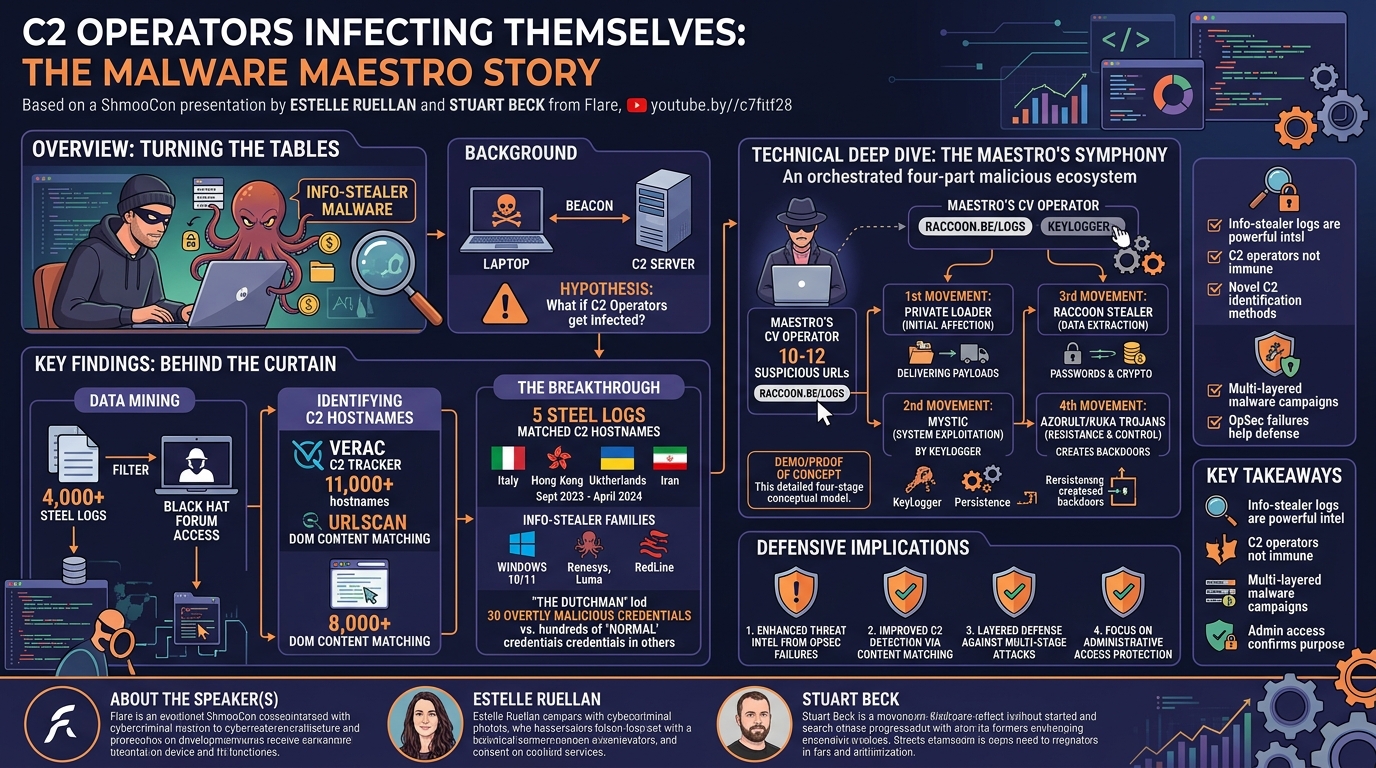
The research embarked on an ambitious data mining exercise, beginning with a pool of over 4,000 steel logs from Flare's extensive database. A crucial filtering criterion was applied: each of these logs had to show at least one access to a popular black hat forum, indicating a high likelihood that the infected device belonged to an individual involved in cybercrime.
To identify potential C2 operators within this pool, the team needed a reliable list of known C2 hostnames. They first leveraged Verac, a C2 tracker that provides data dumps of verified C2 hostnames identified through IOC fingerprinting. This initial step yielded a robust foundation of over 11,000 known C2 hostnames. Recognizing that C2 operations often share common server setups and HTML/DOM content, the researchers then used URLScan's feature for DOM content matching. By feeding the known hostnames from Verac into URLScan, they were able to identify an additional 8,000 C2 hostnames that exhibited similar characteristics, significantly expanding their detection capabilities.
With their combined database of known C2 hostnames and the filtered steel logs, the team initiated a matching process. This led to a breakthrough: five steel logs were flagged for having accessed at least one known C2 hostname. These infected devices were geographically distributed across Ukraine, Iran, Italy, the Netherlands, and Hong Kong, with infections occurring between September 2023 and April 2024. All five devices ran Windows 10 or 11, either Pro or Enterprise editions. The info-stealer families responsible for these infections included two instances of Renesys, one of Luma, one of RedLine, and one whose family could not be definitively identified. Four of the steel logs showed access to a single known C2 hostname, while one particularly interesting log exhibited access to three different C2s.
Further analysis of the accessed domains revealed intriguing patterns. Beyond the initial C2 accesses, the most visited top-level domains among the five logs were .ir (Iranian websites) and .cn (Chinese websites). Notably, there were 12 accesses to the Chinese national government services platform, including transportation, social security, and human resources for the Beijing municipality, hinting at potential state-sponsored activity or highly sensitive targets. Shared interests among the operators included web development, general hacking activities (evidenced by the black hat forum visits), extensive use of platforms like Discord, GitHub, and dash.cloudflare, and a common engagement in cryptocurrency and trading. Specifically, the logs predominantly accessing .ir and .cn domains showed a recurring theme of operating bots and related services for social media platforms like Instagram.
A crucial observation emerged when comparing the credential counts in these logs. Four of the five logs contained several hundred credentials, mostly related to "normal" daily life activities (Gmail, Netflix, Amazon). However, the fifth log, originating from the Netherlands, stood out dramatically: it contained only about 30 credentials, all of which were related to overtly malicious activities. This stark contrast strongly suggested that this particular infected device's sole purpose was for malicious operations, leading the researchers to nickname it "the Dutchman" and later, more evocatively, "the Malware Maestro."
Technical Deep Dive
▶ Watch: Geographic locations and browsing patterns of infected C2s (5:30)
The "Malware Maestro" case became the focal point of the research, offering an unparalleled glimpse into the operational infrastructure of a sophisticated threat actor. The analysis of the Maestro's steel log revealed a series of highly suspicious accesses that corroborated the hypothesis of a dedicated malicious operator.
Among the Maestro's accesses, four stood out immediately. Two were particularly indicative: raccoon.be and st.app. These domains are directly associated with the backend operations of the Raccoon info-stealer malware. Crucially, the accessed paths included /logs and /rag, which are not typical for ordinary users but are commonly used by administrators or operators managing the Raccoon stealer's backend panel. This specific pattern of access provided strong initial evidence that the Maestro was actively operating a Raccoon info-stealer infrastructure.
Further investigation into the Maestro's accesses uncovered 10 to 12 additional highly suspicious URLs, for which the Maestro possessed administrative credentials. When these URLs were cross-referenced with the C2 database, the first three yielded direct matches:
- The first URL pertained to the Mystic type of malware, identified as a multi-functional malware.
- The second was recognized as part of the Private Loader C2 known hostnames, indicating a malware loader.
- The third matched the Azorult/Cogens C2 malware family, a well-known Trojan.
The remaining suspicious URLs, while not directly matching known families in the database at the time, exhibited a consistent pattern: they often involved hashing victim names or IDs. This method is a common C2 operational practice to maintain a degree of anonymity and manage numerous compromised systems efficiently. This observation strongly suggested that the Maestro was not just operating a single type of malware but was managing a comprehensive malicious ecosystem, potentially involving even more unidentified malware families.
Based on these discoveries, the researchers conceptualized the "Maestro's Symphony" – a four-movement orchestration of malware designed to maximize the exploitation of targets. This ecosystem demonstrates how different malware types can be deployed in a coordinated fashion, each building upon the capabilities of the others.
The Maestro's Symphony: A Quadruple Threat
- First Movement: Private Loader (Initial Affection)
- As its name suggests, Private Loader serves as the initial breach mechanism. Its primary function is to deliver malicious payloads onto compromised systems, bypassing initial defenses. In the Maestro's symphony, Private Loader would be responsible for delivering the subsequent waves of malware, including Trojans, info-stealers, and the multi-functional Mystic malware. This movement is all about establishing the initial foothold and preparing the ground for deeper compromise.
- Second Movement: Mystic (System Exploitation)
- Following the initial breach, the Mystic multi-functional malware is deployed. Once installed, Mystic is capable of executing a wide array of tasks crucial for system exploitation. These capabilities include stealing additional data (beyond what an info-stealer might capture), performing keylogging to capture keystrokes, and establishing various mechanisms for persistence to ensure continued access to the compromised system even after reboots or security remediations. This movement focuses on maximizing the exploitation of the system's resources and data.
- Third Movement: Raccoon Stealer (Data Extraction)
- The third movement is led by the Raccoon info-stealer, delivered by the Private Loader. Raccoon's role is hyper-focused on data extraction. Once active, it systematically harvests all valuable data from the victim's device, including login credentials from browsers, cryptocurrency wallet files, and browser cookies. This data is then exfiltrated back to the Maestro's C2 server, ready for sale or further malicious use. This movement emphasizes the high-value data theft component of the operation.
- Fourth Movement: Azorult/Kuka Trojans (Resistance and Control)
- The final movement involves the deployment of Azorult/Kuka Trojans. These Trojans are designed for stealth and persistence, often masquerading as legitimate software to evade detection. Their primary objective in this ecosystem is to maintain long-term control over the compromised system. They can disable security features, create persistent backdoors, and ensure that the Maestro retains access to the device, even if the victim attempts to clean their system or restarts it. This movement secures the attacker's foothold and ensures ongoing access and control.
The "Maestro's Symphony" illustrates a highly integrated and layered approach to cybercrime. Each malware type plays a specific, complementary role, building on the capabilities of the others. The loader ensures initial access and delivery, the multi-functional malware maximizes system exploitation, the info-stealer extracts critical data, and the Trojan ensures stealth and persistent control. The researchers noted that this ecosystem was based solely on the four identified malware types, but given the additional 10-12 suspicious URLs with C2-like patterns, the actual malicious infrastructure managed by the Maestro could be even more complex, involving a wider array of malware families and attack vectors. This analysis provides a blueprint for understanding how sophisticated threat actors construct and manage their multi-faceted attack campaigns.
Demo / Proof of Concept
▶ Watch: Introducing 'The Malware Maestro' - a dedicated malicious device (7:50)
While the presentation did not feature a live, interactive demonstration of malware execution or a step-by-step technical walkthrough of exploiting a system, the "Maestro's Symphony" itself served as a powerful conceptual proof of concept. The researchers meticulously pieced together the observed C2 accesses and the identified malware families to construct a plausible and highly effective multi-stage attack chain.
This conceptual demonstration, outlined in the "Technical Deep Dive," illustrates how a sophisticated threat actor like the Malware Maestro could orchestrate various malicious tools – a loader, a multi-functional malware, an info-stealer, and a persistent Trojan – in a sequential and synergistic manner. By detailing each "movement" of the symphony, Estelle Ruellan effectively demonstrated the potential impact and operational complexity of such an integrated malicious ecosystem. This approach provided a clear and compelling visualization of how the components identified in the steel logs could be combined to achieve maximum exploitation, offering a unique insight into the attacker's intended workflow and the strategic deployment of their arsenal.
Defensive Implications
▶ Watch: Maestro controlled multiple C2 servers (Mystic, Private Loader) (9:20)
The insights gleaned from "C2 Operators Infecting Themselves" offer several critical implications for cybersecurity defenders, enabling a more proactive and informed approach to threat mitigation.
- Enhanced Threat Intelligence from OpSec Failures: The most immediate implication is the validation of info-stealer logs as a potent source of threat intelligence. Defenders should recognize that adversary operational security (OpSec) failures are a goldmine. Monitoring and analyzing compromised credentials and access patterns, even those seemingly mundane, can unveil administrative accesses to C2 panels, dark web forums, or other malicious infrastructure. This "backstage" view provides direct intelligence on the tools, TTPs, and even the identities (or at least the digital personas) of threat actors. Organizations with robust threat intelligence capabilities should consider how they might ethically and legally leverage such data for proactive defense.
- Improved C2 Detection and Identification: The methodology used to identify new C2 endpoints, by starting with known IOCs and then using content matching (e.g., via URLScan), presents a valuable avenue for defenders. Organizations can adapt this approach to expand their own lists of suspected C2 infrastructure. By analyzing web server configurations, HTML/DOM content, and common URL patterns (like hashed victim IDs), security teams can proactively identify previously unknown C2s before they are officially cataloged in public threat feeds. This requires advanced network monitoring, web content analysis tools, and the ability to correlate diverse data points.
- Layered Defense Against Multi-Stage Attacks: The "Maestro's Symphony" vividly demonstrates the reality of multi-stage, multi-malware campaigns. Defenders must move beyond detecting single malware instances and implement layered security architectures that can identify and block threats at various stages of the kill chain. This includes:
- Initial Access Prevention: Strong email filtering, robust endpoint protection, and user education to prevent initial loader delivery (e.g., Private Loader).
- Execution and Exploitation Detection: Advanced Endpoint Detection and Response (EDR) solutions capable of detecting abnormal process execution, keylogging, and persistence mechanisms (e.g., Mystic's activities).
- Data Exfiltration Monitoring: Network egress filtering and Data Loss Prevention (DLP) systems to detect and block attempts to exfiltrate sensitive data (e.g., Raccoon Stealer's actions).
- Persistence and Control Mitigation: Host-based firewalls, intrusion prevention systems, and regular system integrity checks to counter Trojans attempting to establish backdoors and disable security features (e.g., Azorult/Kuka).
- Focus on Administrative Access and Credentials: The discovery of administrative credentials for various C2s within the Maestro's log underscores the critical importance of protecting privileged accounts. Organizations should enforce strict access controls, multi-factor authentication (MFA) for all administrative interfaces (especially those accessible over the internet), and least privilege principles. Attackers often seek to compromise administrative credentials not just for their targets, but also for their own operational infrastructure, making them a high-value target for counter-intelligence.
- Understanding Adversary Infrastructure: The research provides a deeper understanding of how threat actors build and manage their malicious infrastructure. Knowing that they often rely on shared server setups, specific URL patterns, and a combination of off-the-shelf and custom malware helps defenders anticipate their moves. This knowledge can inform the development of more effective detection rules, honeypots, and active defense strategies aimed at disrupting the adversary's command and control capabilities.
In essence, this research empowers defenders by providing a rare glimpse into the adversary's world, turning their vulnerabilities into actionable intelligence for enhanced security posture.
Key Takeaways
- Info-stealer logs are a powerful intelligence source: They can inadvertently expose the digital activities, tools, and infrastructure of cybercriminals, offering a "backstage" view of their operations.
- C2 operators are not immune: Even sophisticated threat actors can fall victim to info-stealers, leading to their own sensitive data and C2 accesses being compromised.
- Novel C2 identification methods exist: Leveraging known C2 hostnames with web content matching tools like URLScan can effectively identify new and previously unknown C2 endpoints.
- Malware campaigns are often multi-layered: Threat actors frequently orchestrate complex "symphonies" of different malware types (loaders, multi-functional malware, info-stealers, Trojans) to maximize exploitation and ensure persistence.
- Operational security failures provide defense opportunities: Observing the OpSec lapses of adversaries offers valuable insights into their TTPs, which can be used to strengthen defensive strategies and detect malicious infrastructure.
- Administrative access to C2s is a critical indicator: Discovery of such access in steel logs confirms a device's malicious purpose and highlights the high value of protecting privileged credentials.
About the Speaker(s)
The research presented in "C2 Operators Infecting Themselves: The Malware Maestro Story" was conducted by Estelle Ruellan and her colleague Stuart Beck. Estelle Ruellan was the primary presenter at ShmooCon, delivering the talk with clarity and engaging analysis. Both researchers are affiliated with Flare, a company specializing in collecting and analyzing various data, including steel logs, to provide threat intelligence. Their work at Flare focuses on leveraging unconventional data sources to uncover insights into cybercrime operations and threat actor behaviors. Stuart Beck, though unable to attend the conference, was an integral part of the research team.
Reviews
Dr. Zero (Offensive Security Researcher) — STRONG ACCEPT
This talk presents a compelling and well-executed methodology for leveraging infostealer logs to identify compromised C2 operators and their infrastructure. The "Malware Maestro" case study is particularly insightful, demonstrating a sophisticated, multi-malware ecosystem. While not a deep dive into exploit mechanics, the novel application of data correlation for threat intelligence is valuable and offers actionable insights for defenders.
Heather Calloway (CISO) — STRONG ACCEPT
This research from Flare offers a compelling and actionable look into the operational security failures of cybercriminals. By leveraging info-stealer logs to identify C2 operators who inadvertently compromised their own infrastructure, the speakers provide invaluable insights into adversary TTPs and multi-stage attack orchestrations. The "Malware Maestro" case study vividly demonstrates how different malware types are combined, offering a rare "backstage" view that directly informs defensive strategies for CISO and threat intelligence teams. This work effectively bridges novel research with practical, institutional-level implications for enhancing threat detection and overall security…