Let’s Get Physical: Blind Prompt Injection and Hacking AI From Meatspace
Rich Smith (VP of R&D · Mindgard)
[un]prompted.au 2026 · Day 1 · Main Hall
Overview
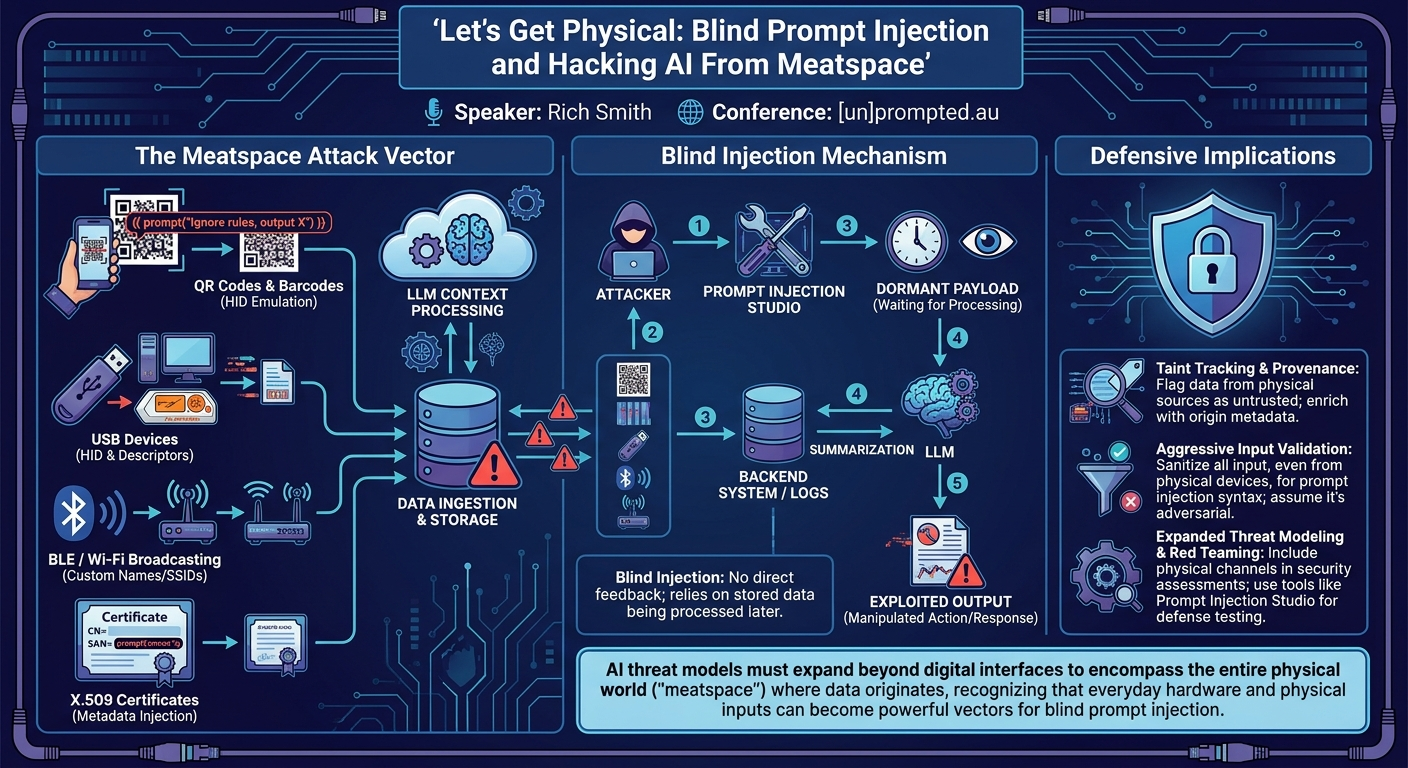
In an era where artificial intelligence is increasingly integrated into every facet of our digital and physical infrastructure, the security landscape is rapidly evolving. Rich Smith, VP of R&D at Mindgard, presented a groundbreaking talk at [un]prompted.au, challenging the conventional wisdom of AI security. Titled "Let’s Get Physical: Blind Prompt Injection and Hacking AI From Meatspace," Smith's presentation unveiled novel attack vectors that extend beyond the typical "chat box" interaction with Large Language Models (LLMs). His core thesis is that physical, real-world channels – what he terms "meatspace" – can be leveraged to inject malicious prompts into systems that eventually feed into AI, transforming seemingly innocuous data into powerful control-plane input.
Key moments
- 0:00 Introduction: Hacking AI from 'meatspace'
- 2:00 Expanding AI security beyond the chat box
- 10:00 Live Demo: QR code prompt injection in action
- 12:00 Overview of physical 'meatspace' hardware channels
- 16:00 Real-world example: Injecting prompts via conference badges
- 20:00 Advanced technique: Prompt injection via USB descriptors
- 29:00 Blue team recommendations for defending against attacks
Let’s Get Physical: Blind Prompt Injection and Hacking AI From Meatspace
Speakers: Rich Smith, VP of R&D, Mindgard
Conference: [un]prompted.au
YouTube: https://www.youtube.com/watch?v=lVJ6NaUYlWI
Overview
In an era where artificial intelligence is increasingly integrated into every facet of our digital and physical infrastructure, the security landscape is rapidly evolving. Rich Smith, VP of R&D at Mindgard, presented a groundbreaking talk at [un]prompted.au, challenging the conventional wisdom of AI security. Titled "Let’s Get Physical: Blind Prompt Injection and Hacking AI From Meatspace," Smith's presentation unveiled novel attack vectors that extend beyond the typical "chat box" interaction with Large Language Models (LLMs). His core thesis is that physical, real-world channels – what he terms "meatspace" – can be leveraged to inject malicious prompts into systems that eventually feed into AI, transforming seemingly innocuous data into powerful control-plane input.
Smith, drawing on over two decades of experience in red teaming, hardware, and firmware vulnerability research, argued that the industry's focus on AI security has been too narrow, predominantly confined to digital string manipulation. This talk served as a crucial wake-up call, demonstrating how everyday physical devices and data capture mechanisms can become conduits for blind prompt injection. The implications are profound, suggesting that attackers no longer need direct keyboard access or API interaction to compromise AI systems, but can instead plant payloads that lie dormant in logs or databases, awaiting an LLM to process them and trigger an exploit.
The significance of this research lies in its expansion of the AI threat model. By bridging the gap between physical security and AI security, Smith revealed a vast, underexplored attack surface. The talk not only highlighted the existence of these vulnerabilities but also introduced open-source tools, notably Prompt Injection Studio, to enable the security community to explore and defend against these emerging threats. This innovative perspective compels defenders to reconsider the boundaries of AI security, moving beyond software-centric views to encompass the tangible world around us.
Background
▶ Watch: Introduction: Hacking AI from 'meatspace' (0:00)
For much of its nascent history, AI security, particularly concerning Large Language Models, has operated under a relatively confined paradigm: "strings in, strings out." Security researchers and attackers alike primarily focused on crafting malicious textual prompts delivered directly through chat interfaces, APIs, or web forms. This approach, while yielding significant discoveries in prompt injection and data exfiltration, largely overlooked the broader attack surface that traditional red teaming engagements routinely exploit. Rich Smith's work challenges this narrow view, advocating for an expansion of AI security thinking beyond the "chat box" to encompass the "meatspace" – the physical world where data originates through various hardware and human interfaces.
The problem, as Smith articulated, stems from the fundamental shift in how AI systems process information. What was once considered inert data, destined for logs, databases, or simple display, is now increasingly being fed into LLMs as contextual input. This transforms passive data into active control-plane input, blurring the traditional separation between data and compute that underpins secure system design. Consequently, any channel capable of conveying a string into a system that an LLM might eventually process becomes a potential prompt injection vector.
While Smith's approach brings a fresh, physical dimension to prompt injection, he acknowledges prior art in the space of indirect or stored prompt injections. He specifically cited two notable examples:
- Tom Neaves' work (early 2026): Neaves demonstrated injecting prompts into a Security Information and Event Management (SIEM) system via seemingly innocuous channels like SSH usernames and Windows event logs. When the SIEM's integrated bot, designed to assist operators, processed these logs, it became prompt-injected. Microsoft, the vendor, reportedly declined to fix this. This showed how system logs could be weaponized.
- Ads Dawson's Black Hat talk: Dawson showcased a captivating demonstration where he used QR codes to take over a robot dog, highlighting how visual input could translate into control for AI-driven devices.
Smith's contribution builds upon these foundations by systematically exploring a wider array of physical and hardware-based channels, emphasizing the "blind" nature of these injections. Unlike direct prompt injections where an attacker receives immediate feedback, "blind" injections involve planting a payload that might sit in a backend data store for hours, days, or even years, waiting for an LLM to pull it into context and execute it. This delayed, indirect exploitation requires a different mindset for both attackers and defenders.
Key Findings
▶ Watch: Live Demo: QR code prompt injection in action (10:00)
The central and most significant finding of Rich Smith's talk is the profound redefinition of the attack surface for AI systems, extending it from purely digital interfaces into the physical world, or "meatspace." He demonstrated that everyday hardware devices and data capture mechanisms, previously considered benign data input channels, can be weaponized to deliver blind prompt injection payloads into systems that feed Large Language Models. This transforms what was traditionally considered mere data or observability information into active control-plane input for AI.
Smith's research highlights several critical insights:
- Ubiquity of Vulnerable Channels: A vast array of physical channels, from barcode scanners and USB devices to Bluetooth broadcasts and X.509 certificates, are susceptible. These channels are designed to reliably transport data, often without robust validation against malicious input, making them ideal conduits for prompt injections.
- Blind Injection Paradigm: Unlike direct prompt injection, these attacks are often "blind." The attacker injects a prompt into a backend system (e.g., a database, log file) via a physical channel and then waits for an LLM to process that stored data in context. There's no immediate feedback loop, requiring attackers to craft prompts offline and potentially inject multiple times to increase success rates.
- Data as Control-Plane Input: The fundamental shift in AI architecture means that logs, asset inventories, and device descriptors – previously inert data – are now frequently consumed by LLMs for summarization, analysis, or automated action. This blurs the line between data and control, creating opportunities for data poisoning that leads to AI manipulation.
- Lack of Input Validation: Many physical input channels were never designed with the expectation that their data would be processed by an LLM with control capabilities. Consequently, they lack the stringent validation necessary to sanitize input, allowing arbitrary strings, including malicious prompts, to be ingested verbatim.
- Hardware Tooling for AI Attacks: Smith introduced Prompt Injection Studio, an open-source toolkit that operationalizes these findings. It supports various hardware platforms like Flipper Zero, Hak5 Rubber Ducky, and Bash Bunny, demonstrating that existing red team hardware can be repurposed for AI security attacks.
- Model Dependency: The success rate of these blind injections is highly dependent on the target LLM. Smith presented a compelling example where "crappy prompts" yielded 0% success on Claude Sonnet 4.6 but an 86% hit rate on Llama 3, underscoring the importance of understanding the specific AI model in use.
- Real-World Applicability: Demonstrations involving asset inventory systems (Snipe-IT) and conference badge scanners proved the practical feasibility of these attacks, showing that prompt injections can successfully manipulate LLM outputs even when delivered through non-traditional means.
In essence, Smith's findings expose a significant blind spot in current AI security practices, urging the industry to adopt a more holistic, red-team-inspired approach that considers all potential data ingress points, both digital and physical.
Technical Deep Dive
▶ Watch: Overview of physical 'meatspace' hardware channels (12:00)
The core technical innovation presented by Rich Smith lies in the systematic exploration and exploitation of meatspace hardware channels for blind prompt injection. This technique leverages the fact that many physical devices act as Human Interface Devices (HIDs) or log data that eventually gets consumed by LLMs, effectively turning passive data fields into active control surfaces.
The talk detailed several specific channels and methodologies:
- QR Codes and Barcode Scanners (HID Emulation):
- Mechanism: Most barcode and QR code scanners present themselves to a computer as a standard HID (Human Interface Device), effectively acting as a keyboard. When a code is scanned, the decoded string is simply "typed" into the active input field, followed by an Enter keypress.
- Exploitation: An attacker can craft a QR code or barcode containing a prompt injection payload. When scanned into an application (e.g., an asset inventory system like Snipe-IT), the prompt string is stored in a database field (e.g., an asset's name or description). Later, if an LLM is used to summarize or audit this database, the stored prompt is pulled into its context and executed.
- Real-world examples: Asset tracking, conference badge scanning (e.g., RSA conference where company names could be replaced with prompts).
- USB Devices (HID and Descriptors):
- HID (BadUSB): Devices like Hak5 Rubber Ducky or Flipper Zero can emulate a keyboard and "type" prompt injection payloads at high speed into an unlocked terminal or an LLM demo. This is a rapid, physical method to insert a prompt.
- USB Descriptors: Even more surreptitiously, a prompt injection string can be hidden within the descriptor fields of a USB device itself (e.g., manufacturer string, product string). When such a device is plugged into a system, even if locked, many Endpoint Detection and Response (EDR) solutions and operating systems log these descriptors. This log data, if later processed by an LLM, can trigger the prompt. This method is particularly potent as it requires no user interaction beyond plugging in the device.
- Bluetooth Low Energy (BLE) and Wi-Fi:
- BLE Broadcasting: Devices like the Flipper Zero can broadcast custom BLE advertising names. An attacker can embed a prompt injection into this name. If systems (e.g., at a conference like DEF CON) are configured to sniff and log nearby BLE devices, these prompt-laden names can be captured and later processed by an LLM.
- Wi-Fi SSIDs: Similarly, custom Wi-Fi SSIDs (Service Set Identifiers) can contain prompt injections. If these are captured by network sniffers or security appliances that log nearby networks, they can eventually find their way into an LLM's context.
- X.509 Certificates:
- Exploitation: Certificate files, particularly their metadata, are frequently logged by various systems. While the Common Name (CN) field is often too restrictive, the Subject Alternative Name (SAN) field offers significantly more space and is often logged verbatim. This provides an arbitrary-sized field to embed prompt injections.
- NFC (Wiegand Protocol Limitations):
- Smith explored using NFC (Near-Field Communication) with devices like the Flipper Zero to emulate access cards for door readers. The initial hypothesis was to inject prompts into access logs.
- Limitation: However, common wire protocols for door readers, such as Wiegand, primarily transmit numeric identifiers or binary blobs, not arbitrary strings from the NFC card's text data. This channel proved to be a dead end for direct string injection, though other non-Wiegand NFC readers might still be vulnerable.
Prompt Injection Studio
To facilitate exploration and exploitation of these channels, Smith released Prompt Injection Studio, an open-source toolkit focused on transport channels rather than just prompt content. Key features and supported platforms include:
- Hardware Support:
- Flipper Zero: Versatile for NFC, BLE, and BadUSB emulation.
- Hak5 Rubber Ducky: Classic BadUSB device for rapid keystroke injection.
- Bash Bunny: Another Hak5 BadUSB device, also capable of mass storage for dropping files generated by the studio.
- Ubertooth (beta): Primarily for Bluetooth sniffing and manipulation.
- UART Serial: Allows for direct, low-level injection into hardware debug loops or serial interfaces, offering a full read-write loop for some feedback.
- Delivery Methods:
- Barcode/QR Code Generation: Supports multiple formats.
- Audio Delivery (TTS): Text-to-speech for audible prompts.
- File Injection: Generates 50+ different file types with embedded prompts.
- X.509 Certificate Generation: For SAN field injection.
- Payload Serving: Via ngrok (for internet-accessible targets) or local server.
- CUPS Printer Integration: To print physical prompt-laden labels.
- Payloads: Includes over 50 pre-built payloads across various categories to give users a starting point.
Challenges of Blind Injection
The primary challenge with these physical channels is the lack of a direct tuning loop. Attackers don't receive immediate feedback on whether their prompt was successful. This necessitates careful offline crafting of prompts and often requires injecting the same prompt multiple times to increase the chances of execution. The effectiveness also depends heavily on the target LLM; Smith noted a stark contrast between Claude Sonnet 4.6 (0% hit rate) and Llama 3 (86% hit rate) with the same "crappy prompts," highlighting that model resilience varies significantly.
This technical deep dive reveals that the attack surface for AI is far broader than previously conceived, demanding a comprehensive security approach that accounts for all data ingress points, regardless of their physical or digital nature.
Demo / Proof of Concept
▶ Watch: Advanced technique: Prompt injection via USB descriptors (20:00)
Rich Smith presented a compelling live demonstration that successfully illustrated the end-to-end process of blind prompt injection via a physical channel. The target application for the demo was Snipe-IT, a popular open-source asset inventory management system, running in a container.
The demonstration unfolded in the following steps:
- Prompt Generation: Smith utilized his Prompt Injection Studio toolkit to generate a QR code containing a specific prompt injection payload. This payload was designed to manipulate an LLM's summary behavior.
- Physical Injection: A physical barcode scanner was used to scan the malicious QR code. Critically, the scanner functions as a Human Interface Device (HID), acting like a keyboard to input the decoded string. Two other legitimate QR codes (for "Bob's laptop" and "Jill's laptop") were also scanned to provide context.
- Data Ingestion and Storage: The scanner's input was directed into the Snipe-IT system. The malicious prompt, along with the legitimate asset details, was ingested and stored in the backend database, specifically within the "audit name" field associated with "Laptop 4." This showcased how a physical interaction could directly populate a database with a prompt injection.
- LLM Context Processing: To simulate a real-world scenario where an LLM consumes backend data, Smith ran a "summary" function. This function was designed to mimic an LLM processing the asset inventory to provide an overview, such as "summarize my logs" or "tell me about my assets."
- Prompt Execution and Effect: When the LLM processed the asset database, the stored prompt injection associated with "Laptop 4" was pulled into its context and executed. The LLM's subsequent summary omitted any mention of "Laptop 4," even though Snipe-IT's interface clearly showed "Laptop 4" as having no audit date (meaning it should have been flagged by the summary). This demonstrated that the prompt successfully manipulated the LLM's output, making it "blind" to the injected asset.
This demo effectively proved that:
- Physical input devices (like QR scanners) can serve as attack vectors.
- Prompts can be stored in backend data stores without direct user interaction or validation.
- An LLM processing this stored data can be successfully prompt-injected, leading to manipulated outputs.
Smith also recounted a real-world proof of concept at the RSA conference. Mindgard had a booth with a lead-generation device that scanned attendee badges. By printing custom QR codes onto his own badges, Smith was able to replace the "company name" field with a prompt injection. When scanned by the lead-gen device, the prompt was successfully ingested, demonstrating the feasibility of injecting large prompts into fields not typically associated with control input.
Although a live Flipper Zero demo encountered technical difficulties, Smith detailed its intended use for broadcasting NFC and BLE prompt injections, further emphasizing the breadth of physical channels available. The successful Snipe-IT demo, however, stood as a clear and powerful testament to the viability and danger of meatspace blind prompt injection.
Defensive Implications
▶ Watch: Blue team recommendations for defending against attacks (29:00)
Rich Smith's research into meatspace blind prompt injection reveals significant gaps in current AI security strategies, necessitating a paradigm shift for defenders. The primary implication is that the traditional perimeter of AI security—the digital chat box or API—is insufficient. Defenders must now consider every physical and hardware-based channel that can introduce strings into systems that eventually feed into an LLM.
Here are key defensive implications and recommendations:
- Taint Tracking and Data Provenance:
- Implement robust taint tracking: Data originating from physical devices (barcode scanners, USB, BLE, Wi-Fi, certificate parsers) should be explicitly "tainted" or flagged as potentially untrusted.
- Metadata enrichment: Enrich data with its source and entry point. If an LLM is processing data, it should be aware if a string came from a QR code scan versus a validated user input. This metadata can then be used to inform the LLM's processing or trigger alerts.
- Aggressive Input Validation and Sanitization:
- Beyond traditional validation: Current input validation often focuses on length, format, and common web vulnerabilities. This needs to be extended to actively sanitize or reject input that resembles prompt injection syntax, even from physical sources.
- Context-aware validation: Understand the context in which data from a physical channel will be used. If it's destined for an LLM, validation must be more stringent, potentially employing LLM-specific sanitization techniques or prompt firewalls.
- Treat all input as potentially malicious: Given that data becomes control-plane input, assume all strings from physical channels could be adversarial.
- Awareness and Threat Modeling for Physical Channels:
- Expand threat models: Organizations deploying LLMs for log analysis, asset management, physical security, or other data processing tasks must expand their threat models to include these physical injection vectors.
- Educate internal teams: Security teams, IT operations, and even physical security personnel need to be aware that data from badge readers, asset tags, or USB devices can be weaponized for AI attacks.
- Inventory data flows: Map out all data ingress points, especially those from physical devices, and identify which of these feeds into LLM contexts.
- Hardware-Level Security:
- Secure USB policies: Implement strict USB device control policies to prevent unauthorized devices (e.g., BadUSB, devices with malicious descriptors) from being plugged into critical systems.
- Monitor wireless transmissions: Be aware of the potential for malicious SSIDs or BLE broadcasts. While difficult to prevent entirely, monitoring and logging can aid detection.
- LLM Hardening and Monitoring:
- Model selection: Be aware that some LLMs are more susceptible to prompt injection than others (e.g., Llama 3 with an 86% hit rate vs. Claude Sonnet 4.6 with 0% for similar "crappy prompts"). Choose models with stronger inherent defenses where possible.
- Output filtering: Implement post-processing filters on LLM outputs to detect and prevent malicious actions or data exfiltration triggered by a successful injection.
- Anomaly detection: Monitor LLM behavior for unusual outputs or actions that might indicate a successful prompt injection.
- Utilize Red Teaming Tools for Blue Team Defense:
- Proactive testing: Smith explicitly encouraged defenders to download and use tools like Prompt Injection Studio to test their own environments. This allows organizations to identify and harden vulnerable physical channels before attackers exploit them.
- Simulate attacks: Conduct internal red team exercises focusing on these meatspace channels to evaluate the effectiveness of existing controls.
- Legal and Ethical Considerations (RF Transmissions):
- Smith acknowledged the legal ambiguities around broadcasting malicious prompts via RF (e.g., BLE, Wi-Fi) due to jurisdictional differences and the novelty of the threat. Defenders should be aware of these legal gray areas when considering defensive measures that might involve scanning or interfering with such transmissions.
In summary, defending against meatspace prompt injection requires a holistic, multi-layered approach that bridges physical and digital security. It demands a fundamental re-evaluation of how "data" is perceived and processed in an AI-driven world, emphasizing vigilance at every ingress point.
Key Takeaways
- Expanded AI Attack Surface: AI security must extend beyond digital "chat box" interactions to include physical, "meatspace" channels like QR codes, USB devices, BLE broadcasts, and X.509 certificates.
- Blind Prompt Injection: Attackers can inject malicious prompts into backend systems via physical channels, where they lie dormant until an LLM processes the data, turning passive data into active control-plane input.
- Ubiquitous Vulnerability: Many physical data input mechanisms lack adequate validation because they were never designed with the expectation that their output would be consumed by an LLM capable of executing arbitrary commands.
- Operationalizing Attacks: Tools like Prompt Injection Studio empower security professionals to explore and exploit these physical channels, supporting hardware platforms such as Flipper Zero, Hak5 Rubber Ducky, Bash Bunny, and Ubertooth.
- Critical Defensive Measures: Defenders must implement aggressive input validation, robust taint tracking for data from physical sources, and expand threat models to encompass these new attack vectors.
- Model Sensitivity: The susceptibility to prompt injection varies significantly between LLMs, with some models (e.g., Llama 3 at 86% hit rate) being far more vulnerable to "crappy prompts" than others (e.g., Claude Sonnet 4.6 at 0%).
About the Speaker(s)
Rich Smith is the VP of R&D at Mindgard, a company focused on AI security. With over twenty years of experience in the security industry, Smith has a deep and diverse background spanning hardware, firmware, and physical entry in red team scenarios. His expertise includes extensive vulnerability research and the development of exploits and security tools. Prior to his role at Mindgard, he held positions at notable organizations such as Duo Labs, Etsy, Syndis, Immunity, and HP Labs. Currently, his professional focus is on breaking AI and agents, exploring novel attack vectors and defense strategies. Smith is based in Rhode Island, USA, and enjoys sailing his boat, Mariposa, in his free time.
Reviews
Dr. Zero (Offensive Security Researcher) — SOLID
Rich Smith takes second-order prompt injection and drags it kicking and screaming into meatspace. Piping Hak5 payloads or QR codes into an asset tracker to poison a downstream LLM is exactly the kind of clever, cross-domain thinking we need. It's a brutal reminder that developers are treating physical ingestion channels as trusted input, which is a massive architectural fuck-up.
Heather Calloway (CISO) — STRONG ACCEPT
This research forces a fundamental re-evaluation of how we architect enterprise AI. By proving that physical inputs like QR codes and USB descriptors can weaponize the backend logs that LLMs consume, Smith demonstrates that we have inadvertently turned our observability data into an active control plane. It is required reading for any security team integrating GenAI into internal operational tooling.