Building the Ultimate AI Cyber Threat Analyst
Shane Huntley (CTO Engineering Lead · Google Threat Intelligence Group)
[un]prompted.au 2026 · Day 2 · Main Hall
Overview
In this insightful talk at [un]prompted.au, Shane Huntley, CTO Engineering Lead for Google Threat Intelligence Group (GTIG), shared Google's ambitious journey to create "GAL" – the GTIG AI Layer, envisioned as the ultimate AI cyber threat analyst. Huntley articulated a compelling vision where artificial intelligence, specifically Large Language Models (LLMs), augments and transforms the demanding field of threat intelligence, addressing the overwhelming scale of threats and data that even Google's vast human analyst teams struggle to manage. The presentation emphasizes that this is an ongoing process, not a solved problem, but one where significant progress is being made by fundamentally rethinking traditional approaches.
Key moments
- 0:00 Introduction to GAL: The AI Cyber Threat Analyst Vision
- 2:00 Google Threat Intelligence Group's Unique Scale and Data
- 7:00 AI Re-evaluating Problem Constraints: The 'Sitzfleisch' Concept
- 13:50 Scaling Problem Scope with AI: Overcoming Amdahl's Law
- 21:30 GAL's Training Breakthrough: Learning from Human Materials
- 25:00 Real-world Examples: GAL's Threat Investigation and Reporting
- 30:00 Advanced Malware Triage and Async Workflow Automation
- 40:15 Q&A: Handling RBAC, Identity, and Prompt Injection Threats
Building the Ultimate AI Cyber Threat Analyst
Speakers: Shane Huntley (CTO Engineering Lead, Google Threat Intelligence Group)
Conference: [un]prompted.au
YouTube: https://www.youtube.com/watch?v=9_8AtWAe7WQ
Overview
In this insightful talk at [un]prompted.au, Shane Huntley, CTO Engineering Lead for Google Threat Intelligence Group (GTIG), shared Google's ambitious journey to create "GAL" – the GTIG AI Layer, envisioned as the ultimate AI cyber threat analyst. Huntley articulated a compelling vision where artificial intelligence, specifically Large Language Models (LLMs), augments and transforms the demanding field of threat intelligence, addressing the overwhelming scale of threats and data that even Google's vast human analyst teams struggle to manage. The presentation emphasizes that this is an ongoing process, not a solved problem, but one where significant progress is being made by fundamentally rethinking traditional approaches.
The core challenge Google faces stems from its unparalleled scale: billions of users across numerous products and the immense data generated by Mandiant's 500,000 hours of incident investigations annually. This talk delves into how Google is leveraging AI to move beyond manual, step-by-step analysis, aiming to shift human analysts from being "the machine" to "tuning the machine." Huntley's narrative highlights the strategic imperative to transform not just individual analyst productivity, but the entire organizational approach to threat intelligence, making it more scalable, efficient, and proactive in defending against global cyber threats.
Background
▶ Watch: Introduction to GAL: The AI Cyber Threat Analyst Vision (0:00)
Google's Threat Intelligence Group operates at a scale unmatched by most organizations, tasked with protecting billions of users across five products with over 3 billion users each, alongside the extensive frontline incident investigation data from Mandiant. For over 15 years, Google's approach to threat intelligence has been characterized by a strong emphasis on system automation. Early on, the philosophy was that human expertise was crucial for judgment, unstructured data analysis, reporting, and making disparate connections, while automation handled everything else. This led to the development of sophisticated internal platforms like Nirvana, a core threat intelligence system built over 15 years to integrate diverse data sources and streamline workflows, and MGraph, Mandiant's graph database system.
Despite these advanced tools, the sheer volume of data and the complexity of threats consistently outpace human capacity. Huntley described the traditional analyst's role as "tuning the machine," creating scripts and signatures to enhance automated systems rather than performing repetitive, step-by-step tasks. However, the advent of AI, particularly LLMs, has fundamentally altered the landscape. What were once considered exclusively human domains—like judgment and understanding unstructured data—are now within the capabilities of advanced AI models. This shift necessitates a re-evaluation of established practices, moving away from mindsets and tools designed for a pre-AI era.
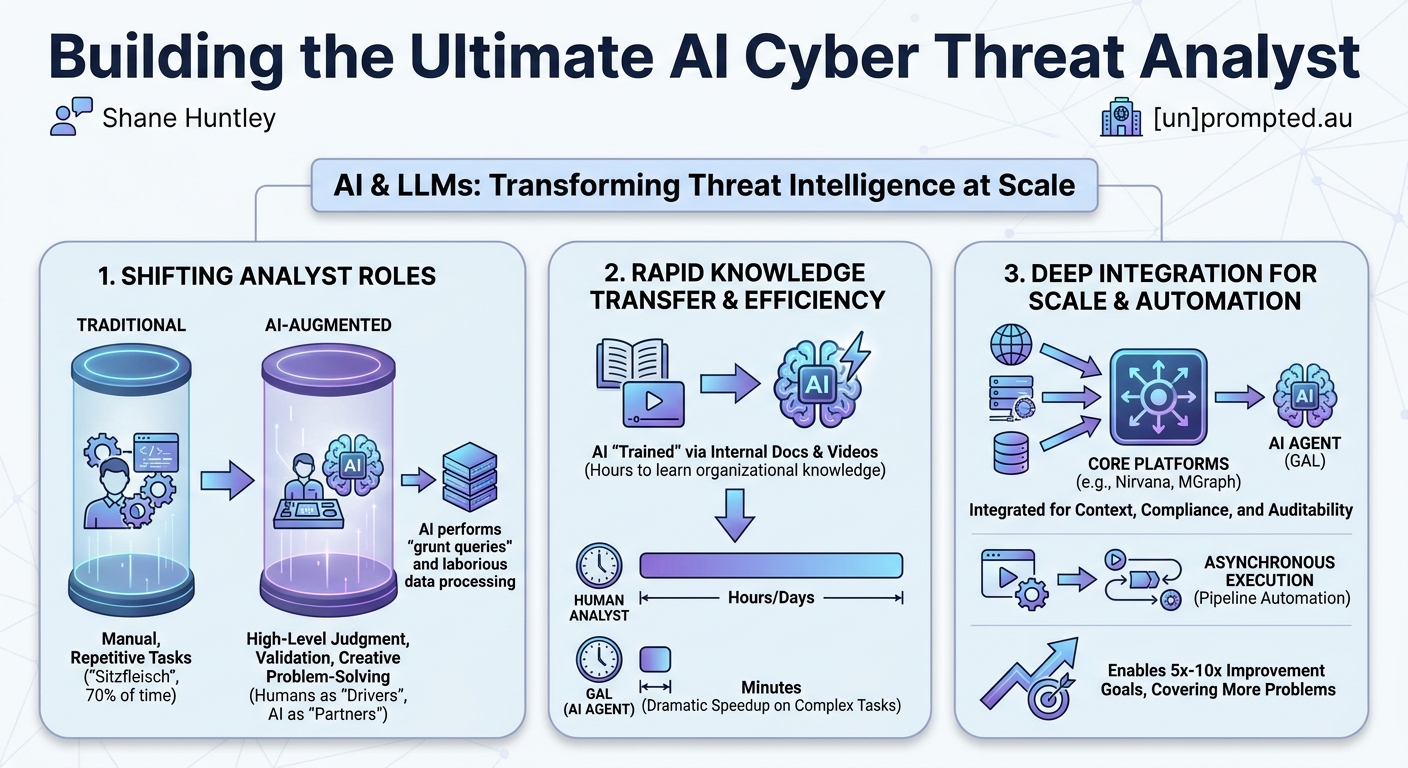
Huntley frames this transformation through an economic lens, likening it to historical shifts driven by the steam engine (overcoming physical power constraints) or early computing (overcoming calculation constraints). Today, the constraint is often "thinking steps" or the sheer volume of analytical grind. He introduces the German term "Sitzfleisch" (literally "sitting meat") to describe tasks that require sustained, laborious effort—a domain where LLMs excel. Unlike humans, AI agents are "happy to sit and grind through a lot of stuff," making them ideal for tasks that are not necessarily "magic sauce" but demand extensive, methodical processing. This changes the economics of threat intelligence, making it viable to address a vast middle ground of tasks that are too low-value for human analysts but too complex for traditional automation. The challenge, then, is to leverage this new capability to expand the scope of threat intelligence rather than just making existing processes marginally faster.
Key Findings
▶ Watch: AI Re-evaluating Problem Constraints: The 'Sitzfleisch' Concept (7:00)
The central finding presented by Shane Huntley is that Large Language Models (LLMs) and AI agents are not merely tools for individual analyst productivity, but foundational technologies capable of transforming entire threat intelligence organizations at scale. Google's journey with GAL demonstrates that these AI systems can overcome long-standing constraints in data volume and analytical depth, fundamentally altering the economics and capabilities of threat intelligence.
Key findings include:
- Expanded Problem Scope: AI enables organizations to tackle a significantly larger set of threat intelligence problems that were previously out of reach due to human resource limitations. Instead of just doing the same work faster, GAL allows Google to "scale up problem size" and "cover more things," addressing the vast "middle ground" of tasks that are economically unviable for human analysts but critical for comprehensive defense.
- Shift in Analyst Role: The role of the human analyst is evolving from performing repetitive "Python, SQL, all of this sort of like mechanicky sort of stuff" (previously 70% of their day) to focusing on higher-level judgment, validation, and creative problem-solving (reducing mechanical tasks to 15%). Analysts become "drivers" of sophisticated AI tools rather than "minions" performing grunt work.
- Dramatic Efficiency Gains: GAL has demonstrated the ability to complete complex intelligence tasks—such as investigating an IIS exploit on Exchange, linking rogue admin accounts, and identifying C2s—in "a couple of minutes," a task that would represent "really good work" for a human analyst over a much longer period. Similar speedups are observed in MGraph queries and malware analysis.
- Effective Knowledge Transfer: AI agents can be "trained" like human analysts, ingesting vast amounts of documentation and training videos. GAL successfully processed Google's two-week threat analyst training program in "a couple of hours," building a comprehensive knowledge base and significantly improving its performance on complex tasks.
- Overcoming Traditional AI Limitations: Through iterative development (raw APIs -> tools -> prompts -> training) and strategic design choices (e.g., anchoring and avoiding hallucination), Google is effectively tackling challenges like the "pre-training deficit" (models not knowing how to do specialized jobs) and the difficulty of verifying complex threat intelligence outcomes.
- High Adoption and Value Proposition: Despite being in early stages, GAL has seen rapid adoption, with a quarter of Google's large threat intelligence organization using it daily and half using it weekly. User feedback indicates that while there are still areas for improvement, the core value proposition is strong, with users demanding more features rather than questioning the fundamental approach.
Technical Deep Dive
▶ Watch: GAL's Training Breakthrough: Learning from Human Materials (21:30)
The development of GAL (GTIG AI Layer) at Google Threat Intelligence Group is a testament to an iterative, pragmatic, and scalable approach to integrating AI into highly complex and data-rich environments. The foundational architecture leverages an Agent Development Kit (ADK), an open-source agent framework, though Huntley stresses that the specific framework is less important than the underlying principles of durability and focus on threat intelligence problems, given the rapid evolution of AI models and tools.
The journey to building GAL involved several critical phases:
- Initial Attempt (Raw API Access): The first step involved simply giving an LLM access to the raw APIs of Google's vast internal systems, including Nirvana and MGraph. This proved largely ineffective. Without context, understanding of terminology, or knowledge of API usage, the model "burnt token after token... stumbling around" and failed to perform meaningful threat intelligence. This highlighted the need for more structured interaction.
- Tool Integration: Recognizing that human analysts rely on extensive tooling, the next phase involved a massive effort to provide the AI agent with equivalent access to these tools. Google's team, utilizing "coding agents" and close collaboration with human analysts, built 245 tools that interface with all internal products and external sources. The principle established was that "anything we build from here on out has to be equally usable by humans and agents." This phase also revealed the importance of keeping agent tooling similar to human tooling to facilitate collaboration and shared understanding. Despite having tools, GAL still "struggled to use the tools," much like a new human analyst without training.
- Prompt Engineering and Skill Capture: The third phase focused on prompt engineering and capturing human analyst "skills." Analysts documented their task workflows and knowledge, creating "skill files" to guide GAL. While this improved performance, it was deemed inefficient and subservient for humans to manually codify all their knowledge.
- Training via Organizational Knowledge: The breakthrough came by treating GAL like a new human hire. Leveraging Gemini as a multimodal model, GAL was fed all existing training videos and documentation. In a remarkable demonstration, GAL completed Google's "two-week training program in like a couple of hours," building an entire knowledge base and taking "better notes than any human." This direct ingestion of organizational knowledge proved far more effective than manual prompt engineering, enabling GAL to perform complex tasks in a "really good way."
Huntley also touched upon the philosophical and computer science underpinnings of this approach:
- Amdahl's Law and Scaling Problem Size: Traditional parallel computing often faces limits due to sequential components (Amdahl's Law). However, Huntley posits that with AI, the insight is that "you can actually scale up your problem size." Instead of merely doing the same tasks faster, AI allows for "more things and at a bigger scale," tackling a wider array of problems that were previously beyond human capacity due to economic or time constraints.
- The "Sitzfleisch" Advantage: LLMs excel at repetitive, laborious tasks, or "Sitzfleisch." This means AI can take on the "grunt queries" and detailed data sifting, freeing human analysts for higher-order thinking.
- Challenges Addressed: The talk acknowledges inherent difficulties:
- Pre-training Deficit: Out-of-the-box models don't understand Google's proprietary threat intelligence job. This is overcome by direct training on internal data.
- Unverifiable Problems: Defining "found something interesting" is hard for AI training. This is mitigated by human validation and focusing AI on generating first passes or summaries for human review.
- Human World/Resistance: Overcoming ingrained analyst identities and resistance to new methods is a continuous effort, requiring leadership to challenge the "written on stone tablets" mentality of security practices.
- Hybrid Integration Strategy: Google is pursuing a hybrid approach to integration, balancing building AI systems directly into core platforms like Nirvana and MGraph with leveraging external harnesses. The integrated approach ensures compliance, access controls, auditability, and visibility for training, while acknowledging that harnesses excel at generic AI tasks like context window management. Huntley predicts a convergence of these approaches.
Demo / Proof of Concept
▶ Watch: Real-world Examples: GAL's Threat Investigation and Reporting (25:00)
Shane Huntley provided several compelling examples of GAL's capabilities, demonstrating its practical application in real-world threat intelligence scenarios:
- IIS Exploit on Exchange Investigation:
- Task: Investigate a compromise activity starting with an IP address, linking various log sources and events.
- GAL's Process: Given an (anonymized) IP, GAL autonomously explored, isolated the victim server, identified it as compromised, applied different hypotheses, constructed the chain of events, investigated further steps, and then "captured it and actually wrote things up."
- Result: GAL completed this complex investigation, involving an IIS exploit on Exchange linking to rogue admin accounts, downloading a tunnel program, and RDP logins, "in a couple of minutes." Huntley noted this would be considered "really good work" for a human analyst's weekly or monthly briefing, highlighting the significant speed and analytical depth achieved. The output included a detailed "intelligence moment" (summary), showcasing GAL's ability to not only find information but also articulate it clearly.
- MGraph Query Generation:
- Task: Analysts often struggle with MGraph's custom domain-specific language (DSL) for exploring its graph database, requiring extensive expertise.
- GAL's Process: Instead of manually crafting complex queries, analysts can simply "ask what you want" in natural language. GAL translates this into the precise MGraph queries.
- Result: This allows analysts to focus on "thinking about the problem versus being so deep in the actual sort of domain-specific language stuff," making the powerful MGraph system accessible to a broader range of users and accelerating research.
- Research Question Answering (LLM-Abusing Malware):
- Task: Answer broad research questions, such as "what AI LLM abusing malware you have and directly observed?"—a common query from executives or customers.
- GAL's Process: The system effectively pulls together internal and commercial intelligence, summarizing findings, identifying links, and providing references to actual malware families. Strategies like "avoiding and anchoring" are used to mitigate hallucination.
- Result: GAL produces "ready to be used" summaries in "a couple of minutes" compared to "a couple of hours" for a human analyst. While not 100% blind trust, it provides a robust starting point for validation and value-add, freeing humans from "grunt queries."
- Malware Static Reverse Engineering & Triage:
- Task: Perform sophisticated malware analysis, including triage, static reverse engineering, and identifying complex artifacts.
- GAL's Process: Working in conjunction with an analyst, GAL engaged in 16 turns of interaction and utilized 127 tools. It triaged tools, performed its own static reverse engineering, and executed "Python things in loops" to analyze encrypted data blocks, secondary payloads, and C2s.
- Result: This demonstrates GAL's capability to perform "fairly sophisticated reversing and understanding," including identifying "in-memory unpacking," at "relatively high speed." The human analyst's role shifted to driving the analysis and understanding the problem, rather than executing every minute step.
- Workflow Automation (Threat Actor Attribution):
- Task: Tying new clusters of activity to known threat actors.
- GAL's Process: By integrating AI assistants into these workflows, Google went from covering only a "certain percentage of things to pretty much 100% coverage."
- Result: This represents a "step function" improvement in coverage, demonstrating the power of AI to automate and scale critical, previously resource-intensive processes.
These examples underscore GAL's ability to act as a powerful partner, executing complex technical tasks, synthesizing information, and generating actionable intelligence with unprecedented speed and scale.
Defensive Implications
▶ Watch: Q&A: Handling RBAC, Identity, and Prompt Injection Threats (40:15)
The insights from Google's development of GAL offer profound defensive implications for any organization grappling with the scale and complexity of modern cyber threats. The core message for defenders is to embrace AI not as a replacement, but as a transformative partner that redefines capabilities and human roles.
- Re-evaluate Constraints and Expand Scope: Defenders should critically assess what currently limits their threat intelligence efforts. If the bottleneck is human "thinking steps" or laborious data analysis ("Sitzfleisch"), AI can unlock new possibilities. Organizations can move beyond merely reacting to high-priority threats to proactively investigating a much broader range of signals, effectively expanding their defensive perimeter without proportionally increasing human headcount. This means tackling the "middle ground" of tasks that were previously too expensive or time-consuming for human analysts.
- Shift Analyst Focus to High-Value Tasks: The traditional 70% of an analyst's day spent on "Python, SQL, all of this sort of like mechanicky sort of stuff" can be drastically reduced to 15% or less. This frees human experts to concentrate on critical thinking, judgment, validation, strategic analysis, and creative problem-solving. Defenders should invest in training their analysts to leverage AI as a force multiplier, moving them from "being the machine" to "tuning the machine."
- Integrate AI Deeply into Existing Workflows and Platforms: Rather than treating AI as a standalone tool, organizations should strive for deep integration into their core security platforms (like Google's Nirvana or MGraph). This ensures AI agents have access to the full context of internal data, enforce existing access controls and compliance, and maintain auditability and provenance of intelligence outputs. While external AI harnesses are useful, a hybrid approach that integrates AI directly into the "source of truth" systems offers significant advantages for enterprise security.
- Prioritize Tooling for Both Humans and Agents: When developing new security tools or features, design them to be "equally usable by humans and agents." This not only streamlines development but also fosters better collaboration, as both human and AI partners can "talk the same language" regarding processes and data.
- Leverage Organizational Knowledge for AI Training: Instead of arduous manual prompt engineering, defenders should explore training AI agents directly on their existing internal documentation, training materials, and knowledge bases. This rapid knowledge transfer allows AI to quickly grasp domain-specific nuances and operational procedures, significantly accelerating its utility.
- Embrace Asynchronous Execution and Automation: The next frontier for AI in defense is asynchronous execution based on triggers (e.g., triage events, new malware hashes). This transforms AI from an assistant into a proactive "machine" that performs initial passes, data collection, and analysis in pipelines, significantly increasing the speed and scale of intelligence production. While human validation remains crucial for final outputs, AI can handle the preparatory steps at machine speed.
- Set Ambitious Goals for AI Adoption: Huntley advises setting goals like "five times improvement or 10 times improvement" rather than incremental 20% gains. Such ambitious targets force teams to rethink processes fundamentally and "unlock the creativity to do things" that wouldn't be considered otherwise, leading to genuinely transformative changes.
- Foster a Culture of Experimentation and Collaboration: The journey with AI is one of continuous learning. Defenders must encourage experimentation, accept that initial attempts may fail, and foster a culture where humans and AI are seen as "partners" or "aliens" with complementary strengths and weaknesses. Continuous feedback loops (e.g., thumbs up/down, user complaints on roadmap items) are vital for guiding development. The goal is a human-plus-AI model, where the combined entity is far more capable than either working in isolation.
Key Takeaways
- AI is a Game-Changer for Threat Intelligence Scale: LLMs fundamentally alter the constraints of threat intelligence, enabling organizations to tackle vastly larger problem sets and achieve unprecedented coverage that was previously impossible with human-only teams.
- Shift from "Being the Machine" to "Tuning the Machine": Human analysts' roles are evolving from performing repetitive, mechanical tasks (e.g., Python, SQL queries) to focusing on high-level judgment, validation, and creative problem-solving, with AI handling the "Sitzfleisch" (laborious grind).
- Train AI Like a Human Analyst: Instead of complex prompt engineering, feed AI agents internal training materials, documentation, and videos. This enables rapid, comprehensive knowledge transfer, allowing AI to quickly become proficient in domain-specific tasks.
- Deep Integration is Key for Enterprise Security: For maximum impact and compliance, integrate AI directly into core security platforms and workflows, ensuring access controls, auditability, and context, rather than relying solely on external, generic AI harnesses.
- Embrace Ambitious Goals and Asynchronous Automation: Set transformative goals (e.g., 5x-10x improvement) to encourage radical rethinking. Leverage AI for asynchronous execution based on triggers to automate initial passes and pipeline intelligence production at scale.
- Human-AI Collaboration is the Future: View AI as a partner with unique strengths and weaknesses ("aliens"). The most effective approach is a "human-plus-AI" model where both entities collaborate, with humans validating and guiding AI outputs, leading to a synergistic increase in overall capability.
About the Speaker(s)
Shane Huntley is the CTO Engineering Lead for Google Threat Intelligence Group (GTIG), a position that places him at the forefront of Google's efforts to understand and counter global cyber threats. With over 16-17 years of experience in threat intelligence, Huntley has been instrumental in shaping Google's approach to cybersecurity since its early days. His career at Google includes leading the Threat Analysis Group (TAG), which focuses on protecting Google's products and billions of users from serious threats. Following Google's acquisition of Mandiant, Huntley inherited the responsibility of integrating the threat intelligence functions of both organizations, bringing together decades of technology and expertise. This unique background provides him with deep insights into the challenges of scale, data, and evolving threat landscapes, making him a leading voice in the application of advanced technologies like AI to cybersecurity.
Reviews
Dr. Zero (Offensive Security Researcher) — SOLID
Shane Huntley dropping actual details on how Google wires LLMs into Mandiant's backend is worth your time. He cuts through the usual 'AI will save us' vendor trash to explain how GAL actually interacts with internal tools and graph databases to automate the grunt work. It's a strong blueprint for agentic SOC workflows, even if you don't have Google's unlimited compute budget.
Heather Calloway (CISO) — SOLID
Google is proving that AI agents in the SOC can execute complex, multi-step threat intelligence investigations when integrated properly with internal tooling. This is a credible, evidence-backed look at the future of security operations that fundamentally changes the math on analyst headcount and automation strategy.