Are we missing the boat? Our need for sovereign AI capability
Ben Gittins (Zepto), Cole Cornford (Galah Cyber)
[un]prompted.au 2026 · Day 2 · Main Hall
Overview
In their compelling [un]prompted.au talk, "Are we missing the boat? Our need for sovereign AI capability," Ben Gittins of Zepto and Cole Cornford of Galah Cyber, representing their public benefit corporation Australi.ai, delivered a critical assessment of Australia's position in the rapidly evolving landscape of artificial intelligence. The speakers argued forcefully that Australia is on a perilous trajectory, increasingly reliant on foreign-controlled AI models and infrastructure, which poses significant risks to national security, economic sovereignty, and the future of its workforce. They posited that this challenge is not unprecedented, drawing parallels to historical industrial shifts that commoditized artisanal skills and reshaped economies.
Key moments
- 0:00 Introduction: Missing the boat, Australi.ai purpose
- 2:00 History repeats: artisanal skills commoditized (textile example)
- 4:00 AI automating cybersecurity: pen testing, GRC, log analysis
- 6:24 K-shape economy: AI divides cybersecurity workforce
- 10:00 Australia's reliance on foreign AI systems
- 13:20 Australi.ai's vision: narrowing the K-shape with open weights
- 17:40 Australi.ai's 3 commitments for sovereign capability
- 22:00 Q&A: Trusting open-weight models vs. closed black boxes
Are we missing the boat? Our need for sovereign AI capability
Speakers: Ben Gittins (Zepto), Cole Cornford (Galah Cyber)
Conference: [un]prompted.au
YouTube: https://www.youtube.com/watch?v=sJP44cu5Dbw
Overview
In their compelling [un]prompted.au talk, "Are we missing the boat? Our need for sovereign AI capability," Ben Gittins of Zepto and Cole Cornford of Galah Cyber, representing their public benefit corporation Australi.ai, delivered a critical assessment of Australia's position in the rapidly evolving landscape of artificial intelligence. The speakers argued forcefully that Australia is on a perilous trajectory, increasingly reliant on foreign-controlled AI models and infrastructure, which poses significant risks to national security, economic sovereignty, and the future of its workforce. They posited that this challenge is not unprecedented, drawing parallels to historical industrial shifts that commoditized artisanal skills and reshaped economies.
The core of their argument revolves around the idea that while AI presents immense opportunities, Australia's current posture as a passive consumer of externally developed, often proprietary, AI solutions leaves it vulnerable. They highlighted how this dependency leads to a lack of control over critical technologies, arbitrary pricing, and an inability to embed local context, standards, and regulatory requirements into the very tools that will define future capabilities. Gittins and Cornford called for a proactive, collective effort to build domestic Australian AI capability, emphasizing the need for sovereign knowledge, tooling, and infrastructure to steer the nation towards a more secure and prosperous future.
This talk is particularly salient for the cybersecurity community, as it directly addresses the profound impact AI is having on the profession itself. The speakers contend that traditional artisanal cybersecurity skills are being devalued and automated, creating a "K-shape economy" where those who embrace and operate AI thrive, while others fall behind. They urged attendees to recognize this shift, not just as a technological advancement, but as a fundamental reordering of economic and strategic power, demanding immediate action to cultivate a sovereign AI ecosystem tailored to Australia's unique needs and challenges.
Background
▶ Watch: Introduction: Missing the boat, Australi.ai purpose (0:00)
The speakers framed the current AI revolution not as an isolated phenomenon, but as a historical echo of past industrial transformations. Cole Cornford drew a direct parallel to the 18th-century Industrial Revolution, specifically the textile industry, where hand-sewn artisanal work was superseded by factory-based manufacturing. This shift, he noted, led to widespread disruption, with hundreds of thousands losing their roles and needing to upskill. Three major shifts characterized this period: expertise became accessible, skills were industrialized, and what was once a luxury became a commodity. Gittins and Cornford argued that these same three shifts are now manifesting in the cybersecurity domain.
Historically, cybersecurity has been an artisanal profession, built on deep technical expertise. Professionals in this field relied on unique problem-solving abilities to protect high-value targets like banks, national security infrastructure, and telecommunications companies. However, this expertise was often bespoke and not readily scalable or accessible to smaller entities, such as local businesses. With the advent of AI, this paradigm is rapidly changing. The speakers highlighted that open weights and open tooling are making previously specialized knowledge accessible to a broader population, eroding the value of traditional, manual skills. Cybersecurity tasks are transitioning from creative, human-led problem-solving to process engineering and automated pipelines.
Examples of this shift abound. A traditional security assessment, once requiring weeks of booking and manual scoping, can now be initiated on demand with agents triaging and spidering websites to build a scope automatically. Static analysis scanning with tools like Fortify, composition analysis, manual code review, and threat modeling are increasingly being automated. Similarly, GRC (Governance, Risk, and Compliance) is moving from annual, manual policy creation and evidence gathering towards continuous evidence collection and policies defined by the current operational state. Even complex tasks like log analysis, as highlighted by other conference presentations, are undergoing significant automation and AI-driven enhancement.
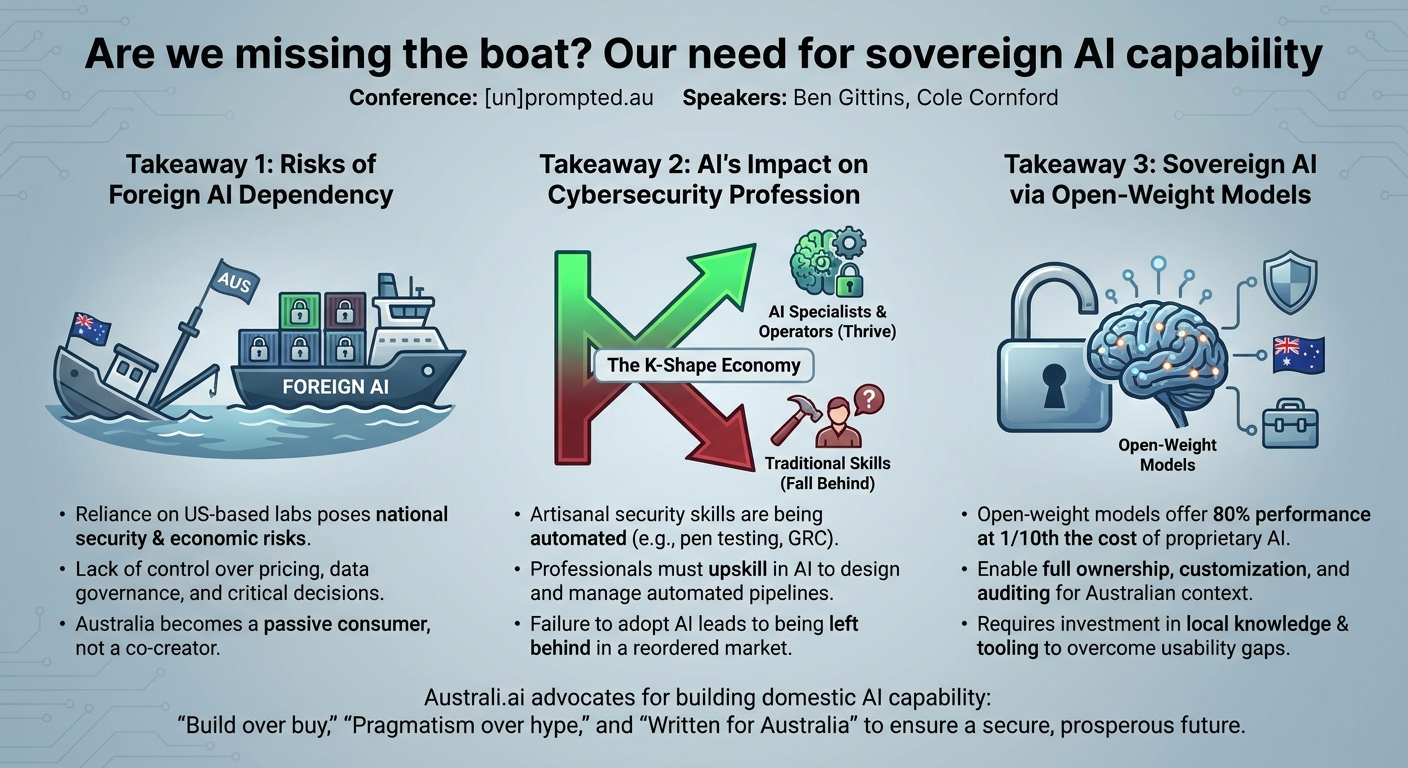
This technological disruption is creating a K-shape economy, a concept borrowed from the COVID-19 era, where society diverges into two groups: those who rapidly benefit and escalate, and those who struggle and fall behind. In the context of AI, the speakers identified AI specialists and operators as those "taking off," enjoying significant wage premiums and new opportunities. Conversely, many cybersecurity professionals lack the psychological safety or opportunity to adopt these new technologies, fearing automation of their own roles or those of their colleagues. This fear is exacerbated by industry trends: the ISC2 cybersecurity workforce study indicated that 40% of respondents reported hiring freezes or headcount reductions, with 24% reporting layoffs. A staggering 95% of respondents identified at least one skills gap, predominantly in artificial intelligence, underscoring the urgent need for upskilling.
Against this backdrop, Australia faces a unique challenge. The speakers pointed out that the vast majority of Australian businesses—97%—are small and medium businesses (SMBs). While this historically made them less attractive targets for sophisticated attacks, the commoditization of offensive AI capabilities now makes attacking even a "fish and chip shop" or a local doctor's surgery economically viable. The current landscape sees Australia heavily reliant on frontier AI labs like Anthropic, OpenAI, and Google. These US-based entities control access, pricing, and the roadmap for their models, with Australia often excluded from critical tiers or decision-making processes. This means Australia has limited control over the security models, data governance, or ethical frameworks embedded within these foundational technologies, effectively leaving the nation "not on this boat."
Key Findings
▶ Watch: AI automating cybersecurity: pen testing, GRC, log analysis (4:00)
The talk presented several critical findings regarding Australia's current standing and future trajectory in the AI landscape:
Firstly, Australia's economic structure, characterized by 97% small and medium businesses (SMBs), renders it uniquely vulnerable to the dual impact of AI. While SMBs historically benefited from being less valuable targets, the commoditization of offensive AI capabilities drastically lowers the cost and increases the viability of cyberattacks against them. This means that entities previously considered too minor for sophisticated targeting, such as local doctor's surgeries or small telecommunications providers, are now within the reach of AI-augmented adversaries.
Secondly, the speakers highlighted a profound lack of sovereign control and influence over the development and deployment of foundational AI models. Major AI labs like Anthropic, OpenAI, and Google, predominantly based in the US, dictate access, pricing, and feature sets. Australia consistently finds itself on lower tiers of access, with limited or no voice in critical decisions regarding security models, data handling, or ethical guidelines. This reliance on external roadmaps means Australia is a consumer, not a co-creator, of its technological future, leading to arbitrary pricing and uncontrollable availability.
Thirdly, the talk identified open-weight models as a crucial, yet underutilized, pathway to establishing sovereign AI capability. These models, often freely available, can achieve 80% performance on benchmarks compared to proprietary frontier models, but at one-tenth of the cost. The absence of restrictive licensing or access controls on open-weight models means they can be owned, customized, and deployed locally without external dependencies. This presents a viable alternative to the "trap" of long-term reliance on gated, commercial offerings.
Fourthly, a significant challenge to open-weight adoption was termed the "Linux problem." While open-weight models are capable and free, they are often hard to use, requiring substantial technical expertise to customize, integrate, and operate effectively. This contrasts with the "single click away" convenience of hosted API services from frontier labs. Overcoming this usability gap requires focused effort on tooling, methodology, and education to make these powerful models accessible to a broader range of users and organizations.
Fifthly, the speakers asserted that the primary barrier to Australian AI sovereignty is not a lack of compute power or data centers, but rather a deficit in knowledge, tooling, and context. There is a critical need to develop the expertise to build with these tools, to encode Australian-specific methodologies, and to imbue models with an understanding of Australian standards, regulations, and threat landscapes. These local considerations are unlikely to be first-class citizens in models developed by global labs for international markets.
Finally, Australi.ai was presented as a direct response to these findings, founded on three core commitments: "Build over buy where it makes sense" to foster ownership of capability; "Pragmatism over hype" to prioritize defensibility and economic viability; and "Written for Australia" to ensure solutions are tailored to the local context rather than retrofitted from foreign business models. These commitments aim to make AI accessible, teach effective use, and drive a national shift in mindset towards AI adoption and development.
Technical Deep Dive
▶ Watch: Australia's reliance on foreign AI systems (10:00)
The technical underpinnings of Gittins and Cornford's argument rest on the transformative power of AI to fundamentally alter the nature of work, particularly within cybersecurity. They outlined three major shifts mirroring the Industrial Revolution, now manifesting through AI:
- Expertise to Accessible: Traditionally, cybersecurity demanded deep, often specialized, human expertise. Achieving proficiency in areas like vulnerability triage or penetration testing often required extensive training, certifications like the OSCP, and years of experience. AI, through open weights and open tooling, is democratizing this expertise. Foundational models, even open-source ones, can now perform tasks that previously required highly skilled human analysts. This means individuals who "don't need to train" or "go get an OSCP" can access capabilities once reserved for a select few. The speakers implicitly suggest that the value of the raw, untooled expertise is diminishing, as AI provides a shortcut to practical application.
- Artisanal to Industrial: The shift from bespoke, human-centric processes to automated, scalable pipelines is central to the AI revolution.
- Security Assessments: What was once a manual, time-consuming process (e.g., booking a pen test six to eight weeks in advance, manual scoping of codebases, threat modeling) is becoming automated. AI agents can now triage vulnerabilities, spider entire websites to build a scope on demand, and perform static analysis scanning more efficiently. This transforms the role from a hands-on tester to a designer and operator of these automated agents.
- GRC and Compliance: Manual compliance tasks, such as policy writing and evidence gathering, are evolving into continuous evidence gathering and collection. AI can monitor an organization's state in real-time, defining policies dynamically based on current configurations and activities, rather than relying on annual, static policy reviews.
- Log Analysis: Advanced AI models, as demonstrated in other talks at the conference, are significantly enhancing the ability to process and derive insights from vast quantities of log data, moving beyond manual "eyes on glass" analysis to automated threat detection and anomaly identification.
- Luxury to Commodity: Services that were once only available to large enterprises with significant budgets are becoming accessible to a much broader market. The cost-effectiveness and scalability of AI mean that advanced security capabilities can be deployed at a fraction of the traditional cost, making them a commodity rather than a luxury.
However, the speakers critically assessed the current state of AI adoption in Australia, highlighting a problematic over-reliance on closed-source, proprietary models from major US-based frontier labs:
- Gated Access: Companies like Anthropic have gated access to their "world-breaking capability" to a mere "40 partner verified orgs," with very few, if any, being Australian. This restricts Australia's ability to leverage cutting-edge AI for its specific needs.
- Controlled Ecosystems: OpenAI and Google offer tiered access, with pricing and availability often controlled and restricted to those they "deem suitable." These ecosystems are typically priced in USD, further removing control from Australian entities. The implication is that Australia is on "somebody else's roadmap," subject to changes in pricing, terms of service, and availability that are outside its influence.
- Lack of Context: Crucially, these global models are not "built for the average Australian business." They lack embedded understanding of Australian standards, regulations, and unique threat landscapes. This necessitates a costly and inefficient retrofitting process or, more likely, results in solutions that are not optimally secure or compliant for the Australian context.
The proposed technical solution revolves around the strategic adoption and development of open-weight models:
- Performance and Cost: Open-weight models are lauded for achieving "80% on benchmarks" at "tenth of the cost" of their proprietary counterparts. This economic advantage is critical for a nation dominated by SMBs.
- Ownership and Customization: Unlike black-box commercial APIs, open-weight models allow for full ownership of the model and the ability to customize and fine-tune them for specific Australian requirements. This provides the necessary visibility to "monitor and manage" their behavior, mitigating risks like hidden agendas or backdoors – a direct counter to the "security through obscurity" inherent in closed systems.
- The "Linux Problem": Acknowledging the challenge, open-weight models are "kind of capable, they're free, but they're actually hard to use." This is where Australi.ai's mission focuses: creating methodology and tooling to encode processes, build harnesses, and develop the judgment necessary to effectively use and evaluate these models. The goal is to make them as accessible for Australian enterprises as Linux became for the server market, rather than remaining a niche for highly technical users.
In essence, the technical deep dive advocated for a shift from consuming black-box AI services to actively building and controlling a sovereign AI capability based on open, auditable, and customizable models. This requires not just compute resources, but a significant investment in developing the human capital and technical infrastructure to adapt, deploy, and manage AI within the unique Australian context.
Demo / Proof of Concept
▶ Watch: Australi.ai's vision: narrowing the K-shape with open weights (13:20)
While the talk did not feature a live demonstration or specific proof of concept of an AI model or tool, the speakers powerfully illustrated the potential and necessity of AI through concrete examples of automated security tasks. They described how AI agents could perform functions like on-demand penetration testing, automated website scoping, continuous GRC compliance evidence gathering, and advanced log analysis, contrasting these with traditional, manual methods. The focus was on articulating the strategic vision for sovereign AI capability rather than showcasing a particular implemented solution.
Defensive Implications
▶ Watch: Q&A: Trusting open-weight models vs. closed black boxes (22:00)
The insights presented by Gittins and Cornford carry profound defensive implications for Australian organizations and the cybersecurity profession as a whole.
Firstly, the most critical defensive implication is the urgent need for upskilling in AI. The "K-shape economy" model clearly demonstrates that cybersecurity professionals who fail to adopt and become proficient in AI will be left behind. Defenders must shift their mindset from purely manual, artisanal tasks to understanding how to design, operate, and manage AI-driven security pipelines. This includes learning to integrate AI into existing security operations, understanding AI's capabilities for automated threat detection, incident response, and vulnerability management, and developing the skills to build and interpret AI models. The current 95% skills gap in AI among cybersecurity professionals underscores this imperative.
Secondly, organizations must actively explore and embrace open-weight AI models. Relying solely on proprietary, black-box AI solutions from foreign vendors introduces significant risks related to control, transparency, and context. By utilizing open-weight models, defenders can gain visibility into the underlying mechanics of their AI tools, allowing for better monitoring, auditing, and detection of potential backdoors or malicious modifications. This aligns with the principle of "security through visibility" over "security through obscurity." Investing in the capability to customize and fine-tune these models for Australian standards, regulations, and threat intelligence is paramount to ensuring their effectiveness and compliance.
Thirdly, the shift towards process engineering is unavoidable. Defenders should identify repetitive, manual cybersecurity tasks—such as initial security assessments, compliance checks, or basic log triage—and strategize how AI agents can automate or augment these processes. This frees up human analysts to focus on higher-order, complex problems that still require human creativity and judgment. Implementing continuous compliance and evidence gathering through AI will transform GRC from an annual burden into a real-time security posture assessment.
Fourthly, a proactive approach to building domestic AI capability is essential. This means investing in local talent, fostering R&D, and supporting initiatives like Australi.ai that aim to create Australian-centric AI tooling and knowledge. Rather than merely renting AI services, organizations should strive to own the capability to ensure long-term control, resilience, and adaptability. This also involves collaborating with government and industry to establish frameworks for responsible AI development and deployment that reflect Australian values and legal requirements.
Finally, defenders must recognize that the cost of attack is decreasing due to AI. This makes even small and medium Australian businesses viable targets. Consequently, all organizations, regardless of size, need to reassess their threat models and enhance their defensive strategies with AI-powered tools that can match the sophistication of AI-augmented adversaries. This includes leveraging AI for early warning, automated vulnerability discovery, and rapid response to complex threats that might overwhelm traditional defenses. The overall message is clear: AI is a double-edged sword, and defenders must wield it themselves to protect against its misuse.
Key Takeaways
- Australia faces an urgent need for sovereign AI capability, as current reliance on foreign, closed-source models from US-based labs poses significant national security, economic, and control risks.
- The cybersecurity profession is undergoing a fundamental shift, with traditional artisanal skills being devalued by AI-driven automation; professionals must upskill in AI to avoid falling into the "bottom arm" of the K-shape economy.
- Open-weight AI models offer a viable and cost-effective pathway to sovereignty, providing 80% benchmark performance at one-tenth of the cost of proprietary solutions, alongside crucial ownership and customization capabilities.
- The primary challenge for Australian AI adoption is not compute, but a deficit in local knowledge, tooling, and context, requiring dedicated effort to encode Australian standards, regulations, and threat intelligence into AI systems.
- Australi.ai aims to address this gap by committing to "build over buy," "pragmatism over hype," and developing AI solutions "written for Australia," thereby fostering domestic capability and reducing external dependency.
- Defenders must proactively embrace AI by upskilling, leveraging open-weight models for transparency and control, and transforming manual processes into AI-augmented pipelines to counter the decreasing cost and increasing viability of AI-powered attacks against Australian organizations.
About the Speaker(s)
Ben Gittins is associated with Zepto, a company in the financial technology sector. He presented alongside Cole Cornford on behalf of Australi.ai, an initiative they co-founded.
Cole Cornford is the owner of Galah Cyber, a cybersecurity company. He presented with Ben Gittins on behalf of Australi.ai, which they established as a "public benefit corporation style thing." Their shared intention with Australi.ai is to "help build domestic Australian capability for our country and for all the people that live within it," reflecting their deep concern for Australia's future in the AI landscape.
Reviews
Dr. Zero (Offensive Security Researcher) — WEAK
This isn't a research talk. It's a 45-minute manifesto leading up to a launch pitch for the speakers' new AI consultancy. They correctly identify that relying on US-hosted API endpoints is a data sovereignty nightmare, but they bring zero actual engineering to the stage.
Heather Calloway (CISO) — STRONG ACCEPT
This is a sharp, macro-level look at AI vendor concentration risk and the looming commoditization of artisanal security skills. Gittins and Cornford correctly identify that relying exclusively on a handful of US-based frontier models creates unacceptable data sovereignty and pricing risks. It is a necessary briefing for any leadership team mapping out their three-year AI integration and workforce development strategy.