Build the Tooling, Don’t Be the Tooling
Casey Ellis (Principal · Tall Poppy Group / disclose.io)
[un]prompted.au 2026 · Day 2 · Main Hall
Overview
In this insightful talk from [un]prompted.au, Casey Ellis, a seasoned veteran in offensive security and the founder of Bugcrowd, shared his journey into leveraging artificial intelligence to address a pervasive challenge in vulnerability disclosure: efficiently identifying the correct entity and contact point for reporting security vulnerabilities. The presentation, aptly titled "Build the Tooling, Don’t Be the Tooling," delves into the practical application of AI to construct a self-improving system for vulnerability attribution, highlighting how practitioners, even those without extensive traditional engineering backgrounds, can become builders in the age of AI.
Key moments
- 0:00 Introduction, disclose.io, and AI journey
- 3:30 The 'Slop-demic' problem: finding vulnerability contacts
- 5:30 Defining Ideal State Agreement (ISA) for AI projects
- 6:40 'Cheating' tip: Build deterministic tools using powerful models
- 7:50 Self-improvement loop: mitigating false positives in AI tools
- 10:30 'Loop engineering' for recursive self-improvement and product fidelity
- 12:50 Key takeaways: Product thinking, ISA, and agent loops
- 15:10 Q&A: Tooling vs. human work in AI security
Build the Tooling, Don’t Be the Tooling
Speakers: Casey Ellis, Principal, Tall Poppy Group / disclose.io
Conference: [un]prompted.au
YouTube: https://www.youtube.com/watch?v=dCmJ6X4uigU
Overview
In this insightful talk from [un]prompted.au, Casey Ellis, a seasoned veteran in offensive security and the founder of Bugcrowd, shared his journey into leveraging artificial intelligence to address a pervasive challenge in vulnerability disclosure: efficiently identifying the correct entity and contact point for reporting security vulnerabilities. The presentation, aptly titled "Build the Tooling, Don’t Be the Tooling," delves into the practical application of AI to construct a self-improving system for vulnerability attribution, highlighting how practitioners, even those without extensive traditional engineering backgrounds, can become builders in the age of AI.
Ellis's work centers around disclose.io, a non-profit initiative dedicated to creating robust infrastructure for security and vulnerability reporting across the internet. His motivation stems from what he terms the "slop-demic"—a significant increase in vulnerability discovery coupled with a rise in "rookie" researchers resorting to full disclosure on public platforms due to the frustration of being unable to locate appropriate contact channels. This problem, characterized by its probabilistic and often incomplete nature, presents an ideal candidate for AI-driven solutions, as traditional methods frequently fall short.
The talk underscores a critical shift in how security professionals can approach problem-solving. Rather than relying solely on human effort to navigate the complexities of vulnerability disclosure, Ellis demonstrates how AI can be harnessed to automate and optimize this process. By focusing on the principles of product management and continuous improvement, he illustrates how AI-powered tooling can not only make vulnerability reporting more efficient but also empower a new generation of security researchers to contribute meaningfully without becoming overwhelmed by the operational "suck" of the process.
Background
▶ Watch: Introduction, disclose.io, and AI journey (0:00)
The genesis of Ellis's project lies in the fundamental mission of disclose.io: to foster a safer internet by enabling good faith security research and ensuring that individuals reporting vulnerabilities are protected and can do so effectively. Originally conceived as a "safe harbor" project to reform laws protecting security researchers, disclose.io has evolved into a broader initiative aimed at building the necessary infrastructure for vulnerability reporting. This includes addressing the glaring gap in how researchers identify who owns a vulnerable asset and, crucially, how to contact them.
The problem Ellis addresses is exacerbated by the current state of cybersecurity, which he vividly labels the "slop-demic." This phenomenon is characterized by an explosion in the discovery and reporting of vulnerabilities, but not necessarily a corresponding increase in widespread exploitation—hence "slop" rather than "vuln-pocalypse." A significant byproduct of this surge is an increase in "spam" reports and, more critically, instances where new or impatient researchers, unable to find official disclosure channels, resort to public "full disclosure" out of frustration. This often leads to unnecessary risks and undermines the principles of responsible disclosure.
For a subset of the internet, proactive organizations have made their vulnerability disclosure programs (VDPs) and security contact information readily accessible. However, for a vast majority, this information is either obscure, non-existent, or difficult to ascertain, leaving researchers in a quandary. Ellis identifies this as a "probabilistic and unsolvable to completion" problem, meaning there will always be a degree of uncertainty and missing information. This inherent ambiguity makes it a prime candidate for Large Language Models (LLMs), which excel at processing vast amounts of unstructured data and inferring connections, even when definitive answers are elusive. By applying AI, Ellis sought to remove the "excuse" for public disclosure by providing a reliable, automated means to locate the appropriate contacts.
Key Findings
▶ Watch: Defining Ideal State Agreement (ISA) for AI projects (5:30)
Casey Ellis's talk highlights several pivotal findings regarding the application of AI in security tooling, challenging conventional approaches and offering a blueprint for future development.
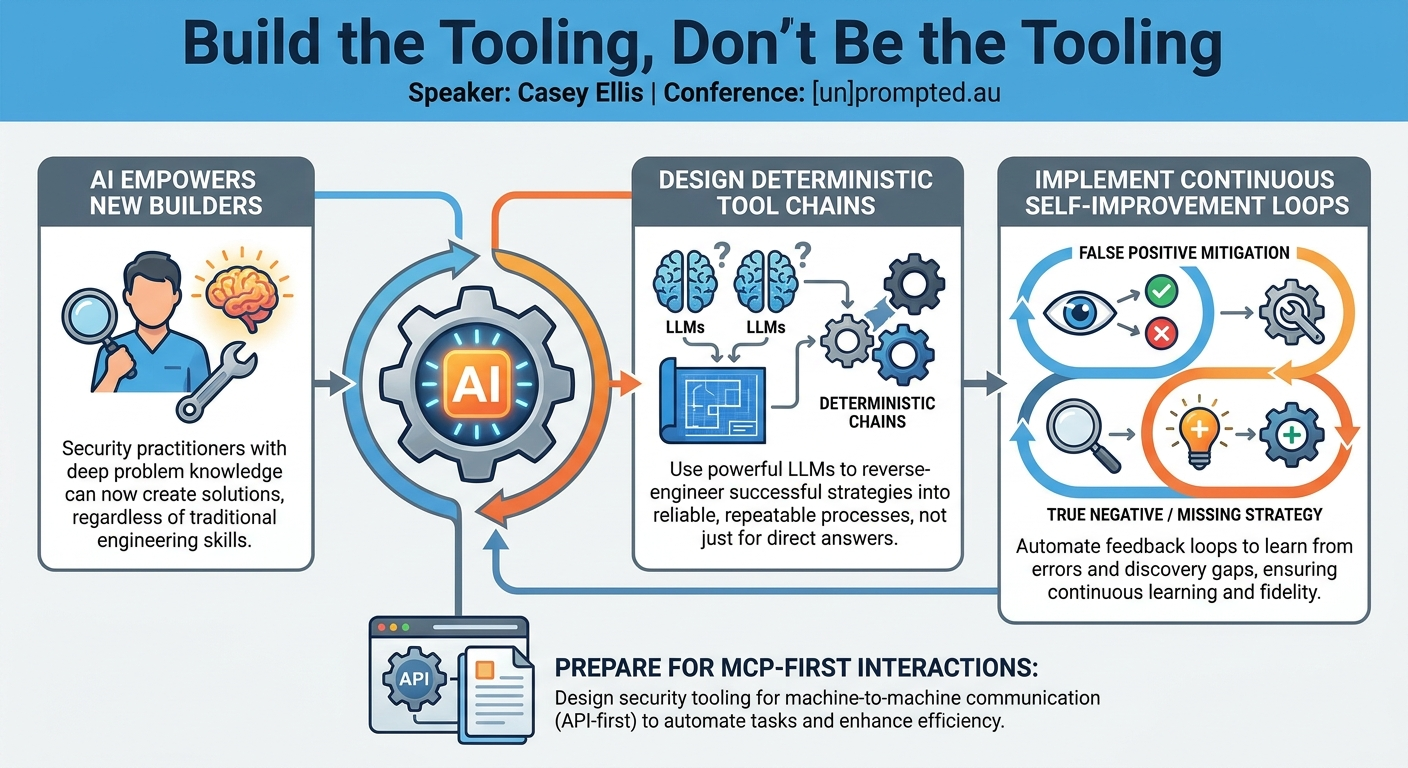
Firstly, a significant takeaway is the democratizing power of AI for security practitioners. Ellis posits that AI enables individuals who deeply understand security problems but may not possess traditional engineering skills to become effective builders. The ability to "just do shit" with AI tools empowers a broader range of talent to create solutions, shifting the focus from intricate coding to problem definition and strategic application.
Secondly, the talk introduces the PAI harness, developed by Dan Miessler, as a foundational component for building sophisticated AI-driven systems. This multi-agent, multi-modal harness provides a structured environment for AI development, integrating various learnings and capabilities. Central to this framework is the concept of Ideal State Agreement (ISA). Ellis emphasizes that defining the ISA—essentially a "product contract" outlining core constraints and desired outcomes—is paramount. For his vulnerability attribution tool, the ISA mandated accepting any input, always providing an answer, getting as close to the correct owner as possible, but crucially, never hallucinating and remaining deterministic. This focus on deterministic outcomes, rather than simply querying LLMs, is a critical distinction.
Thirdly, Ellis unveiled an innovative build strategy: leveraging the most powerful available LLMs not just to answer questions, but to design the underlying deterministic tool chains. By repeatedly asking powerful models what successful trajectories led to correct answers, developers can instruct them to "build that for me." This approach, which Ellis half-jokingly describes as "cheating," dramatically accelerates development by having AI models reverse-engineer effective problem-solving methodologies into structured, repeatable processes. This bypasses the inherent non-determinism and hallucination risks associated with direct LLM queries.
Finally, a cornerstone of Ellis's methodology is the implementation of self-improvement loops, which he refers to as "loop engineering." Recognizing that no probabilistic problem can be solved with 100% accuracy, these loops are designed for continuous refinement. Two distinct loops were detailed: one for mitigating false positives (ensuring reported contacts are correct) and another for addressing true negatives (identifying missing strategies for queries that yield no response). These loops automate the process of analyzing performance, diagnosing errors, proposing fixes, and integrating improvements, creating a "self-licking ice cream" machine where increased usage generates more data, leading to further fidelity enhancements.
Technical Deep Dive
▶ Watch: Self-improvement loop: mitigating false positives in AI tools (7:50)
The technical architecture underpinning Ellis's vulnerability attribution tool is built upon several innovative principles, moving beyond simple API calls to LLMs towards a more structured, self-improving system.
At its core, the system utilizes Dan Miessler’s PAI harness, a multi-agent, multi-modal framework. This harness provides the scaffolding for orchestrating various AI models and tools, allowing them to work collaboratively. The harness is designed to learn and integrate new strategies over time, making it highly adaptable.
The initial phase of development is dictated by the Ideal State Agreement (ISA). For this project, the ISA established stringent requirements:
- Accept any input whatsoever: The tool must be versatile enough to process diverse types of information related to a vulnerability.
- Always provide an answer: Even if imperfect, a response is preferred over no response.
- Get as close to the correct answer and owner as possible: Accuracy is paramount, especially in the sensitive context of vulnerability disclosure.
- Never hallucinate: This is a critical constraint, directly addressing a known weakness of LLMs. Providing incorrect contact information is worse than providing no information.
- Be deterministic: The system should not rely solely on the probabilistic nature of LLMs for final answers but rather build reliable, repeatable processes.
To achieve determinism and avoid hallucination, Ellis employed a clever build strategy. Instead of directly querying powerful LLMs like Claude, Astra, or Kimi for contact information, he used them in a meta-capacity. Initially, these models were used to solve the problem, and then, crucially, they were asked to describe the "successful trajectories" or logical steps that led to a correct answer. This meta-prompting allowed Ellis to extract and codify these trajectories into deterministic tool chains—sequences of actions that leverage existing infrastructure (like WHOIS, DNS records, public VDP databases, etc.) rather than relying on the LLMs' internal knowledge base for direct answers. This approach fundamentally shifts the role of the LLM from an oracle to a "solution architect."
The continuous improvement of the system is managed through two distinct self-improvement loops:
1. False Positive Mitigation Loop: This loop operates on a three-day cycle and focuses on ensuring the accuracy of the attribution.
- Log Analysis: The system reviews its past responses.
- Spot Checking: A sample of 100 answers is selected for verification.
- Cross-Referencing: A powerful model (e.g., Daybreak Blue or Opus 4.7) is used to cross-reference the system's answers.
- Second-Guessing: A second, powerful model is employed to second-guess the first model's assessment, further mitigating the risk of hallucination in the evaluation process itself.
- Root Cause Analysis: If both models agree the system provided an incorrect answer, the root cause is identified.
- Fix Proposal & Build: The AI proposes and then constructs a fix (e.g., modifying a tool chain, adding a new data source).
- Testing & Regression: The fix is tested, and regression tests are run to ensure it doesn't negatively impact other functionalities.
- Deployment: Once validated, the fix is deployed. This loop ensures that the system consistently learns from its mistakes and refines its accuracy.
2. True Negative / Missing Strategy Loop: This loop addresses instances where the tool fails to provide any response, indicating a gap in its capabilities.
- Query Analysis: The system identifies queries that yielded no attribution.
- Strategy Proposal: The AI analyzes these failures and proposes new strategies for attribution or context acquisition.
- Build, Test, Integrate: Similar to the false positive loop, the AI then builds, tests, and integrates these new strategies into the harness. This allows the system to expand its coverage and handle a wider range of input types.
The models used primarily include Daybreak Blue and Opus 4.7 for complex reasoning and evaluation. For more constrained, code-specific tweaks within the deterministic tool chains, Ellis uses a local rig running a smaller model like Qwen3.6 27B, demonstrating an intelligent allocation of computational resources based on task complexity.
The result of this sophisticated architecture is a system that has processed 54,000 lookups in just four months and supports 16 lookup types, a significant expansion from the initial eight or nine. This growth is largely attributed to the effectiveness of the self-improvement loops. Ellis also emphasized building the tool to be MCP (Model Context Protocol) first, anticipating a future where AI systems communicate directly via APIs, with web or manual interaction serving as fallbacks.
Demo / Proof of Concept
▶ Watch: 'Loop engineering' for recursive self-improvement and product fidelity (10:30)
While the talk did not feature a live, on-stage demonstration of the disclose.io vulnerability attribution tool, Ellis thoroughly detailed its operational capabilities and statistical performance, serving as a compelling proof of concept. He described a system that has been actively used and refined over several months, showcasing its real-world effectiveness.
The core function of the tool, as described, is to accept various inputs related to a vulnerability (e.g., a domain, IP address, or other identifiers) and output the most probable owner and their contact information for responsible disclosure. Ellis highlighted that the tool had already processed 54,000 lookups within four months of its development, demonstrating significant adoption and utility. Furthermore, the number of supported lookup types had expanded from an initial eight or nine to 16, a testament to the efficacy of the self-improvement loops in continuously extending the tool's capabilities based on user queries and identified gaps.
Ellis also mentioned the tool's integrations with "a whole bunch of different tooling sets," implying its design for seamless incorporation into existing security research workflows. This integration aspect, combined with the impressive usage statistics and the detailed explanation of its self-improving mechanisms, effectively communicated the tool's practical value and robust design without the need for a live demo. The focus was less on the immediate user interface and more on the underlying intelligence and continuous evolution of the system.
Defensive Implications
▶ Watch: Q&A: Tooling vs. human work in AI security (15:10)
The work presented by Casey Ellis carries profound implications for both offensive and defensive security postures, particularly in the realm of vulnerability management and disclosure.
For organizations, Ellis's tool serves as a stark reminder of the escalating challenge in managing vulnerability disclosures. The "slop-demic" signifies that defenders are facing an unprecedented volume of potential reports. The fact that an AI-powered tool can efficiently identify asset owners and contact points highlights a critical defensive vulnerability: if a machine can find you, then you must have a clear, discoverable, and accessible channel for responsible disclosure. Organizations without robust Vulnerability Disclosure Programs (VDPs) or easily identifiable security contact information (e.g., security.txt, well-documented security pages) are effectively creating friction that can lead to public disclosure, reputational damage, and increased risk. Defenders should proactively ensure their contact information is machine-readable and easily discoverable by automated tools.
Furthermore, Ellis's emphasis on building for MCP (Model Context Protocol) first signals a future where AI systems will increasingly interact directly with each other. This means that defensive security strategies need to evolve beyond human-centric communication. Organizations should consider how their VDPs, incident response processes, and general security communications can be exposed via APIs or other machine-readable formats, allowing AI-powered tools to seamlessly report and triage vulnerabilities. This shift could significantly reduce the manual overhead of vulnerability intake and accelerate remediation efforts.
The underlying philosophy of "Build the Tooling, Don’t Be the Tooling" is also a call to action for defenders. Many repetitive, high-volume, and "sucky" tasks in defensive security—like initial triage, threat intelligence correlation, or even basic incident response—could be prime candidates for AI-driven automation. By embracing AI to build self-improving tools, security teams can free up human analysts to focus on complex, strategic tasks that require uniquely human cognitive abilities, rather than being bogged down by operational drudgery. This strategic application of AI can enhance efficiency, reduce burnout, and ultimately strengthen an organization's overall security posture.
Key Takeaways
- AI Empowers New Builders: AI significantly lowers the barrier to entry for security practitioners to develop practical tools, allowing those with deep problem understanding, but not necessarily extensive engineering skills, to create solutions.
- Define Ideal State Agreement (ISA): Clearly outlining the product contract, core constraints (e.g., "never hallucinate," "be deterministic"), and desired outcomes is crucial for successful AI project development.
- Implement Continuous Self-Improvement Loops: Robust AI tooling, especially for probabilistic problems, requires automated feedback loops to mitigate false positives and discover new strategies for true negatives, fostering continuous learning and fidelity improvement.
- Leverage AI for Design, Not Just Execution: Use powerful LLMs to reverse-engineer successful problem-solving trajectories and construct deterministic tool chains, rather than relying solely on their direct, often non-deterministic, outputs.
- Prepare for MCP-First Interactions: The future of security tooling will increasingly involve machine-to-machine (MCP) communication. Organizations should design their vulnerability disclosure and security contact mechanisms to be API-first and machine-readable.
- Automate the "Suck": Strategically apply AI to automate repetitive, undesirable tasks within security operations, allowing human experts to focus on higher-value, uniquely human contributions.
About the Speaker(s)
Casey Ellis is a highly respected figure in the cybersecurity community, known for his entrepreneurial spirit and deep expertise in offensive security. He is the founder of Bugcrowd, a pioneering platform in crowdsourced security testing. Having concluded his tenure with Bugcrowd in January, Ellis is now primarily focused on disclose.io, a non-profit initiative dedicated to improving vulnerability reporting infrastructure. He also serves as the Principal of the Tall Poppy Group. With a career in offsec dating back to the 1990s, Ellis describes himself as "AI pilled" since 2022, having recognized the transformative potential of ChatGPT early on. He advocates for a pragmatic approach to AI, believing in its consequences and utility rather than subscribing to a "cult of AI."
Reviews
Dr. Zero (Offensive Security Researcher) — SOLID
Casey Ellis tackles the 'slop-demic' of garbage vulnerability reports by doing something almost nobody in this industry does: using LLMs correctly. He built a deterministic toolchain for VDP routing instead of a hallucination-prone magic 8-ball. It's a highly practical, no-bullshit blueprint for automating the agonizing parts of disclosure without the usual generative AI marketing garbage.
Heather Calloway (CISO) — SOLID
Casey Ellis delivers a sharp, pragmatic look at using AI to solve the massive scaling problem of vulnerability attribution. For any organization with a public footprint, the message is clear: the volume of inbound vulnerability reports is exploding, and if you don't have a standardized, machine-readable front door, you are inviting uncoordinated public disclosure. It is a required watch for whoever owns your vulnerability disclosure program.