Improving the Ability of Thermal Radiation Based Hardware Trojan Detection
Ting Su
33rd USENIX Security Symposium · Day 1 · USENIX Security '24 · USENIX Security '24
Overview
In the rapidly evolving landscape of integrated circuit (IC) security, Hardware Trojans (HTs) represent a persistent and growing threat. These insidious malicious circuits, stealthily embedded during the design or fabrication stages, can compromise the integrity, confidentiality, and availability of critical systems. Ting Su's presentation at USENIX Security '24, titled "Improving the Ability of Thermal Radiation Based Hardware Trojan Detection," delves into a novel approach to combat this challenge, particularly focusing on the elusive sub-pixel HTs that often evade traditional detection methods. The research introduces NICE, a framework that ingeniously repurposes what was previously considered noise – mechanical vibration from thermal cameras – into a powerful signal for enhanced HT detection.
Key moments
- 0:00 Introduction to Hardware Trojans and TR detection advantages
- 2:15 The challenge: Detecting subpixel Hardware Trojans
- 4:00 Leveraging thermal camera vibration for subpixel HT detection
- 4:50 Introducing NICE: A new framework for subpixel HT detection
- 5:25 Direction-based TRM classification mechanism in NICE
- 7:15 Hardware Trojan detection stage using K-statistic and criterion
- 8:20 Hardware and software system implementation of NICE
Improving the Ability of Thermal Radiation Based Hardware Trojan Detection
Speakers: Ting Su
Conference: USENIX Security '24
YouTube: https://www.youtube.com/watch?v=dv9_xMO0z2I
Overview
In the rapidly evolving landscape of integrated circuit (IC) security, Hardware Trojans (HTs) represent a persistent and growing threat. These insidious malicious circuits, stealthily embedded during the design or fabrication stages, can compromise the integrity, confidentiality, and availability of critical systems. Ting Su's presentation at USENIX Security '24, titled "Improving the Ability of Thermal Radiation Based Hardware Trojan Detection," delves into a novel approach to combat this challenge, particularly focusing on the elusive sub-pixel HTs that often evade traditional detection methods. The research introduces NICE, a framework that ingeniously repurposes what was previously considered noise – mechanical vibration from thermal cameras – into a powerful signal for enhanced HT detection.
The talk highlights the critical need for advanced detection techniques, especially given the practicality and stealth of fabrication-stage HT attacks, which can exploit unused spaces within an IC layout. While side-channel analysis, including methods based on power and electromagnetic radiation, has shown promise, these often face limitations such as the need for a Golden Chip (a known good reference IC) or specific testing vectors, along with limited detection resolution. Thermal radiation (TR) based detection, on the other hand, offers advantages in resolution and resistance to process variations. However, existing TR methods struggle with HTs that do not fully occupy a single pixel, leaving a significant vulnerability.
This paper is significant because it directly addresses the realistic challenge posed by sub-pixel HTs, which are difficult to detect due to their "transparent nature" and the subtle changes they induce in thermal profiles. By re-imagining mechanical vibration as a beneficial factor rather than a hindrance, Su's work provides a substantial performance boost, enabling the detection of smaller, more sophisticated HTs and offering a more flexible and cost-effective approach to IC security. The NICE framework represents a crucial step forward in securing the hardware supply chain against increasingly sophisticated adversaries.
Background
▶ Watch: Introduction to Hardware Trojans and TR detection advantages (0:00)
The proliferation of integrated circuits across virtually every sector, from critical infrastructure to consumer electronics, has elevated hardware security to a paramount concern. Among the most formidable threats are Hardware Trojans (HTs), malicious modifications to an IC's circuitry that can lead to data leakage, denial-of-service, or even complete system compromise. These Trojans are particularly dangerous when inserted during the fabrication stage, as attackers can leverage extensive access to the manufacturing process and exploit unused or "vacant" spaces within the IC layout to embed their malicious logic with high stealth.
Historically, efforts to detect HTs have primarily relied on two broad categories: reverse engineering and side-channel analysis. Reverse engineering involves delayering and imaging an IC to visually inspect its physical structure, comparing it against design specifications. While thorough, this method is destructive, time-consuming, and prohibitively expensive for large-scale application. Side-channel analysis, which monitors physical emanations during IC operation, offers a non-invasive and potentially faster alternative. Traditional side-channel techniques often utilize power consumption or electromagnetic (EM) radiation profiles. However, these methods are not without their limitations. They frequently require a Golden Chip for comparison, necessitating a known good reference, or depend on specific testing vectors to trigger the HT's functionality, which can be difficult to devise for stealthy Trojans. Furthermore, their detection resolution can be limited, and factors such as varying IC sizes and process variations (manufacturing inconsistencies) can complicate analysis and lead to false positives or negatives.
Recognizing these challenges, researchers have turned to thermal radiation (TR) as a promising side-channel for HT detection. The fundamental principle behind TR-based detection lies in the fact that active logic regions within an IC generate heat, emitting thermal radiation, while vacant regions remain relatively cool. When an IC operates, logic regions heat up rapidly, causing a significant increase in TR, whereas vacant regions heat up slowly. If an HT, which is essentially active logic, is stealthily inserted into a vacant region, it will cause an anomalous increase in TR in that specific area. By meticulously analyzing the thermal radiation map (TRM) of the IC and comparing it against designed data, HTs can theoretically be detected without the need for a Golden Chip or specific testing vectors, offering high detection resolution and resilience against process variations.
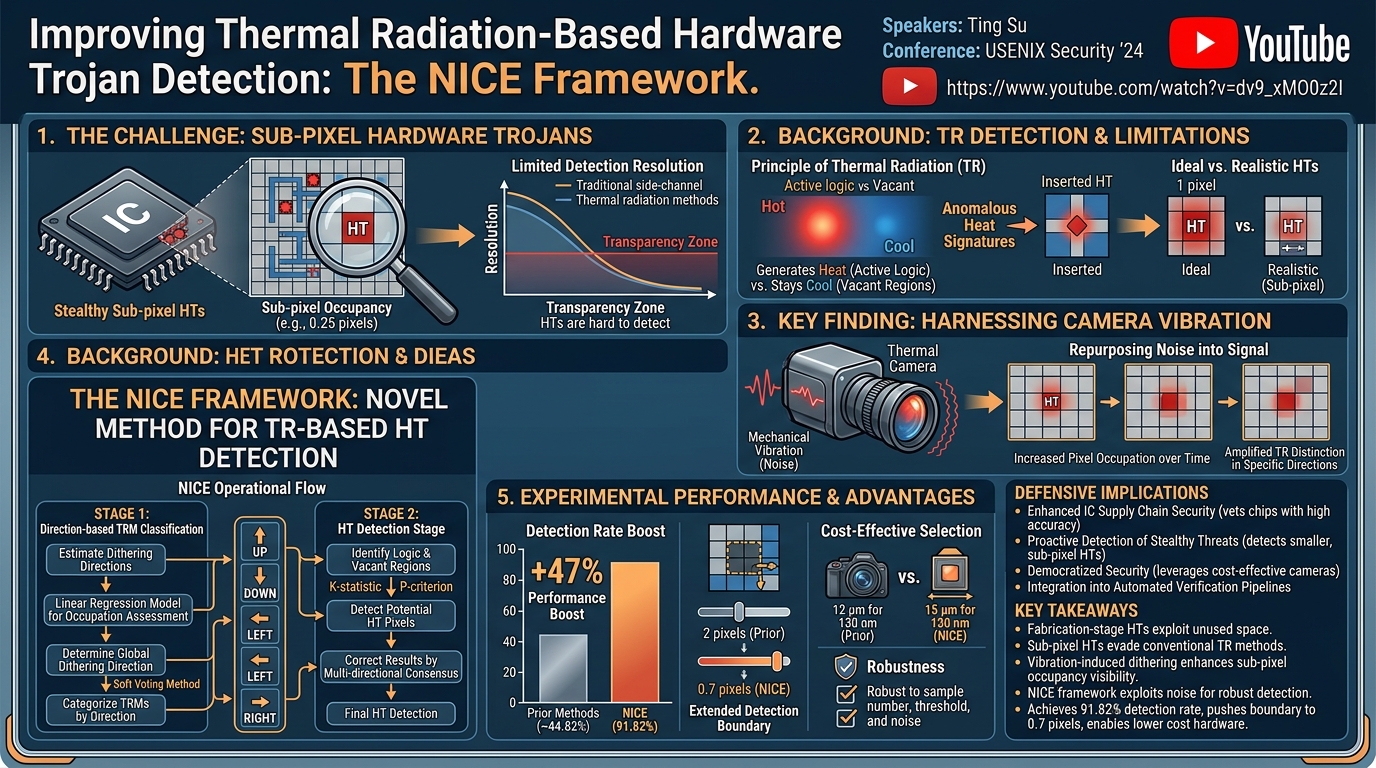
Despite these inherent advantages, existing TR-based methods face a critical hurdle: they are primarily designed for ideal HTs that fully occupy at least one pixel in the TRM. In reality, HTs can be much smaller and more dispersed, often spreading across multiple pixels or occupying only a fraction of a single pixel. These are referred to as sub-pixel HTs. As highlighted by Su, an HT might occupy only a quarter of an affected pixel. Since TR changes are directly proportional to the extent of pixel occupation, such partial occupation leads to subtle TR variations that are difficult to distinguish from normal vacant regions, causing these sub-pixel HTs to evade detection by conventional TR methods. This transparency of sub-pixel HTs constitutes a significant, realistic challenge, motivating the research presented in this talk.
Key Findings
▶ Watch: Leveraging thermal camera vibration for subpixel HT detection (4:00)
The central discovery of this research is the innovative realization that mechanical vibration emanating from thermal cameras, typically dismissed as noise, can be strategically harnessed to enhance the detection of elusive sub-pixel Hardware Trojans (HTs). While this vibration usually complicates the distinction between partially occupied and vacant pixels by introducing variability, the authors found that it can actually cause the HTs to shift position slightly within the thermal camera's field of view. This subtle shifting, or dithering, leads to a heightened variability in the HT's pixel occupation over time, making the thermal radiation (TR) distinction more pronounced in certain directions compared to a static scenario.
This insight led to the core challenge: how to identify the specific direction of vibration that would best amplify the TR distinction for detecting sub-pixel HTs, given that the exact location and orientation of an HT are unknown. Instead of attempting to pinpoint a single optimal direction for all potential HTs, the key finding was to adopt a comprehensive approach: detect HTs by analyzing TR changes in all possible vibration directions separately and then combining the results. If an HT reaches a sufficiently high pixel occupation in any of these analyzed directions, its TR signature becomes more noticeable, significantly increasing the probability of detection.
Based on this principle, the research proposes a novel HT detection framework called NICE (Novel method exploiting the potential of noise for TR-based HT detection). NICE works by categorizing thermal radiation maps (TRMs) into several sets, each corresponding to a distinct vibration direction. It then traverses these directional datasets, applying statistical analysis to detect HTs, and finally combines the outcomes from all directions to achieve a more accurate and robust detection of sub-pixel HTs.
The effectiveness of NICE is demonstrated through compelling experimental results:
- High Detection Rate and Low False Alarms: NICE achieved a detection rate of up to 91.82% with a false alarm rate below 1%. This represents a substantial performance boost of over 47% compared to previous thermal radiation-based methods.
- Enhanced Detection Boundary: The framework pushes the detection boundary of TR-based methods significantly, from HTs larger than 2 pixels down to those as small as 0.7 pixels. This capability is crucial for identifying the smaller, more stealthy HTs prevalent in modern IC designs.
- Cost-Effective Camera Selection: NICE enables a more flexible and cost-effective selection of thermal cameras. For instance, it can detect HTs under a 130 nanometer (nm) process using a 15 micrometer (µm) thermal camera, whereas previous methods required a more expensive 12 µm camera for the same task. This broadens the accessibility and practicality of TR-based HT detection.
- Robustness: Sensitivity analyses confirmed the robustness of NICE across varying numbers of TRM samples, classification thresholds, and levels of white noise, indicating its reliability in diverse operational environments.
These findings collectively underscore the transformative potential of leveraging inherent system "noise" as a beneficial signal, fundamentally improving the efficacy and practicality of hardware Trojan detection.
Technical Deep Dive
▶ Watch: Introducing NICE: A new framework for subpixel HT detection (4:50)
The NICE framework is meticulously designed to leverage the subtle mechanical vibrations from thermal cameras for enhanced sub-pixel Hardware Trojan (HT) detection. Its operational flow comprises two primary stages: Direction-based TRM Classification and the HT Detection Stage.
Direction-based TRM Classification
This initial stage is critical for organizing the raw thermal data in a way that highlights the effects of vibration-induced dithering. The core challenge here is accurately measuring the minute, often invisible, changes in thermal radiation (TR) caused by sub-pixel shifts. NICE addresses this by exploiting the inherent correlation between pixel occupation and TR increment.
- Estimating Dithering Directions: The process begins by analyzing the IC layout to understand how pixel occupation might increase or decrease in various vibration directions. Simultaneously, the system calculates the change in TR between successive sampling times from the raw TRM sequences. By correlating these two sets of data, NICE can estimate the potential dithering directions for individual pixels.
- Linear Regression Model for Occupation Assessment: To precisely delineate the relationship between pixel occupation and TR increment, a linear regression model is developed. This model is fine-tuned using comprehensive pixel data, including known pixel occupations from the IC layout and corresponding TR change data. Once trained, the model utilizes the TR increment of each pixel at every sample time to reassess its occupation.
- Categorizing Occupation Change: Based on a predefined threshold for occupation change, the model categorizes these changes into three distinct classes. These classes directly correspond to the possible dithering directions (e.g., increasing, decreasing, or stable occupation relative to a specific vibration axis).
- Determining Global Dithering Direction: Since image dithering (the effect of vibration) is known to affect all pixels equally across the thermal radiation map, NICE analyzes the statistical convergence of all pixels at the same sampling time. To robustly determine the most probable dithering direction for an entire TRM, a soft voting method is employed. This method aggregates the individual pixel-level assessments to identify the dominant vibration direction. TRMs exhibiting the same dominant direction are then grouped into specific datasets, preparing them for the subsequent detection stage.
HT Detection Stage
Once the TRMs are classified and grouped by their estimated vibration direction, the NICE framework proceeds to identify potential HTs within these datasets.
- Distinguishing Logic and Vacant Regions: For each directional TRM set, NICE analyzes the thermal profiles to differentiate between legitimate logic regions (which generate heat) and vacant regions (which should remain cool). Previous research has established that TR changes in active logic regions tend to follow a normal distribution.
- Statistical Parameter Extraction (K-statistic): NICE employs the K-statistic to extract the statistical parameters characterizing the TR distribution of logic regions. This allows for a robust baseline understanding of what constitutes "normal" thermal behavior for active components.
- Vacant Pixel Identification (P-criterion): Leveraging the inherent TR difference between logic and vacant regions, the P-criterion (likely referring to a statistical criterion for outlier detection or classification based on probability) is then applied. This criterion helps to distinguish vacant pixels from logic pixels by identifying those exhibiting significantly lower or anomalous TR increments compared to the established logic region parameters.
- Identifying Potential HTs: The identified "vacant" pixels are then compared against the original IC layout. Any pixels that appear as logic (i.e., show elevated TR signatures) but are designated as vacant in the design are flagged as potential HT pixels. The strength of NICE lies in its multi-directional analysis: if such an "extra logic pixel" is detected in any of the analyzed vibration directions, it is initially considered an HT candidate.
- Result Correction: To minimize false positives, a correction mechanism is implemented. If these extra logic pixels happen to match legitimate logic regions in most other directions (i.e., they consistently show logic-like behavior across multiple vibration perspectives), the initial detection result is corrected. This ensures that only truly anomalous logic in areas designated as vacant, which persist across directional analyses, are confirmed as HTs.
Hardware System
To implement and validate NICE, a dedicated hardware system was developed. This system consists of three key components:
- Thermal Camera: The primary sensor for capturing TRMs. The quality and resolution of the camera are crucial, though NICE aims to reduce reliance on the absolute highest-end models.
- Support and Isolation Platform: This platform is designed for versatility, allowing adjustments to accommodate various types of thermal cameras and the integrated circuits under test. Crucially, it incorporates an isolation platform which, in conjunction with a low-noise module, effectively mitigates environmental interference. This mitigation is vital for ensuring the precision of TR measurements and the robustness of the detection framework, making NICE suitable for deployment in diverse testing environments.
By integrating these sophisticated classification and detection algorithms with a robust hardware setup, NICE provides a comprehensive and highly effective solution for identifying even the most challenging sub-pixel Hardware Trojans.
Demo / Proof of Concept
▶ Watch: Hardware Trojan detection stage using K-statistic and criterion (7:15)
The efficacy of the NICE framework was rigorously demonstrated through a series of experiments designed to simulate and detect Hardware Trojans (HTs) in a controlled yet realistic environment. Given the inherent challenges of implementing a large number of diverse HTs within a real integrated circuit (IC) for experimental purposes, the researchers employed an equivalently approach to simulate HTs.
Experimental Implementation of HTs
Instead of physically embedding malicious circuits, the equivalent approach involved randomly removing some legitimate logic regions from the IC layout's golden reference data. In the context of the experiment, these removed regions would appear vacant in the "golden reference" (the design specification without HTs) but would remain logic in the "actual IC" under test. This clever method effectively simulates an HT: an area that should be vacant according to the design but exhibits active logic behavior during operation, thus generating anomalous thermal radiation. For the purpose of thorough evaluation, each logic pixel was iteratively treated as an HT, allowing for a comprehensive assessment of NICE's detection capabilities across various potential HT locations and sizes.
Performance Evaluation
The experimental results unequivocally demonstrated the superior performance of NICE compared to previous thermal radiation (TR) based detection methods:
- Detection Rate and False Alarms: NICE achieved an impressive detection rate of up to 91.82%, while maintaining a remarkably low false alarm rate below 1%. This represents a significant performance boost, exceeding 47% compared to prior art in TR-based HT detection. This high detection rate coupled with minimal false positives is crucial for practical deployment, as false alarms can lead to costly and time-consuming investigations.
- Detection Boundary Enhancement: A critical aspect of the evaluation involved assessing NICE's ability to detect HTs of varying sizes. The experiments revealed that NICE can push the detection boundary of TR-based methods significantly. While previous methods struggled with HTs smaller than 2 pixels, NICE successfully detected HTs as small as 0.7 pixels. This capability is vital for addressing modern, stealthy HT designs that are often engineered to be as small and inconspicuous as possible.
- Thermal Camera Flexibility and Cost-Effectiveness: The research also highlighted the economic and practical advantages of NICE. For detecting HTs under a 130 nanometer (nm) process (a common fabrication node), previous TR-based methods typically required high-resolution thermal cameras, specifically those with a pixel pitch of 12 micrometers (µm) or finer. NICE, however, was demonstrated to cover these same HT designs using more accessible and cost-effective 15 µm thermal cameras. This means that the framework enables a broader and more flexible selection of thermal cameras, reducing the reliance on highly specialized and expensive equipment, thereby making TR-based HT detection more economically viable for a wider range of organizations.
- Robustness Analysis: To ensure the reliability of the NICE framework in real-world scenarios, sensitivity analysis experiments were conducted. These experiments investigated the impact of various parameters, including the number of TRM samples collected, the classification threshold used for categorizing occupation changes, and the presence of white noise. The results consistently showed the robustness of NICE, indicating its resilience to variations in operational conditions and environmental interference.
In summary, the experimental proof of concept robustly validates NICE's ability to detect sub-pixel HTs with high accuracy, low false alarms, and improved cost-effectiveness, marking a significant advancement in hardware security.
Defensive Implications
▶ Watch: Hardware and software system implementation of NICE (8:20)
The NICE framework presents several crucial defensive implications for various stakeholders involved in the integrated circuit (IC) supply chain, from design houses to end-users. Its ability to detect sub-pixel Hardware Trojans (HTs) with high accuracy fundamentally shifts the landscape of hardware security.
- Enhanced IC Supply Chain Security: For IC designers, manufacturers, and procurement agencies, NICE offers a more robust tool to vet chips for malicious modifications. The threat of fabrication-stage HTs is increasingly sophisticated, with attackers capable of embedding very small, stealthy logic. NICE's ability to detect HTs as small as 0.7 pixels significantly raises the bar for adversaries, making it harder for them to hide malicious circuits even when employing advanced obfuscation techniques. This can help build greater trust in the IC supply chain.
- Proactive Detection of Stealthy Threats: Traditional detection methods often struggle with HTs that don't fully occupy a pixel or require specific triggers. NICE's approach, by leveraging inherent mechanical vibration, provides a proactive and non-invasive method to uncover these elusive sub-pixel HTs without needing a Golden Chip or specific test vectors. This reduces the burden on security teams to develop complex trigger patterns and allows for broader, more consistent screening.
- Cost-Effective Security Investment: The finding that NICE can achieve high detection rates with more flexible and less expensive thermal cameras (e.g., a 15 µm camera instead of a 12 µm camera for a 130 nm process) is a significant defensive advantage. It lowers the barrier to entry for implementing advanced thermal radiation-based HT detection, making it accessible to a wider range of organizations, including smaller firms or those with tighter budgets. This democratizes access to state-of-the-art hardware security.
- Integration into Verification Flows: The NICE framework, with its statistical analysis and robust performance, is a strong candidate for integration into automated IC verification and validation pipelines. By incorporating thermal imaging and the NICE algorithms, manufacturers and large-scale procurers can add another layer of automated security checks, identifying potential HTs before chips are deployed in critical systems.
- Rethinking "Noise" in Security: Beyond the immediate application, NICE offers a broader defensive paradigm shift: the potential to repurpose what is traditionally considered "noise" or interference into a valuable signal for security analysis. This encourages security researchers and engineers to re-evaluate other forms of environmental or system noise for hidden information that could aid in threat detection, potentially leading to novel defensive strategies across various domains.
- Guidance for Defenders: Defenders should consider investing in thermal imaging equipment and exploring the implementation of NICE-like algorithms for their IC verification processes. They should also be aware that even small, seemingly insignificant thermal anomalies could indicate a sub-pixel HT, and that tools like NICE are emerging to identify these subtle indicators.
In essence, NICE provides a powerful, practical, and more accessible tool that enhances the ability of defenders to detect a critical class of hardware threats, thereby bolstering the overall security posture of IC-dependent systems.
Key Takeaways
- Fabrication-stage Hardware Trojans (HTs) are a severe and growing threat to integrated circuit (IC) security, capable of stealthily exploiting unused spaces in IC layouts.
- While thermal radiation (TR) based detection offers high resolution and resistance to process variations, existing methods struggle to detect sub-pixel HTs due to their subtle thermal signatures.
- The NICE framework innovatively leverages mechanical vibration (typically considered noise) from thermal cameras to enhance detection by causing HTs to dither, increasing their pixel occupation in certain directions.
- NICE achieves exceptional performance, demonstrating a detection rate of up to 91.82% with a false alarm rate below 1%, representing over a 47% performance boost compared to previous TR-based methods.
- The framework significantly pushes the detection boundary, enabling the identification of HTs as small as 0.7 pixels (down from >2 pixels), and allows for the use of more cost-effective thermal cameras (e.g., 15 µm for 130 nm process).
- NICE highlights a novel paradigm in security: strategically exploiting inherent system "noise" to derive valuable information for robust threat detection, offering a more flexible and practical approach to hardware security.
About the Speaker(s)
Ting Su is the author of the paper "Improving the Ability of Thermal Radiation Based Hardware Trojan Detection" and presented this research at USENIX Security '24. The presentation focused on their latest findings regarding the detection of sub-pixel Hardware Trojans using a novel framework called NICE.
Reviews
Dr. Zero (Offensive Security Researcher) — MUST SEE
Ting Su's NICE framework isn't just another incremental paper; it’s a genuinely clever piece of work that weaponizes thermal camera 'noise' to detect sub-pixel Hardware Trojans. This is exactly the kind of innovative thinking needed in hardware security, moving beyond rehashed concepts to deliver a truly impactful defensive technique.
Heather Calloway (CISO) — STRONG ACCEPT
This research delivers a significant advancement in hardware security, directly addressing the critical and often overlooked threat of sub-pixel Hardware Trojans. By innovatively leveraging thermal camera vibration, it provides a more effective and cost-efficient method for supply chain integrity. This work offers clear, actionable insights for organizations with significant hardware dependencies.