The Impact of Exposed Passwords on Honeyword Efficacy
Zonghao Huang (Duke), Lujo Bauer, Michael K. Reiter
33rd USENIX Security Symposium · Day 1 · USENIX Security '24 · USENIX Security '24
Overview
In the ever-evolving landscape of cybersecurity, credential database breaches remain a persistent and critical threat. When these breaches occur, attackers gain access to vast repositories of hashed passwords, which, once reversed, can compromise user accounts across multiple services. The talk "The Impact of Exposed Passwords on Honeyword Efficacy" by Zonghao Huang, Lujo Bauer, and Michael K. Reiter from Duke University at USENIX Security '24 addresses a crucial aspect of breach detection: the effectiveness of honeywords in a world saturated with leaked credentials.
Key moments
- 0:00 Introduction to Honeywords and the problem of breaches
- 2:00 Key research focus: false rates with password exposure
- 4:00 Understanding False Positive and False Negative attacker models
- 7:00 Experimental results: L-list (password independent) performance
- 9:15 Comparing password independent and dependent honeyword methods
- 9:45 Why dependent methods have different false positive/negative rates
The Impact of Exposed Passwords on Honeyword Efficacy
Speakers: Zonghao Huang, Lujo Bauer, Michael K. Reiter
Conference: USENIX Security '24
YouTube: https://www.youtube.com/watch?v=O9fHvsUZu9E
Overview
In the ever-evolving landscape of cybersecurity, credential database breaches remain a persistent and critical threat. When these breaches occur, attackers gain access to vast repositories of hashed passwords, which, once reversed, can compromise user accounts across multiple services. The talk "The Impact of Exposed Passwords on Honeyword Efficacy" by Zonghao Huang, Lujo Bauer, and Michael K. Reiter from Duke University at USENIX Security '24 addresses a crucial aspect of breach detection: the effectiveness of honeywords in a world saturated with leaked credentials.
Honeywords are a proactive defense mechanism designed to detect credential database breaches by embedding decoy passwords alongside real user passwords. The core idea is that if an attacker attempts to log in with a honeyword, it signals a breach. However, this research systematically evaluates honeyword efficacy under a realistic threat model where attackers can leverage exposed passwords from other breaches, significantly challenging the assumptions underlying current honeyword designs. The talk highlights a critical trade-off between detecting breaches (minimizing false negatives) and avoiding false alarms (minimizing false positives), a balance that existing algorithms struggle to maintain.
This work is particularly timely given the frequency and scale of credential leaks, such as the RockYou 2024 dataset, which aggregated billions of passwords. The research demonstrates that an attacker armed with external password intelligence can drastically reduce the effectiveness of honeyword systems, forcing a re-evaluation of their design and deployment. By analyzing 22 different honeyword generation algorithms against a sophisticated attacker model, the speakers provide deep insights into the vulnerabilities and necessary improvements for this important defensive technique.
Background
▶ Watch: Introduction to Honeywords and the problem of breaches (0:00)
The digital age has unfortunately been plagued by an incessant stream of credential database breaches. These incidents, often involving major service providers, expose billions of user passwords. A stark example cited by the speakers is the RockYou 2024 dataset, a compilation of approximately 10 billion passwords from various breaches over the past two decades, released in July 2024. What exacerbates this problem is the significant delay between a breach occurring and its discovery, often ranging from 6 to 8 months on average, according to IBM Security reports. During this critical window, attackers can freely exploit the compromised credentials.
To combat this, honeywords were introduced in 2013 as a detection mechanism for credential database breaches. The concept is straightforward: for each user account in a database, one real password is stored alongside several decoy passwords, known as honeywords. These honeywords are designed to look plausible but are not actual user passwords. If an attacker breaches the database, reverses the password hashes, and then attempts to log in using one of these honeywords, it immediately triggers a system breach alarm. For instance, if a system is configured to have k honeywords per account (e.g., k=2), an attacker trying T passwords from the database (where T > 1 and one of those is a honeyword) would raise an alert.
Honeyword generation algorithms generally fall into two categories:
- Password-independent methods: These algorithms learn the general distribution of passwords from a large corpus (e.g., using probabilistic context-free grammars (PCFGs)) and then sample candidates from this learned model to create honeywords. These honeywords are designed to look like typical passwords but are not directly related to the user's actual password.
- Password-dependent methods: These algorithms focus on generating honeywords that are specifically conditioned on the user's actual password. They aim to create decoys that are similar to the real password, making them harder for an attacker to distinguish. This often involves techniques like deep neural networks to generate variations.
A significant gap in prior research, as highlighted by the speakers, has been the neglect of the false positive rate (FPR) in honeyword evaluations. While minimizing the false negative rate (FNR) (i.e., failing to detect a breach) is crucial, a high FPR (i.e., triggering an alarm when no breach has occurred) can lead to system instability, alert fatigue, and distrust. Furthermore, most existing analyses do not adequately account for a sophisticated attacker's ability to leverage exposed passwords—passwords belonging to the same user but leaked from other websites. This realistic threat model, where attackers possess external intelligence, forms the core of this research. The work also uniquely considers the case of machine-generated passwords, although the primary focus of the presentation was on user-chosen passwords.
Key Findings
▶ Watch: Understanding False Positive and False Negative attacker models (4:00)
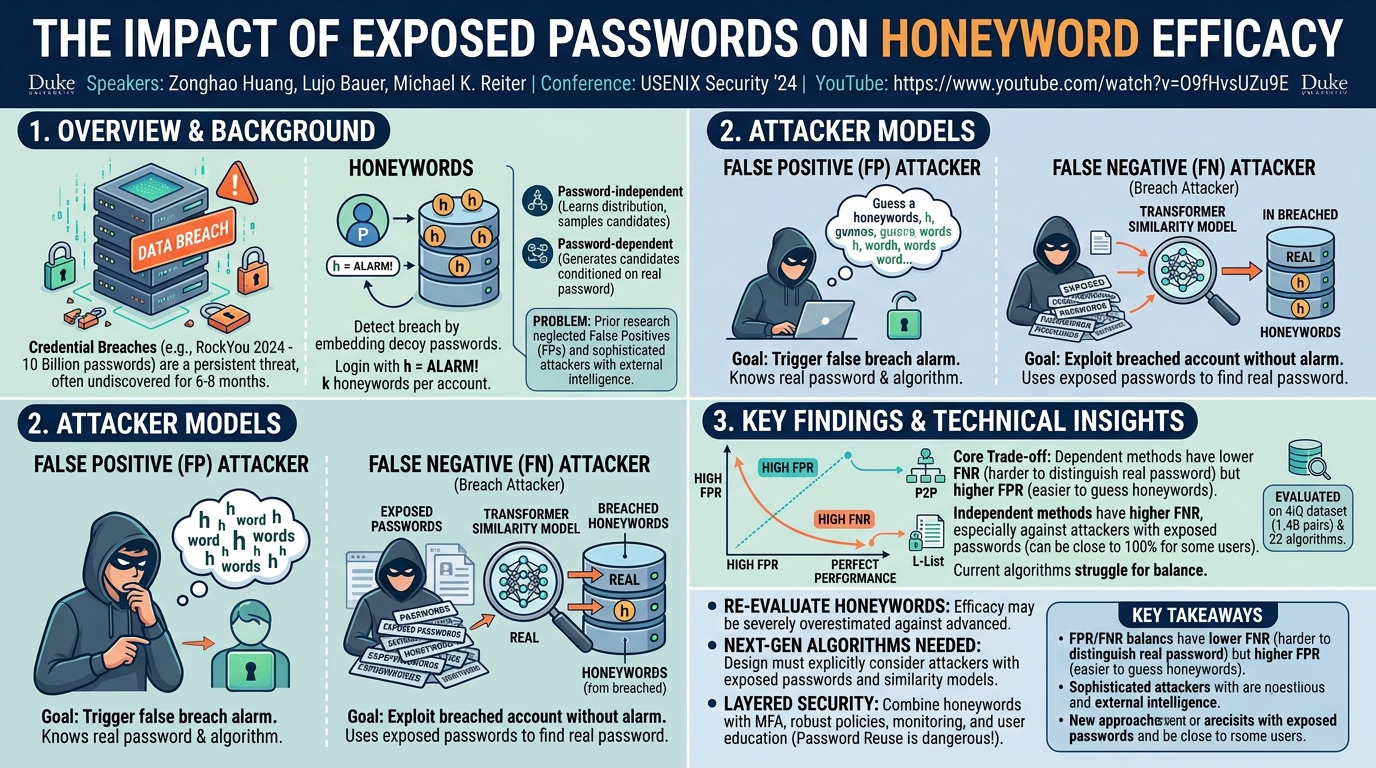
The central finding of this research is that current honeyword generation algorithms struggle significantly to achieve a desirable balance between the false positive rate (FPR) and the false negative rate (FNR), especially when confronted with a sophisticated attacker model that leverages exposed passwords. The "perfect performance" point, where FPR is near zero and FNR is close to 1/(1+k) (where k is the number of honeywords per account), remains largely out of reach for existing methods.
Specifically, the study reveals a critical trade-off:
- Password-dependent methods generally yield a lower FNR. This is because they generate honeywords that are more similar to the user's actual password, making it harder for a false negative attacker (breach attacker) to distinguish the real password from the decoys. However, this benefit comes at the cost of a higher FPR.
- Password-independent methods, while potentially having a lower FPR, often exhibit a significantly higher FNR, particularly against attackers using exposed passwords. For "easy" users, where an exposed password from another site matches the real password in the breached database, the FNR can approach 100%, rendering the honeyword defense virtually useless for those accounts.
The research conclusively demonstrates that an attacker equipped with knowledge of a user's exposed passwords from other sites—a highly realistic scenario given pervasive credential reuse and breaches—can dramatically increase their success in identifying the real password without triggering an alarm. This capability fundamentally undermines the assumed security posture of many existing honeyword implementations, necessitating a paradigm shift in how these systems are designed and evaluated. The analysis also underscores the importance of evaluating honeywords under both FPR and FNR metrics, correcting a historical oversight in much of the prior academic work.
Technical Deep Dive
▶ Watch: Experimental results: L-list (password independent) performance (7:00)
The research establishes a rigorous framework for evaluating honeyword efficacy by defining two distinct attacker models: the False Positive Attacker and the False Negative Attacker.
The False Positive Attacker, also referred to as the false alarm attacker, aims to trigger the system's breach alarm even when no credential database breach has occurred. This attacker is assumed to know the user's real password at the site (e.g., through phishing or by legitimately registering an account) and also the specific honeyword generation algorithm employed by the site. Their objective is to craft or guess honeywords that are present in the database, thereby causing a false alarm. The success of this attacker directly correlates with the false positive rate (FPR).
Conversely, the False Negative Attacker, also known as the breach attacker, seeks to exploit a breached account without raising a system alarm. Their primary goal is to distinguish the real user password from the honeywords within the compromised database. Crucially, this attacker is assumed to possess additional intelligence: some passwords belonging to the same user from other sites (i.e., exposed passwords). This is a highly realistic assumption given the prevalence of credential reuse and the vast number of publicly available breach datasets. The attacker leverages a Transformer-based similarity model to measure the similarity between these exposed passwords and the passwords (real and honeywords) found in the breached database. By assigning similarity scores, the attacker predicts the password with the highest score as the real one. The success of this attacker directly contributes to the false negative rate (FNR).
The experimental setup for this evaluation was robust, utilizing a significant real-world dataset and a comprehensive set of honeyword generation algorithms:
- Dataset: The 4iQ Data set was chosen, a widely used password dataset compiled from various credential database breaches. It comprises approximately 1.4 billion email and password pairs. For the purpose of model training and testing, 80% of this dataset was used for training, and the remaining 20% for testing. This dataset is particularly relevant as it naturally contains instances of password reuse across different services, providing a realistic basis for modeling the FNR attacker's capabilities.
- Honeyword Generation Algorithms: The study considered 22 representative honeyword generation methods. These were categorized into:
- Five password-independent methods: These methods, like L-List, generate honeywords by sampling from a general password list or a learned password distribution. They do not directly leverage the user's actual password during generation.
- Seventeen password-dependent methods: These methods, such as P2P, utilize techniques like deep neural networks to generate honeywords that are intentionally similar to the user's real password.
The experimental results were visualized using Receiver Operating Characteristic (ROC)-like curves, plotting FNR against FPR. Each curve represents the trade-off achieved by varying a threshold parameter, T (the number of honeywords an attacker tries before an alarm is raised). A lower T (e.g., T=1) corresponds to the leftmost point on the curve, with successive points obtained by increasing T.
Key observations from the evaluation included:
- L-List (Password-Independent): For "easy users" (where an exposed password from another site exactly matches the real password in the breached database), L-List exhibited an FNR close to 100%. This means the FNR attacker could almost always identify the real password without triggering an alarm if they had access to a matching exposed password. The study categorized users into "easy," "median," and "hard" based on the similarity between their exposed passwords and their real password in the breached database, reflecting the attacker's difficulty in distinguishing the real password.
- P2P (Password-Dependent): When compared to L-List under the same settings, P2P generally demonstrated a lower FNR but a higher FPR. The explanation for this lies in its design: P2P generates honeywords that are more similar to the user's actual password. This similarity makes it harder for the FNR attacker to differentiate the real password from the decoys, thus reducing the FNR. However, this same similarity makes it easier for the FPR attacker to guess a honeyword and trigger a false alarm, leading to a higher FPR.
The presented figures consistently showed that the performance of all evaluated honeyword algorithms was "far away from the perfect point" (FPR ≈ 0, FNR = 1/(1+k)). This gap underscores the fundamental challenge: generating honeywords similar enough to trick an FNR attacker inevitably makes them vulnerable to an FPR attacker who can guess plausible decoys. The research concludes that no existing honeyword generation algorithm achieves a good balance between FPR and FNR, especially under the realistic threat model incorporating exposed passwords.
While the presentation focused on user-chosen passwords, the speakers briefly mentioned that their paper also includes analyses for machine-generated passwords. They acknowledged that this scenario applies primarily when passwords are stored using reversible encryption, but due to time constraints, the detailed results were not presented during the talk.
Demo / Proof of Concept
▶ Watch: Comparing password independent and dependent honeyword methods (9:15)
The presented talk did not include a live demonstration or a specific proof of concept of the described attacks or honeyword generation methods. The evaluation was primarily analytical and based on extensive experimental results derived from the 4iQ dataset and various honeyword algorithms.
Defensive Implications
▶ Watch: Why dependent methods have different false positive/negative rates (9:45)
The findings presented in this research carry significant implications for the design, deployment, and evaluation of honeyword systems and, more broadly, for organizational cybersecurity strategies.
Firstly, the research clearly indicates that the efficacy of current honeyword implementations may be severely overestimated, particularly against sophisticated attackers who leverage readily available exposed passwords. Organizations relying on honeywords as a primary breach detection mechanism must understand that these systems are vulnerable to bypass if an attacker has external intelligence about user credentials. This necessitates a re-evaluation of the assumed security posture provided by existing honeyword deployments.
Secondly, security practitioners must recognize the critical trade-off between false positive rate (FPR) and false negative rate (FNR). Prioritizing only FNR (detecting all breaches) often comes at the cost of a high FPR, leading to alert fatigue and potentially desensitizing security teams to genuine threats. Conversely, an overly conservative approach to minimize FPR might allow breaches to go undetected (high FNR). Organizations need to carefully define their acceptable thresholds for both metrics based on their risk appetite and operational capabilities. This may involve dynamic adjustment of honeyword system parameters based on threat intelligence or user risk profiles.
Thirdly, there is an urgent need for the development of next-generation honeyword generation algorithms that can better balance FPR and FNR under the advanced threat model. Future algorithms must be designed with the explicit consideration of attackers possessing exposed passwords and employing similarity models. This could involve more context-aware honeyword generation, adaptive decoy strategies, or integrating additional user-specific data (without compromising privacy) to make decoys more robust against external intelligence. The findings suggest a need for algorithms that generate honeywords that are both sufficiently similar to the real password to confuse a breach attacker, yet distinct enough to prevent a false alarm attacker from easily guessing them.
Finally, the pervasive issue of password reuse and the constant stream of credential breaches underscore the importance of layered security defenses. While honeywords are a valuable detection tool, they should not be seen as a standalone solution. Organizations should reinforce their defenses with strong multi-factor authentication (MFA), robust password policies (encouraging unique, complex passwords), continuous monitoring for anomalous login patterns, and proactive credential stuffing detection. User education regarding password hygiene and the risks of reuse remains paramount. The research serves as a stark reminder that in an interconnected digital ecosystem, a breach anywhere can impact security everywhere.
Key Takeaways
- Both false positive rate (FPR) and false negative rate (FNR) are critical metrics for thoroughly evaluating the efficacy of honeyword generation algorithms. Neglecting either can lead to a misleading assessment of security.
- Achieving a robust balance between FPR and FNR is exceptionally challenging for current honeyword systems, especially when considering a realistic threat model where attackers can leverage exposed passwords from other data breaches.
- The capability of false negative attackers to utilize exposed passwords and Transformer-based similarity models significantly undermines the effectiveness of honeywords, making it easier for them to distinguish real passwords without triggering alarms.
- Password-dependent honeyword methods generally offer a lower FNR by creating decoys more similar to the real password, but this benefit is often offset by a higher FPR, making them more susceptible to false alarms.
- Existing honeyword generation algorithms fall considerably short of "perfect performance" (near-zero FPR and minimal FNR), indicating a fundamental limitation in their current design against advanced threats.
- Organizations must re-evaluate their reliance on honeywords, integrate these findings into their risk assessments, and pursue next-generation algorithms or multi-layered defenses to mitigate the impact of exposed credentials.
About the Speaker(s)
The research presented in this talk was a collaborative effort by Zonghao Huang, Lujo Bauer, and Michael K. Reiter, all affiliated with Duke University. Zonghao Huang delivered the presentation, sharing the team's insights into honeyword efficacy. Lujo Bauer is a distinguished professor known for his work in computer security and privacy, while Michael K. Reiter is a highly regarded professor specializing in network security and distributed systems. Their collective expertise in security research underpins the rigorous analysis and critical findings presented in this study.
Reviews
Dr. Zero (Offensive Security Researcher) — MUST SEE
This research delivers a brutal, much-needed dose of reality for honeyword systems. By finally evaluating them against an attacker leveraging real-world exposed passwords and advanced similarity models, it exposes a fundamental flaw in their efficacy. This work will redefine how these defensive primitives are designed and assessed going forward.
Heather Calloway (CISO) — STRONG ACCEPT
This research delivers a critical, unsentimental assessment of honeyword efficacy, revealing that current systems are fundamentally compromised by attackers leveraging exposed credentials. It forces a re-evaluation of breach detection capabilities and highlights a significant gap in our assumed security posture, demanding immediate attention from security leadership.