Towards Generic Database Management System Fuzzing
Yupeng Yang, Yongheng Chen, Rui Zhong, Jizhou Chen, Wenke Lee
33rd USENIX Security Symposium · Day 1 · USENIX Security '24 · USENIX Security '24
Overview
Database Management Systems (DBMSs), encompassing both relational (SQL) and non-relational (NoSQL) variants, form the backbone of modern data storage, retrieval, and management across a vast array of applications. Given their pervasive adoption and critical role, the security and robustness of these systems are paramount. Flaws within DBMSs can lead to data corruption, unauthorized access, denial of service, and significant operational disruptions. Fuzzing, a powerful software testing technique involving the injection of random or semi-random inputs, has proven highly effective in uncovering vulnerabilities and stability issues in various software systems. While specialized fuzzers have achieved considerable success in identifying bugs in SQL DBMSs, a significant gap exists in effective fuzzing solutions for the increasingly diverse landscape of non-SQL DBMSs.
Key moments
- 0:00 Introduction to generic DBMS fuzzing and its challenges
- 2:00 Challenge 1: Generalizing diverse non-SQL DBMS interfaces
- 3:55 Challenge 2: Handling context-sensitive semantics (scope, type constraints)
- 4:50 Challenge 3: Poor fuzzing from loose data dependencies
- 5:30 Overview of solutions and the Busby fuzzing framework
- 6:00 Solution 1: Generalizing semantics with Define/Use/Invalidate
- 7:00 Solution 2: Context-sensitive constraints using CQL language
Towards Generic Database Management System Fuzzing
Speakers: Yupeng Yang, Yongheng Chen, Rui Zhong, Jizhou Chen, Wenke Lee
Conference: USENIX Security '24
YouTube: https://www.youtube.com/watch?v=56q3kBL32yc
Overview
Database Management Systems (DBMSs), encompassing both relational (SQL) and non-relational (NoSQL) variants, form the backbone of modern data storage, retrieval, and management across a vast array of applications. Given their pervasive adoption and critical role, the security and robustness of these systems are paramount. Flaws within DBMSs can lead to data corruption, unauthorized access, denial of service, and significant operational disruptions. Fuzzing, a powerful software testing technique involving the injection of random or semi-random inputs, has proven highly effective in uncovering vulnerabilities and stability issues in various software systems. While specialized fuzzers have achieved considerable success in identifying bugs in SQL DBMSs, a significant gap exists in effective fuzzing solutions for the increasingly diverse landscape of non-SQL DBMSs.
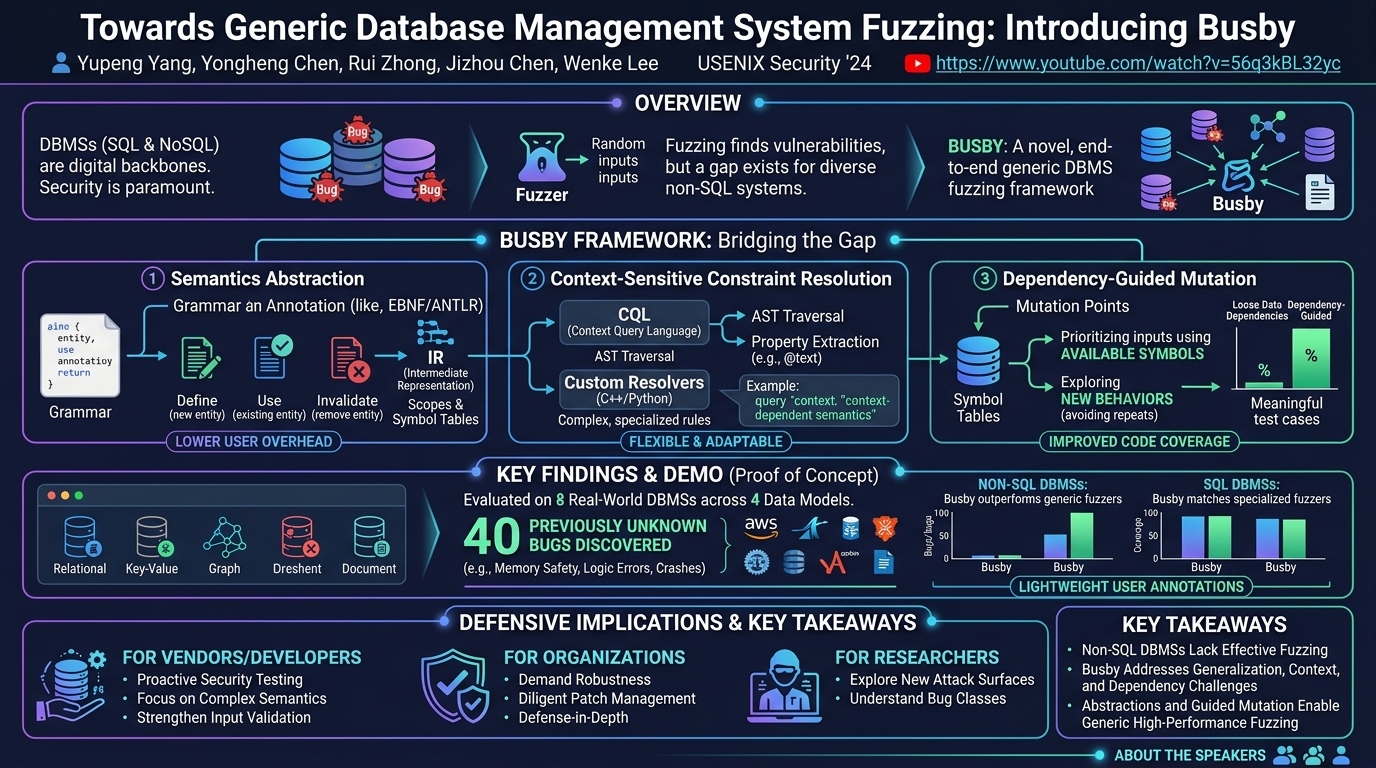
This talk, presented by Yupeng Yang and co-authored by Yongheng Chen, Rui Zhong, Jizhou Chen, and Wenke Lee, introduces Busby, a novel, end-to-end fuzzing framework designed to bridge this gap. Busby aims to provide a generic and effective solution for fuzzing both SQL and non-SQL DBMSs, addressing fundamental challenges that have historically limited the applicability of existing fuzzing approaches. The research highlights the critical need for a fuzzer that can adapt to the varied interfaces and complex semantics of modern database systems, moving beyond the limitations of hardcoded models and inefficient generic input generation.
The significance of Busby lies in its ability to systematically test a wide range of DBMS technologies, from traditional relational databases to newer key-value, graph, and document-based systems. By tackling the complexities of semantic correctness, context-sensitive constraints, and data dependency awareness, Busby offers a robust methodology for improving the security posture of an essential component of the digital infrastructure. Its demonstrated success in uncovering 40 previously unknown bugs underscores its practical value for database vendors, security researchers, and anyone relying on the integrity and availability of database systems.
Background
▶ Watch: Introduction to generic DBMS fuzzing and its challenges (0:00)
The security and robustness of Database Management Systems (DBMSs) are critical concerns in today's data-driven world. Both traditional SQL-based relational databases and the rapidly expanding ecosystem of NoSQL databases (including key-value, document, and graph databases) are widely deployed across diverse applications, making their integrity non-negotiable. Fuzzing has emerged as a highly effective methodology for uncovering vulnerabilities and stability issues in complex software systems. In the realm of SQL DBMSs, specialized fuzzers like SQLSmith, Squirrel, and SQLLancer have achieved notable successes, identifying numerous bugs over the years. These tools are often highly tailored to the SQL language's syntax and semantics, allowing them to generate semantically valid and complex queries that effectively exercise deep code paths within SQL engines.
However, the landscape for non-SQL DBMSs presents a stark contrast. Despite their widespread adoption, these systems largely lack similarly effective fuzzing solutions. The researchers identified two primary reasons for this disparity. First, existing SQL DBMS fuzzers face significant challenges when attempting to migrate to non-SQL environments. Their effectiveness is often predicated on hardcoded, static models of SQL's specific syntax and semantics, which are not readily transferable to the diverse and often radically different interfaces of NoSQL databases. For instance, a fuzzer designed for SQL's CREATE TABLE statements cannot easily adapt to a MongoDB insert operation or a Neo4j Cypher query.
Second, generic fuzzers, such as AFL (American Fuzzy Lop), struggle profoundly with DBMS inputs. These fuzzers are highly effective at byte-level mutation but lack the inherent understanding of complex input formats and semantic rules required by database systems. Consequently, generic fuzzers tend to generate a high volume of malformed or syntactically incorrect inputs that are quickly rejected by the DBMS parser, failing to reach deeper, more complex logic where vulnerabilities often reside. This results in extremely poor code coverage and an inability to uncover meaningful bugs.
In their quest to design a fuzzer capable of extending to both SQL and non-SQL DBMSs, the researchers identified three core challenges:
- Generalization Difficulty: Non-SQL DBMSs exhibit an immense diversity in their interfaces and semantic structures. Unlike the relatively standardized SQL, NoSQL systems can range from simple key-value stores with basic commands to graph databases with intricate query languages (e.g., Cypher) or document databases processing complex JSON structures. Input formats vary drastically, from simple ASCII commands to nested JSON documents. This heterogeneity makes it exceedingly difficult to create a generalized model for semantic correctness, which is crucial for exploring deep and meaningful code paths during fuzzing. Without semantic understanding, fuzzers often produce inputs that are syntactically valid but semantically meaningless, leading to shallow code coverage.
- Context-Sensitive Constraints: A significant limitation of existing fuzzing approaches is their reliance on static semantic binding. Typically, fuzzers would associate a fixed semantic meaning (e.g., "define a table variable") with a specific syntax structure (e.g.,
TBL_NAMEafterCREATE TABLE). While this works for common, unambiguous SQL semantics, many critical semantics in both SQL and NoSQL environments are context-dependent. The researchers highlighted two main scenarios:
- Scope Constraints: A single syntax structure can have different semantics based on its surrounding context. For example, in a Cypher query like
MATCH (n)-[]->(n), the lettern(an identifier) might mean "define a node variable" in its first occurrence but "use an existing node variable" in its second occurrence, despite both being of the same syntax type. - Type Constraints: The data type of a value can depend on other values or conditions within the same context. Static typing rules fail when types are dynamically inferred or constrained by related parts of the query. These context-dependent semantics are prevalent and pose a significant hurdle for fuzzers that rely on fixed semantic rules.
- Loose Data Dependencies: Random mutation-based fuzzers often generate inputs with weak or non-existent data dependencies. For DBMSs, where operations frequently build upon previously defined data (e.g., creating a table, then inserting into it, then querying it), random mutations often break these dependencies. The researchers demonstrated this issue with a random mutation-based fuzzer for Redis, observing that fewer than 6% of newly mutated test cases managed to trigger new data dependencies. This implies that over 94% of the generated inputs failed to exercise new or meaningful DBMS logic, leading to severely diminished fuzzing performance and coverage. Such "dead-end" mutations contribute little to uncovering bugs, making the fuzzing process highly inefficient.
These challenges collectively underscore the need for a more sophisticated, adaptable, and semantically aware fuzzing approach for database management systems, particularly for the diverse and complex NoSQL landscape.
Key Findings
▶ Watch: Challenge 2: Handling context-sensitive semantics (scope, type constraints) (3:55)
The research successfully addresses the identified challenges by introducing Busby, a novel, end-to-end fuzzing framework meticulously engineered for generic DBMS fuzzing. Busby represents a significant advancement in the field, moving beyond the limitations of specialized SQL fuzzers and ineffective generic approaches to offer a unified solution for testing both relational and non-relational database systems.
The primary key findings and contributions of this work are:
- Development of Busby: The researchers designed and implemented Busby, a comprehensive fuzzing framework capable of effectively targeting a wide array of DBMSs. Busby is distinguished by its innovative solutions to the three core challenges: semantics abstraction, context-sensitive constraint resolution, and dependency-guided mutation.
- Demonstrated Generality: Busby's design allows it to fuzz both SQL and non-SQL DBMSs with high efficacy. This generic capability is a crucial breakthrough, as previous solutions were either highly specialized or lacked the semantic understanding required for diverse database types.
- Superior Performance for Non-SQL DBMSs: In extensive evaluations, Busby consistently outperformed generic fuzzers in terms of both code coverage and the number of bugs discovered when applied to non-SQL DBMSs. This validates its unique approach to handling complex input formats and semantic rules inherent in NoSQL systems.
- Comparable Performance for SQL DBMSs: Remarkably, Busby achieved results comparable to those of highly specialized SQL fuzzers when testing SQL DBMSs. This demonstrates that its generic design does not compromise performance in established domains, effectively matching the state-of-the-art for relational databases while extending its capabilities to NoSQL.
- Discovery of Real-World Vulnerabilities: The most compelling validation of Busby's effectiveness is its success in uncovering 40 previously unknown bugs in the latest versions of eight real-world DBMSs. These systems spanned four mainstream data models, including key-value, document, and graph databases, alongside traditional relational systems. The discovery of such a significant number of vulnerabilities highlights the prevalence of security flaws even in mature database products and underscores Busby's ability to uncover critical issues that evade other testing methods. These bugs likely include memory safety issues, logic errors, and crashes, impacting the stability and security of widely used database software.
- Lightweight User Overhead: The proposed annotation system for defining abstract semantics and constraints was designed to be lightweight, minimizing the effort required for users to adapt Busby to new DBMS targets. This ease of configurability enhances its practical applicability.
In essence, Busby provides a robust and adaptable framework that significantly elevates the state of the art in DBMS fuzzing. Its ability to intelligently navigate the complexities of database semantics and data dependencies allows it to generate far more effective test cases, leading to deeper code coverage and the identification of critical vulnerabilities across the diverse landscape of modern database systems.
Technical Deep Dive
▶ Watch: Challenge 3: Poor fuzzing from loose data dependencies (4:50)
Busby's effectiveness stems from its three core technical solutions designed to overcome the challenges of generic DBMS fuzzing: Semantics Abstraction, Context-Sensitive Constraint Resolution, and Dependency-Guided Mutation. These approaches are integrated into an end-to-end framework, implemented using C++ and Python.
1. Semantics Abstraction
The first fundamental solution in Busby is semantics abstraction, which aims to generalize the complex and diverse operations found across different DBMS types. Instead of hardcoding specific SQL or NoSQL commands, Busby models common DBMS operations at a high, abstract level using three fundamental data operations:
- Define: An operation that introduces a new data entity or variable into the system's scope (e.g., creating a table, defining a node in a graph, inserting a document).
- Use: An operation that references or manipulates an already defined data entity (e.g., querying a table, updating a document, traversing a graph node).
- Invalidate: An operation that removes or renders a data entity unusable (e.g., dropping a table, deleting a record).
To apply these abstract semantics, Busby introduces a lightweight annotation system. Users can directly annotate an input grammar (e.g., an EBNF or ANTLR grammar) with these abstract semantics and their associated constraints. This process is designed to be highly flexible and involves minimal overhead for users. The annotations specify:
- Scope Constraints: When a
Define,Use, orInvalidateoperation should occur relative to a particular syntax structure. - Type Constraints: What specific type of data is being defined, used, or invalidated.
Internally, Busby converts the user-provided grammar and annotations into an Intermediate Representation (IR). This IR carries both the syntactic structure and the specified semantic information. To manage the state of defined and used entities, Busby maintains scopes and symbol tables, which are crucial for tracking data dependencies throughout the fuzzing process. This allows the fuzzer to understand which entities are "available" for Use or Invalidate operations at any given point in a generated test case.
2. Context-Sensitive Constraint Resolution
Addressing the challenge of context-dependent semantics, Busby incorporates two powerful features into its annotation system, enabling users to specify context-based constraints dynamically:
- CQL (Context Query Language): CQL is a lightweight, specialized language designed to be embedded directly within the grammar annotations. It allows users to dynamically fetch information from the current context of the parsing process. CQL operates with two primary components:
- Navigators: These allow traversal of the Abstract Syntax Tree (AST) of the current test case. Navigators include
parent,child,left sibling, andright sibling, enabling the fuzzer to locate any node relative to the current position. - Properties: Once a node is located, properties can be extracted. The most common property mentioned is
@text, which fetches the literal text of a specific node. - Usage Example: An annotation might include
@{left1.text}. This Python-format-string-like syntax instructs Busby to dynamically fetch the text of the first left sibling of the current node during evaluation. This allows, for instance, aDefineoperation to depend on the value or type specified by a sibling node, ensuring semantic consistency. Busby's internal mechanisms evaluate CQL expressions and resolve constraints based on this dynamically acquired context.
- Custom Resolvers: For more complex or highly specialized semantic rules that cannot be adequately captured by CQL, Busby supports custom resolvers. These are external plugins or functions written in high-level languages like C++ that users can integrate into the framework. An annotation can simply refer to a named custom resolver, and Busby will invoke the corresponding function. This provides an escape hatch for intricate logic, allowing the fuzzer to handle arbitrary, complex resolution rules that might involve external lookups, conditional logic, or intricate data type conversions.
Together, CQL and custom resolvers provide a flexible and powerful mechanism for Busby to interpret and enforce context-sensitive semantic constraints, a critical capability for fuzzing the diverse and often dynamic semantics of modern DBMSs.
3. Dependency-Guided Mutation
The third core solution, dependency-guided mutation, directly tackles the problem of "loose data dependencies" generated by random mutations. Instead of blind mutation, Busby intelligently guides the replacement and insertion mutations to prioritize the creation of meaningful data dependencies.
The process works as follows:
- Identify Available Symbols: When a mutation point (e.g., point
A) is identified in a test case, Busby first consults its symbol tables to determine all available symbols (i.e., data entities that have been previouslyDefined and are currently in scope). - Filter Mutation Candidates: Busby then examines the pool of potential mutation candidates (IRs representing various commands or operations). It filters this set, favoring those candidates that explicitly use one or more of the available symbols. For example, if a table named
usersis available, Busby would prioritize inserting or replacing commands that referenceusers(e.g.,SELECT * FROM users). This strategy significantly increases the likelihood that newly generated inputs will interact with existing data, thus triggering deeper, more complex DBMS logic. - Finer-Grain Prioritization: To further enhance code coverage and behavior exploration, Busby applies a secondary prioritization. Among the set of mutation candidates that use available symbols, it prioritizes those IRs that did not yet exist in the current test case. This encourages the fuzzer to explore new types of interactions and operations rather than simply repeating existing ones, thereby covering a broader range of DBMS functionalities.
By guiding mutations in this data-dependency-aware manner, Busby ensures that a much higher percentage of generated test cases are semantically meaningful and capable of exercising complex interactions within the DBMS. This directly translates to improved fuzzing performance, deeper code coverage, and a higher probability of discovering bugs related to data manipulation and integrity.
The framework's implementation in C++ provides the performance necessary for efficient fuzzing, while Python is likely used for higher-level control, scripting, and potentially the annotation processing or custom resolver integration. This combination allows for both speed and flexibility in adapting to new DBMS targets.
Demo / Proof of Concept
▶ Watch: Solution 1: Generalizing semantics with Define/Use/Invalidate (6:00)
While the talk did not feature a live, step-by-step demonstration of Busby in action, the researchers presented compelling evidence of its capabilities through a thorough evaluation. This evaluation effectively served as the proof of concept, showcasing the framework's practical utility and superior performance.
The researchers applied Busby to eight real-world DBMSs, carefully selected to cover four mainstream data models. This diverse set of targets allowed them to rigorously test Busby's generic capabilities across different database paradigms, including relational, key-value, document, and graph databases. The evaluation focused on the latest versions of these systems, ensuring that the findings were relevant to current software.
The results were striking: Busby successfully discovered 40 previously unknown bugs across these systems. This significant number of findings, including potential vulnerabilities and stability issues, serves as concrete proof of Busby's effectiveness in real-world scenarios. Furthermore, the evaluation quantitatively demonstrated Busby's advantages: it outperformed generic fuzzers for non-SQL DBMSs in terms of both code coverage and the sheer number of bugs found. For SQL DBMSs, Busby achieved comparable results to highly specialized SQL fuzzers, indicating that its generic approach did not sacrifice performance in a domain where mature, specialized tools already exist.
The talk also briefly alluded to an internal experiment to illustrate the problem of loose data dependencies, where a random mutation-based fuzzer for Redis generated new data dependencies in fewer than 6% of its test cases. This example, while not a direct demo of Busby, underscored the problem Busby's dependency-guided mutation aims to solve, thereby implicitly demonstrating the necessity and value of Busby's approach.
In summary, although no live demo was presented, the comprehensive evaluation and the discovery of numerous real-world bugs provide robust proof of concept for Busby's innovative design and its significant potential to enhance DBMS security.
Defensive Implications
▶ Watch: Solution 2: Context-sensitive constraints using CQL language (7:00)
The findings presented in "Towards Generic Database Management System Fuzzing" carry significant implications for defenders across various roles, from database vendors to system administrators and application developers. The existence of a generic, effective fuzzer like Busby fundamentally changes the landscape of DBMS security testing and highlights areas where defensive strategies need to be strengthened.
- For DBMS Vendors and Developers:
- Proactive Security Testing: Vendors of both SQL and NoSQL DBMSs should integrate advanced fuzzing techniques, similar to Busby's methodology, into their development and quality assurance pipelines. This is especially critical for NoSQL databases, which have historically lacked robust, generic fuzzing solutions.
- Focus on Semantic and Contextual Correctness: The talk emphasizes that many bugs arise from complex, context-sensitive semantics and data dependencies. Developers must pay closer attention to how their DBMS handles input parsing, semantic interpretation, and state management, particularly when operations depend on prior definitions or dynamic contexts. Rigorous testing of these intricate interactions is paramount.
- Input Validation and Sanitization: While fuzzers aim to bypass these, the discovery of 40 bugs suggests that existing input validation mechanisms might be insufficient, especially for complex, nested inputs (e.g., JSON documents) or multi-statement queries where context can shift. Strengthening these layers to prevent malformed or semantically ambiguous inputs from reaching deeper logic is crucial.
- For Security Researchers and Penetration Testers:
- New Attack Surface Exploration: Busby provides a blueprint for exploring new attack surfaces in DBMSs. Its ability to generate semantically valid yet novel inputs can uncover vulnerabilities that traditional manual testing or less sophisticated fuzzers might miss. This framework can inspire new research into automated vulnerability discovery in database systems.
- Understanding Bug Classes: The nature of bugs found by Busby (likely memory corruption, logic flaws, crashes related to data dependencies or complex query processing) indicates that these are fertile areas for further investigation and exploitation.
- For Organizations Deploying and Managing DBMSs:
- Demand Robustness from Vendors: Organizations should be aware that even widely used and seemingly mature DBMSs can harbor significant vulnerabilities. This reinforces the need to demand comprehensive security testing (including advanced fuzzing) from database vendors.
- Patch Management: The discovery of 40 bugs in latest versions underscores the continuous need for diligent patch management. Even recently updated systems are not immune to critical flaws.
- Defense-in-Depth: While Busby targets the DBMS itself, a defense-in-depth strategy remains vital. This includes network segmentation, strong access controls, least privilege principles for database users, and monitoring for unusual database activity. Exploitation of a DBMS vulnerability often requires initial access or specific privileges, which can be mitigated by robust perimeter defenses.
- Application-Level Security: Application developers interacting with DBMSs must also be mindful of how their applications construct and submit queries. Injections, whether SQL or NoSQL, often stem from improper sanitization at the application layer. While Busby targets DBMS flaws directly, application-level vulnerabilities can expose these underlying DBMS weaknesses.
In essence, Busby's work is a call to action for improved security across the entire DBMS ecosystem. It provides a powerful tool and a sophisticated methodology for uncovering flaws, thereby enabling more resilient and secure database systems for the future.
Key Takeaways
- Non-SQL DBMSs Lack Effective Fuzzing: Despite their widespread adoption, non-SQL (NoSQL) database management systems have historically lacked effective, generic fuzzing solutions, in contrast to the more mature fuzzing landscape for SQL databases.
- Busby Addresses Core Fuzzing Challenges: The Busby framework directly tackles three fundamental challenges: the difficulty of generalizing diverse DBMS interfaces, the prevalence of context-sensitive semantic constraints, and the inefficiency of random mutations leading to loose data dependencies.
- Semantics Abstraction for Generality: Busby achieves generality by abstracting common DBMS operations into Define, Use, and Invalidate, and employing a lightweight annotation system on input grammars to specify these abstract semantics and their scope/type constraints.
- Context-Aware Constraint Resolution is Key: To handle dynamic semantics, Busby integrates CQL (Context Query Language) for dynamic context fetching from the AST and supports custom resolvers for highly complex, arbitrary semantic rules, allowing for precise, context-sensitive input generation.
- Dependency-Guided Mutation Enhances Effectiveness: Busby's innovative dependency-guided mutation strategy prioritizes generating inputs that use available symbols and explore new behaviors, significantly improving fuzzing performance and coverage by creating meaningful data dependencies.
- Proven Efficacy in Real-World Systems: Busby demonstrated its power by discovering 40 new bugs in the latest versions of eight real-world DBMSs across four data models, outperforming generic fuzzers for NoSQL systems and matching specialized SQL fuzzers.
About the Speaker(s)
The research presented in "Towards Generic Database Management System Fuzzing" was a collaborative effort by Yupeng Yang, Yongheng Chen, Rui Zhong, Jizhou Chen, and Wenke Lee. The talk at USENIX Security '24 was delivered by Yupeng Yang. The team's work focuses on advancing the state of the art in database management system security through innovative fuzzing techniques.
Reviews
Dr. Zero (Offensive Security Researcher) — MUST SEE
Busby delivers a genuinely novel framework for fuzzing both SQL and NoSQL DBMSs, tackling long-standing challenges in semantic correctness and data dependencies. Its sophisticated approach, particularly the dependency-guided mutation and context-sensitive constraint resolution, led to the discovery of 40 new vulnerabilities across eight real-world systems. This isn't just theory; it's a practical tool that raises the bar for database security.
Heather Calloway (CISO) — STRONG ACCEPT
This research introduces Busby, a novel fuzzing framework that effectively uncovers vulnerabilities across diverse database management systems, including NoSQL, by intelligently addressing semantic and contextual complexities. The discovery of 40 new bugs in current systems highlights significant underlying risks that demand immediate attention from vendors and security leaders.