SoK: The Good, The Bad, and The Unbalanced: Measuring Structural Limitations of Deepfake Media Datasets
Seth Layton
33rd USENIX Security Symposium · Day 1 · USENIX Security '24 · USENIX Security '24
Overview
In an era where synthetic media, or deepfakes, are becoming increasingly sophisticated and prevalent, the security community faces a critical challenge in accurately detecting them. This talk, "SoK: The Good, The Bad, and The Unbalanced: Measuring Structural Limitations of Deepfake Media Datasets," delivered by Seth Layton at USENIX Security '24, presents a sobering Systematization of Knowledge (SoK) that scrutinizes the foundational elements of deepfake detection research: the datasets and evaluation metrics. Layton argues that the current methodologies, particularly regarding class distributions in datasets and the pervasive use of Equal Error Rate (EER), are fundamentally flawed, leading to an overstatement of model performance and actively hindering meaningful progress in the field.
Key moments
- 0:00 Introduction and the base rate fallacy motivation
- 3:00 Deepfake dataset distributions are inverted compared to anomaly detection
- 3:30 Experiment setup: retraining models with varying data splits
- 4:00 Deepfake detectors are biased by training data distribution
- 5:00 Analyzing the problematic use of Equal Error Rate (EER)
- 6:00 EER inherently obscures true model performance results
SoK: The Good, The Bad, and The Unbalanced: Measuring Structural Limitations of Deepfake Media Datasets
Speakers: Seth Layton
Conference: USENIX Security '24
YouTube: https://www.youtube.com/watch?v=KcdiRDyIvsw
Overview
In an era where synthetic media, or deepfakes, are becoming increasingly sophisticated and prevalent, the security community faces a critical challenge in accurately detecting them. This talk, "SoK: The Good, The Bad, and The Unbalanced: Measuring Structural Limitations of Deepfake Media Datasets," delivered by Seth Layton at USENIX Security '24, presents a sobering Systematization of Knowledge (SoK) that scrutinizes the foundational elements of deepfake detection research: the datasets and evaluation metrics. Layton argues that the current methodologies, particularly regarding class distributions in datasets and the pervasive use of Equal Error Rate (EER), are fundamentally flawed, leading to an overstatement of model performance and actively hindering meaningful progress in the field.
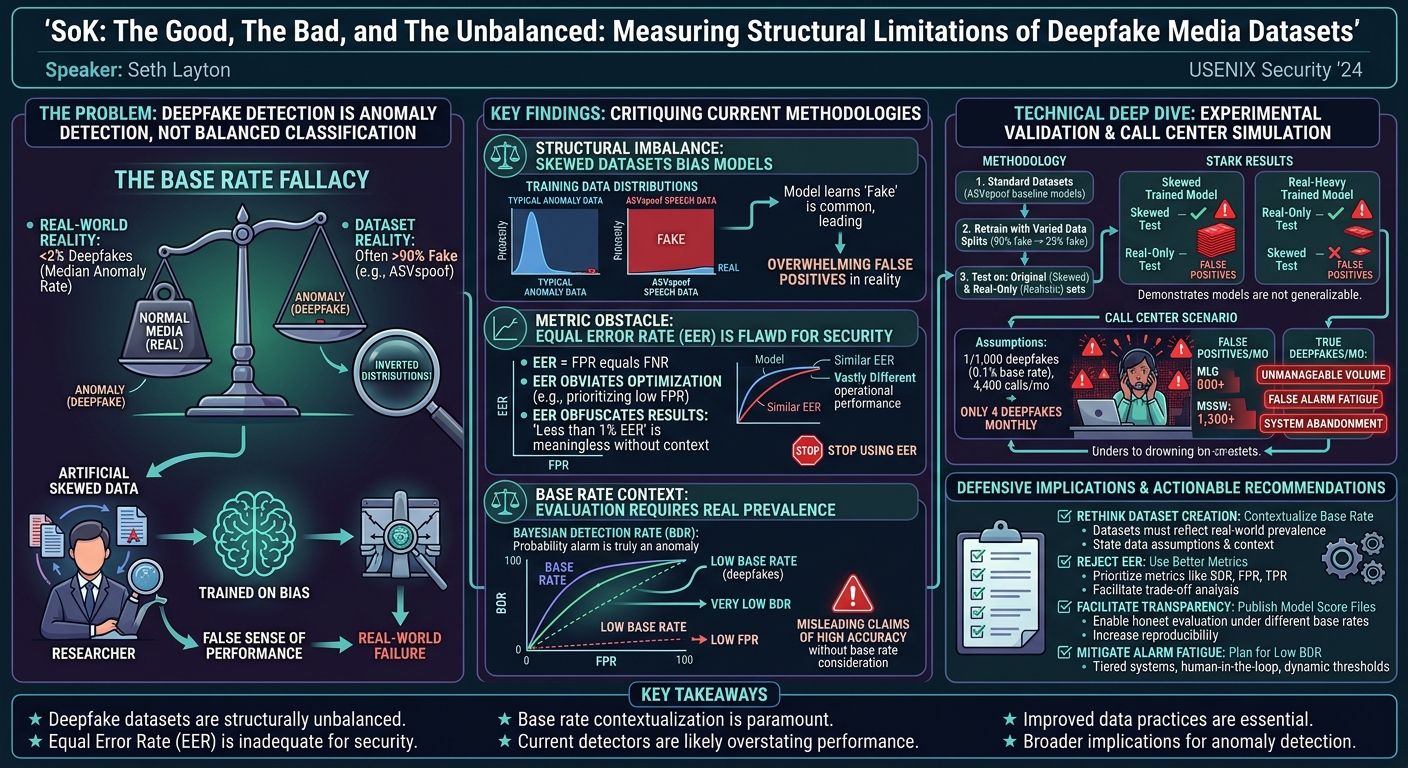
The core premise of Layton's work draws a parallel to the base rate fallacy, a statistical error where the true prevalence of an event is ignored, leading to erroneous conclusions. He contends that deepfake detection, inherently a problem of anomaly detection, suffers from this exact fallacy. By examining existing deepfake datasets and common evaluation metrics through this lens, the research reveals severe structural imbalances that bias detectors, rendering them largely ineffective in real-world, low-prevalence scenarios. This article delves into Layton's comprehensive analysis, highlighting the critical issues and offering actionable recommendations for the future of deepfake detection research.
Background
▶ Watch: Introduction and the base rate fallacy motivation (0:00)
The landscape of deepfake detection research typically follows a well-defined pipeline: problem recognition, followed by the creation of defense mechanisms. This involves the development of a dataset, training machine learning models on that dataset, and then evaluating their performance using specific metrics. As deepfakes have grown in popularity, a multitude of datasets and models have emerged, ostensibly to spur the field forward. However, Layton's research posits that a critical oversight in this pipeline—specifically, the failure to properly contextualize data distributions and metric usage—may be leading researchers down a misleading path.
To establish a baseline for comparison, the talk first draws parallels between deepfake detection and the mature field of anomaly detection. In anomaly detection, the goal is to identify rare, unusual events within a vast sea of normal data. A survey of 15 established anomaly detection datasets revealed a median rate of anomalous samples at approximately 2%. This provides a crucial benchmark for what a balanced dataset in an anomaly detection context should look like.
When deepfake datasets (including images, videos, and speech) were examined against this benchmark, a stark contrast emerged. Rather than reflecting the rare nature of deepfakes in the real world, these datasets often exhibit significantly skewed class distributions, with some even showing an inverted distribution where fake samples far outnumber real ones. The ASVspoof dataset, the de facto community standard for speech deepfakes, serves as a primary case study for this analysis due to its widespread adoption and pronounced distributional imbalances. The problem, as Layton meticulously details, is that models trained on these unrepresentative datasets learn biases rather than robust discriminative features, leading to an illusion of high performance that crumbles when confronted with real-world scenarios.
Key Findings
▶ Watch: Experiment setup: retraining models with varying data splits (3:30)
The research systematically dissects three critical areas where current deepfake detection methodologies fall short: class distributions, metric usage, and base rate contextualization.
Firstly, regarding class distributions, Layton's analysis revealed a profound disconnect between deepfake datasets and typical anomaly detection problems. While established anomaly detection datasets typically feature a low percentage of anomalous samples (median 2%), deepfake datasets, particularly for speech, often exhibit significantly higher proportions of synthetic samples, with ASVspoof's training distribution being 90% fake to 10% real, and its test distribution 97% fake to 3% real. This imbalance, Layton demonstrates, biases models towards identifying deepfakes. When ASVspoof baseline models, trained on these skewed distributions, were tested against a purely real-only dataset (representing a more realistic scenario), they generated an overwhelming number of false positives. Conversely, models trained with a higher proportion of real samples performed well on the real-only dataset but poorly on the original, fake-heavy ASVspoof test set. This strongly suggests that these models are not learning intrinsic differences between real and fake audio but rather exploiting the statistical biases of their training data.
Secondly, the talk critically examines metric usage, specifically the pervasive reliance on Equal Error Rate (EER) in deepfake detection. EER is defined as the point where the false positive rate (FPR) and false negative rate (FNR) are equal. Layton argues that EER is fundamentally unsuitable for security applications, especially anomaly detection. In security, it is often prudent to prioritize minimizing false positives, even at the cost of a slightly higher false negative rate, given the rarity of true anomalies. EER, by definition, prevents this optimization. More critically, Layton demonstrates that EER obfuscates results: two models can have similar EERs but vastly different true positive and false positive rates. This "many-to-one mapping" makes EER an unreliable indicator of a model's true operational performance, rendering claims of "less than 1% EER" largely meaningless in a practical security context.
Finally, the research highlights the severe lack of base rate contextualization in deepfake detection. Layton introduces the concept of Bayesian Detection Rate, which calculates the probability that an alarm is truly an anomaly, taking into account both the false positive rate and the actual prevalence (base rate) of the anomaly. He illustrates that in low base rate environments (where deepfakes are rare), even a seemingly small false positive rate can lead to an extremely low Bayesian Detection Rate, meaning most alarms will be false. Using a call center scenario parameterized by real-world fraud studies (e.g., 1 deepfake per 1,000 calls), Layton shows that even the "best" ASVspoof baseline models would generate an unmanageable number of false alarms (e.g., only 1 in 200 alarms being a true deepfake), leading to rapid false alarm fatigue and system abandonment. This powerfully demonstrates that without considering the real-world base rate, reported model performances are drastically overstated and practically irrelevant.
Technical Deep Dive
▶ Watch: Deepfake detectors are biased by training data distribution (4:00)
The technical rigor of Layton's SoK stems from a meticulous experimental methodology designed to expose the structural limitations of deepfake detection. The research systematically investigated 15 diverse anomaly detection datasets, confirming a median anomalous sample rate of approximately 2%. This crucial empirical baseline underscored the skewed nature of deepfake datasets, where speech deepfakes, for instance, exhibited an almost inverted distribution compared to typical anomaly detection problems.
The primary case study focused on the ASVspoof dataset, which serves as the de facto community standard for speech deepfake detection. Layton utilized the five baseline models provided by ASVspoof, retraining each under varying distributions of training data. The original ASVspoof training data is heavily skewed, with a 90% fake to 10% real split. Layton systematically adjusted this ratio, augmenting the real samples to achieve splits down to 25% fake to 75% real. Crucially, this augmentation process avoided oversampling or undersampling, ensuring that no additional bias was inadvertently introduced.
Each retrained model was then subjected to evaluation against two distinct testing distributions:
- The original ASVspoof test set, which maintains a highly skewed distribution of 97% fake to 3% real samples.
- A real-only dataset, comprising 100% real samples, designed to simulate a more realistic operational environment where real samples are far more common than deepfakes.
The results were stark: models trained on the original, fake-heavy ASVspoof distribution showed "good results" when tested against the similarly skewed original ASVspoof test set. However, when these same models were applied to the 100% real-only test set, they produced an "overwhelming number of false positives." This phenomenon strongly indicated that the models were not learning generalizable features distinguishing real from fake audio, but rather were biased by the underlying training distribution, defaulting to classifying samples as "fake" due to the high prevalence of fakes in their training data.
Conversely, when models were trained with an increased number of real samples (e.g., 25% fake, 75% real), they achieved "almost a near perfect prediction accuracy" against the real-only test set. Yet, when these models were then applied back to the original ASVspoof test distribution, their performance was "poor." This bidirectional failure underscores the critical problem: current deepfake detection models are not robust and are highly sensitive to the base rate of the data they encounter, whether in training or testing. The paper extends this analysis to multiple ASVspoof baselines, different languages, and various deepfake domains, consistently observing the same trends.
The critique of Equal Error Rate (EER) is equally technical. EER is defined as the point on the Receiver Operating Characteristic (ROC) curve where the false positive rate (FPR) equals the false negative rate (FNR). Layton highlights that EER inherently prevents the strategic optimization of either FPR or FNR, which is critical in security contexts where minimizing false positives is often paramount for rare events. He demonstrated that two models could have similar EERs (e.g., 0.5%) but vastly different true positive rates (e.g., 90% vs. 40%) and false positive rates (e.g., 10% vs. 60%) at other operating points. This "many-to-one mapping" makes EER a deceptive metric that obscures crucial details about a detector's actual performance characteristics.
The concept of Bayesian Detection Rate is introduced to properly contextualize model efficacy. This metric is defined as the probability that an alarm is truly an anomaly, calculated as (True Positives / (True Positives + False Positives)). Layton plots this against the false positive rate for various base rates. The analysis reveals that in low base rate environments (e.g., 0.001% prevalence), even a very low false positive rate (e.g., 0.01%) is insufficient to achieve a high Bayesian Detection Rate (e.g., 80%). This means that a detector might trigger frequently, but the vast majority of those triggers would be false alarms. The dark gray line on Layton's chart, representing the current operating environment of ASVspoof, vividly illustrates how its high base rate in the dataset itself allows for a "supreme overstatement of model performance."
The talk further concretizes this with a call center scenario, parameterized by a real-world study of fraudulent calls. Assuming 1 out of 1,000 incoming calls are deepfakes (a base rate of 0.1%) and 4,400 calls per month, this translates to only 4 deepfake calls monthly. Two ASVspoof baseline models, MLG (worst EER) and MSSW (best EER), were applied. Despite their reported EERs, both models exhibited a "huge number of false positives." Specifically, for MLG, only 1 out of 200 alarms was truly a deepfake, and for MSSW, only 1 out of 333. This translates to an unmanageable volume of false alerts, rendering the system practically useless due to false alarm fatigue. The scenario then shifts to a hypothetical future where deepfakes are more prevalent (1 out of 11 calls, a base rate of ~9%). In this high base rate environment, the same models become "much more applicable," with 1 in 2 alarms from MLG and 2 in 5 alarms from MSSW being true deepfakes. This dramatic shift highlights that model performance is inextricably linked to the base rate, and evaluating detectors without this context is fundamentally misleading.
Demo / Proof of Concept
▶ Watch: Analyzing the problematic use of Equal Error Rate (EER) (5:00)
As a Systematization of Knowledge (SoK) paper, this talk did not feature a traditional software or hardware demonstration of a novel exploit or a new deepfake detection tool. Instead, the "proof of concept" was the rigorous analytical framework and the empirical evidence derived from re-evaluating existing deepfake datasets and models. The experimental setup, involving the retraining of ASVspoof baseline models under varied data distributions and testing them against both skewed and real-only datasets, served as a powerful demonstration of the inherent biases and limitations. The call center scenario, parameterized with realistic base rates, effectively functioned as a simulated proof of concept, illustrating the catastrophic real-world implications of current evaluation practices. This analytical demonstration compellingly validated the core arguments regarding structural limitations and overstatement of performance.
Defensive Implications
▶ Watch: EER inherently obscures true model performance results (6:00)
The findings presented by Seth Layton carry profound implications for the defensive strategies against deepfakes and, by extension, for anomaly detection systems across various security domains. The core message is that without addressing the fundamental flaws in data representation and evaluation metrics, defense efforts are built on a shaky foundation, leading to a false sense of security and misdirected research.
- Rethink Data Set Creation and Curation: The most critical implication is the urgent need for deepfake dataset creators to acknowledge and address base rate contextualization. Datasets must accurately reflect the real-world prevalence of deepfakes, which are anomalies, meaning real samples should significantly outnumber synthetic ones. Furthermore, data set creators should explicitly state the assumptions regarding base rates and the intended operational context. Publishing model score files alongside datasets is crucial, as it allows researchers to combine data and scores to honestly evaluate and contextualize model performance under different base rates, fostering greater reproducibility and comparability.
- Abandon Equal Error Rate (EER): Defenders should immediately cease using EER as a primary metric for evaluating deepfake detectors in security contexts. EER's inability to allow for optimization of false positive rate (which is paramount for rare anomalies) and its inherent obfuscation of true performance characteristics make it unsuitable. Instead, security researchers should prioritize metrics that clearly delineate true positive rates, false positive rates, and Bayesian Detection Rate, allowing for an informed trade-off analysis that aligns with operational security requirements.
- Prioritize Real-World Applicability: Deepfake detection models must be trained and evaluated not just on synthetic, lab-generated distributions, but on data that accurately represents the low prevalence of deepfakes in real-world scenarios. This means designing test sets with a significantly higher proportion of real samples. The goal should be to develop models that are robust to varying base rates, rather than models that are biased by their training data.
- Mitigate False Alarm Fatigue: The call center scenario vividly demonstrated that even seemingly "high-performing" models can generate an unmanageable volume of false positives in low base rate environments. Defenders deploying deepfake detection systems must account for this, implementing strategies to manage alerts, prioritize investigations, and prevent false alarm fatigue among human operators. This might involve tiered detection systems, human-in-the-loop verification, or dynamic thresholding based on estimated base rates.
- Facilitate Meaningful Research: The current state of deepfake research, driven by flawed metrics and datasets, risks hindering genuine progress. By adopting more rigorous methodologies, the community can foster research that leads to truly effective and deployable deepfake detection solutions, moving beyond inflated performance claims to address the actual societal impact of synthetic media. This also implies a broader acceptance within academic conferences for research that critically examines existing methodologies, rather than solely focusing on novel (but potentially flawed) detection techniques.
Key Takeaways
- Deepfake datasets are structurally unbalanced: Many widely used deepfake datasets, particularly for speech, exhibit highly skewed class distributions, often containing a disproportionately high number of synthetic samples compared to real-world prevalence.
- Equal Error Rate (EER) is an inadequate metric for security: EER obfuscates true model performance, prevents optimization for false positives (critical in anomaly detection), and leads to an overstatement of detector efficacy in security contexts.
- Base rate contextualization is paramount: Evaluating deepfake detectors without considering the real-world prevalence (base rate) of deepfakes leads to misleading performance claims and systems prone to severe false alarm fatigue.
- Current deepfake detectors are likely overstating performance: Models trained on skewed datasets and evaluated with EER are often biased towards detecting fakes, performing poorly when confronted with realistic, low-prevalence scenarios.
- Improved data practices are essential: Future deepfake research requires datasets that reflect real-world base rates, explicit documentation of data assumptions, and the publication of model score files to enable honest and reproducible evaluation.
- Broader implications for anomaly detection: The issues identified in deepfake detection extend to anomaly detection at large, underscoring the universal importance of representative data, appropriate metrics, and contextualized evaluation for any security system.
About the Speaker(s)
Seth Layton is a researcher who presented this Systematization of Knowledge (SoK) paper at USENIX Security '24. His work focuses on critically evaluating the underlying methodologies and assumptions in emerging security fields, specifically deepfake detection. Through his research, Layton aims to highlight structural limitations in current practices and advocate for more robust and contextually aware approaches to developing and assessing security technologies.
Reviews
Dr. Zero (Offensive Security Researcher) — MUST SEE
Layton's SoK delivers a brutal, yet essential, critique of deepfake detection research. By exposing fundamental flaws in dataset construction and metric usage (especially EER), he demonstrates how current models are biased and fundamentally fail in real-world, low-prevalence scenarios. This talk is a necessary wake-up call for the entire deepfake community, forcing a re-evaluation of what constitutes 'effective' detection.
Heather Calloway (CISO) — MUST SEE
This critical analysis exposes foundational flaws in deepfake detection research, highlighting how unrepresentative datasets and misleading metrics like EER lead to overstated performance and operational failure. It's a vital wake-up call for security leaders to reassess current approaches, demand realistic evaluations, and ensure their deepfake defenses are built on a credible understanding of real-world risk and prevalence.