Stack Overflow Meets Replication: Security Research Amid Evolving Code Snippets
Alfusainey Jallow
34th USENIX Security Symposium (USENIX Security '25) · Day 2 · Software Security and Usable Security
Overview
In "Stack Overflow Meets Replication: Security Research Amid Evolving Code Snippets," Alfusainey Jallow presents a critical meta-analysis of how security research leveraging Stack Overflow data has traditionally been conducted. The talk highlights a fundamental flaw in many data-driven security studies: the assumption of static data. Stack Overflow, a cornerstone for developers seeking and sharing code snippets, is in fact a highly dynamic platform where code and context evolve continuously through community edits, comments, and revisions. This research underscores that while prior studies, often cross-sectional, yielded valid results at their time of publication, their conclusions might not hold true when applied to newer versions of the data.
Watch on YouTube · Read the paper · Download the PDF (PDF) · Slides
Paper abstract
Hardware fuzzing has recently gained momentum with many discovered bugs in open-source RISC-V CPU designs. Comparing the effectiveness of different hardware fuzzers, however, remains a challenge: each fuzzer optimizes for a different metric and is demonstrated on different CPU designs. Furthermore, the number of newly-discovered bugs is not an appropriate metric since finding new bugs becomes increasingly more difficult as designs mature. We argue that a corpus of automatically injectable bugs will help compare hardware fuzzers to better understand their strengths and weaknesses. Through a large-scale study of 177 software-observable bugs in open-source RISC-V CPUs, we discover that CPU bugs can be modelled by manipulating conditional statements or signal drivers. Based on this observation, we design Encarsia, a framework that automatically transforms the intermediate representation of a given CPU design to inject bugs that are equivalent to incorrect conditions or assignments at the HDL level. To ensure that an injected bug has an observable architectural effect, we leverage formal methods to prove the existence of an architectural deviation due to the bug-specific transformation. We evaluate Encarsia by injecting bugs into three open-source RISC-V CPUs, fuzzing these CPUs with recently-proposed CPU fuzzers, and comparing their bug-finding performance. Our experiments reveal key insights into the limitations of existing hardware fuzzers, including their inability to cover large sections of the designs under test, ineffective coverage metrics, and bug detection mechanisms that often miss bugs or produce false positives, highlighting the urgent need to reassess current approaches.
Key moments
- 0:00 Introduction: Stack Overflow's role in security research
- 2:00 Problem: Stack Overflow data evolves, but studies use static snapshots
- 4:00 Concrete research questions on data evolution's impact
- 4:30 Methodology: Literature review, comparison, and replication
- 6:00 Result: Programming languages trend differently on Stack Overflow
- 7:00 Result: Trends in security-relevant code snippet edits
- 8:00 Summary of findings on data evolution affecting research
Stack Overflow Meets Replication: Security Research Amid Evolving Code Snippets
Speakers: Alfusainey Jallow
Conference: USENIX Security
YouTube: https://www.youtube.com/watch?v=RsG0T1lTkwM
Overview
In "Stack Overflow Meets Replication: Security Research Amid Evolving Code Snippets," Alfusainey Jallow presents a critical meta-analysis of how security research leveraging Stack Overflow data has traditionally been conducted. The talk highlights a fundamental flaw in many data-driven security studies: the assumption of static data. Stack Overflow, a cornerstone for developers seeking and sharing code snippets, is in fact a highly dynamic platform where code and context evolve continuously through community edits, comments, and revisions. This research underscores that while prior studies, often cross-sectional, yielded valid results at their time of publication, their conclusions might not hold true when applied to newer versions of the data.
The core of Jallow's work is a call for the adoption of longitudinal analysis in security research that uses evolving datasets. By replicating six prominent security studies on Stack Overflow using more recent data snapshots, the research demonstrates significant shifts in findings, challenging the generalizability and long-term validity of results derived from static datasets. This article will delve into the methodology, key findings, and profound implications of this work for the security research community, emphasizing the importance of understanding data evolution and promoting open science practices.
Background
▶ Watch: Introduction: Stack Overflow's role in security research (0:00)
Stack Overflow has long been recognized as an indispensable resource for software developers, facilitating knowledge exchange through question-and-answer posts that frequently include reusable code snippets. Its vast repository of code examples has, in turn, made it a fertile ground for data-driven security studies. Researchers commonly extract a snapshot of Stack Overflow data, apply filters (e.g., specific programming languages, highly ranked answers), and then run experimental pipelines—ranging from machine learning for code snippet analysis to natural language processing for contextual understanding—to draw insights and recommendations.
The fundamental issue identified by Jallow and his team is that these studies almost invariably treat Stack Overflow data as a static snapshot. Researchers typically access the latest available quarterly data release from platforms like archive.org, conducting what is known as a cross-sectional study. While cross-sectional studies offer valuable insights into a phenomenon at a specific point in time, they are inherently limited when the subject matter is dynamic and evolving. The Stack Overflow community actively contributes to the evolution of content, making suggestions, fixing bugs, and even patching security vulnerabilities within posted snippets. An example provided in the talk illustrates a code snippet being patched to prevent resource leakage, a clear indication of ongoing refinement.
This dynamic nature necessitates a shift towards longitudinal studies, which track changes and patterns over time across different versions of a dataset. Drawing parallels from other domains like stock market analysis or climate science, where time-series data is crucial for understanding trends, the researchers argue that Stack Overflow data, with its inherent revisioning system, is perfectly suited for such an approach. The motivation for this meta-research was to investigate how much Stack Overflow code snippets and their surrounding context truly evolve, and critically, how the results of prior security research would differ if replicated using newer data versions.
Key Findings
▶ Watch: Concrete research questions on data evolution's impact (4:00)
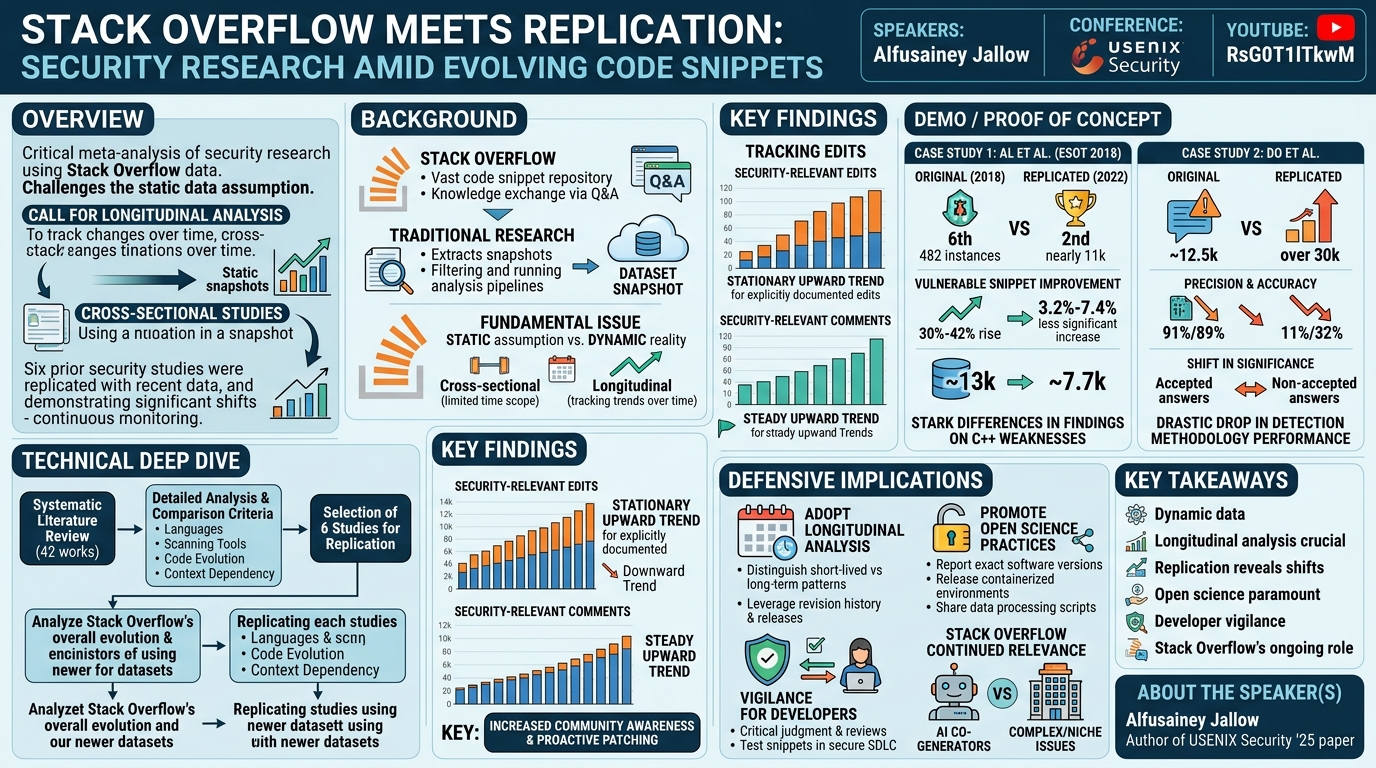
The research began by addressing three core questions: which aspects of Stack Overflow could affect prior research, how much do code snippets and their context evolve, and how would prior research results differ upon replication? The systematic literature review identified 42 relevant security research works that relied on Stack Overflow data. Through a detailed analysis, the team established a set of comparison criteria, categorizing these works based on their dependency on factors such as specific programming languages, code scanning tools, consideration of code evolution in their methodology, or reliance on the surrounding context of snippets. This foundational work provided the basis for selecting six studies for in-depth replication.
The initial phase of the study focused on understanding the general evolution of Stack Overflow data itself. This involved analyzing trends across different programming languages, observing how their post volumes changed over time. The findings indicated that languages trend differently; collecting data at varying points in time could yield significantly different pictures of post volume and activity for a given language.
Crucially, the study meticulously tracked the frequency and nature of edits made to Stack Overflow posts. Over approximately a decade, there has been a steady stream of edits per month. These edits were categorized into:
- Those without a commit message (unclear intent, potentially auto-edits).
- Those with a message but not classified as security-relevant.
- Those clearly identified as security-relevant using a methodology from prior work.
When considering all edits, including those without messages, there appeared to be a downward trend in the percentage of security-relevant edits over time. However, when excluding empty commit messages and focusing on edits with clear intentions, the opposite trend emerged: a stationary upward trend. This suggests that over time, a growing proportion of explicitly documented edits are indeed security-relevant, with a notable uptick in recent years. This implies increased community awareness and proactive patching of security issues within shared code. Similarly, the analysis of comments revealed a steady upward trend for increasingly security-relevant comments being raised on the platform, further emphasizing the dynamic nature of security discourse.
These general findings about Stack Overflow's evolving landscape provided the critical context for the subsequent replication studies. They confirmed that treating the platform's data as static is a significant oversight, as the underlying content, including security-critical aspects, is in constant flux.
Technical Deep Dive
▶ Watch: Methodology: Literature review, comparison, and replication (4:30)
The methodology for this meta-research was rigorous, beginning with a systematic literature review following established protocols, such as those by Kitchenham et al. This review identified 42 security research papers that utilized Stack Overflow data. To systematically compare these works, the researchers developed a comprehensive set of comparison criteria, summarized in a table in their full paper. These criteria included aspects like:
- The programming languages considered (e.g., C++, Python, Java).
- The specific code scanning tools employed (e.g., CPPcheck, custom static analyzers).
- Whether the study’s methodology considered code evolution or revisions.
- The degree to which the results depended on the surrounding context of the code snippets (e.g., natural language descriptions, comments).
From these 42 works, six were meticulously selected for replication. The selection process prioritized works that were representative of different methodological approaches and dependencies on Stack Overflow data features. Before commencing the full replication studies, the team undertook a detailed analysis of Stack Overflow's evolution over time. This involved leveraging the quarterly data releases available on archive.org, allowing them to trace changes in programming language trends, edit frequencies, and the nature of security-relevant contributions across multiple snapshots.
For the replication phase, the core technical approach involved reproducing the original studies' pipelines as closely as possible, but feeding them with a newer Stack Overflow dataset version. This allowed for a direct, controlled comparison of results obtained from different temporal snapshots of the same underlying data source. The technical challenge often lay in reproducing the original experimental setups due to a lack of detailed documentation or artifact availability, underscoring one of the key recommendations of the paper.
The specific tools and methodologies used in the replicated studies varied based on the original papers. For instance, in the first case study, the replication involved using Gatling to classify C++ snippets and CPPcheck for static analysis to identify security weaknesses. The ability to precisely re-run these tools on different versions of the Stack Overflow dataset—e.g., comparing an ESoT 2018 dataset against an ESoT 2022 dataset—was central to demonstrating the impact of data evolution on research outcomes. The meticulous process of identifying, reproducing, and then re-executing these pipelines on updated data forms the technical backbone of this significant meta-research.
Demo / Proof of Concept
▶ Watch: Result: Trends in security-relevant code snippet edits (7:00)
The most compelling "proof of concept" in this research comes from the direct replication of prior studies. Jallow highlights two of the six replicated case studies to illustrate how dramatically results can shift when a newer dataset is used. These replications serve as concrete demonstrations of the limitations of cross-sectional studies in a dynamic environment like Stack Overflow.
Case Study 1: Al et al. (ESoT 2018) – C++ Code Snippet Weaknesses
The first replication focused on a study by Al et al., originally presented at ESoT 2018, which investigated C++ code snippet weaknesses on Stack Overflow. The original work aimed to understand how revisions to C++ snippets affected their security, identifying types of weaknesses, tracking their evolution through revisions, and characterizing contributing users. Their pipeline consumed Stack Overflow data from 2018, filtered for C++ snippets of a particular length, classified them using the Gatling tool, and then checked for security vulnerabilities using CPPcheck. They identified approximately 15,000 vulnerable snippet versions across nearly 12,000 snippets in over 11,000 answer posts.
The replication effort applied this identical pipeline to the ESoT 2022 dataset, a snapshot four years newer. The comparison revealed stark differences:
- Vulnerability Improvement: The original study found that the proportion of vulnerable snippets that improved with revisions rose from 30% to 42%. In contrast, the replicated study on the newer data found a much less significant increase, from just 3.2% to 7.4%. This suggests that the rate or impact of security improvements through revisions has changed considerably.
- CWE Prevalence: Al et al. reported CWE-758 (Improper Neutralization of Special Elements used in an OS Command) as the sixth most prevalent CWE type, with 482 instances. In the 2022 dataset, CWE-758 surged to become the second most prevalent type, with nearly 11,000 instances. Furthermore, a new CWE type, CWE-476 (NULL Pointer Dereference), emerged as the sixth most common, indicating a shift in the types of weaknesses present or being detected.
- Total Instances: The original work identified almost 13,000 instances of vulnerabilities in the latest versions of 7,500 answers. The replicated study found only 7,700 such instances in the latest versions of almost 6,000 answers, a significant reduction.
These discrepancies highlight that the landscape of C++ vulnerabilities on Stack Overflow, their prevalence, and how they are addressed through revisions, is not static but evolves significantly over time.
Case Study 2: Do et al. – Security-Sensitive Keywords and Control Flows
The second replication focused on a study by Do et al., which examined whether snippet revisions demonstrated evidence of security fixing by analyzing changes in security-sensitive APIs, keywords, and control flows between the oldest and newest versions of a snippet. Their research questions included whether older posts were more insecure, if accepted answers were more secure, and the types of insecure code snippets discovered.
Applying their methodology to a newer dataset yielded even more dramatic differences:
- Insecure Post Count: The original study reported approximately 12,500 insecure posts, with 788 of them exhibiting all three analyzed security features. The replication on the newer dataset discovered over 30,000 insecure posts, with almost 5,000 having all three features. This represents a very sharp, alarming increase in the identified insecure content.
- Precision and Accuracy: Perhaps the most striking difference was in the performance metrics of the detection methodology. The original work reported a high 91% precision and 89% accuracy. However, when replicated on the newer dataset, the precision plummeted to 11% and accuracy to 32%, while recall remained almost identical. This drastic drop suggests that the characteristics of insecure snippets or the effectiveness of the detection heuristics changed considerably, rendering the original model largely ineffective on newer data.
- Accepted vs. Non-Accepted Answers: The original authors found no statistically significant difference in the ratios of insecure posts between accepted and non-accepted answers. In contrast, the replicated study found a higher ratio of insecure posts in non-accepted answers, and this difference was statistically significant. This implies that the community's curation or acceptance of answers, particularly concerning their security posture, has evolved.
These two case studies powerfully demonstrate that security research findings derived from Stack Overflow data are highly sensitive to the temporal snapshot used. The evolution of the data can invalidate prior conclusions, alter the prevalence of specific vulnerabilities, and even render previously effective detection methodologies obsolete.
Defensive Implications
▶ Watch: Summary of findings on data evolution affecting research (8:00)
The findings of this meta-research carry profound implications for security researchers, developers, and practitioners who rely on Stack Overflow or similar evolving code repositories.
Firstly, the most critical implication is the imperative to adopt longitudinal analysis in security research. While cross-sectional studies provide valuable insights at a given moment, they are insufficient for understanding dynamic phenomena like code evolution and security trends. Defenders need to distinguish between short-lived trends and long-term patterns. When using Stack Overflow data, leveraging its revision history and quarterly releases for longitudinal studies can provide a much deeper, more accurate understanding of how vulnerabilities emerge, are addressed, and how community security awareness changes over time. This approach allows for the identification of persistent weaknesses, the evaluation of mitigation strategies over extended periods, and a more robust basis for policy recommendations.
Secondly, the research strongly advocates for promoting open science practices. The difficulty encountered in reproducing original study pipelines highlights a significant hurdle for replication. To ensure the verifiability and long-term utility of security research, authors should:
- Report exact software versions: This includes programming languages, compilers, libraries, and analysis tools used. Versioning can significantly impact results, as demonstrated by the precision/accuracy drop in one case study.
- Release containerized environments: Providing Docker images or similar containerized setups that encapsulate the entire experimental pipeline (code, dependencies, data processing scripts) would drastically improve reproducibility and replicability. This practice is already gaining traction, with initiatives like USENIX Security 25 and 26 requiring artifact availability.
- Share data processing scripts: Clearly documenting and sharing the scripts used for data filtering, transformation, and analysis ensures transparency and allows others to adapt the methodology to newer datasets.
For developers, these findings serve as a cautionary tale. Code snippets found on Stack Overflow, even those highly upvoted or accepted, are not immutable and can contain latent or newly discovered vulnerabilities. Developers should always exercise critical judgment, perform thorough security reviews, and ideally, test any adopted snippet within their own secure development lifecycle. The fact that security-relevant edits are continuously made, and that the prevalence of certain CWEs can dramatically shift, underscores the need for vigilance.
Finally, the discussion on Stack Overflow's continued relevance, even in the age of AI code generators like Copilot, suggests that it remains a source for complex or niche coding problems. This means the issues identified in this research will persist. Security professionals must recognize that while AI tools may handle "easy" questions, the more intricate and potentially vulnerable code snippets will continue to be exchanged and evolve on platforms like Stack Overflow, necessitating ongoing, dynamic security analysis.
Key Takeaways
- Stack Overflow Data is Dynamic: Unlike static data sources, code snippets and their context on Stack Overflow continuously evolve through community edits and revisions, including security-relevant fixes.
- Longitudinal Analysis is Crucial: Relying solely on cross-sectional snapshots of Stack Overflow data can lead to conclusions that are time-bound and may not reflect current security landscapes or long-term trends. Adopting longitudinal methods is essential for accurate, evolving insights.
- Replication Reveals Significant Shifts: Replicating prior security studies on newer Stack Overflow datasets demonstrates substantial changes in vulnerability prevalence, detection tool effectiveness, and overall findings, challenging the generalizability of original results.
- Open Science Practices are Paramount: To enable effective replication and build cumulative knowledge, researchers must embrace open science by documenting exact software versions, providing containerized experimental setups, and sharing data processing scripts.
- Vigilance for Developers: Code snippets, even from trusted sources like Stack Overflow, require continuous security scrutiny. Their inherent mutability means that a secure snippet today might become insecure tomorrow, or vice-versa.
- Stack Overflow Remains Relevant: Despite the rise of AI code generators, Stack Overflow continues to be a vital platform for complex and niche coding problems, ensuring its ongoing importance as a data source for security research that demands dynamic analysis.
About the Speaker(s)
Alfusainey Jallow is the speaker for this presentation. Based on the provided metadata and transcript, he is the author of the USENIX Security '25 paper "Stack Overflow Meets Replication: Security Research Amid Evolving Code Snippets." Further specific biographical details were not provided in the talk transcript or metadata.
Reviews
Dr. Zero (Offensive Security Researcher) — SOLID
Legitimate academic meta-research identifying a real methodological blind spot — static snapshots of dynamic data — and demonstrating concrete replication drift across six prior studies. Competent work, but it's a research methods paper that belongs in a journal proceedings session, not a highlight reel.
Heather Calloway (CISO) — WEAK
Methodologically sound meta-research that correctly identifies a real problem in how security studies consume Stack Overflow data — but the work stays entirely inside the research community and never reaches the people who actually govern software security programs. The gap between 'replication studies matter' and 'here is what a CISO, AppSec lead, or policy body should do differently' is never closed.
→ Top-rated talks at 34th USENIX Security Symposium (USENIX Security '25)
All talks from 34th USENIX Security Symposium (USENIX Security '25)