Gotta Detect 'Em All: Fake Base Station and Multi-Step Attack Detection in Cellular Networks
Kazi Samin Mubasshir (Paru University)
34th USENIX Security Symposium (USENIX Security '25) · Day 3 · Network Security 3: BLE and Cellular
Overview
In an era where cellular connectivity is ubiquitous, the foundational security assumption that devices connect to legitimate network infrastructure is increasingly challenged. This talk, "Gotta Detect 'Em All: Fake Base Station and Multi-Step Attack Detection in Cellular Networks," presented by Kazi Samin Mubasshir, delves into the pervasive and critical threat posed by Fake Base Stations (FBS), often known as IMSI catchers or stingrays. These malicious stations exploit a fundamental vulnerability in cellular protocols: the lack of authentication during the initial setup phase, allowing them to masquerade as legitimate network towers and intercept user communications.
Watch on YouTube · Read the paper · Download the PDF (PDF) · Slides
Paper abstract
Cryptographic security protocols, such as TLS or WireGuard, form the foundation of a secure Internet; hence, a long line of research has shown how to formally verify their high-level designs. Unfortunately, these formal guarantees have not yet reached real-world implementations of these protocols, which still rely on testing and ad-hoc manual audits for security and correctness. This gap may be explained, in part, by the substantial performance and/or development overhead imposed by prior efforts to verify implementations. To make it more practical to deploy verified implementations of security protocols, we present OwlC, the first fully automated , security-preserving compiler for verified, high-performance implementations of security protocols. From a high-level protocol specification proven computationally secure in the Owl language, OwlC emits an efficient, interoperable, side-channel resistant Rust library that is automatically formally verified to be correct. We produce verified libraries for all previously written Owl protocols, and we also evaluate OwlC on two new verified case studies: WireGuard and Hybrid Public-Key Encryption (HPKE). Our verified implementations interoperate with existing implementations, and their performance matches unverified industrial baselines on end-to-end benchmarks.
Key moments
- 0:00 Introduction: The fake base station problem
- 1:30 Five key challenges in detection
- 2:10 Building the large-scale FBS/MSA dataset
- 3:00 Packet and trace level FBS detection framework
- 4:50 Graph neural networks for multi-step attacks
- 6:20 Detection accuracy and system overhead results
- 8:00 Real-world experimental validation setup
- 9:00 Robustness against unseen and reshaped attacks
Gotta Detect 'Em All: Fake Base Station and Multi-Step Attack Detection in Cellular Networks
Speakers: Kazi Samin Mubasshir
Conference: USENIX Security
YouTube: https://www.youtube.com/watch?v=80WR0AwrpcY
Overview
In an era where cellular connectivity is ubiquitous, the foundational security assumption that devices connect to legitimate network infrastructure is increasingly challenged. This talk, "Gotta Detect 'Em All: Fake Base Station and Multi-Step Attack Detection in Cellular Networks," presented by Kazi Samin Mubasshir, delves into the pervasive and critical threat posed by Fake Base Stations (FBS), often known as IMSI catchers or stingrays. These malicious stations exploit a fundamental vulnerability in cellular protocols: the lack of authentication during the initial setup phase, allowing them to masquerade as legitimate network towers and intercept user communications.
The research presented addresses the significant gap in practical, scalable detection mechanisms for FBS and the more sophisticated Multi-Step Attacks (MSA) that often leverage them. Existing solutions are frequently characterized by their high cost, reliance on specialized hardware, or the necessity for disruptive protocol changes, rendering them impractical for widespread deployment. This work proposes a novel, software-defined approach that leverages advanced machine learning techniques to provide robust, real-time detection directly on end-user devices, without requiring any modifications to existing cellular standards or the introduction of new hardware.
The talk highlights the real-world implications of FBS, citing instances where law enforcement agencies have confirmed their use for surveillance and scams in strategically important locations. By providing a framework capable of identifying both standalone FBS presence and complex attack sequences, this research offers a crucial defense against a persistent threat affecting billions of devices globally. It represents a significant step towards empowering users with the ability to discern legitimate network connections from malicious ones, even in dynamic and evolving threat landscapes.
Background
▶ Watch: Introduction: The fake base station problem (0:00)
The core problem addressed by this research stems from a fundamental design choice in cellular networks: user devices are programmed to connect to the base station emitting the strongest signal. While seemingly logical for ensuring optimal connectivity, this mechanism creates a critical security vulnerability. There is no inherent authentication process during the initial broadcast messages exchanged between a device and a base station. This absence of mutual authentication at the initial connection phase means that a device cannot reliably distinguish a legitimate cellular tower from a malicious Fake Base Station (FBS) that is intentionally broadcasting a stronger signal.
This vulnerability has been exploited for decades, leading to the proliferation of devices like IMSI catchers (International Mobile Subscriber Identity catchers) or stingrays. These devices can perform various malicious activities, including intercepting communications, tracking user locations, injecting malware, or downgrading network connections to less secure protocols (e.g., from 4G/5G to 2G) to facilitate further attacks. News reports frequently confirm the deployment of FBS by state actors, criminal organizations, and even for targeted surveillance, underscoring the severity and persistence of this threat across all generations of 3GPP protocols.
Prior attempts to mitigate FBS threats have faced significant hurdles. Many proposed solutions are either impractical, requiring expensive specialized hardware (e.g., dedicated RF scanners, tamper-resistant SIMs), or necessitate protocol changes that would require a massive, coordinated overhaul of global cellular infrastructure, an undertaking fraught with economic and logistical challenges. Furthermore, some methods rely on network-side detection, which may not protect users from sophisticated, localized attacks or when they are roaming outside their home network's immediate oversight.
The speakers identified five key challenges that previous efforts often failed to adequately address:
- Lack of High-Quality Datasets: A significant barrier to developing effective machine learning solutions has been the scarcity of comprehensive datasets incorporating diverse FBS traces and multi-step attack scenarios under realistic conditions.
- Incorporating Contextual Information: The same network packets can be benign or malicious depending on the surrounding context. Differentiating these requires sophisticated analysis beyond isolated packet inspection.
- Capturing Characteristics of Multi-Step Attacks: Many advanced attacks involve a sequence of messages and interactions, making them harder to detect with simple, single-event anomaly detection.
- Combining Predictions from Multiple Layer 3 Protocols: Cellular networks involve various Layer 3 protocols (e.g., RRC, NAS), and an attack might manifest across several of them, requiring a unified detection approach.
- Meeting Real-Time Detection Constraints: Any practical solution for end-user devices must operate with minimal overhead in terms of memory, power, and processing time to ensure seamless integration and avoid disrupting ongoing connections.
This research aims to overcome these challenges by developing a robust machine learning framework that can operate efficiently on commodity end-user devices, providing a much-needed, practical defense against the evolving landscape of cellular network attacks.
Key Findings
▶ Watch: Building the large-scale FBS/MSA dataset (2:10)
The research presented by Kazi Samin Mubasshir and colleagues delivers several pivotal findings that collectively offer a novel and practical approach to securing cellular communications against sophisticated threats.
Firstly, the core finding is the demonstration that machine learning (ML) can serve as a robust and practical solution for detecting both Fake Base Stations (FBS) and Multi-Step Attacks (MSA) in cellular networks. Crucially, this ML-driven approach circumvents the major limitations of prior solutions: it requires no changes to existing cellular protocols, necessitates no extra hardware on the user device, operates with minimal overhead, and remains effective even when users are roaming across different networks. This makes it a highly scalable and deployable defense mechanism for billions of unprotected devices worldwide.
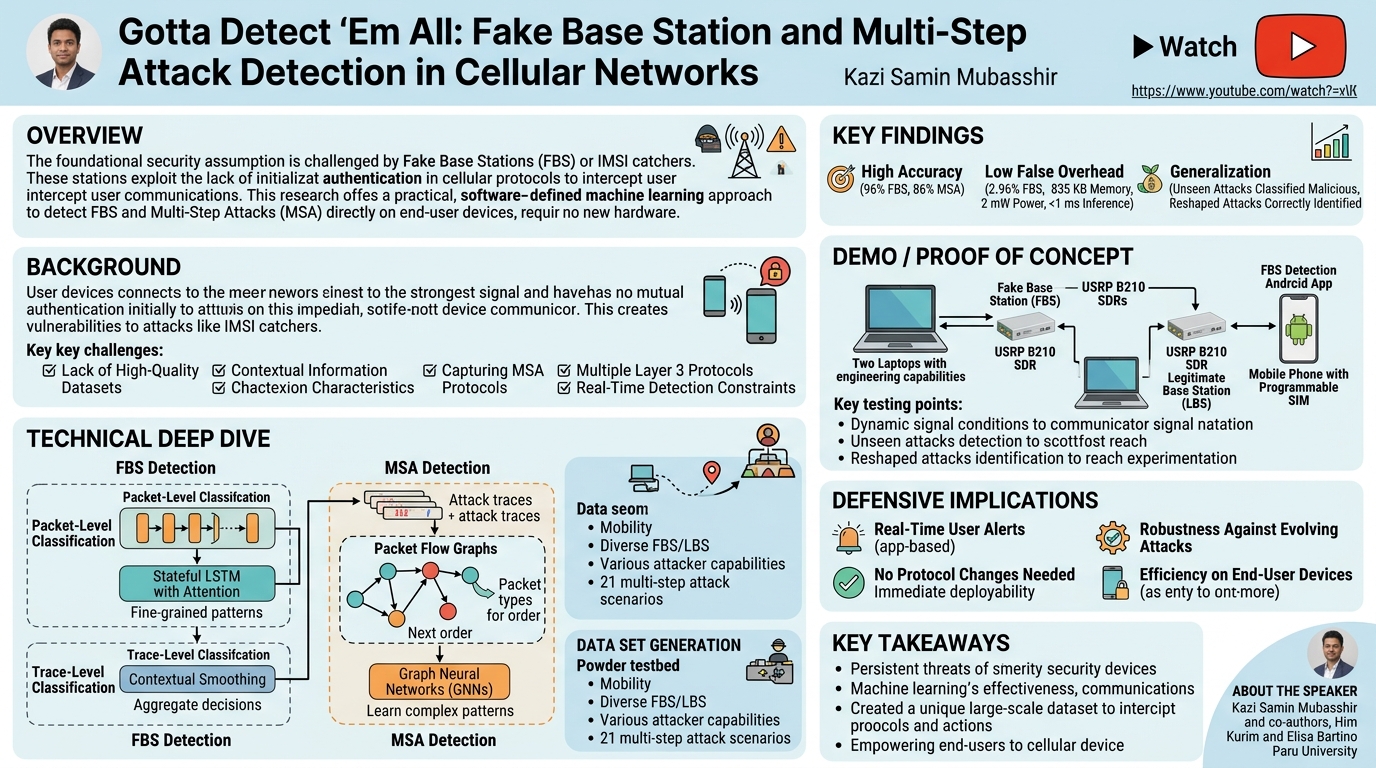
A significant contribution detailed in the talk is the creation of the first-ever large-scale FBS and MSA dataset. This dataset was meticulously prepared using the Powder testbed, an NSF-funded, remotely accessible, large-scale programmable wireless testbed. The data collection incorporated real-world scenarios, including device mobility, diverse legitimate and fake base station configurations, varying attacker capabilities, and traces of 21 distinct multi-step attack scenarios. This high-quality, comprehensive dataset is instrumental for training and evaluating advanced ML models for cellular security.
The researchers designed a novel machine learning framework that combines multiple sophisticated techniques to achieve high detection accuracy and robustness. This framework comprises:
- A two-layer classification system for FBS detection: a packet-level classification using a stateful Long Short-Term Memory (LSTM) network with an attention mechanism, followed by a trace-level classification.
- A graph-based model leveraging Graph Neural Networks (GNNs) for detecting complex multi-step attacks by transforming attack traces into packet flow graphs.
The empirical evaluation of this framework yielded impressive results:
- For FBS detection, the system achieved a remarkable 96% accuracy with an exceptionally low false positive rate (FPR) of just 2.96%.
- For MSA recognition, it demonstrated 86% accuracy with a 3.2% FPR, successfully identifying all 21 multi-step attack types included in their comprehensive dataset.
Beyond accuracy, the framework was rigorously evaluated for practical deployment. It exhibited minimal resource overhead, consuming, on average, just 835 kilobytes of memory and approximately 2 milliwatts of power. The inference time for detection was consistently under 1 millisecond, ensuring real-time operation without disrupting ongoing connections. Furthermore, the overhead scaled linearly with increased input load, demonstrating the framework's efficiency and scalability for real-world traffic conditions on commodity devices.
Finally, the robustness of the framework was validated against evolving threats. In experiments with unseen attacks (where a specific attack type was excluded from training), the model consistently classified them as known malicious behaviors rather than benign traffic, showcasing its ability to generalize beyond known signatures. Similarly, when tested on reshaped attacks (where packet fields, message structures, and order were deliberately modified), the framework correctly classified them as their original attack types, proving its resilience against variations and adaptability to evolving attack tactics. These findings underscore the framework's potential as a proactive defense against both current and future cellular network threats.
Technical Deep Dive
▶ Watch: Graph neural networks for multi-step attacks (4:50)
The technical core of this research is a sophisticated machine learning framework designed to detect both isolated Fake Base Station (FBS) presence and complex Multi-Step Attacks (MSAs) within cellular networks. The framework is built upon meticulously prepared data and employs a multi-layered approach combining sequential and graph-based neural networks.
Data Set Generation
A critical foundation for this research was the creation of the first large-scale FBS and MSA dataset. To ensure the dataset's realism and comprehensiveness, the researchers utilized Powder, an NSF-funded, large-scale, remotely accessible testbed. Powder provided a controlled environment for deploying FBS with over-the-air transmissions, crucial for generating authentic attack traces. The data capture process incorporated:
- Mobility scenarios: Traces were collected with devices in motion, reflecting real-world user behavior.
- Legitimate and Fake Base Stations: Both benign network traffic and malicious FBS interactions were recorded.
- Diverse Attacker Capabilities: The setup allowed for varying levels of attacker sophistication.
- 21 Different Multi-Step Attack Scenarios: A wide array of complex attack sequences were simulated and captured, providing a rich dataset for MSA detection.
- Real-world signal interference: The testbed allowed for the incorporation of realistic environmental factors affecting signal quality.
This comprehensive data collection was paramount for training robust machine learning models capable of generalizing to diverse real-world conditions.
FBS Detection Framework
The FBS detection framework operates in two distinct layers:
- Packet-Level Classification:
This initial layer focuses on identifying individual packets that exhibit malicious characteristics, while also considering their context. The core component here is a stateful Long Short-Term Memory (LSTM) network equipped with an attention mechanism.
- Stateful LSTM: Unlike stateless models that process each batch of data independently, the stateful LSTM maintains its internal state across batches. This capability is crucial for processing sequences of packets, allowing the model to "remember" long-term temporal dependencies and patterns that unfold over time within a network trace. This is vital because the evidence of an FBS might not be contained in a single packet but rather in a sequence of subtle deviations.
- Attention Mechanism: The attention layer enhances the LSTM's ability by dynamically highlighting the most informative packets within a trace. Instead of treating every packet equally, attention allows the model to focus its computational resources on signaling events or anomalies that strongly indicate an attack. This is particularly effective when only a small portion of a trace contains the definitive evidence of an FBS, enabling the model to achieve high accuracy even with sparse indicators.
By combining statefulness and attention, this layer can capture fine-grained temporal patterns and contextual cues, making accurate predictions even when the malicious signals are subtle.
- Trace-Level Classification:
Following the independent labeling of individual packets by the packet-level classifier, the trace-level classification makes a final, aggregated decision for an entire network trace (a sequence of packets). This layer moves beyond isolated packet events to look for sequence-level patterns that are characteristic of an FBS presence.
- Contextual Smoothing: One key strength of this approach is its ability to smooth out noisy or ambiguous packet-level predictions. By considering the full context of a trace, it can resolve conflicting signals and arrive at a more confident overall decision.
- Capture of Sequential Behaviors: This layer is adept at identifying attack behaviors that only emerge when packets are viewed in their specific order. This is particularly important for subtle or slow-acting FBS attacks where no single packet might be overtly malicious, but the cumulative sequence of events indicates compromise.
This two-layered architecture ensures both granular detection at the packet level and robust, context-aware decision-making at the trace level, leading to high accuracy and a low false positive rate.
Multi-Step Attack (MSA) Detection
Detecting MSAs requires a different approach, as these attacks unfold across sequences of messages and involve complex interdependencies. The researchers developed a graph-based model for this purpose:
- Packet Flow Graph Transformation:
Each attack trace is first transformed into a packet flow graph.
- Nodes: For every distinct packet type observed during the attack sequence, a corresponding node is created in the graph.
- Directed Edges: Directed edges are added between each pair of consecutive packets, meticulously preserving the original order of message flow. This captures the temporal progression of the attack.
- Edge Labels: Each edge is further labeled as either "benign" or "malicious," based on whether it represents legitimate network behavior or an attacker-driven action. This labeling provides crucial information for the learning process.
This conversion effectively transforms a raw, linear sequence of packets into a structured graph representation, making the inherent relationships and dependencies more explicit.
- Graph Neural Networks (GNNs):
The transformed packet flow graphs are then fed into Graph Neural Networks (GNNs). GNNs are specifically designed to operate on graph-structured data, allowing them to learn higher-level dependencies and complex patterns that span across multiple nodes and edges.
- Learning Attack Patterns: By processing these labeled packet flow graphs, the GNNs learn the characteristic structural and temporal patterns associated with different multi-step attacks. For example, in a Tracking Area Update Reject attack, the GNN can identify the specific sequence of RRC and NAS messages, their timing, and the specific rejection codes that signify malicious intent. This enables the model to recognize the "fingerprint" of an MSA, even if individual packets might appear innocuous in isolation.
The integration of stateful LSTMs with attention for FBS detection and GNNs for MSA detection provides a comprehensive and powerful framework, capable of identifying a broad spectrum of cellular network threats.
Deployment and Performance
The entire detection framework was packaged into an Android application, demonstrating its feasibility for end-user deployment. Performance evaluations confirmed its practicality:
- Memory: Average consumption of just 835 KB.
- Power: Approximately 2 mW of power.
- Inference Time: Under 1 millisecond, ensuring real-time, non-disruptive operation.
- Scalability: Overhead grew linearly with increasing input load, indicating efficient scaling under heavy traffic.
These metrics highlight that the solution is not only accurate but also lightweight, fast, and scalable for real-world deployment on commodity user devices.
Demo / Proof of Concept
▶ Watch: Detection accuracy and system overhead results (6:20)
To validate the framework's efficacy beyond controlled datasets and ensure its applicability in realistic scenarios, the researchers constructed a comprehensive real-world experimental setup. This served as a robust proof of concept for the entire detection pipeline.
The setup involved:
- Hardware: Two USRP B210 software-defined radios (SDRs) were used, each paired with an engineering laptop. SDRs are highly versatile and can emulate various radio functionalities, making them ideal for creating custom cellular network environments.
- Core Network and Base Station Emulation: The laptops running the USRP B210s were equipped with SRS Ran's open-source core network and base station implementations. SRS Ran is a popular software suite for building and experimenting with LTE/5G networks, allowing the researchers to create both legitimate and malicious cellular infrastructure.
- Client Device: A standard mobile phone with a programmable SIM card was used as the victim device. This phone ran the developed FBS detection Android application, which integrates the machine learning framework.
In this configuration, one laptop/USRP pair was designated to act as a Fake Base Station (FBS), simulating an attacker's infrastructure. The other laptop/USRP pair functioned as a Legitimate Base Station (LBS), representing a genuine cellular network. By carefully varying key parameters such as the distances between the mobile phone and the two base stations, as well as their respective power levels, the researchers were able to create a diverse range of real-world signal conditions. This dynamic environment allowed for testing under various signal strengths, interference levels, and handover scenarios, closely mirroring the complexities of actual cellular deployments.
The primary objective of this experimental setup was to test the entire detection pipeline end-to-end under live network conditions. The results from these real-world tests confirmed that the developed machine learning model accurately identifies fake base stations. This validation was crucial, demonstrating that the framework's high performance observed in controlled simulations translates effectively to realistic, dynamic operational environments. The successful deployment on an Android app, coupled with the low overhead metrics (835 KB memory, 2 mW power, <1 ms inference time), further solidified the practical viability of this solution for end-user devices.
Beyond validating core detection, the experimental setup also facilitated crucial robustness testing. The framework's ability to detect unseen attacks was evaluated using a "leave-one-out" strategy, where one attack type was excluded from training and then used for testing. The system consistently classified these novel attacks as malicious, demonstrating its generalization capabilities. Similarly, reshaped attacks, where key packet fields and message structures were deliberately altered, were also correctly identified as their original attack types. This comprehensive demonstration proved that the framework is not just a theoretical concept but a practical, resilient defense mechanism ready for real-world deployment against evolving cellular threats.
Defensive Implications
▶ Watch: Robustness against unseen and reshaped attacks (9:00)
The research on detecting Fake Base Station (FBS) and Multi-Step Attacks (MSA) in cellular networks carries profound defensive implications for individuals, organizations, and the broader security landscape. The most significant aspect is the provision of a practical, software-based defense mechanism that can operate directly on commodity end-user devices.
Firstly, the framework empowers individual users by offering a real-time detection capability for malicious cellular activity. By integrating the solution into an Android application, it makes advanced cellular threat detection accessible without requiring users to purchase specialized hardware or rely on their network operator for protection that might not exist. This shifts the power dynamic, giving users direct visibility and alerts when their device might be connecting to an FBS or subjected to a multi-step attack. Such an app could become an essential security tool, similar to antivirus software, alerting users to potential surveillance, data interception, or network downgrades.
Secondly, the solution’s design—requiring no protocol changes—is a game-changer. The immense cost and logistical challenges of updating global cellular standards have historically stalled efforts to address the FBS problem at its root. By working within existing 3GPP protocols, this framework offers an immediate and deployable countermeasure without waiting for industry-wide consensus or infrastructure overhauls. This makes it a highly attractive option for rapid deployment across diverse network environments and device generations.
Thirdly, the framework’s demonstrated robustness against unseen and reshaped attacks is critical for long-term defense. Attackers constantly evolve their tactics, modifying existing attack signatures or developing entirely new ones. The ability of this ML model to generalize—classifying unseen malicious behaviors as known attacks and correctly identifying variants of existing ones—means it can provide a proactive defense against an evolving threat landscape. This adaptability is paramount in cybersecurity, where static signature-based detections quickly become obsolete.
Fourthly, the low resource overhead (835 KB memory, 2 mW power, <1 ms inference time) ensures that the defense mechanism itself does not degrade user experience or device performance. This is crucial for widespread adoption, as resource-intensive security features are often disabled by users. Its efficiency makes it viable for continuous background operation, providing constant vigilance without noticeable impact on battery life or processing speed.
Finally, the comprehensive detection capabilities, covering both single-step FBS presence and complex multi-step attack sequences, mean that a broader spectrum of threats can be addressed. Multi-step attacks, often more sophisticated and harder to detect, can lead to more severe compromises. By using Graph Neural Networks (GNNs) to analyze packet flow graphs, the framework can unravel these complex attack patterns, providing a deeper layer of security.
For enterprises and organizations, this technology could be integrated into mobile device management (MDM) solutions or custom security applications, providing a fleet-wide defense against targeted cellular attacks that could compromise corporate data or intellectual property. Law enforcement and intelligence agencies could also leverage such tools for forensic analysis or to identify and track malicious base station deployments. Ultimately, this research provides a powerful, practical, and adaptable tool to significantly bolster the security posture of cellular network users against a persistent and under-addressed threat.
Key Takeaways
- Persistent Threat to Cellular Networks: Fake Base Stations (FBS), like IMSI catchers, exploit a fundamental lack of authentication in initial cellular connection protocols, posing a significant, unaddressed security risk across all 3GPP generations.
- Machine Learning as a Practical Solution: Advanced machine learning, specifically a novel framework combining stateful LSTMs with attention and Graph Neural Networks (GNNs), offers a highly effective and practical method for detecting both FBS and complex Multi-Step Attacks (MSAs) without requiring protocol changes or specialized hardware.
- High Accuracy and Low Overhead: The proposed ML framework achieves high detection accuracy (96% for FBS, 86% for MSA) with remarkably low false positive rates (2.96% for FBS, 3.2% for MSA), while consuming minimal resources (835 KB memory, 2 mW power, <1 ms inference time), making it suitable for real-time deployment on commodity end-user devices.
- Robustness Against Evolving Attacks: The framework demonstrated strong generalization capabilities, successfully detecting both unseen attack types (classifying them as known malicious behaviors) and reshaped attack variants, which is crucial for defending against an evolving threat landscape.
- First Large-Scale Dataset for Research: The creation of the first comprehensive, large-scale dataset for FBS and MSA detection, generated using the Powder testbed under diverse, real-world conditions, is a significant contribution to cellular security research.
- Empowering End-Users: By enabling detection directly on an Android application, this research empowers individual users with a critical security tool to identify and be alerted to malicious cellular network activity, enhancing their privacy and security posture.
About the Speaker(s)
The talk "Gotta Detect 'Em All: Fake Base Station and Multi-Step Attack Detection in Cellular Networks" was presented by Kazi Samin Mubasshir. He is affiliated with Paru University, where this research was conducted as a joint work. While Kazi Samin Mubasshir was the primary presenter, he acknowledged his co-authors, Him Kurim and Elisa Bartino, also from Paru University, highlighting the collaborative nature of this significant research effort in cellular network security.
Reviews
Dr. Zero (Offensive Security Researcher) — STRONG ACCEPT
Solid systems-security research that earns its place at USENIX. The combination of a purpose-built large-scale dataset (Powder testbed, 21 MSA scenarios), a stateful LSTM+attention pipeline for FBS detection, and GNN-based graph classification for multi-step attacks is a coherent and novel contribution — not a retread. The 96%/2.96% FPR numbers for FBS and the sub-1ms inference on an Android app are the kind of metrics that turn a paper into something deployable.
Heather Calloway (CISO) — WEAK
Technically credible research on a real and persistent threat — FBS detection is a legitimate gap, the ML framework is novel, and the dataset contribution matters. But this talk never makes the leap from research result to institutional action, and the defensive framing is aimed at users and app developers, not the organizations and security leaders who could actually move the needle on cellular threat posture.
→ Top-rated talks at 34th USENIX Security Symposium (USENIX Security '25)
All talks from 34th USENIX Security Symposium (USENIX Security '25)