SoK: Data Reconstruction Attacks Against Machine Learning Models: Definition, Metrics, and Benchmark
Rui Wen
34th USENIX Security Symposium (USENIX Security '25) · Day 3 · ML and AI Privacy 2
Overview
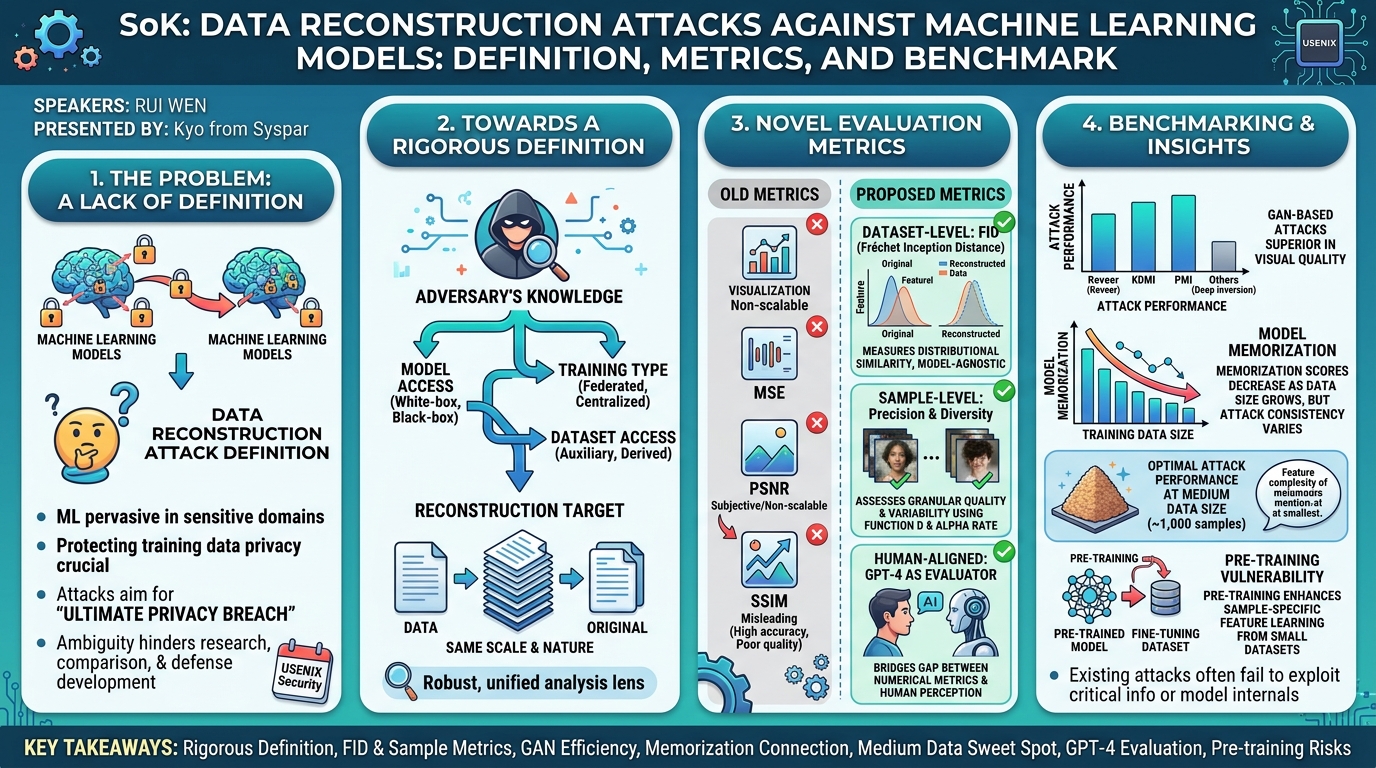
This talk, presented by Kyo from Syspar and authored by Rui Wen, delves into the critical and evolving field of data reconstruction attacks against machine learning (ML) models. As machine learning models become increasingly pervasive, particularly in highly sensitive domains like personal identification, disease diagnosis, and financial assessment, the imperative to protect the privacy of training data has grown exponentially. While model owners often release only the trained model, a growing body of research demonstrates that sophisticated adversaries can infer sensitive information about the underlying training samples. Data reconstruction attacks represent the "ultimate privacy breach" in this context, as they aim to expose all information about individual training samples.
Key moments
- 0:00 Introduction: Data Reconstruction Attacks & Lack of Definition
- 1:30 Providing a rigorous definition of data reconstruction
- 2:40 Limitations of existing metrics for attack evaluation
- 3:50 Proposed new dataset-level metric: FID score
- 4:40 Introducing sample-level metrics for precision and diversity
- 5:20 Visualizing reconstruction results and initial observations
- 6:00 Analysis of FID and sample-level metric results
- 7:50 Investigating model memorization and attack vulnerability
SoK: Data Reconstruction Attacks Against Machine Learning Models: Definition, Metrics, and Benchmark
Speakers: Rui Wen
Conference: USENIX Security
YouTube: https://www.youtube.com/watch?v=Y5G59f9OcBk
Overview
This talk, presented by Kyo from Syspar and authored by Rui Wen, delves into the critical and evolving field of data reconstruction attacks against machine learning (ML) models. As machine learning models become increasingly pervasive, particularly in highly sensitive domains like personal identification, disease diagnosis, and financial assessment, the imperative to protect the privacy of training data has grown exponentially. While model owners often release only the trained model, a growing body of research demonstrates that sophisticated adversaries can infer sensitive information about the underlying training samples. Data reconstruction attacks represent the "ultimate privacy breach" in this context, as they aim to expose all information about individual training samples.
The core challenge addressed in this Systematization of Knowledge (SoK) paper is the current lack of a rigorous definition for data reconstruction attacks and a consensus on appropriate metrics for their evaluation. This ambiguity hinders consistent research, comparison of attack methods, and the development of effective defenses. The talk systematically categorizes diverse attack scenarios, proposes a comprehensive set of metrics that account for both quantitative fidelity and perceptual quality, and benchmarks existing attacks. This work is crucial for establishing a robust foundation for future research in ML privacy, enabling a clearer understanding of vulnerabilities and guiding the design of more resilient ML systems.
Background
▶ Watch: Introduction: Data Reconstruction Attacks & Lack of Definition (0:00)
The rapid adoption of machine learning across various industries has brought unprecedented capabilities but also significant privacy concerns. Modern high-performance ML models are typically trained on vast datasets, which often contain sensitive personal or proprietary information. To mitigate the risk of data leakage, model developers commonly release only the trained model parameters, not the raw training data itself. However, this practice has proven insufficient to guarantee data privacy. A range of privacy attacks against ML models has emerged, including membership inference (determining if a specific record was part of the training set), attribute inference (inferring sensitive attributes of training data records), and property inference (inferring general properties of the training data distribution).
Among these, data reconstruction attacks are considered the most severe privacy breach. Unlike other attacks that infer partial information, reconstruction attacks aim to generate complete or near-complete copies of the original training samples. The proliferation of such attacks in recent years has highlighted a significant gap in the field: the absence of a standardized, rigorous definition. This definitional ambiguity stems from the diverse scenarios in which these attacks operate, varying across training types (e.g., federated learning, centralized training), levels of model access (e.g., white-box, black-box), and the availability of auxiliary datasets to the adversary. Without a clear definition, comparing different attack methodologies and understanding their true impact becomes inherently difficult.
Compounding this issue is the lack of consensus on appropriate evaluation metrics for reconstructed data. Traditional metrics commonly used in image processing, such as Mean Squared Error (MSE), Peak Signal-to-Noise Ratio (PSNR), and Structural Similarity Index Measure (SSIM), are often sensitive to arbitrary pairings of reconstructed and original samples and fail to capture the diversity of the reconstructed outputs. Feature-based evaluation networks also fall short in assessing diversity, while accuracy-based metrics can be misleading; visually noisy reconstructions might still achieve high accuracy, indicating a disconnect between numerical scores and perceptual fidelity. This critical void in definition and evaluation methodology underscores the need for a systematized approach to understanding and benchmarking data reconstruction attacks.
Key Findings
▶ Watch: Limitations of existing metrics for attack evaluation (2:40)
The research presented in this talk offers several pivotal findings that redefine the landscape of data reconstruction attack analysis:
- Rigorous Definition and Categorization: The talk establishes a comprehensive definition for data reconstruction attacks, clarifying what information an adversary possesses (e.g., training type, model access, dataset access) and what data they aim to reconstruct (samples of the same scale as the original training data). This framework categorizes 10 representative reconstruction attacks, providing a much-needed structure to the field.
- Novel Multi-faceted Evaluation Metrics: Recognizing the limitations of existing metrics, the authors propose a set of desirable properties for effective evaluation: quantifiability, consistency, precision, and diversity. To meet these, they introduce:
- A dataset-level metric: Fréchet Inception Distance (FID), which measures the distributional similarity between the reconstructed and target datasets. FID is model-agnostic and provides a macro-level view of reconstruction quality.
- Sample-level metrics: These focus on the fidelity and variability of individual reconstructions, assessing how closely each reconstructed sample aligns with its corresponding target. They incorporate a flexible similarity function
Dand a coverage alpha rate to provide a granular view of precision and diversity.
- Benchmarking and Performance Insights: Through extensive evaluation of 10 attacks on target models trained with varying dataset sizes (100 to 20,000 samples), the research demonstrates that Generative Adversarial Network (GAN)-based attacks like Reveer, KDMI, and PMI generally produce reconstructions of higher visual quality and achieve lower FID scores compared to other methods. However, the study also highlights that high-quality reconstructions do not necessarily imply high diversity among the generated data.
- The Role of Memorization: The work investigates the connection between model memorization (the degree to which a model "remembers" specific training examples) and vulnerability to reconstruction attacks. While model memorization scores generally decrease with increasing training data size, the performance of different attacks shows inconsistency. This suggests that current attack methods may lack the capacity to fully exploit these vulnerabilities, or that existing metrics fail to capture the true attack performance.
- GPT-4 as a Human-Aligned Metric: To bridge the gap between numerical metrics and human perception, the talk proposes leveraging GPT-4 as an evaluation tool. By inputting original images alongside reconstructions, GPT-4's responses are used to compute numeric metrics that align with human preference. This approach confirms that reconstruction quality generally diminishes as memorization scores decrease, aligning with visual evidence.
- Optimal Data Size for Reconstruction: Counter-intuitively, the study finds that for many attack methods, optimal reconstruction performance is achieved at a medium data size, specifically around 1,000 samples, rather than the smallest possible dataset. This suggests a balance where the model has learned sufficient features for reconstruction but the dataset is not so extensive as to complicate the recovery of individual samples. Pre-training a model on a disjoint dataset further enhances the advantage of smaller target datasets, as the model develops generalizability and learns sample-specific features more efficiently.
- Limitations of Current Attacks: The research points out that existing low-quality reconstruction methods often fail to exploit critical attack information, and some attack methods cannot fully leverage the model's internal information, indicating room for improvement in attack design.
Technical Deep Dive
▶ Watch: Introducing sample-level metrics for precision and diversity (4:40)
The technical core of this work lies in its rigorous definition of data reconstruction attacks and its innovative approach to evaluation metrics.
Defining Data Reconstruction Attacks
The authors formalize data reconstruction by clarifying two key aspects:
- Adversary's Knowledge: This encompasses the information available to the attacker, which can vary significantly. The talk categorizes this based on:
- Training Type: Whether the model was trained centrally, in a federated learning setup, or using other paradigms.
- Model Access: The level of access the adversary has to the target model, ranging from white-box (full access to model parameters and gradients) to black-box (only query access to model predictions).
- Dataset Access: The availability of auxiliary datasets to the adversary, which might be public, privately held, or derived.
- Reconstruction Target: The adversary's goal is to reconstruct data of the same scale and nature as the original training dataset. It is permissible to generate more samples than originally present and to select high-quality reconstructions, provided this selection process does not involve any information about the target data set itself. This robust definition provides a unified lens through which to analyze diverse attack strategies.
Limitations of Existing Metrics
The paper critically examines the shortcomings of prevalent evaluation metrics:
- Visualization: While intuitive, visual assessment is inherently subjective, non-quantifiable, and not scalable for large datasets.
- Quantitative Metrics (MSE, PSNR, SSIM): These pixel-wise or structural similarity metrics are highly sensitive to the exact pairing of reconstructed and original samples. They struggle to reflect the diversity of reconstructed outputs, meaning a reconstruction that is perceptually good but slightly shifted might score poorly.
- Feature-Based Evaluation Networks: Metrics derived from feature extractors often fail to capture the comprehensive diversity of the reconstructed data distribution.
- Accuracy-Based Metrics: Using classification accuracy on reconstructed samples can be misleading. A reconstruction might be visually noisy or distorted but still retain enough salient features to be correctly classified, leading to a high accuracy score that misrepresents its true fidelity.
Proposed Multi-faceted Metrics
To overcome these limitations, the authors propose a new suite of metrics built on four desirable properties: quantifiability, consistency, precision, and diversity.
- Dataset-Level Metric: Fréchet Inception Distance (FID)
- FID is a widely recognized metric for evaluating the quality of generated images by comparing the distribution of generated images to the distribution of real images.
- It operates by extracting features from both the reconstructed dataset and the target dataset using an Inception v3 network (pre-trained on ImageNet).
- These feature vectors are then modeled as multivariate Gaussians, and the Fréchet distance (a measure of similarity between two distributions) is calculated.
- Advantages: FID is model-agnostic (it doesn't depend on the specific attack model), provides quantitative comparability across different attacks, and measures distributional similarity, addressing the diversity aspect at a macro level. Lower FID scores indicate higher reconstruction quality.
- Sample-Level Metrics (Precision and Diversity)
- These metrics provide finer-grained insights into individual reconstruction quality and the variability among them.
- They assess how closely each reconstructed sample aligns with its corresponding target sample.
- A flexible similarity function
Dcan be chosen based on the specific aspect of reconstruction quality being evaluated (e.g., pixel-wise similarity, feature similarity). - The inclusion of a coverage alpha rate is crucial. It measures the proportion of target samples that have a "sufficiently similar" reconstructed counterpart, providing a comprehensive view of how many distinct original samples were successfully reconstructed.
- These metrics offer insights into whether attacks are generating diverse samples or merely variations of a few high-quality reconstructions.
Experimental Setup and Findings
The evaluation involved training target models on varying subsets of data, ranging from 100 to 20,000 samples, ensuring both training and auxiliary datasets were balanced to avoid class bias. The 10 representative attacks were then applied and evaluated using the proposed metrics.
- GAN-based attacks like Reveer, KDMI, and PMI consistently showed lower FID scores and generally higher visual quality, indicating their superiority in capturing the overall data distribution. However, the study found that high-quality reconstructions do not necessarily translate to high diversity, and coverage often declined with larger training datasets, suggesting attacks tend to capture general features rather than reconstructing individual samples in detail.
- Memorization and Vulnerability: The study adopted a method to calculate model memorization based on label changes. As expected, memorization scores decreased with larger training sizes. However, the correlation with attack performance was inconsistent, leading to two hypotheses: either current attacks lack the capacity to fully exploit memorization, or the metrics used (prior to GPT-4) were insufficient to capture true performance.
GPT-4 for Perceptual Evaluation
To address the disconnect between numerical metrics and human perception, the researchers innovatively employed GPT-4 as a proxy for human evaluators.
- Methodology: For each experiment, the original image and six reconstructed versions (from different attacks or conditions) were input into GPT-4. The model's response was then processed to derive three numeric metrics assessing reconstruction quality.
- Results: GPT-4's evaluations generally confirmed that reconstruction quality diminishes as the model's memorization score decreases. This was further supported by visual evidence, where reconstructions from smaller datasets (e.g., 100 samples) often resembled targets more closely than those from larger datasets (e.g., 20,000 samples).
- Nuances in Performance: GPT-4's insights revealed that while very small datasets (100 samples) could lead to blurred reconstructions (e.g., eyes, cheeks), negatively impacting traditional metrics, their effect on perceptual assessment (by GPT-4) was modest if the blurring wasn't extensive. Crucially, the optimal performance for many attacks was observed at 1,000 samples, not the smallest dataset size, suggesting a sweet spot where models learn sufficient features without the complexity of recovering individual samples from very large datasets.
- Impact of Pre-training: The study also explored the effect of pre-training models on disjoint datasets before fine-tuning on the target data. This approach improved testing accuracy and significantly enhanced the advantage of using smaller target dataset sizes, as pre-trained models could learn sample-specific features more efficiently. This finding highlights a potential vulnerability where models with pre-existing generalizability might be more susceptible to reconstruction attacks on smaller, sensitive fine-tuning datasets.
Demo / Proof of Concept
▶ Watch: Visualizing reconstruction results and initial observations (5:20)
While the talk did not present an interactive, live demonstration of an attack, it heavily relied on visualizations and visual evidence to illustrate the effectiveness and quality of the data reconstruction attacks. The speaker presented side-by-side comparisons of original target images and their reconstructed counterparts generated by various attack methods, such as Reveer, KDMI, PMI, Deep Inversion, and "if alignment." These visual demonstrations were crucial for showcasing the nuances of reconstruction quality—from clearly discernible human faces in some reconstructions to blurred or incomplete images in others. The visual evidence was also instrumental in highlighting the discrepancies between traditional quantitative metrics and human perception, particularly when discussing the role of GPT-4 in evaluating reconstruction fidelity. The talk's emphasis was on showing the results of the benchmarked attacks rather than an interactive proof-of-concept tool.
Defensive Implications
▶ Watch: Investigating model memorization and attack vulnerability (7:50)
The findings from this SoK paper carry significant implications for designers and practitioners tasked with defending machine learning models against privacy breaches.
- Understand Model Vulnerability: Model owners must move beyond generic privacy assumptions and actively assess the specific vulnerabilities of their deployed models to data reconstruction attacks. The research highlights that not all models are equally susceptible, and factors like training data size and model architecture play a critical role.
- Monitor Memorization: The strong connection between model memorization and vulnerability to reconstruction attacks suggests that memorization metrics could serve as a valuable indicator of risk. Defenders should investigate methods to quantify and monitor model memorization, potentially integrating it into their model auditing processes. Models exhibiting high memorization scores, especially for sensitive data, warrant closer scrutiny and stronger defensive measures.
- Rethink Data Management for Small Datasets: The finding that optimal reconstruction performance often occurs at smaller to medium dataset sizes (e.g., 1,000 samples) challenges the intuition that "more data is always better" for privacy. While large datasets might dilute individual sample information, very small datasets (like those used for fine-tuning) can be highly vulnerable, especially if the model has been pre-trained on other data. This necessitates careful consideration of data distribution, diversity, and size when handling sensitive information, particularly in fine-tuning scenarios.
- Mitigate Generative Attack Vectors: Since GAN-based attacks consistently demonstrate superior reconstruction quality, defensive strategies should prioritize mitigating these types of generative approaches. This could involve techniques like differential privacy during training, adversarial training specifically against generative attacks, or robust output sanitization mechanisms.
- Develop Context-Aware Defenses: The diverse scenarios of data reconstruction attacks (varying model access, training types, auxiliary data) underscore the need for context-aware defensive strategies. A defense effective against a white-box attack might be irrelevant for a black-box scenario. Defenders need to analyze their specific threat model and tailor their protections accordingly.
- Invest in Robust Evaluation: The limitations of traditional metrics and the utility of GPT-4 for human-aligned evaluation suggest that defenders should adopt more comprehensive evaluation frameworks. Relying solely on metrics like MSE or accuracy might provide a false sense of security. Integrating dataset-level, sample-level, and even AI-assisted perceptual metrics can provide a more accurate assessment of a model's true privacy posture.
- Future Research in Defense: The paper explicitly calls for directions in designing future defense strategies. This suggests an ongoing need for research into novel privacy-preserving techniques that directly counter the mechanisms employed by data reconstruction attacks, focusing on reducing memorization without sacrificing utility, or scrambling reconstructed outputs to render them unusable.
Key Takeaways
- The field of data reconstruction attacks against ML models has suffered from a lack of rigorous definition and standardized, robust evaluation metrics, hindering consistent research and comparison.
- This work introduces a comprehensive definition for data reconstruction attacks, categorizing them by adversary knowledge and reconstruction targets, and proposes a multi-faceted evaluation framework.
- The proposed metrics include Fréchet Inception Distance (FID) for dataset-level distributional similarity and novel sample-level metrics for precision, diversity, and coverage, providing a more complete picture of reconstruction quality.
- GAN-based attacks (e.g., Reveer, KDMI, PMI) generally outperform other methods in terms of visual quality and FID scores, highlighting their effectiveness in reconstructing training data.
- Model memorization is closely linked to vulnerability, and while it decreases with larger training datasets, attack performance can be inconsistent due to limitations in current attack methods or evaluation metrics.
- GPT-4 can serve as an effective, human-aligned evaluation tool, revealing that reconstruction quality often diminishes with decreasing memorization and that an optimal performance point for reconstruction often exists around 1,000 training samples.
- Pre-training can enhance the efficiency of learning sample-specific features from smaller datasets, potentially increasing the risk of data reconstruction for fine-tuned models.
About the Speaker(s)
The talk "SoK: Data Reconstruction Attacks Against Machine Learning Models: Definition, Metrics, and Benchmark" was authored by Rui Wen. The presentation was delivered by Kyo from Syspar, who introduced himself at the beginning of the talk. While the metadata lists Rui Wen as the speaker, it is common for one of the authors to present the work at a conference. Kyo from Syspar represented the research team, sharing their insights into the formal definition, evaluation metrics, and benchmarking of data reconstruction attacks against machine learning models.
Reviews
Dr. Zero (Offensive Security Researcher) — SOLID
Legitimate academic SoK work that fills a real gap — the field genuinely lacked a unified definition and evaluation framework for data reconstruction attacks. Solid systematization effort, but the contributions are largely methodological scaffolding rather than a novel attack or a meaningful new threat revelation. USENIX-appropriate, conference-appropriate, not a must-see.
Heather Calloway (CISO) — WEAK
Technically rigorous SoK work that fills a real gap in ML privacy research — the field needed a common definition and consistent metrics, and this delivers both. But the bridge from research finding to institutional decision is almost entirely absent, and the defensive implications read like a graduate seminar outline rather than guidance anyone can act on.
→ Top-rated talks at 34th USENIX Security Symposium (USENIX Security '25)
All talks from 34th USENIX Security Symposium (USENIX Security '25)