SoK: Gradient Inversion Attacks in Federated Learning
Vincenzo Carletti
34th USENIX Security Symposium (USENIX Security '25) · Day 3 · ML and AI Security 3: Backdoors, Poisoning, Unlearning
Overview
This talk presents a comprehensive Systematization of Knowledge (SoK) regarding gradient inversion attacks (GIAs) within federated learning (FL) environments. Delivered by Joseph Varela from the University of Salerno, the presentation distills insights from an extensive review of 107 publications spanning from 2016 to 2025. The core focus is on understanding how adversaries can reconstruct sensitive client data from the seemingly innocuous model updates exchanged during collaborative FL training, despite FL's promise of enhanced privacy.
Key moments
- 0:00 Introduction to Federated Learning and its privacy.
- 2:00 Understanding gradient inversion attacks and data reconstruction.
- 2:27 Identifying eight distinct threat models for adversaries.
- 4:33 Overview of three main gradient inversion attack categories.
- 4:59 Optimization-based attacks and their vulnerable setups.
- 6:16 Generative model attacks and the role of surrogate data.
- 8:00 Introducing analytic-based gradient inversion attacks.
SoK: Gradient Inversion Attacks in Federated Learning
Speakers: Joseph Varela, University of Salerno
Conference: USENIX Security
YouTube: https://www.youtube.com/watch?v=mnrbV29ynd4
Overview
This talk presents a comprehensive Systematization of Knowledge (SoK) regarding gradient inversion attacks (GIAs) within federated learning (FL) environments. Delivered by Joseph Varela from the University of Salerno, the presentation distills insights from an extensive review of 107 publications spanning from 2016 to 2025. The core focus is on understanding how adversaries can reconstruct sensitive client data from the seemingly innocuous model updates exchanged during collaborative FL training, despite FL's promise of enhanced privacy.
The research meticulously categorizes threat models, dissects various attack methodologies, evaluates defensive countermeasures, and analyzes the metrics used to assess attack effectiveness. This work is critical because it provides a structured framework for understanding the evolving landscape of privacy risks in federated learning, identifying crucial gaps in current research, and guiding future development of robust privacy-preserving machine learning systems. By offering a systematic analysis, the paper serves as an invaluable resource for both researchers and practitioners navigating the complex trade-offs between model utility and data privacy in distributed AI.
Background
▶ Watch: Introduction to Federated Learning and its privacy. (0:00)
Federated learning (FL) has emerged as a prominent machine learning paradigm designed to enable multiple clients to collaboratively train a shared model without directly exposing their raw, private datasets. In a typical FL setup, a central server coordinates the training process. Clients perform local training on their private data using a global model received from the server, then send back only model updates (gradients or model parameters) to the server. The server aggregates these updates to refine the global model, and this iterative process continues until convergence. This architecture is celebrated for its potential to offer stronger privacy guarantees compared to traditional centralized training, as sensitive data never leaves the client's device.
However, the very nature of these model updates, while not raw data, can still leak significant information about the underlying private datasets. This vulnerability forms the basis of gradient inversion attacks (GIAs). GIAs aim to reconstruct the client's original private input data—such as images, text, or other sensitive records—solely from the model updates transmitted to the central server. Early research demonstrated that even an approximate reconstruction could reveal highly sensitive information, directly undermining FL's privacy assurances. The existence and increasing sophistication of these attacks necessitate a thorough understanding of their mechanisms, the conditions under which they succeed, and effective countermeasures. This SoK paper addresses this need by providing a structured overview of the current state of GIAs.
Key Findings
▶ Watch: Identifying eight distinct threat models for adversaries. (2:27)
The SoK paper by Varela et al. presents five key contributions, each offering a structured understanding of gradient inversion attacks in federated learning:
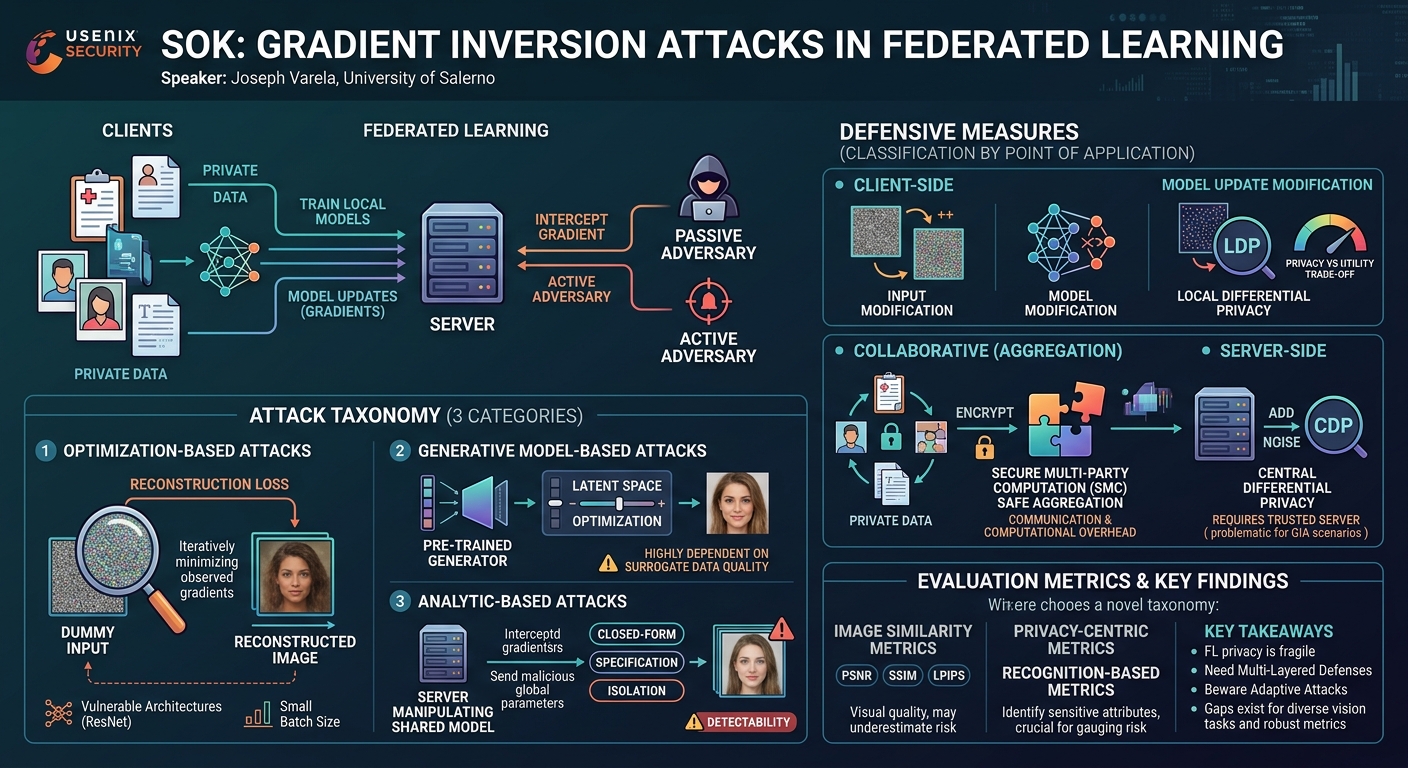
- Comprehensive Threat Model Definition: The research identifies eight distinct threat models, labeled A through H, categorizing adversaries based on their knowledge and capabilities. Models A-E describe a passive server that adheres to the standard FL protocol but leverages its inherent knowledge. Models F-H depict a more powerful active server capable of interfering with the training procedure, for instance, by manipulating the global model sent to clients. For each model, the paper assesses its real-world applicability, noting that active server models (F-H) are generally rated lower (one out of three stars) due to higher detectability and potential accountability issues. Passive server models utilizing surrogate data (D, E) are rated higher (two out of three stars) but still face challenges in obtaining high-quality auxiliary data in certain scenarios (e.g., medical applications, absence of batch norm layers).
- Taxonomy of Gradient Inversion Attacks: The paper categorizes GIAs into three primary families:
- Optimization-based attacks: These formulate data reconstruction as an optimization problem, often using surrogate data for regularization. They are highly sensitive to experimental setup (network architecture, initialization, batch size, training state).
- Generative model-based attacks: These integrate generative models (e.g., GANs, VAEs) into the attack strategy, frequently by shifting the optimization problem to the latent space of a pre-trained generator. Their success heavily relies on the availability and quality of surrogate data that closely matches client data distribution.
- Analytic-based attacks: These typically involve an active server manipulating the shared model to induce specific properties in the gradients, facilitating reconstruction. Historically considered impractical due to detectability, recent advancements have made them more sophisticated and harder to detect.
- Classification of Defensive Measures: Defenses against GIAs are categorized based on their application point:
- Client-side defenses: These include input modification (preprocessing data), model modification (altering local model architecture), and model update modification (e.g., local differential privacy). Many have an impact on model utility, and some have been bypassed by adaptive attacks.
- Collaborative defenses: Applied during the aggregation phase, these often leverage secure multi-party computation (SMC) protocols to protect individual updates, allowing the server to see only the aggregated result. They introduce significant communication and computational overhead.
- Server-side defenses: These primarily involve applying central differential privacy to aggregated updates. A significant limitation is the need to trust the server, which is often the primary threat actor in GIA scenarios.
- Novel Taxonomy of Evaluation Metrics: The paper introduces a taxonomy for assessing GIAs, particularly for image data, dividing metrics into image similarity-based (e.g., PSNR, SSIM, LPIPS) and image recognition-based (e.g., classification accuracy of reconstructed images). A crucial finding is the necessity of privacy-centric metrics for accurately gauging privacy leakage, especially for threat models A-E. Relying solely on traditional image similarity metrics can underestimate the actual privacy risk posed by approximate reconstructions.
- Identification of Open Challenges and Future Directions: The SoK highlights several critical areas for future research, including the need for attacks targeting diverse vision tasks beyond image classification, development of client-side defenses against stealthy active adversaries, systematic analysis of distribution shifts between surrogate and real data, and the development of more robust privacy metrics that fully capture the risk of approximate data reconstruction.
Technical Deep Dive
▶ Watch: Overview of three main gradient inversion attack categories. (4:33)
The technical depth of the SoK paper lies in its meticulous dissection of GIA mechanisms, defensive strategies, and evaluation methodologies.
Gradient Inversion Attack Categories
- Optimization-Based Attacks:
These attacks frame the reconstruction of client data as an optimization problem. The adversary aims to find an input x that, when passed through the client's model, produces gradients ∇L(x, y) that are as close as possible to the observed gradients ∇L_observed. This is typically expressed as minimizing a loss function that measures the distance between the reconstructed and observed gradients.
- Mechanism: The adversary initializes a dummy input (e.g., a random image) and iteratively refines it using gradient descent (or similar optimization techniques) to match the received gradients.
- Auxiliary Knowledge: Surrogate data can be incorporated in two ways:
- As auxiliary regularization terms within the optimization objective, guiding the reconstruction towards more realistic data distributions.
- By incorporating generative models (either interleaved with the optimization or applied post-optimization) to constrain the reconstructed input to the latent space of a pre-trained generator.
- Vulnerability Factors: The effectiveness of these attacks is highly sensitive to the experimental setup. Key factors include:
- Network Architecture: Architectures like ResNet are noted as particularly vulnerable.
- Network Initialization and Training State: The initial parameters and the current stage of model training influence reconstructability.
- Batch Size: Smaller batch sizes tend to leak more information, making reconstruction easier.
- Training Algorithm: The Federated Stochastic Gradient Descent (FedSGD) algorithm, combined with vulnerable architectures and small batch sizes, represents a highly susceptible setup, especially under threat models D and E where adversaries leverage auxiliary knowledge.
- Limitations: While often accurate, optimization-based attacks lack formal mathematical convergence guarantees, and their success can be brittle to changes in the FL environment.
- Generative Model-Based Attacks:
This category integrates generative models (e.g., Generative Adversarial Networks (GANs), Variational Autoencoders (VAEs)) to enhance reconstruction quality and efficiency.
- Mechanism: The most common approach is latent space optimization. Instead of optimizing directly in the high-dimensional input space, the adversary optimizes in the lower-dimensional latent space of a pre-trained generative model. This forces the reconstructed output to be a realistic sample from the generator's distribution, often leading to more visually coherent and semantically meaningful reconstructions.
- Subcategories:
- Latent Space Optimization: As described above, optimizing latent vectors.
- Online Optimization: Generative models are trained or fine-tuned during the attack process.
- Direct Reconstruction: The generative model is directly used to map gradients to inputs, bypassing explicit optimization loops in some cases.
- Prerequisite: A surrogate data set is essential for pre-training the generative model.
- Real-world Applicability Challenge: The success of these attacks critically depends on how closely the surrogate data matches the client's private data distribution. A high degree of similarity is often required, which can be challenging to achieve in real-world scenarios, particularly in sensitive domains like medical imaging where data collection is restricted. The lack of systematic analysis regarding this distribution shift is identified as a significant gap in the literature.
- Analytic-Based Attacks:
These attacks typically involve an active server that strategically manipulates the shared model or the training process to create conditions conducive to data reconstruction.
- Mechanism: The server distributes a specially crafted model to clients, causing their model updates to exhibit specific properties that simplify or directly reveal input data.
- Subcategories:
- Closed-Form Attacks: These involve designing the model (e.g., a single linear layer) such that the gradients directly provide enough information to solve for the input data in a closed-form mathematical expression.
- Gradient Specification Attacks: The server modifies the model to make certain gradients correspond directly to specific features or values of the input.
- Gradient Isolation Attacks: The server manipulates the model to isolate the contribution of a single data point or feature to the overall gradient, making it easier to reconstruct.
- Detectability: Historically, these attacks were considered impractical due to their high detectability, as the server's active interference could be observed by clients or anomaly detection systems. However, recent advancements have introduced more sophisticated techniques that achieve effective data reconstruction with model modifications that are harder to detect on the client side, increasing their practical threat in real FL systems.
Defensive Measures
Defenses are categorized by their application point:
- Client-Side Defenses: Applied directly on the client's device.
- Input Modification: Clients alter their raw input data through preprocessing operations before local training. Examples include adding noise, quantization, or obfuscation.
- Trade-off: Balances privacy protection with model utility.
- Weakness: Some methods have been bypassed by subsequent adaptive attacks.
- Model Modification: Clients locally modify the model architecture or parameters to make it harder for the server to compute accurate gradients.
- Mechanism: Designed to hinder gradient computation, especially for optimization-based GIAs.
- Weakness: Many lack evaluation against modern, sophisticated GIAs.
- Model Update Modification: Clients apply privacy-preserving mechanisms directly to the model updates before sending them to the server.
- Most Effective: Local differential privacy (LDP) approaches, which add calibrated noise to gradients.
- Strength: Offers formal privacy guarantees based on a well-defined framework.
- Drawback: Can significantly compromise model utility, especially when applied by all clients.
- Collaborative (Aggregation Phase) Defenses: Applied jointly by clients during the aggregation of updates.
- Mechanism: Primarily based on secure multi-party computation (SMC) protocols. These protocols allow clients to compute an aggregated update without revealing their individual contributions to the server or other clients. The server only sees the final, aggregated result.
- Requirement: All participating clients must be trusted to correctly apply the protocol.
- Drawback: Introduces substantial additional communication and computational overhead compared to traditional FL.
- Server-Side Defenses: Applied by the central server to the aggregated updates.
- Mechanism: Typically involve applying central differential privacy (CDP) to the aggregated model update before distributing it or using it to update the global model.
- Limitation: Requires trusting the server, which is inherently problematic as the server is often considered the primary threat actor for GIAs. This fundamental conflict limits the effectiveness and applicability of server-side CDP against a malicious server.
Evaluation Metrics
The SoK introduces a novel taxonomy for evaluating GIAs, particularly for image data, highlighting the need for appropriate metrics:
- Image Similarity-Based Metrics: These are generic metrics traditionally used to compare image quality.
- Examples: Peak Signal-to-Noise Ratio (PSNR), Structural Similarity Index Measure (SSIM), Learned Perceptual Image Patch Similarity (LPIPS).
- Limitation: While useful for visual assessment, they may not fully capture the privacy risk, especially if the reconstruction is semantically similar but visually distinct.
- Image Recognition-Based Metrics: These assess whether the reconstructed image retains enough information to be recognized by a machine learning model.
- Examples: Training a classifier on reconstructed images and evaluating its accuracy, or using pre-trained models for feature extraction and comparison.
- Strength: More privacy-specific, as they evaluate the utility of the reconstructed data for adversarial tasks.
- Privacy-Centric Metrics: The paper emphasizes that for passive threat models (A-E), privacy-centric metrics are essential. These metrics are specifically designed to quantify privacy leakage from approximate input reconstructions. Relying solely on traditional image similarity metrics can lead to an underestimation of privacy risks, as even visually imperfect reconstructions can still leak sensitive attributes or identity information.
Demo / Proof of Concept
▶ Watch: Generative model attacks and the role of surrogate data. (6:16)
As a Systematization of Knowledge (SoK) paper, the talk focuses on a comprehensive review, categorization, and analysis of existing research rather than presenting a novel attack, defense, or live demonstration. The speaker showcased examples of tables from their detailed paper, which systematically list and categorize various gradient inversion attacks, defensive measures, and their characteristics (e.g., year of publication, key factors impacting effectiveness, threat models, availability of open-source repositories). These tables serve as a structured presentation of the research findings, illustrating the taxonomy and analysis performed, rather than a traditional software or hardware demonstration.
Defensive Implications
▶ Watch: Introducing analytic-based gradient inversion attacks. (8:00)
The detailed analysis of gradient inversion attacks and defenses offers critical insights for practitioners and researchers aiming to secure federated learning systems. Defenders must recognize that FL's inherent privacy promise is fragile and can be significantly compromised by sophisticated GIAs.
- Adopt Multi-Layered Defenses: No single defense is foolproof. A robust strategy requires combining multiple defensive mechanisms. For instance, client-side input modifications (e.g., data obfuscation) can be combined with local differential privacy applied to model updates, further bolstered by secure multi-party computation during aggregation.
- Understand Your Threat Model: The choice of defense heavily depends on the assumed adversary. If the central server is explicitly distrusted (a common assumption for GIAs), server-side defenses like central differential privacy are insufficient. Defenses must primarily focus on client-side and collaborative mechanisms that do not rely on server trust.
- Prioritize Local Differential Privacy (LDP) with Caution: LDP offers strong, formal privacy guarantees. However, its significant impact on model utility, especially when widely applied, necessitates careful calibration and evaluation. Organizations must quantify the acceptable trade-off between privacy leakage and model performance for their specific application.
- Beware of Adaptive Attacks: Many proposed defenses have been bypassed by subsequent, more sophisticated adaptive attacks. Defenders should assume that adversaries will attempt to circumvent existing protections. This necessitates continuous monitoring, research into new attack vectors, and the development of defenses that are robust against evolving threats.
- Evaluate Against Privacy-Centric Metrics: When assessing the effectiveness of defenses, relying solely on traditional image similarity metrics (like PSNR or SSIM) is insufficient and can be misleading. Defenders should utilize privacy-centric metrics that specifically quantify the information leakage from reconstructed data to accurately gauge the residual privacy risk.
- Address Data Distribution Shifts for Surrogate Data: For defenses that rely on synthetic or surrogate data (e.g., for generative models), ensure that the surrogate data closely matches the client's real data distribution. Significant distribution shifts can render such defenses ineffective or easily bypassed.
- Consider Communication and Computation Overhead: Collaborative defenses like Secure Multi-Party Computation (SMC) offer strong privacy but come with substantial communication and computational overhead. Organizations need to assess whether their infrastructure and application requirements can tolerate these increased demands.
- Stay Informed on Active Server Threats: While active server attacks are harder to implement and potentially detectable, recent advancements are making them stealthier. Defenders should implement anomaly detection systems to identify suspicious server behavior or model manipulations that could indicate an active attack.
Key Takeaways
- Federated Learning's privacy promise is challenged by Gradient Inversion Attacks (GIAs): Despite not sharing raw data, model updates can leak sensitive client information, enabling reconstruction of private inputs.
- Adversary capabilities vary significantly: The SoK defines eight threat models, ranging from passive servers leveraging auxiliary knowledge to active servers manipulating training, with varying real-world applicability.
- GIAs are diverse and evolving: They are categorized into optimization-based, generative model-based, and analytic-based attacks, each with specific mechanisms, vulnerabilities, and reliance on factors like surrogate data quality.
- Defenses exist but have limitations: Defenses applied client-side, collaboratively, or server-side each involve trade-offs between privacy, model utility, and computational overhead, with some client-side defenses already bypassed.
- Privacy-centric evaluation is crucial: Relying solely on traditional image similarity metrics for assessing GIA effectiveness can underestimate privacy risks; specific privacy-centric metrics are essential.
- Significant open challenges remain: Future research needs to focus on attacks beyond image classification, stealthier client-side defenses, systematic analysis of data distribution shifts for auxiliary data, and improved privacy metrics.
About the Speaker(s)
The talk was presented by Joseph Varela from the University of Salerno. As the speaker for this Systematization of Knowledge paper, Joseph Varela's work focuses on the intersection of machine learning, privacy, and security, specifically in the context of federated learning. His research contributes to a deeper understanding of gradient inversion attacks and the development of robust countermeasures to protect sensitive user data in collaborative AI paradigms.
Reviews
Dr. Zero (Offensive Security Researcher) — SOLID
A competent SoK that does the literature-organization work someone needed to do — 107 papers taxonomized into threat models, attack families, defenses, and metrics. Solid contribution for the ML privacy research community, but it's a survey paper dressed up as a conference talk, and the inherent limitations of that format show: no novel attacks, no new defenses, no empirical results that weren't already in the cited literature.
Heather Calloway (CISO) — WEAK
Technically rigorous SoK on gradient inversion attacks in federated learning — 107 papers reviewed, eight threat models defined, defenses catalogued. The research is real, but it never crosses the threshold into operational or governance relevance. A security leader deploying FL in healthcare, financial services, or federal infrastructure gets no usable decision framework from this.
→ Top-rated talks at 34th USENIX Security Symposium (USENIX Security '25)
All talks from 34th USENIX Security Symposium (USENIX Security '25)