V-ORAM: A Versatile and Adaptive ORAM Framework with Service Transformation for Dynamic Workloads
Bo Zhang (PhD student · Northwestern Poly Technical University)
34th USENIX Security Symposium (USENIX Security '25) · Day 3 · System Security 5: Securing Systems and Protocols
Overview
Oblivious RAM (ORAM) is a cryptographic primitive designed to protect against access pattern attacks, where an adversary observing the frequency and sequence of data requests can infer sensitive information about the underlying plaintext, even if the data itself is encrypted. While ORAM schemes provide a robust solution for privacy-preserving outsourced storage, their practical deployment has been hampered by a critical limitation: most existing ORAMs are highly optimized for specific, static workloads. However, real-world cloud storage and data processing environments are inherently dynamic, with fluctuating demands, diverse query types, and varying performance requirements.
Key moments
- 0:20 ORAM's role: protecting access patterns from attacks
- 2:00 Inefficiency of existing solutions for dynamic ORAM workloads
- 2:40 V-ORAM: Secure, efficient ORAM transformation for dynamic workloads
- 4:10 Path ORAM workflow: tree-based, instant eviction mechanism
- 5:00 Real ORAM workflow: dummy blocks, XOR, periodic eviction
- 6:20 Matching ORAMs (Path, Real, Conquer) to diverse workloads
- 7:40 Real ORAM chosen as intermediate for transformation compatibility
- 8:00 High-level ORAM transformation workflow and leakage considerations
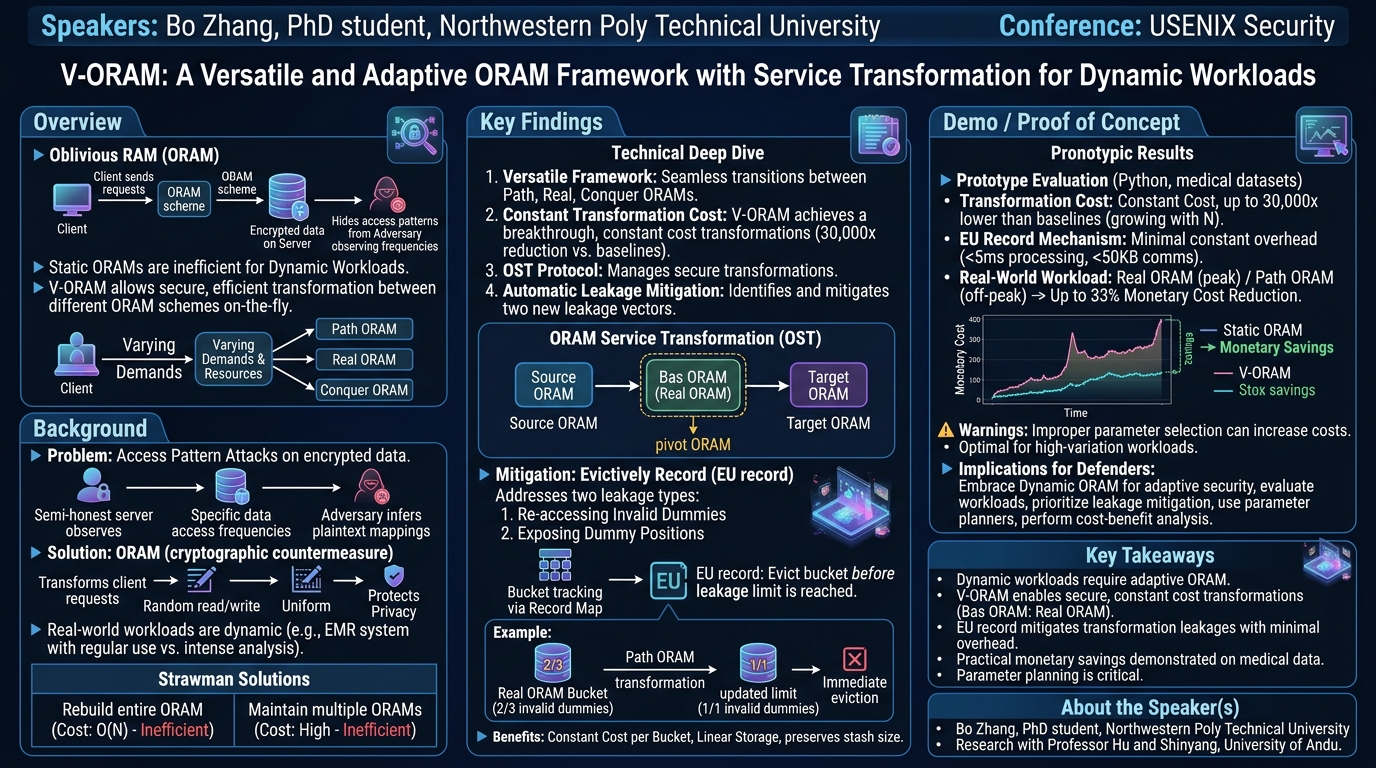
V-ORAM: A Versatile and Adaptive ORAM Framework with Service Transformation for Dynamic Workloads
Speakers: Bo Zhang, PhD student, Northwestern Poly Technical University
Conference: USENIX Security
YouTube: https://www.youtube.com/watch?v=xQCA_cPG76E
Overview
Oblivious RAM (ORAM) is a cryptographic primitive designed to protect against access pattern attacks, where an adversary observing the frequency and sequence of data requests can infer sensitive information about the underlying plaintext, even if the data itself is encrypted. While ORAM schemes provide a robust solution for privacy-preserving outsourced storage, their practical deployment has been hampered by a critical limitation: most existing ORAMs are highly optimized for specific, static workloads. However, real-world cloud storage and data processing environments are inherently dynamic, with fluctuating demands, diverse query types, and varying performance requirements.
This talk, presented by Bo Zhang, introduces V-ORAM, a novel framework that addresses this challenge by enabling secure and efficient transformations between different tree-based ORAM schemes. V-ORAM eliminates the need for costly and insecure workarounds like rebuilding an entire ORAM instance or maintaining multiple, redundant ORAMs. By allowing systems to adapt their ORAM strategy on the fly, V-ORAM makes ORAM a far more practical and viable solution for protecting sensitive data, such as electronic medical records, in dynamic cloud environments.
The significance of V-ORAM lies in its ability to bridge the gap between theoretical ORAM security guarantees and the practical demands of real-world systems. It offers a sophisticated solution that maintains the strong privacy properties of ORAM while providing the flexibility needed to handle diverse and changing workloads efficiently. This innovation is particularly crucial for industries dealing with highly sensitive data, where both security and operational agility are paramount.
Background
▶ Watch: ORAM's role: protecting access patterns from attacks (0:20)
The foundational problem V-ORAM addresses is the vulnerability of encrypted outsourced data to access pattern attacks. Even when data is encrypted before being sent to a semi-honest cloud server, an adversary monitoring the client's access frequency to specific ciphertexts can, in conjunction with publicly available information, deduce the mapping between ciphertexts and their corresponding plaintexts. This leakage undermines the privacy intended by encryption alone.
Oblivious RAM (ORAM) was developed as a cryptographic countermeasure. An ORAM scheme transforms a client's actual data access requests into a series of random read and write operations on the server side. This randomization ensures that the server (and any adversary observing server-side activity) cannot distinguish between different access patterns, thus protecting the client's privacy. ORAMs are stateful, requiring metadata to be maintained on both client and server sides, and have a theoretical cost lower bound of O(log N), where N is the total number of blocks. Over the years, various ORAM schemes have been proposed, each typically tailored and optimized for specific scenarios, such as parallel computation, secure multi-party computation, or searchable encryption.
However, a significant challenge arises when these specialized ORAMs are confronted with dynamic workloads. In practical settings, the nature of data access can change dramatically. For instance, a hospital's electronic medical record (EMR) system might experience routine usage with no specific performance demands, interspersed with periods of intensive medical analysis requiring keyword searches or complex queries like joins and aggregates. Similarly, a cloud storage system might face daily peaks requiring high throughput and low latency, contrasted with off-peak periods where maintenance costs are prioritized. System performance changes, such as varying CPU availability or network bandwidth, can also dictate different optimal ORAM configurations.
Using an ORAM that is mismatched to the current workload leads to severe inefficiencies or even security vulnerabilities:
- Inefficiency: Employing a communication-centric ORAM in a low-bandwidth network, for example, would drastically degrade performance.
- Insecurity: Using a synchronous ORAM in an asynchronous network could compromise data correctness.
Existing "strawman" solutions to dynamic workloads are either prohibitively expensive or impractical:
- Downloading and rebuilding the entire ORAM: This involves massive communication costs, as the entire dataset and ORAM structure must be re-initialized. The cost scales with O(N), where N is the number of blocks.
- Maintaining multiple ORAM instances: This approach would multiply the access cost, as each potential workload would require its own dedicated ORAM, leading to significant storage and computation overhead.
Both these solutions, while technically secure, are not efficient enough for real-world deployment. V-ORAM aims to provide a solution that is both secure and efficient, capable of handling dynamic workloads without these extreme penalties.
Key Findings
▶ Watch: V-ORAM: Secure, efficient ORAM transformation for dynamic workloads (2:40)
V-ORAM introduces a novel framework for securely and efficiently transforming between different ORAM services in response to dynamic workloads. The core contributions and findings of this research are:
- A Versatile and Adaptive ORAM Framework (V-ORAM): The framework enables seamless transitions between a selection of tree-based ORAMs, specifically Path ORAM, Real ORAM, and Conquer ORAM. This versatility allows a system to dynamically adjust its ORAM strategy to match current performance requirements or resource constraints.
- Constant Transformation Cost: Unlike naive solutions that incur costs proportional to the number of blocks (O(N)) or logarithmic to it (O(log N)), V-ORAM achieves a constant transformation cost. This is a significant breakthrough, making ORAM reconfigurations practical and affordable even for large datasets. The talk highlights that V-ORAM can reduce transformation costs by up to 30,000 times compared to baseline methods, with this factor growing with data size.
- ORAM Service Transformation (OST) Protocol: V-ORAM includes a dedicated protocol for managing these transformations. This protocol is designed to address specific security challenges that arise when switching between ORAM schemes.
- Automatic Leakage Mitigation: A crucial finding is the identification of two distinct access pattern leakage vectors that can occur during ORAM transformations. The framework provides an automatic, constant-cost mechanism to mitigate these leakages, ensuring that the security guarantees of ORAM are preserved throughout the transformation process.
- Strategic Selection of ORAMs: The researchers carefully selected Path ORAM, Real ORAM, and Conquer ORAM as the core components of the V-ORAM framework. These three ORAMs were chosen because they collectively cover a broad taxonomy of common workloads:
- Path ORAM: An "instant eviction" ORAM, suitable for general storage where maintaining cost is paramount.
- Real ORAM: A "periodic eviction" ORAM that leverages dummy blocks and XOR computation, suitable for low-latency update workloads.
- Conquer ORAM: Built upon Real ORAM, also using dummy blocks, designed for multi-client scenarios requiring higher throughput.
This combination allows V-ORAM to serve diverse requirements, including general storage, low-latency updates, high-throughput multi-client access, resource-constrained clients (limited storage for position map), and specialized functionalities like keyword search or secure computation in synchronous networks.
- Parameter Planner: While not detailed in the talk, the paper introduces a planner tool to assist users in choosing optimal ORAM parameters. This is an important finding given that improper parameter selection can negate V-ORAM's benefits and even increase costs, particularly for workloads with high variation.
Technical Deep Dive
▶ Watch: Real ORAM workflow: dummy blocks, XOR, periodic eviction (5:00)
The technical core of V-ORAM revolves around identifying an efficient and secure method for transforming between different ORAM schemes. Directly designing transformation protocols for every arbitrary pair of ORAMs is impractical. Instead, V-ORAM introduces an intermediate ORAM, referred to as the Bas ORAM, which acts as a pivot for all transformations. The Bas ORAM must be compatible with other ORAMs, affordable in terms of computation and communication, and avoid heavy costs during transformation.
After investigation, Real ORAM was chosen as the Bas ORAM. Real ORAM offers several advantages:
- Compatibility: It is compatible with both Path ORAM and Conquer ORAM.
- Lightweight Computation: It leverages lightweight XOR computation for data retrieval.
- Dummy Block Reuse: It can efficiently reuse dummy blocks when switching with Conquer ORAM, minimizing regeneration costs.
High-Level Transformation Workflow
The general idea is to transform any ORAM (Source ORAM) to Real ORAM, and then from Real ORAM to any other ORAM (Target ORAM).
- Switching from Conquer ORAM to Real ORAM: Real ORAM can inherit the dummy blocks from Conquer ORAM, avoiding the need to regenerate them. The server-side metadata of Conquer ORAM needs to be downloaded and merged with Real ORAM's metadata.
- Switching from Path ORAM to Real ORAM: The position map (which records the position of each block) and the stash (for caching data) can be directly inherited. However, Path ORAM does not use dummy blocks, posing a challenge for Real ORAM which relies on them. One naive option is to retrieve all dummy blocks and treat them as real blocks, but this significantly increases cost. The goal is to retrieve only the real blocks without leaking dummy block positions.
Addressing Leakage During Transformation
The transformation process, if not carefully managed, can introduce new avenues for access pattern leakage. V-ORAM identifies and mitigates two critical leakage types:
- Leakage 1: Re-accessing Invalid Dummies
- Scenario: This occurs when switching between two ORAMs that employ periodic eviction (e.g., Real ORAM to Conquer ORAM). In periodic eviction ORAMs, dummy blocks are used to obscure real accesses. Once a dummy block is accessed, it becomes "invalid" until the next eviction cycle. If, during a transformation, the new ORAM (e.g., Conquer ORAM) initializes its metadata without correctly inheriting the "invalid" status of previously accessed dummy blocks, it might mark all dummies as "valid." If the adversary observes the new ORAM accessing a dummy block that was previously accessed and marked invalid by the old ORAM, they can deduce that it is indeed a dummy block because it was accessed twice without an intervening eviction of the bucket. Real blocks are only accessed once per logical read/write operation.
- Example: A bucket in Real ORAM has dummy block 3 accessed and its status updated to invalid. If switching to Conquer ORAM initializes all dummy statuses to valid, and then Conquer ORAM accesses dummy block 2 (which was previously valid), the adversary learns nothing. But if it accesses dummy block 3 again, the adversary knows it's a dummy.
- Leakage 2: Exposing Dummy Positions
- Scenario: This leakage primarily happens when switching from a periodic eviction ORAM (e.g., Real ORAM) to an instant eviction ORAM (e.g., Path ORAM). Path ORAM does not use dummy blocks and only accesses real blocks. If the new Path ORAM instance simply downloads and processes only the real blocks from a bucket, it implicitly reveals the locations of all dummy blocks in that bucket to the adversary. This information, once leaked, can compromise the access patterns of any subsequent periodic eviction ORAM (e.g., Conquer ORAM) that uses dummy blocks, as the adversary would already know which positions contain dummies.
Mitigation: Evictively Record (EU record)
V-ORAM's mitigation strategy for both leakage types is simple yet effective: evict the bucket before the leakage occurs. This is achieved through a mechanism called Evictively Record (EU record).
The core idea of EU record is based on tracking the access limit for each bucket. The access limit is defined as the number of secure accesses a bucket can endure before it must be evicted to prevent leakage.
- For ORAMs with instant eviction (like Path ORAM), the access limit is
1, meaning a bucket must be evicted after each access. - For ORAMs with periodic eviction (like Real ORAM or Conquer ORAM), the access limit is the total number of dummy blocks in the bucket. Once all dummy blocks have been accessed and marked invalid, the bucket must be evicted.
The client maintains a record map that tracks the current access limits of all buckets. During a transformation, when switching from one ORAM type to another:
- The metadata, including the
record map, is correctly inherited. - The
record mapis updated according to the access limits of the new ORAM type. - Any bucket that has reached or exceeded its updated access limit is immediately evicted according to predefined rules.
Example of EU record in action:
- Consider a bucket in Real ORAM. Its
record mapmight show(2, 3), indicating that 2 out of 3 dummy blocks have been accessed and are invalid. - When switching to Path ORAM (instant eviction), the
record mapfor this bucket is updated to(1, 1). If the current state (2 invalid dummies) exceeds this new limit, the bucket is marked for eviction. - When subsequently switching to Conquer ORAM (periodic eviction), if the bucket was marked for eviction by the previous step, it is indeed evicted before Conquer ORAM performs any access. This ensures that Conquer ORAM can then securely re-initialize and access all dummies without revealing their positions or re-accessing invalid ones.
Efficiency of EU record
The EU record mechanism is designed to be highly efficient:
- It incurs only constant communication and computation costs per bucket, irrespective of the total number of blocks (N).
- It requires linear storage cost for the
record map, proportional to the number of buckets. - Since V-ORAM does not modify the internal protocols of the underlying ORAMs, their inherent stash size (O(log N) blocks) and other complexities remain unchanged.
- The overall transformation cost of Real ORAM (as the Bas ORAM) itself remains constant, independent of N.
This robust and efficient technical framework allows V-ORAM to provide strong security guarantees while enabling dynamic adaptation to evolving workload requirements.
Demo / Proof of Concept
▶ Watch: Matching ORAMs (Path, Real, Conquer) to diverse workloads (6:20)
The V-ORAM framework was implemented as a prototype in Python to validate its design and evaluate its performance. The evaluation utilized real-world medical datasets as case studies, underscoring the practical applicability of the research to sensitive data environments.
The key results from the prototype evaluation demonstrated the significant advantages of V-ORAM over traditional, inefficient approaches:
- Transformation Cost:
- The evaluation confirmed that V-ORAM achieves a constant transformation cost, which does not scale with the number of blocks (N).
- In stark contrast, the two "strawman" baseline solutions (downloading and rebuilding, or maintaining multiple ORAM instances) exhibited costs scaling as O(N) and O(log N) respectively.
- Quantitatively, V-ORAM was shown to reduce transformation costs by up to 30,000 times compared to these baselines. The researchers noted that this cost reduction factor would grow even larger with increasing data sizes, highlighting V-ORAM's scalability benefits.
- EU Record Mechanism Cost:
- The overhead introduced by the
Evictively Record(EU record) mechanism, crucial for mitigating access pattern leakages during transformation, was also evaluated. - The EU record mechanism was found to incur only constant costs:
- Additional processing time: Less than 5 milliseconds.
- Communication cost: Less than 50 kilobytes.
- These minimal overheads confirm that the security-preserving aspects of V-ORAM do not significantly impede performance.
- Real-World Workload Evaluation:
- Using three medical datasets, the researchers simulated dynamic workloads by dividing them into "peaks" (high throughput requirements) and "off-peaks" (lower throughput).
- During peak periods, Real ORAM was employed for its suitability in low-latency update scenarios. During off-peak periods, Path ORAM was used, which is optimized for general storage and lower maintenance costs.
- The results indicated that V-ORAM, by dynamically switching between these ORAMs, could reduce the monetary cost by up to 33% compared to using a single, static ORAM that might be suboptimal for certain periods.
- An important caveat was also observed: if the ORAM parameters are not chosen properly, V-ORAM can, in some cases, increase the cost. This finding directly supports the necessity of the parameter planner (mentioned in the paper) to guide users in optimal configuration.
- Finally, the evaluation concluded that V-ORAM is most beneficial and suitable for workloads characterized by higher variation, where the ability to adapt frequently yields the greatest cost savings and performance improvements.
The prototype implementation and thorough evaluation demonstrate that V-ORAM is not merely a theoretical concept but a practical and efficient framework capable of delivering substantial performance and cost benefits while maintaining robust security in dynamic, real-world data outsourcing scenarios.
Defensive Implications
▶ Watch: High-level ORAM transformation workflow and leakage considerations (8:00)
The V-ORAM framework offers several critical implications for defenders, particularly organizations that outsource sensitive data to potentially semi-honest cloud environments.
- Embrace Dynamic ORAM for Adaptive Security: Organizations should recognize that relying solely on static ORAM configurations for outsourced data is often suboptimal and inefficient for real-world dynamic workloads. V-ORAM provides a robust model for implementing adaptive security, allowing the underlying data protection mechanism (ORAM) to dynamically adjust to changing operational demands without compromising privacy. This means defenders can leverage the strong access pattern protection of ORAM across various use cases, from routine storage to complex analytics, without being locked into a single, potentially inefficient, ORAM type.
- Evaluate Workload Characteristics: Before deploying ORAM, organizations must thoroughly analyze their data access patterns and workload dynamics. Understanding periods of high throughput, low latency requirements, or resource constraints will enable defenders to strategically select the most appropriate ORAM types (e.g., Path ORAM for general storage, Real ORAM for frequent updates) and leverage frameworks like V-ORAM for seamless transitions. This proactive analysis is crucial for maximizing the benefits of dynamic ORAM and achieving significant cost reductions (up to 33% as demonstrated).
- Prioritize Leakage Mitigation during Transformation: The talk highlights that ORAM transformations themselves can introduce new, subtle access pattern leakages if not handled correctly. Defenders must be aware of potential vulnerabilities such as re-accessing invalid dummy blocks or exposing dummy block positions. Any custom ORAM transformation mechanism implemented by an organization should incorporate robust mitigation strategies, similar to V-ORAM's
Evictively Recordmechanism, which ensures constant-cost, secure transitions by tracking access limits and forcing timely evictions. This is paramount to maintaining end-to-end access pattern privacy.
- Consider Parameter Planning and Optimization: As demonstrated in the evaluation, improper parameter selection for ORAMs can negate the benefits of dynamic transformation and even increase costs. Defenders should seek or develop tools and methodologies for ORAM parameter planning, similar to the planner described in the V-ORAM paper. This ensures that the chosen ORAM configurations are optimized for specific workload segments, leading to efficient and secure operations. This is especially vital for highly variable workloads where the wrong parameters can quickly lead to performance degradation.
- Cost-Benefit Analysis: V-ORAM's ability to reduce transformation costs by up to 30,000 times compared to naive solutions underscores its potential for significant operational savings. Defenders can use this information to justify the investment in sophisticated ORAM frameworks, demonstrating how advanced cryptographic techniques can lead to both enhanced security and improved resource efficiency in cloud outsourcing scenarios.
By adopting the principles and mechanisms demonstrated by V-ORAM, defenders can implement more resilient, efficient, and truly private outsourced data storage solutions that are capable of withstanding both passive access pattern attacks and the dynamic nature of modern computing environments.
Key Takeaways
- Dynamic Workloads are a Challenge for Static ORAMs: Traditional ORAM schemes, optimized for specific workloads, are inefficient or insecure when faced with fluctuating demands in real-world cloud environments.
- V-ORAM Enables Secure and Efficient ORAM Transformation: The framework allows seamless, on-the-fly switching between different tree-based ORAMs (Path ORAM, Real ORAM, Conquer ORAM) to adapt to dynamic workloads.
- Constant Transformation Cost is Achieved via Bas ORAM: V-ORAM utilizes Real ORAM as an intermediate "Bas ORAM," enabling transformations with a constant cost, significantly reducing overhead compared to O(N) or O(log N) baseline solutions (up to 30,000x cost reduction).
- Leakage During Transformation is Mitigated by EU record: Two critical access pattern leakage vectors (re-accessing invalid dummies and exposing dummy positions) are identified and securely addressed by the
Evictively Record(EU record) mechanism, which incurs minimal constant overhead (<5ms processing, <50KB communication). - Practical Benefits for Real-World Data: Evaluated with medical datasets, V-ORAM demonstrated up to 33% monetary cost reduction by intelligently adapting ORAM types to peak and off-peak workloads.
- Careful Parameter Selection is Crucial: While V-ORAM offers significant advantages, its effectiveness hinges on proper parameter selection, especially for highly variable workloads, underscoring the need for tools like V-ORAM's planner.
About the Speaker(s)
Bo Zhang is a PhD student from Northwestern Poly Technical University. This research, V-ORAM, is a joint work conducted with Professor Hu and Shinyang from the University of Andu.
Reviews
Dr. Zero (Offensive Security Researcher) — SOLID
Legitimate cryptographic systems research with a clean theoretical contribution — constant-cost ORAM transformation via a pivot ORAM and a lightweight leakage mitigation mechanism. The core result (30,000x cost reduction vs. naive baselines, <5ms / <50KB EU record overhead) is credible and the problem framing is honest about where V-ORAM actually helps. Not a groundbreaking paradigm shift, but it's real work.
Heather Calloway (CISO) — PASS
Technically rigorous ORAM research with a well-defined contribution — constant-cost transformation between tree-based ORAM schemes. No governance angle, no institutional accountability dimension, no path to operator adoption. Outside my lane entirely.
→ Top-rated talks at 34th USENIX Security Symposium (USENIX Security '25)
All talks from 34th USENIX Security Symposium (USENIX Security '25)