The Wolf of Wall Steal: inside crypto traffer group operations
Anna Pham (Senior Threat Hunter · Huntress), Joan Garcia (Universitat Politecnica de Valencia)
Virus Bulletin Conference 2025 (VB2025) · Day 1 · Red room
Overview
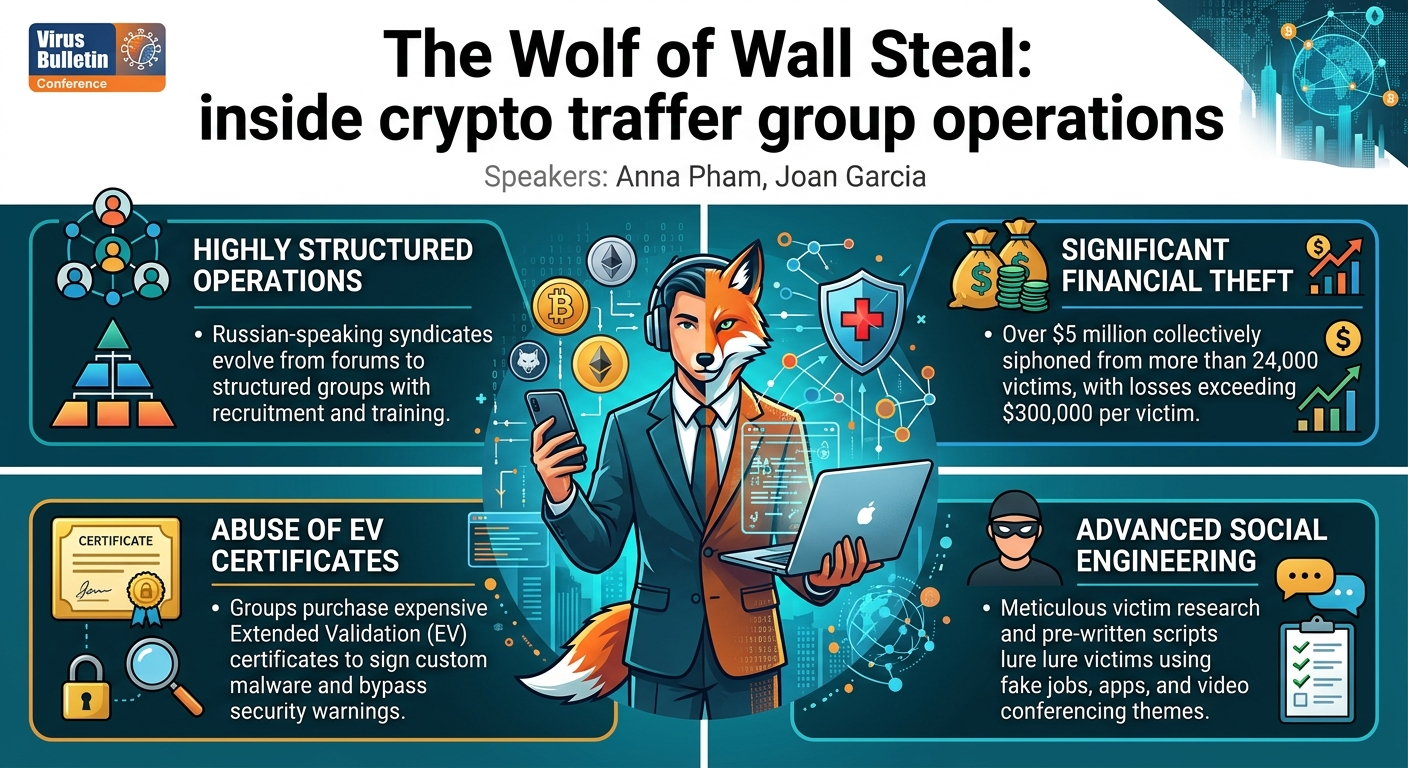
In "The Wolf of Wall Steal: Inside Crypto Trafficker Group Operations," Anna Pham and Joan Garcia expose the sophisticated tactics and organizational structures of Russian-speaking cybercrime groups specializing in cryptocurrency theft. This compelling presentation unveils the evolution of these "crypto traffickers" from individual forum users to highly organized syndicates with structured teams, recruitment processes, and advanced social engineering schemes. The talk provides an in-depth look at their operational methodologies, ranging from the use of custom malware and code-signing certificates to elaborate fake business registrations and targeted social engineering campaigns.
Key moments
- 1:30 Defining crypto traffickers and key terminology
- 6:30 CryptoLove's sophisticated organizational structure
- 9:15 Evasive promo codes and victim photo tactics
- 13:00 Bypassing security with EV certs; revocation impact
- 15:00 Technical deep dive into CryptoLove's launchers
- 20:15 How crypto workers find and target victims
- 25:40 Key takeaways and call for community awareness
The Wolf of Wall Steal: Inside Crypto Trafficker Group Operations
Speakers: Anna Pham, Senior Threat Hunter, Huntress; Joan Garcia, Universitat Politecnica de Valencia
Conference: Virus Bulletin
YouTube: https://www.youtube.com/watch?v=ayXu5wToRNc
Overview
In "The Wolf of Wall Steal: Inside Crypto Trafficker Group Operations," Anna Pham and Joan Garcia expose the sophisticated tactics and organizational structures of Russian-speaking cybercrime groups specializing in cryptocurrency theft. This compelling presentation unveils the evolution of these "crypto traffickers" from individual forum users to highly organized syndicates with structured teams, recruitment processes, and advanced social engineering schemes. The talk provides an in-depth look at their operational methodologies, ranging from the use of custom malware and code-signing certificates to elaborate fake business registrations and targeted social engineering campaigns.
Pham and Garcia delve into two prominent case studies, Crypto Love and WagMe, revealing how these groups collectively siphoned over $5 million from more than 24,000 victims between 2022 and 2025, with individual losses sometimes exceeding $300,000. The speakers meticulously detail the technical underpinnings of these operations, including their bespoke loaders, anti-analysis techniques, and multi-stage payload deliveries, alongside the intricate social engineering that underpins their success.
This research is critical for understanding the current landscape of cryptocurrency-related cybercrime, highlighting the significant threat posed by these groups not just to high-value crypto holders but also to everyday individuals seeking employment or engaging with web3 projects. The talk underscores the urgent need for enhanced awareness, robust security measures, and collaborative disruption efforts, demonstrating that proactive certificate revocation and public research can indeed have a measurable impact on these financially motivated adversaries.
Background
▶ Watch: Defining crypto traffickers and key terminology (1:30)
The phenomenon of crypto traffickers represents a significant evolution in cybercrime, particularly within the Russian-speaking underground. These groups are not merely opportunistic scammers but highly organized entities with a singular focus: stealing cryptocurrency and sensitive data through sophisticated social engineering. Their origins can be traced back to individual users on cybercrime forums, gradually coalescing into structured organizations that mimic legitimate businesses, complete with recruitment, training, and specialized roles.
A key aspect of understanding these groups is their unique lexicon. Terms like worker (the individual conducting social engineering and delivering payloads), mentor (who guides workers and distributes materials), mammoth (the victim), launcher (the malicious payload), whale (a victim with substantial crypto holdings), and landing page (the malicious website hosting the payload) are central to their operational communication. This specialized terminology reflects their internal structure and the systematization of their criminal activities.
The problem persists because these groups effectively leverage human vulnerabilities through advanced social engineering. They exploit trust, ambition, and a lack of technical awareness, employing themes like fake PDF readers, conferencing software, and gaming platforms to lure victims. Their recruitment advertisements, often professionally designed and posted on underground forums, promise significant profits, attracting individuals eager to participate in these illicit schemes. The talk highlights that these groups are not only targeting "hot wallets" (online crypto addresses) but also employing seed phrase phishing for "cold wallets" (offline storage like Ledger devices), demonstrating a comprehensive approach to crypto asset theft. This context sets the stage for a deeper examination of their operational mechanics and the challenges they pose to cybersecurity.
Key Findings
▶ Watch: Evasive promo codes and victim photo tactics (9:15)
The research presented by Anna Pham and Joan Garcia uncovered several critical findings regarding crypto trafficker group operations, primarily through the detailed analysis of two major entities: Crypto Love and WagMe.
Crypto Love, which ceased operations shortly after public research exposed them, generated over $2.5 million across seven affiliate teams. Their most profitable teams included Yellow Empire and Heaven Era 2.0, with a single largest theft exceeding $300,000, from which a worker reportedly took home $186,000. Crypto Love specialized in themes related to gaming platforms, PDF readers, and video conference software for their malicious landing pages. Their organizational structure was highly hierarchical, led by "Landlord Rock" as the primary infrastructure developer, supported by management layers (e.g., Routine Love, support leads) and specialized operations (e.g., Oscar, Cortio, Pink as the mentor for social engineering manuals). They operated with seven major affiliate teams, each with distinct landing pages and themes, meticulously designed with 3D animations and background sounds to appear legitimate. Victims of Crypto Love numbered over 22,000, primarily from countries like Nigeria, India, and the United States, although evidence also suggested targeting within Russian-speaking countries despite internal rules against it.
In contrast, WagMe operated on a slightly smaller scale but with similar tactics, generating $2.4 million from June 2023 to March 2025. Uniquely, WagMe was managed by a single individual, "Dan Walk," who often stole landing pages from other criminal groups or legitimate mobile games, indicating a lack of original development but effective execution. WagMe targeted around 2,000 victims, predominantly in the United States, focusing on crypto investors, crypto holders, and web3 job seekers. Their organizational structure was notably simpler, with Dan Walk managing operations and "Scarlettex" handling worker management.
A significant finding was the implementation of a promotional code system by Crypto Love. Initially, landing pages were openly accessible, but after security researchers began analyzing their launchers, they introduced unique codes generated by Telegram bots for each worker. These codes, required for victims to download payloads, served as a defensive mechanism, tracked infections, maintained victim databases, and facilitated payment splitting among workers. This system demonstrated their adaptability and efforts to evade detection and analysis.
Furthermore, the talk highlighted the groups' deep investment in appearing legitimate. Crypto Love, for instance, registered actual companies through the UK Company’s House, such as "Cosmo Wales," spending considerable time and money on legal paperwork and branding. This commitment to a façade of legitimacy underscores the advanced nature of their operations and their understanding of psychological manipulation. The collective impact of these groups is staggering, with over $5 million stolen from more than 24,000 victims, illustrating the severe financial and personal consequences of their sophisticated campaigns.
Technical Deep Dive
▶ Watch: Bypassing security with EV certs; revocation impact (13:00)
The operational sophistication of crypto trafficker groups like Crypto Love and WagMe extends across multiple technical and social engineering domains, from their infrastructure and malware to their victim targeting and evasion techniques.
Infrastructure and Evasion Mechanisms
Initially, crypto traffickers allowed open access to their malicious landing pages. However, in response to security researchers' analysis and revocation of certificates, they evolved. Crypto Love implemented a promotional code system (09:00), where unique codes were generated via Telegram bots for each worker to distribute to victims. This system served multiple purposes: hindering security research, tracking infections to specific worker teams, maintaining a victim database, and facilitating payment distribution. The underlying infrastructure, as revealed by researcher Vangelis Stikas, was a simple server with PHP files managing code generation and storing these codes in a database, linking victims to workers for profit sharing (10:00).
To further enhance their deceptive posture, these groups engaged in fake business registrations. Crypto Love registered actual companies, such as "Cosmo Wales," through legitimate channels like the UK Company's House (12:00). This tactic, involving legal paperwork and professional branding, was designed to lend an air of legitimacy to their operations, making their social engineering attempts more convincing.
Abusing Code-Signing Certificates
A critical technical aspect of their operations is the abuse of Extended Validation (EV) certificates. Criminals purchase these certificates from underground services for prices ranging from $3,000 to $10,000 (13:00). When a malicious launcher is signed with an EV certificate, Windows presents it as a safe application, bypassing SmartScreen warnings that would typically flag unsigned or untrusted executables. This significantly lowers the victim's guard, as they see a "clean file" rather than a stark red warning.
The speakers detailed their ongoing efforts to combat this by reporting and revoking these certificates. For instance, the WagMe group repeatedly switched certificates, moving from a Vietnamese cosmetics company to an Indian real estate company, then another Vietnamese company, and finally an Indian charity company, each time having their certificates revoked (14:00). While this is a continuous battle, each revocation disrupts operations, costs threat actors significant money (due to limited stock and high prices), and temporarily protects potential victims during the scramble for new certificates. This active disruption demonstrates a measurable impact on their operations.
Malware Analysis: Crypto Love Launchers
Crypto Love's malware development showcased an evolution in sophistication. Early launchers were .NET self-contained loaders, initially unoffuscated but later protected with Net Reactor for obfuscation (15:00). These loaders performed extensive information gathering, including host details, country based on IP, and specific crypto wallet browser extension IDs, indicating a targeted approach to identify crypto holders.
Crucially, the malware incorporated robust anti-analysis and evasion capabilities. These included:
- Binary checks: Detecting execution in sandboxes or emulated environments using methods like
check emulation. - System resource checks: Exiting if available memory was less than 4 GB.
- Directory checks: Terminating if running from root or temporary folders.
- Filename checks: Exiting if the executable name (without extension) was more than 11 characters long.
- Username/Machine name matching: Checking against hard-coded values in the binary array (16:00).
- VM and cloud detection: Scanning for manufacturers like QEMU, VirtualBox, VMware, and cloud environments such as AWS, Azure, and Google Cloud, exiting if any were detected (16:00).
If these checks passed, confirming execution on a bare-metal victim machine, the launcher would add exclusions for Windows Defender for the C: drive before proceeding to multi-stage payload delivery.
The C2 infrastructure was segmented, with three separate C2 servers: one for hosting payloads, another for receiving telemetry, and a third for error reporting (17:00). The payload delivery mechanism was designed for resilience: three different stealers (Luma Stealer, Mantis, or Stealc) were deployed sequentially, with delays of 15 seconds between the first and second, and 20 seconds between the second and third. If any stealer failed, the next one would be deployed, maximizing the chance of successful compromise. Granular error codes (10-18) provided threat actors with detailed insights into what was blocking their launches in different environments.
In November 2024, Crypto Love further evolved their launchers, integrating Devil.NET, an IDE for PHP. This version required the victim to input a code into the launcher, which was then sent to the backend. A correct code would trigger a JSON response containing the Telegram worker's username and deliver a DLL payload. This DLL was typically a PE loader sample from an open-source project, leveraging process hollowing injection to inject either Luma Stealer or Stealc from hard-coded C2 URLs (18:00).
Most recently, in November 2024, they introduced Morpham Loader (19:00). This loader employs reflective loading to dynamically allocate, load, and execute the final payload in the current process. It utilizes the ASMG library (a lightweight C++ library for low-latency code generation) to facilitate memory allocation. API obfuscation was achieved with simple XOR operations, but the binary was heavily padded with garbage code, making analysis significantly more challenging. At the time of the talk, Morpham Loader still had zero detections on VirusTotal, highlighting its stealth and the difficulty in detecting its sophisticated obfuscation.
Worker Operations and Social Engineering
The success of these groups heavily relies on their workers, who undergo a structured recruitment process. Applicants must submit forms via Telegram bots, detailing their experience and social media accounts. Once accepted into an affiliate team, workers familiarize themselves with the assigned "project," studying social media platforms, documentation, and websites to answer victim questions convincingly (20:00). They then purchase compromised social media accounts (Twitter, Instagram, Discord, Gmail) from underground services to initiate contact.
Workers employ multiple strategies to identify potential victims (21:00):
- DAP Radar: A platform for web3 users to find active crypto projects. Workers identify social media links (Discord, Telegram, Twitter) embedded in these projects.
- Discord: They target users with Nitro subscriptions or those who list wallet information in their bios.
- Zapper.xyz and Arkham Intel Platform: Portfolio explorers and blockchain analytics platforms used to look up wallet balances and transaction histories. Arkham Intel's visualization feature helps identify accounts with multiple tied wallets or over 50 transactions, indicating high-value targets.
- Twitter: Searching for "ETH handles" and wallet addresses to identify potential targets.
- TG Stat: Used for Telegram to find high-value crypto channels, often populated by Chinese users.
Fraudulent recruitment posts on platforms like Freelancer and Upwork are a common lure, tricking job seekers into downloading malicious payloads (22:00). Workers conduct extensive victim research, pulling up all available social media accounts to understand a person's activities, such as conferences attended or recent meals.
A prime example of successful social engineering involved a victim who attended Devcon (23:00). The worker initiated contact, feigning a previous conversation at the booth, then hooked the victim with a job opportunity. To proceed, the victim was asked to sign a non-disclosure agreement (NDA), leading them to download a malicious "fake PDF reader" launcher. Workers are equipped with pre-written, often AI-generated, canned responses for common questions and scenarios, allowing them to maintain consistent and believable dialogues, much like legitimate recruiters (24:00).
Demo / Proof of Concept
▶ Watch: How crypto workers find and target victims (20:15)
While the presentation did not feature a live, interactive demonstration of the malware or attack chain, the speakers provided compelling visual evidence and detailed explanations that served as a robust proof-of-concept for their findings. This included:
- Examples of Infostealer Logs: The presentation showed a screenshot of a log generated by an infostealer, detailing machine information and, critically, hot wallet crypto addresses. This visually demonstrated the type of sensitive data these groups collect from victims (03:00).
- Seed Fishing Examples: An image of a seed fishing page for cold wallets from Ledger was displayed, illustrating how these groups target even secure offline crypto storage, highlighting the breadth of their attack vectors (04:00).
- Recruitment Advertisements: Screenshots of professionally designed recruitment posters from WME team and Crypto Love on underground forums were shown, underscoring the sophisticated marketing and recruitment tactics employed by these groups (04:00).
- Organizational Structure Diagrams: Detailed diagrams illustrating the hierarchical structures of Crypto Love, including landlord, management, specialized operations, and affiliate teams, provided a clear visual representation of their complex organization (06:00). A simpler structure for WagMe was also presented (12:00).
- Landing Page Examples: The talk described the elaborate design of fake gaming metaverse platforms and meeting software landing pages, noting their 3D animations and background sounds, designed to appear highly legitimate (08:00).
- Promotional Code Database: A screenshot of a database table used to store and relate generated promotional codes to specific workers and victims was shown, illustrating the backend mechanism for tracking infections and splitting profits (10:00).
- Fake Business Registrations: Evidence of Crypto Love registering actual companies through the UK Company's House, such as "Cosmo Wales," was discussed, showcasing their commitment to a legitimate façade (12:00).
- Malware Execution Flow Diagrams: A diagram illustrating the execution flow of the Crypto Love launcher, from VM/cloud detection through information gathering, Defender exclusions, and multi-stage payload delivery with C2 infrastructure, provided a clear technical overview of the malware's operation (16:00).
- Worker Manuals and Social Engineering Scripts: Examples of pre-written responses and questions, some AI-generated, from Crypto Love's Telegram channels were displayed. These illustrated the standardized and sophisticated nature of their social engineering tactics, used by workers to engage with victims (24:00).
These visual and descriptive elements served to concretely illustrate the intricate operations, technical capabilities, and deceptive practices of crypto trafficker groups, effectively demonstrating the findings of the research without requiring a live, potentially risky, malware execution.
Defensive Implications
▶ Watch: Key takeaways and call for community awareness (25:40)
The detailed insights into crypto trafficker group operations provide several critical defensive implications for individuals, organizations, and the cybersecurity community at large.
First and foremost, the presentation strongly advocates for proactive certificate revocation campaigns. The speakers demonstrated that repeatedly reporting and revoking abused EV certificates significantly disrupts threat actor operations, forcing them to spend considerable time and money to acquire new ones. While not a permanent solution, this strategy creates operational gaps and protects potential victims during these periods of disruption (14:00). Cybersecurity vendors and certificate authorities must collaborate more effectively to identify and revoke such certificates promptly.
Secondly, public research and disclosure play a vital role in disrupting these groups. The cessation of Crypto Love's operations shortly after public exposure underscores the impact of shedding light on their activities (04:00, 25:00). Sharing intelligence about their tactics, infrastructure, and malware can force them to adapt or shut down, thus raising the cost of their operations.
Third, the pervasive use of sophisticated social engineering highlights that technology alone is insufficient for defense. Even with advanced security solutions, human vulnerabilities remain the primary attack vector. Therefore, widespread awareness campaigns are crucial, especially within the crypto and web3 communities (26:00). Users need to be educated about the deceptive tactics employed, such as fake job postings, malicious PDF readers, and "interview" scenarios. They should be suspicious of unsolicited offers, verify identities, and critically evaluate requests to download software, even if it appears to come from a legitimate source or is code-signed. Taping over webcams when not in use is a simple but effective measure against potential picture-taking malware (10:00).
Organizations should implement multi-layered security defenses that go beyond basic antivirus. This includes robust email and communication channel security, endpoint detection and response (EDR) solutions capable of detecting process hollowing and reflective loading, and network traffic analysis to identify suspicious C2 communications. Regular security awareness training, incorporating real-world examples from these crypto trafficker groups, is essential for employees, particularly those handling cryptocurrency or working in web3 roles.
Finally, the use of anti-analysis techniques by the malware (VM/cloud detection, system checks) implies that security researchers and incident responders must employ advanced analysis environments that can evade these checks to fully understand and counter the threats. Collaborative intelligence sharing among threat intelligence teams, law enforcement, and private sector security researchers is paramount to track these evolving groups and their infrastructure. The fight against crypto traffickers requires a holistic approach combining technical countermeasures, active disruption, and human education.
Key Takeaways
- Organized Cybercrime: Crypto traffickers are highly structured, Russian-speaking cybercrime groups that have evolved from individual scammers into sophisticated organizations with defined roles, recruitment, and advanced social engineering tactics.
- Significant Financial Impact: Groups like Crypto Love and WagMe have collectively stolen over $5 million from more than 24,000 victims, with individual losses sometimes exceeding $300,000 in a single attack.
- Abuse of EV Certificates: Threat actors leverage expensive, legitimate Extended Validation (EV) certificates to bypass security warnings, making their malicious payloads appear safe to victims. Proactive revocation campaigns significantly disrupt their operations.
- Sophisticated Malware and Evasion: Their custom loaders (e.g., Morpham Loader) employ advanced techniques like reflective loading, API obfuscation, and extensive anti-analysis checks (VM/cloud detection, system resource checks) to evade detection and analysis.
- Advanced Social Engineering: Success hinges on meticulous victim research (using tools like DAP Radar, Arkham Intel), fake business registrations, and pre-written, often AI-generated, social engineering scripts for scenarios like fake job interviews and NDA signings.
- Beyond Technology: Effective defense requires more than just technological solutions; widespread community awareness, education on social engineering tactics, and collaborative public research are crucial to mitigate this evolving threat.
About the Speaker(s)
Anna Pham, also known as "Russian Panda" on social media, is a Senior Threat Hunter at Huntress. With over five years of experience in cybersecurity, primarily in the MSSP field, she has actively contributed to threat labs and DFR reports. Her expertise spans threat intelligence, malware reversing, and threat hunting, with a particular obsession for tracking adversary infrastructure, disrupting operations, and reversing malware. She has previously worked at Unit 42 and Toyota.
Joan Garcia is a student from the Universitat Politecnica de Valencia. He is passionate about sharing his findings and collaborating with other researchers. Joan is a self-proclaimed fanatic about everything related to infostealers, making him a fitting co-speaker for a talk on crypto traffickers.
Reviews
Dr. Zero (Offensive Security Researcher) — STRONG ACCEPT
Solid threat intel work that maps the operational structure, TTPs, and economics of Russian-speaking crypto trafficker groups with real numbers and real names. Not novel exploitation research, but exactly the kind of adversary tradecraft documentation that makes defenders smarter. The certificate revocation campaign showing measurable disruption is the highlight.
Heather Calloway (CISO) — STRONG ACCEPT
Solid operational intelligence on organized crypto theft groups, with actionable disruption tactics and clear victim profiles. Worth your security awareness team's time, and worth a conversation with your CFO if you have crypto-exposed employees or treasury operations.
→ Top-rated talks at Virus Bulletin Conference 2025 (VB2025)