No payload for you: inside Sidewinder's selective exploitation strategy
Eliad Kimhy (Security Researcher · Acronis), Santiago Pontiroli (Acronis)
Virus Bulletin Conference 2025 (VB2025) · Day 2 · Green room
Overview
This talk, presented by Eliad Kimhy and Santiago Pontiroli from Acronis, delves into the evolving tactics of the Sidewinder advanced persistent threat (APT) group. Often characterized as less technically sophisticated due to their reliance on older vulnerabilities and readily available tools, Sidewinder distinguishes itself through unparalleled persistence and exceptional social engineering capabilities. The researchers highlight how this group effectively leverages deep understanding of regional geopolitics and target profiles to achieve its objectives, primarily focusing on long-term strategic access rather than immediate data exfiltration.
Key moments
- 0:00 Sidewinder: Persistent, socially engineered, not technically sophisticated
- 4:00 Sidewinder's evolution: Server-side polymorphism and geo-fencing
- 6:00 Targeting strategy: Geopolitical understanding for high-level targets
- 7:40 Example: Highly specific military pentathlon phishing email
- 10:00 Technical details: Exploiting old Office OLE vulnerabilities
- 11:40 Evading analysis: Server-side polymorphism and geo-fencing mechanics
- 14:00 Final payload: Stealerbot installer and information theft
- 17:40 Key takeaways: Victim ecosystem, education, and defense
No payload for you: inside Sidewinder's selective exploitation strategy
Speakers: Eliad Kimhy (Security Researcher, Acronis); Santiago Pontiroli (Acronis)
Conference: Virus Bulletin
YouTube: https://www.youtube.com/watch?v=7aG1r94-1Is
Overview
This talk, presented by Eliad Kimhy and Santiago Pontiroli from Acronis, delves into the evolving tactics of the Sidewinder advanced persistent threat (APT) group. Often characterized as less technically sophisticated due to their reliance on older vulnerabilities and readily available tools, Sidewinder distinguishes itself through unparalleled persistence and exceptional social engineering capabilities. The researchers highlight how this group effectively leverages deep understanding of regional geopolitics and target profiles to achieve its objectives, primarily focusing on long-term strategic access rather than immediate data exfiltration.
The core of Sidewinder's strategy lies in its selective exploitation model, which has seen a significant shift from broader, repetitive attacks to highly targeted spear-phishing campaigns. While the technical attack chain may utilize vulnerabilities that are almost a decade old, the initial compromise is meticulously crafted through sophisticated social engineering. This approach allows Sidewinder to maintain a low profile, evade detection, and secure a persistent foothold within high-value government and military organizations across South and Southeast Asia.
The presentation sheds light on Sidewinder's journey from a "low-effort" group to a highly effective threat actor, emphasizing that technical prowess is not the sole determinant of success in the cyber threat landscape. Their ability to adapt, personalize attacks, and employ server-side polymorphism and geo-fencing techniques demonstrates a strategic evolution aimed at maximizing impact while minimizing exposure. Understanding Sidewinder's methodology offers critical insights for defenders, underscoring the importance of comprehensive security strategies that encompass both advanced technical controls and robust human-centric defenses.
Background
▶ Watch: Sidewinder: Persistent, socially engineered, not technically sophisticated (0:00)
The Sidewinder APT group, also known by other monikers such as T-APT-04 and Hardcore Nationalist, first emerged around 2012, with early reports attributing attacks to them targeting the Pakistani military. Initially, the group was considered relatively unsophisticated, often described as a "low-effort" actor due to its consistent use of well-known, older vulnerabilities and a "copy-paste and attack" methodology. For years, their operational tempo involved repeating the same attack patterns without significant changes, primarily focusing on countries in South and Southeast Asia, including India, Pakistan, Sri Lanka, and Bangladesh. Their targets consistently included high-value entities such as ministries of defense, finance, and various military divisions.
Over time, Sidewinder's strategy underwent a notable evolution. While their technical foundation remained rooted in older exploits, their pre-exploitation and post-exploitation tactics became increasingly refined. Around 2018, attribution efforts by organizations like Kaspersky began to formally fingerprint the group, tracing their activities back to their reported inception. By 2020, while still relying on repetition, they started to iterate and improve their operational security. A significant shift observed around 2023 was the introduction of server-side polymorphism and geo-fencing, capabilities that allowed them to generate unique payloads for each victim and restrict access to their command-and-control (C2) infrastructure based on geographical location.
The most recent phase, extending into 2024 and 2025, sees Sidewinder heavily investing in highly targeted spear-phishing campaigns. This transition reflects their deep understanding of regional geopolitics and the specific interests of their targets. The problem Sidewinder exploits is not a lack of technical defenses in their targets, but rather a perceived gap in security awareness and employee education, particularly concerning highly specialized social engineering lures. This allows them to bypass initial defenses with relatively unsophophisticated malware, focusing their efforts on persistent access rather than developing zero-day exploits. The speakers emphasize that Sidewinder's success stems from this strategic adaptation: when the "ecosystem" (i.e., the victims' defenses and education) doesn't evolve, threat actors don't need to either, allowing them to perfect other aspects of their attack chain like social engineering and persistence.
Key Findings
▶ Watch: Targeting strategy: Geopolitical understanding for high-level targets (6:00)
The research presented by Kimhy and Pontiroli uncovers several critical insights into Sidewinder's operational methodology and strategic evolution. Foremost among these is the group's paradoxical nature: despite being consistently classified as technically unsophisticated dueor their reliance on decade-old vulnerabilities and off-the-shelf tools (eschewing zero-days), they are remarkably effective due to their persistence and mastery of social engineering. This highlights a crucial disconnect between perceived technical complexity and actual threat efficacy.
A key finding is Sidewinder's strategic pivot towards highly targeted spear-phishing. They no longer rely on broad, less specific campaigns but meticulously craft lures based on an intricate understanding of their victims' roles, interests, and regional geopolitical contexts. This personalization significantly increases the likelihood of initial compromise, even against high-value targets in military and government sectors. The goal of these initial infections is not immediate financial gain or data theft, but rather long-term strategic access and intelligence gathering, indicating a patient, calculated approach to cyber espionage.
Technically, the speakers identified Sidewinder's adoption of server-side polymorphism and geo-fencing in their C2 infrastructure. This sophisticated C2 behavior allows them to generate unique malware payloads for each victim, effectively changing the hash of the delivered malware and complicating detection by signature-based antivirus solutions and automated analysis tools like VirusTotal. Geo-fencing further restricts access to the C2 server to specific target regions and user agents, making it significantly harder for security researchers outside these regions to acquire samples or analyze the full attack chain.
The research also details the specific, outdated vulnerabilities still being exploited by Sidewinder, notably an Office OLE object embedding vulnerability and the infamous CVE-2017-11882, a stack overflow in Microsoft Office's Equation Editor. The continued effectiveness of these known flaws underscores a persistent challenge in enterprise security: the patching gap. Finally, the analysis revealed a simplified kill chain in recent Sidewinder operations compared to what had been previously reported by other security vendors, suggesting a deliberate effort to reduce their footprint and increase efficiency by stripping down unnecessary complexities that might increase their chances of detection.
Technical Deep Dive
▶ Watch: Technical details: Exploiting old Office OLE vulnerabilities (10:00)
Sidewinder's attack chain, while relying on aged vulnerabilities, is meticulously orchestrated, beginning with highly personalized social engineering and culminating in the deployment of a custom information stealer. The process unfolds in several distinct stages, each designed to minimize suspicion and maximize the chances of persistent access.
The initial vector is consistently a spear-phishing email containing an malicious attachment. These emails are not generic but are crafted with an exceptional understanding of the target's role and the regional geopolitical landscape. Examples shown include lures related to national security, military exercises, internal memos, and foreign affairs briefings. One specific example detailed an email sent to a Sri Lankan military official, purportedly from a high-ranking military figure, inviting volunteers for a "Pentathlon" event involving the Chinese People's Liberation Army. This event was real, demonstrating Sidewinder's ability to integrate genuine events into their deceptive campaigns. The attached documents are often forged official documents, designed to look nearly identical to legitimate ones, with only minor alterations, further reducing target suspicion.
Upon opening the attachment, the exploitation chain begins. Sidewinder leverages a known Microsoft Office OLE object embedding vulnerability. This old flaw allows an embedded OLE object to trigger the download and execution of an RTF file. This RTF file, in turn, exploits another well-known vulnerability: CVE-2017-11882. This stack overflow in Microsoft Office's Equation Editor (released in 2017) executes a shellcode payload. The speakers noted its continued prevalence, highlighting its enduring utility for threat actors.
A critical component of Sidewinder's operational security is its server-side polymorphism and geo-fencing during the delivery of the second-stage payload. When the victim's machine attempts to fetch the next stage from the C2 server, the C2 performs several checks:
- Victim Identification: The C2 server tracks each attack and victim with a unique ID.
- Geo-fencing: It filters requests based on the source IP address, ensuring that only requests originating from target countries (e.g., India, Pakistan, Sri Lanka, Bangladesh) receive a payload.
- User-Agent Filtering: The C2 also inspects HTTP headers, specifically the User-Agent string. It expects an Office-like user agent, indicating that the request is coming from a compromised Office application.
If these criteria are not met, the C2 server responds with an HTTP error or an empty RTF file, effectively preventing security researchers and automated analysis tools outside the target region from obtaining live samples. If the checks pass, the C2 dynamically generates a unique payload for that specific victim, ensuring that each delivered malware sample has a different hash, further complicating signature-based detection.
The executed shellcode contains basic anti-analysis techniques. It includes encrypted stack strings and performs anti-sandbox checks, such as verifying the RAM size of the infected machine and checking for the presence of the donerlocal32.dll (a common indicator of a sandbox environment). After these checks, the shellcode decrypts its next-stage payload using a simple XOR encryption with a single-byte key.
The decrypted payload consists of a custom P-loader and an embedded DLL file. The P-loader's role is to inject the final payload. It achieves this by allocating memory within the legitimate explorer.exe process and then using CreateRemoteThread to execute the embedded DLL. This technique, known as process injection, allows the malware to run within a trusted process, making it harder to detect.
The injected DLL is identified as the Stealerbot installer. This DLL has an export function named "icecream" and incorporates its own anti-analysis measure: it checks the Process Environment Block (PEB) for the BeingDebugged flag, which indicates if a debugger is attached to the process. If a debugger is detected, the installer may alter its behavior or terminate. If no debugger is present, the installer proceeds to gather basic system information, including the username, machine name, and memory details. Each piece of information is curiously separated by the word "differentation" before being Base64 encoded and sent back to the C2 server.
In response, the C2 provides a configuration for the installer, detailing how to deploy the final Stealerbot payload. This configuration typically includes:
- A legitimate executable vulnerable to DLL side-loading. This is a common technique where a legitimate application loads a malicious DLL (with the same name as a legitimate but missing DLL) from its execution directory.
- Another P-loader/decryptor DLL. This DLL is the malicious component that will be side-loaded.
- Encrypted binary data containing the final Stealerbot malware.
- Installation parameters, such as the protocol (observed as HTTP) and the installation path.
The final Stealerbot malware is an information stealer, known for its modular design that can include capabilities for remote control, remote access, and comprehensive credential stealing. The speakers noted that the observed kill chain was simpler than what was reported in previous analyses (e.g., a Kaspersky report from the previous year), suggesting Sidewinder's continuous efforts to streamline their operations for reduced footprint and increased effectiveness.
Demo / Proof of Concept
▶ Watch: Evading analysis: Server-side polymorphism and geo-fencing mechanics (11:40)
While the talk did not feature a live, step-by-step demonstration of the exploitation or a functional proof-of-concept during the presentation, the speakers provided extensive evidence and detailed analysis of Sidewinder's tactics. This included visual examples of the sophisticated spear-phishing emails and forged documents used in their campaigns, highlighting the near-identical replication of official templates. They also walked through the technical intricacies of the attack chain, from the initial OLE vulnerability and CVE-2017-11882 exploitation to the C2's geo-fencing and polymorphism mechanisms, and the subsequent deployment of the Stealerbot installer. The detailed technical deep dive, including descriptions of anti-analysis techniques and the DLL side-loading process, served as a comprehensive exposition of Sidewinder's capabilities rather than a live demonstration.
Defensive Implications
▶ Watch: Key takeaways: Victim ecosystem, education, and defense (17:40)
The insights into Sidewinder's selective exploitation strategy offer crucial defensive implications for organizations, particularly those in high-value sectors like government, military, and critical infrastructure. The primary takeaway is that technical sophistication alone is not a prerequisite for effective cyber espionage; rather, social engineering mastery and persistence can be equally, if not more, potent.
1. Enhanced Employee Education and Awareness: This is paramount. Generic phishing training is insufficient. Organizations must implement tailored security awareness programs that educate employees, especially those in targeted roles, about highly specific and contextually relevant spear-phishing lures. Training should cover how to identify forged documents, scrutinize email sender details, and be wary of requests related to sensitive geopolitical or organizational events, even if they appear plausible. The focus should shift from identifying obvious scams to recognizing subtle manipulations of trust and authority.
2. Robust Patch Management: Sidewinder's continued reliance on decade-old vulnerabilities like the Office OLE object embedding flaw and CVE-2017-11882 (Equation Editor stack overflow) underscores the critical importance of a rigorous patch management program. All systems, especially those handling sensitive information, must be kept up-to-date with the latest security patches to mitigate known exploitation vectors. Legacy systems or applications that cannot be updated should be isolated or decommissioned.
3. Advanced Endpoint Detection and Response (EDR): While initial compromise relies on social engineering, the post-exploitation phase involves recognizable technical indicators. EDR solutions are essential to detect behaviors such as:
- Process injection (e.g.,
CreateRemoteThreadintoexplorer.exe). - DLL side-loading attempts.
- Anti-analysis checks (e.g.,
BeingDebuggedflag, RAM size checks). - Unusual outbound network connections (even over plain HTTP) from legitimate processes.
- Information gathering activities by the Stealerbot installer.
4. Network Traffic Analysis and C2 Detection: Despite the use of HTTP for C2 communication, network monitoring can still identify suspicious patterns. Defenders should look for:
- Connections to known malicious IPs or domains (though Sidewinder's C2 infrastructure might be dynamic).
- Unusual HTTP User-Agent strings or requests that deviate from typical user behavior.
- Outbound connections to unexpected geographical regions, which might indicate a geo-fencing bypass attempt or a compromised internal machine.
- Encrypted (Base64) data exfiltration patterns.
5. Threat Intelligence and Attribution: Understanding Sidewinder's TTPs (Tactics, Techniques, and Procedures), including their target regions and preferred lures, allows organizations to proactively strengthen defenses. Awareness of their server-side polymorphism and geo-fencing strategies can help security researchers develop more effective methods for acquiring and analyzing samples, leading to better detection signatures.
6. Defense-in-Depth: A layered security approach remains critical. This includes strong email security gateways to filter malicious attachments, application whitelisting to prevent unauthorized code execution, and network segmentation to limit lateral movement if a compromise occurs. Given Sidewinder's persistence, organizations must assume that initial defenses might fail and focus on detecting and responding to post-exploitation activities swiftly.
In essence, defending against Sidewinder requires a dual approach: fortifying the human element against sophisticated social engineering and deploying robust technical controls to detect and respond to the inevitable technical stages of their attacks, even if those stages rely on older, less "glamorous" vulnerabilities.
Key Takeaways
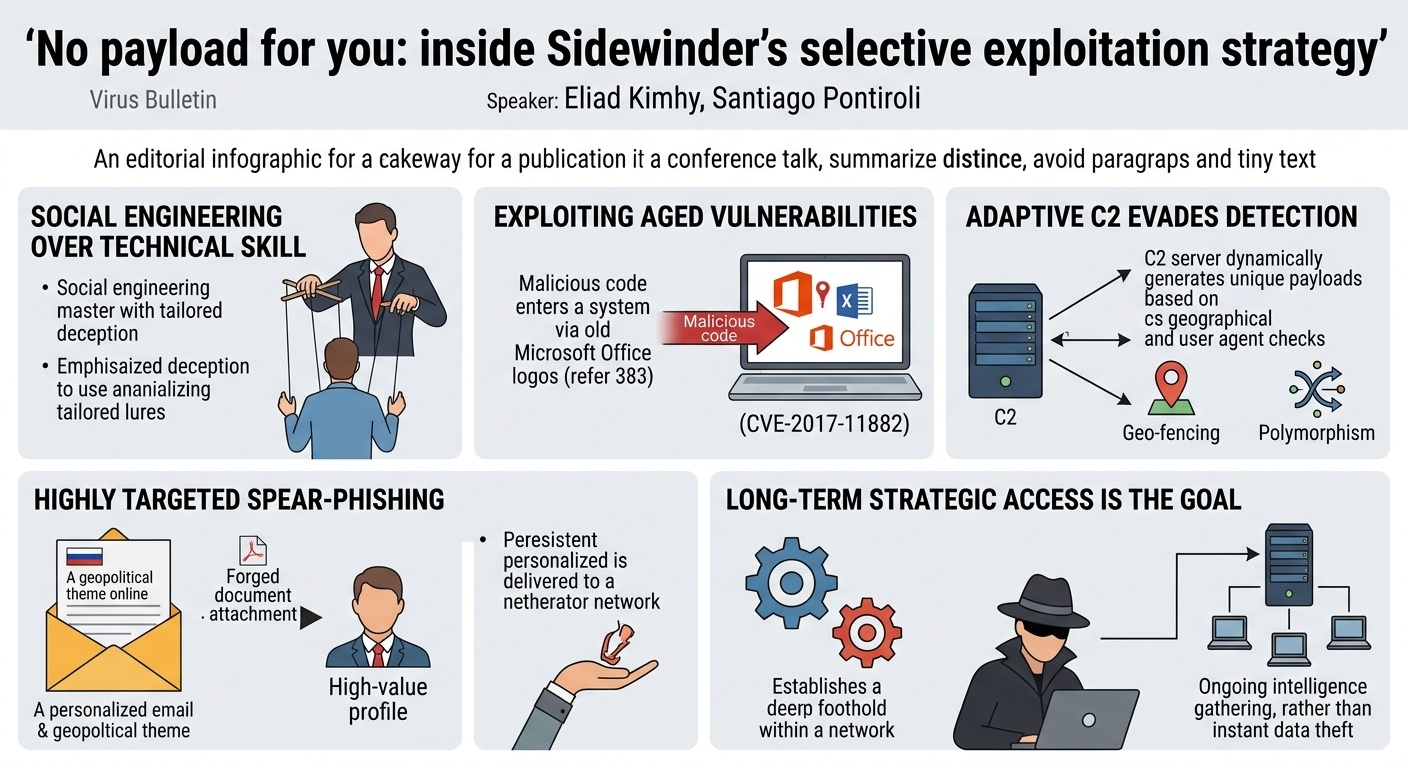
- Social Engineering Trumps Technical Sophistication: Sidewinder proves that deep understanding of targets and excellent social engineering, combined with persistence, can be more effective than relying on zero-day exploits or advanced malware.
- Old Vulnerabilities Remain Potent: Decade-old flaws like the Office OLE vulnerability and CVE-2017-11882 are still actively and successfully exploited, highlighting the critical need for comprehensive and timely patch management.
- Adaptive C2 Evades Detection: Sidewinder's use of server-side polymorphism (unique payloads per victim) and geo-fencing (restricting C2 access by IP and User-Agent) significantly complicates malware analysis and signature-based detection.
- Targeted Education is Crucial: Generic security awareness training is insufficient. High-value organizations must provide tailored education on highly specific, contextually relevant spear-phishing lures that leverage geopolitical knowledge and internal organizational themes.
- Long-Term Access is the Goal: Sidewinder's objective is not a quick smash-and-grab but establishing long-term strategic access for intelligence gathering, requiring defenders to focus on detecting persistent footholds and subtle indicators of compromise.
- Persistence Demands Persistent Defense: Sidewinder's relentless pursuit of targets means that organizations must maintain continuous vigilance, assuming that a failed attack attempt will likely be followed by others.
About the Speaker(s)
Eliad Kimhy is a Security Researcher at Acronis. His work involves in-depth analysis of cyber threats and attack methodologies, contributing to the understanding and defense against sophisticated threat actors like Sidewinder.
Santiago Pontiroli is also a Security Researcher at Acronis. His expertise lies in malware analysis and understanding the technical underpinnings of cyber attacks, as demonstrated by his detailed breakdown of Sidewinder's exploitation chain and C2 mechanisms. Together, they bring a comprehensive view of both the social engineering and technical aspects of modern cyber threats.
Reviews
Dr. Zero (Offensive Security Researcher) — SOLID
Competent Sidewinder overview that delivers solid TTPs and a clear technical walkthrough, but nothing here will surprise anyone who's tracked this group since Kaspersky's 2018 reports. The geo-fencing/polymorphism angle is the freshest bit, and even that's incremental.
Heather Calloway (CISO) — SOLID
Competent APT analysis with a useful reminder that patching discipline and employee education still matter more than chasing novel threats. Worth the time for teams with South/Southeast Asia exposure; limited strategic novelty for everyone else.
→ Top-rated talks at Virus Bulletin Conference 2025 (VB2025)