Towards a Vulnerability Reporting Specification
Matinska, Mikuel Barau (Head of Security · Eclipse Foundation)
CVE/FIRST VulnCon 2025 · Main Stage
Overview
In an era of escalating cybersecurity regulations, the talk "Towards a Vulnerability Reporting Specification" at VulnCon addressed a critical need for open-source software projects. Presented by Matinska and Mikuel Barau from the Eclipse Foundation, this session introduced a concerted effort to develop a concise, actionable, and open-source-friendly specification for vulnerability management. The initiative is primarily driven by the impending European Cyber Resilience Act (CRA) and aims to provide clear guidance for open-source maintainers, often operating with limited resources, to achieve compliance.
Key moments
- 0:00 Introduction and Eclipse Foundation's security focus
- 2:00 Purpose of Open Regulatory Compliance (ORC) Working Group
- 3:00 ORC's diverse membership, including other open source foundations
- 4:00 Cyber Resilience Act's requirements for vulnerability management
- 6:00 Why existing vulnerability reporting standards are insufficient
- 8:00 Five main goals for the new specification
Towards a Vulnerability Reporting Specification
Speakers: Matinska, Mikuel Barau, Head of Security, Eclipse Foundation
Conference: VulnCon
YouTube: https://www.youtube.com/watch?v=JvmT6EiwUCM
Overview
In an era of escalating cybersecurity regulations, the talk "Towards a Vulnerability Reporting Specification" at VulnCon addressed a critical need for open-source software projects. Presented by Matinska and Mikuel Barau from the Eclipse Foundation, this session introduced a concerted effort to develop a concise, actionable, and open-source-friendly specification for vulnerability management. The initiative is primarily driven by the impending European Cyber Resilience Act (CRA) and aims to provide clear guidance for open-source maintainers, often operating with limited resources, to achieve compliance.
The Eclipse Foundation, a prominent open-source software foundation, recognized the growing regulatory pressure on software producers, particularly after major security incidents like Log4Shell. To address this, they established the Open Regulatory Compliance (OC) working group. This talk detailed the group's initial focus on vulnerability management, outlining their methodology for distilling best practices into a lean, prescriptive document that bridges the gap between broad regulatory requirements and the practical realities of open-source development.
The significance of this work extends beyond mere compliance. By fostering a community consensus on fundamental vulnerability management practices, the specification aims to elevate the overall security posture of open-source ecosystems. Furthermore, the working group intends for this specification to serve as direct input to European regulators and standard organizations, potentially shaping official guidance and harmonized standards for CRA compliance. This proactive, community-driven approach is crucial for ensuring that future regulations are both effective and pragmatic for the open-source world.
Background
▶ Watch: Introduction and Eclipse Foundation's security focus (0:00)
The Eclipse Foundation has a long history of stewarding diverse open-source projects, from its foundational Eclipse IDE to modern cloud-native, IoT, and software-defined vehicle initiatives. While traditionally providing governance, IP management, and infrastructure, the past three years have seen a significant investment in security services and tools for its projects. This increased focus was a direct response to major security events and the looming threat of new global regulations, most notably the European Union's Cyber Resilience Act (CRA).
To navigate this complex regulatory landscape, the Eclipse Foundation spearheaded the creation of the Open Regulatory Compliance (OC) working group. This working group serves as a neutral forum, bringing together key stakeholders from across the industry, including large software manufacturers from both Europe and the US, as well as a remarkable coalition of other major open-source foundations such as Apache, FreeBSD, Python, Rust, and PHP. The OC working group's primary objective is to elaborate specifications that help open-source communities comply with forthcoming regulations, acting as an interface between open-source projects and regulators, particularly in Europe.
The CRA, as highlighted in the talk, places significant emphasis on vulnerability management. Specifically, Annex 2 Part 2 mandates that information about fixed vulnerabilities must be released, a policy of Coordinated Vulnerability Disclosure (CVD) must be in place, and parties must communicate, for example, by reporting vulnerabilities upstream. Recital 76 further reinforces the need for a structured process, machine-readable security policies where possible, and encourages programs like bug bounties. These requirements, while not entirely new to experienced vulnerability managers, underscore the need for a standardized approach.
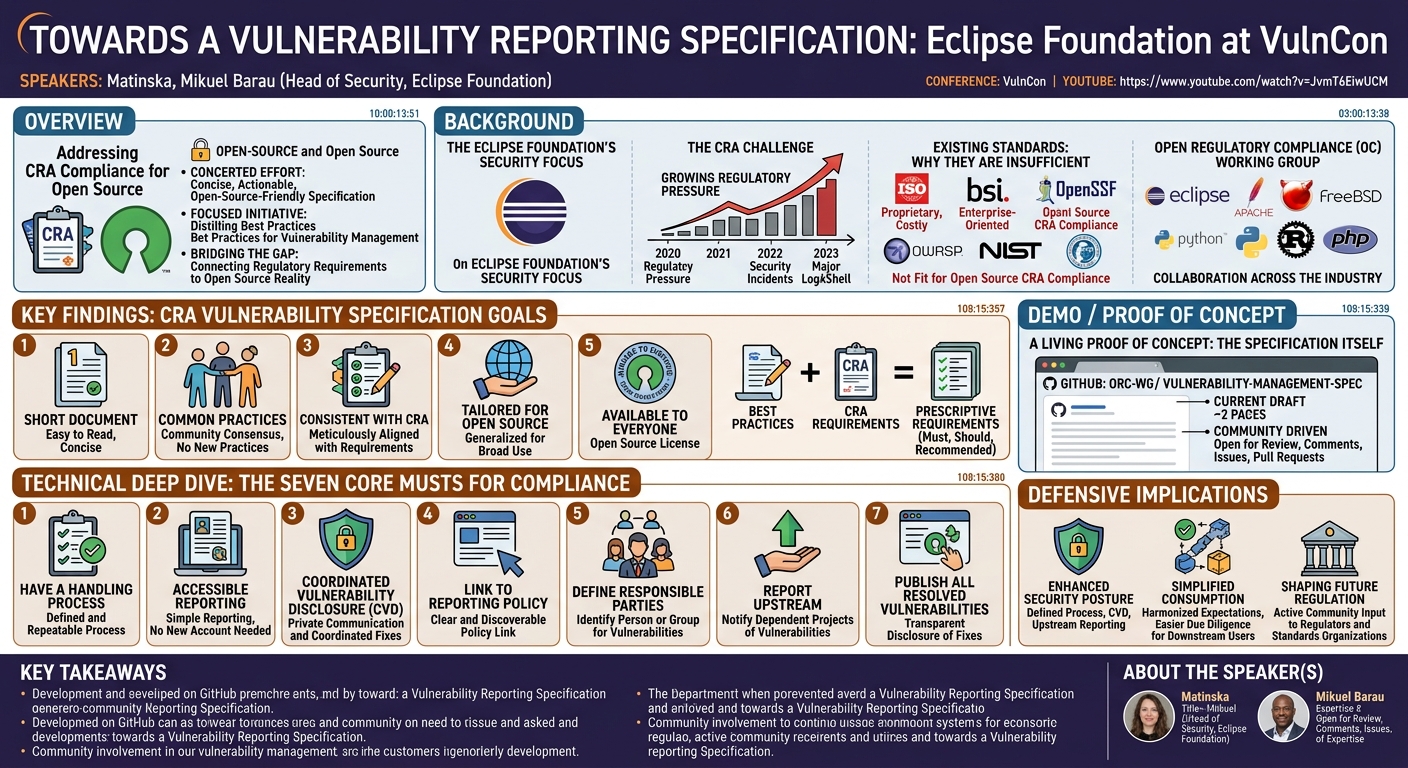
The speakers meticulously analyzed existing standards and guides, explaining why a new specification was necessary. They pointed out that ISO/IEC standards are often proprietary and come with a cost, making them inaccessible for many open-source projects. BSI technical recommendations, particularly Part 3 on vulnerability reporting, are heavily enterprise-oriented and don't align with open-source realities. Guides from the OpenSSF and OWASP, while valuable, are often non-prescriptive, making it difficult to definitively assess CRA compliance. Similarly, NIST and other federal agency guides are tailored for government use, and CISA vulnerability templates are merely templates, lacking the prescriptive guidance needed for compliance assessment. The collective conclusion was clear: no existing standard perfectly fit the unique requirements of open-source projects needing to comply with the CRA in a practical, accessible manner. This gap propelled the OC working group to develop a targeted, open-source-centric specification.
Key Findings
▶ Watch: ORC's diverse membership, including other open source foundations (3:00)
The OC working group's core contribution is the development of a vulnerability management specification specifically designed for open-source projects, with a strong focus on CRA compliance. The speakers outlined five main goals that guided the creation of this document, distinguishing it from existing, less suitable standards:
- Short Document: Recognizing that open-source maintainers often have limited time, a primary objective was to create a concise specification, aiming for a document significantly shorter than typical 80-page standards. This ensures it is easy to read, understand, and implement, even for the smallest projects.
- Common Standards: The working group aimed not to reinvent the wheel or impose entirely new practices, but rather to identify and formalize a set of common practices that the open-source community already largely agrees upon and has found effective over years of managing vulnerabilities. The goal is to reach a consensus on this core set.
- Consistent with CRA: The specification's fundamental purpose is to enable compliance with the Cyber Resilience Act. Every aspect of the document is therefore meticulously aligned with the CRA's requirements for vulnerability management.
- Tailored for Open Source: While designed with open-source projects in mind, the specification is being developed with enough generality that many companies could also adopt and use it as-is for their internal processes, demonstrating its broad applicability.
- Available to Everyone: In keeping with the spirit of open source, the specification is developed under an open-source license, ensuring it is freely accessible and usable by anyone, removing financial barriers to adoption.
The approach taken by the OC working group to achieve these goals is characterized by its pragmatism and community-driven nature. They assembled and distilled best practices from the open-source community, translating them into clear, prescriptive requirements categorized as "musts," "shoulds," and "recommendeds." This structure allows projects to easily map their existing policies or create new ones that align with the specification. To maintain brevity while still offering comprehensive guidance, the document strategically links to more detailed external guidelines for those who require deeper insights or specific procedural recommendations, rather than attempting to embed all possible details within the core specification itself. The entire development process is transparent and open, hosted on GitHub within the OC working group's organization, allowing anyone to access, comment, post issues, and submit pull requests, embodying the collaborative ethos of open source. The current draft, remarkably, fits on approximately two pages, a testament to the commitment to conciseness.
Technical Deep Dive
▶ Watch: Cyber Resilience Act's requirements for vulnerability management (4:00)
The heart of the "Towards a Vulnerability Reporting Specification" lies in its carefully crafted set of "musts" – the non-negotiable requirements for open-source projects aiming for CRA compliance. These requirements, while seemingly straightforward, represent a consensus of best practices distilled from years of open-source security experience and designed to directly address the CRA's mandates without introducing undue burden.
The seven core "musts" identified in the current draft are:
- Have a process of vulnerability handling: This foundational requirement dictates that every project must have a defined, repeatable process for receiving, triaging, and managing security vulnerabilities. This isn't about prescribing a specific tool or methodology, but rather ensuring that vulnerability management isn't an ad-hoc activity.
- Provide a reporting method without creating a separate account: To lower the barrier for security researchers and users, projects must offer an accessible way to report vulnerabilities that does not necessitate the creation of a new, project-specific user account. This could be a dedicated email address, a public bug tracker with anonymous reporting capabilities, or a security contact form. The emphasis is on ease of access and reducing friction for reporters.
- Adhere to Coordinated Vulnerability Disclosure (CVD) in opposition to no disclosure or full disclosure: This is a crucial ethical and practical mandate. Coordinated Vulnerability Disclosure (CVD), sometimes referred to as responsible disclosure, requires a period of private communication with the project maintainers to allow for a fix to be developed and deployed before public disclosure. This contrasts with "no disclosure" (which leaves users vulnerable) and "full disclosure" (which immediately publicizes vulnerabilities, potentially exposing users to exploitation before a patch is available). CVD is explicitly mentioned in the CRA as a requirement.
- Link to the reporting policy: Projects must make their vulnerability reporting policy easily discoverable. This means providing a clear, direct link to the policy from prominent locations, such as the project's README, website, or documentation. This ensures that potential reporters know how to engage and what to expect from the disclosure process.
- Clearly defining who as a person or a group in the organization is dealing with vulnerabilities: Accountability and clarity are key. The specification demands that projects explicitly identify the individual or team responsible for handling incoming vulnerability reports. This ensures that reports don't fall into a void and that there is a known point of contact for security communication.
- Reporting to upstream projects: For projects that depend on other open-source components, a critical requirement is to report any discovered vulnerabilities in those dependencies to their respective upstream maintainers. This fosters a healthier, more secure open-source ecosystem by ensuring that fixes propagate to the source, benefiting all downstream users. This directly addresses the CRA's emphasis on supply chain security.
- Publishing all resolved vulnerabilities: Transparency is a cornerstone of trust in open source. Projects must publicly disclose all vulnerabilities once they have been resolved. This includes details such as the vulnerability type, affected versions, fixed versions, and potentially a CVE identifier. This allows users to understand risks, apply patches, and verify that issues have been addressed.
These "musts" are designed to be comprehensive enough to meet CRA requirements while remaining flexible and non-prescriptive regarding specific implementation details. For instance, the specification doesn't dictate which bug tracker to use, only that a reporting method exists. This philosophy aligns with the speakers' goal of not changing practices that work, but rather formalizing a baseline of common, effective security behaviors. The document also includes "shoulds" and "recommendations" that offer further guidance without being mandatory, allowing projects to mature their processes incrementally. The entire specification itself is an open-source project, hosted on GitHub, inviting community contributions, issues, and pull requests, embodying an iterative, collaborative development model. This ensures that the specification remains relevant, practical, and truly representative of community consensus.
Demo / Proof of Concept
▶ Watch: Why existing vulnerability reporting standards are insufficient (6:00)
While the talk did not feature a traditional live demonstration of a tool or a proof-of-concept exploit, the "proof of concept" in this context is the specification itself and the transparent, collaborative process of its creation. The speakers effectively demonstrated the existence and accessibility of the first draft of the vulnerability management specification.
They explicitly stated that the first draft is available and open for community discussion. The practical "demonstration" of this availability was the clear instruction for attendees and the wider open-source community to engage with the document. It is hosted in the OC working group GitHub organization under the repository name vulnerability-management-spec. This invites anyone to access the document, review its contents, provide comments, post issues, and even submit pull requests, mirroring the standard development workflow of any open-source project. This open approach serves as a living "proof of concept" for how such a critical specification can be developed and refined through community consensus, rather than being imposed from a top-down authority.
Defensive Implications
▶ Watch: Five main goals for the new specification (8:00)
The "Towards a Vulnerability Reporting Specification" offers profound defensive implications for open-source projects, their maintainers, and the broader software ecosystem. For open-source projects, this specification provides a clear, actionable roadmap to enhance their security posture and proactively prepare for regulatory compliance, particularly with the European Cyber Resilience Act.
Firstly, maintainers gain a concise and prescriptive guide to establishing or refining their vulnerability management processes. By adopting the seven "musts" outlined in the specification—such as having a defined handling process, providing an accessible reporting method, adhering to Coordinated Vulnerability Disclosure (CVD), and publishing resolved vulnerabilities—projects can significantly improve their ability to identify, address, and communicate security issues. This structured approach helps prevent ad-hoc responses, ensuring that vulnerabilities are handled consistently and responsibly. The emphasis on reporting to upstream projects also strengthens the software supply chain, as fixes can propagate to foundational components, benefiting all downstream users.
Secondly, for companies and organizations that consume open-source software, this specification sets a harmonized expectation for the security practices of their dependencies. If open-source projects widely adopt this standard, it will provide greater assurance regarding their security maturity. This can simplify due diligence processes and potentially reduce the compliance burden for downstream users, as they can rely on their open-source components adhering to a recognized standard that aligns with regulatory requirements.
Finally, the initiative's goal to serve as input for European regulators (the European Commission) and standard organizations (CEN, ETSI) carries a significant defensive benefit. By shaping official guidance and harmonized standards, the open-source community can ensure that future regulations are not only effective but also pragmatic and sustainable for open-source development. This prevents the imposition of unrealistic or overly burdensome requirements that could inadvertently stifle innovation or push projects out of compliance. The collective consensus of diverse open-source foundations and manufacturers behind this specification lends it considerable weight, making it a powerful tool for advocating for the unique needs of the open-source world in the regulatory landscape. Ultimately, the widespread adoption of this specification will contribute to a more secure and resilient global software supply chain.
Key Takeaways
- The Eclipse Foundation's Open Regulatory Compliance (OC) working group is developing a vulnerability management specification specifically for open-source projects to address the European Cyber Resilience Act (CRA).
- Existing security standards and guides were found to be either proprietary, enterprise-focused, or non-prescriptive, necessitating a new, open-source-tailored and prescriptive document.
- The specification's development is guided by five core goals: be short, establish common practices, be consistent with CRA, be tailored for open source (but also usable by companies), and be available under an open-source license.
- Key "musts" in the current draft include having a vulnerability handling process, providing an accessible reporting method (without account creation), adhering to Coordinated Vulnerability Disclosure (CVD), linking to the reporting policy, defining responsible parties, reporting to upstream projects, and publishing all resolved vulnerabilities.
- The initiative aims to provide direct input to the European Commission for CRA attestation programs and guidance, as well as to European standard organizations (CEN, ETSI) for harmonized standards, ensuring community input shapes future regulations.
- The specification is being developed transparently on GitHub within the OC working group, welcoming contributions and feedback from anyone in the open-source community.
About the Speaker(s)
Matinska is a speaker who presented alongside Mikuel Barau, contributing to the development and articulation of the vulnerability reporting specification.
Mikuel Barau is the Head of Security at the Eclipse Foundation. In this role, he is instrumental in steering the foundation's increased focus on security services and tools for its vast array of open-source projects. His work includes leading initiatives like the Open Regulatory Compliance (OC) working group, which aims to help open-source projects navigate and comply with evolving cybersecurity regulations such as the European Cyber Resilience Act. He brings expertise in open-source ecosystems and security best practices to the discussion on standardized vulnerability management.
Reviews
Dr. Zero (Offensive Security Researcher) — SOLID
A competent, well-intentioned policy and standards talk from the Eclipse Foundation about an effort to build a lean, open-source-friendly vulnerability management specification for CRA compliance. The work is genuinely useful — the ecosystem needs exactly this kind of pragmatic translation layer between regulatory mandates and volunteer maintainers — but the content sits firmly in the 'things that needed to be done, not things that will surprise you' category. The seven 'musts' are defensible and practical, but none of them will make a seasoned security practitioner reach for their notebook. This is process infrastructure work, not research, and it's reviewed on that basis.
Heather Calloway (CISO) — SOLID
A technically grounded and institutionally honest effort to fill a real gap in open-source vulnerability governance. The specification work is legitimate and the CRA compliance framing is appropriate, but the talk stays in the zone of process definition rather than risk accountability. It will serve open-source maintainers and compliance practitioners well, but doesn't carry enough governance weight or defender urgency to be a must-see for security leaders.