The Quality Era of CVE: A Blueprint for Global Software Safety
Bob Lord
Overview
In his compelling VulnCon talk, "The Quality Era of CVE: A Blueprint for Global Software Safety," Bob Lord challenges the cybersecurity community to fundamentally rethink the Common Vulnerabilities and Exposures (CVE) program. Lord invites the audience to imagine a world where CVE was never built, then asks what an ideal system for eliminating software vulnerabilities in 2026 would look like. His presentation critiques the current CVE mission as activity-focused rather than outcome-driven, proposing a radical shift towards a North Star vision centered on improving software safety through enhanced data quality and secure-by-design practices.
Key moments
- 0:00 Imagining a new CVE program from scratch
- 4:20 Proposed outcome-focused mission statement for CVE
- 6:00 Defining CVE quality: Complete, Accurate, Timely (CAT)
- 9:30 Prototype: Enforcing upstream product identity management
- 13:00 Prototype: AI-assisted CWE classification for accuracy
- 15:00 Prototype: Standardized community notes for feedback
- 19:00 Key takeaways: North Star, product management, upstream quality
- 23:00 Q&A: Addressing business constraints and product changes
The Quality Era of CVE: A Blueprint for Global Software Safety
Speakers: Bob Lord
Conference: VulnCon
YouTube: https://www.youtube.com/watch?v=t_CYTZo9GjI
Overview
In his compelling VulnCon talk, "The Quality Era of CVE: A Blueprint for Global Software Safety," Bob Lord challenges the cybersecurity community to fundamentally rethink the Common Vulnerabilities and Exposures (CVE) program. Lord invites the audience to imagine a world where CVE was never built, then asks what an ideal system for eliminating software vulnerabilities in 2026 would look like. His presentation critiques the current CVE mission as activity-focused rather than outcome-driven, proposing a radical shift towards a North Star vision centered on improving software safety through enhanced data quality and secure-by-design practices.
Lord argues that the existing CVE framework, while revolutionary in 1999, now faces significant challenges related to data entry, root cause analysis, and consistent product identification. These issues hinder defenders' ability to protect systems effectively and prevent developers from learning from past mistakes. To illustrate his vision, Lord introduces a prototype system designed to address these deficiencies, emphasizing quality through completeness, accuracy, and timeliness (CAT) of vulnerability records. This talk is crucial for anyone involved in vulnerability management, software development, or cybersecurity policy, offering a bold new direction for global software safety.
Background
▶ Watch: Imagining a new CVE program from scratch (0:00)
The CVE program, established in 1999, revolutionized how cybersecurity vulnerabilities are identified, defined, and cataloged. Its original mission — "to identify, define, and catalog publicly disclosed cybersecurity vulnerabilities" — was a much-needed improvement for its time, providing a standardized identifier (CVE ID) for known vulnerabilities. However, Bob Lord contends that this mission, while foundational, is inherently activity-focused, describing what CVE does rather than what outcome it aims to achieve. This focus on activity, rather than a clear societal outcome, is identified as a root cause for many of the program's current limitations.
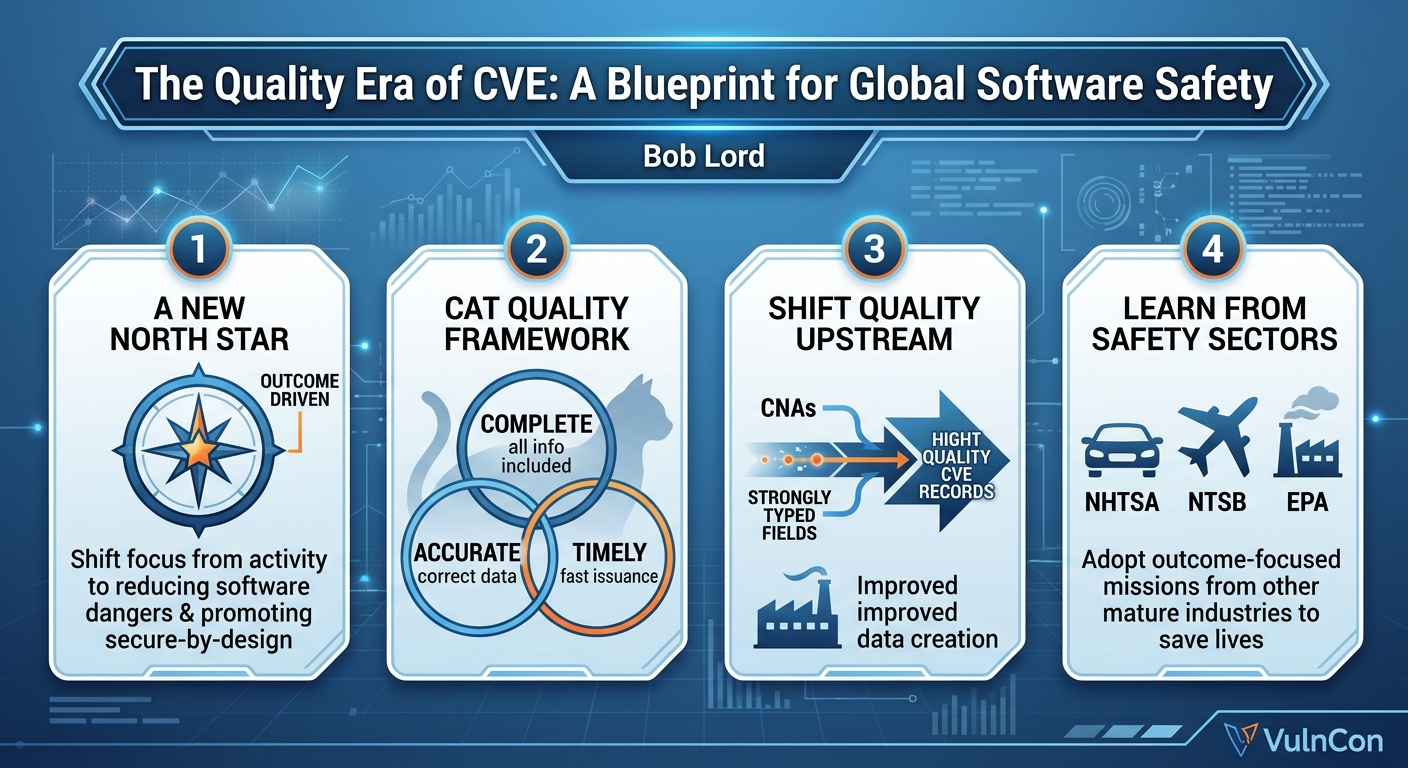
Lord draws parallels with other safety-critical sectors, highlighting agencies like the National Highway Traffic Safety Agency (NHTSA), Environmental Protection Agency (EPA), and National Transportation Safety Board (NTSB). These organizations have clear, outcome-driven missions: "save lives," "protect human health and the environment," "make transportation safer." Over decades, these sectors have achieved dramatic improvements in safety by focusing on measurable outcomes and building processes to support those goals. In contrast, the cybersecurity sector often struggles with recurring classes of coding errors and an inability to consistently learn from past vulnerabilities.
The current CVE program faces several core challenges:
- Data Entry Problem: The existing CVE schema lacks sufficient specificity, allowing for varied and inconsistent data entry across fields. This makes standardized analysis difficult and introduces ambiguity.
- Root Cause Analysis (RCA): While Common Weakness Enumeration (CWE) exists to categorize recurring coding errors, its inconsistent adoption and usage by various CVE Numbering Authorities (CNAs) limit its effectiveness in driving secure-by-design development. Without consistent RCA, the industry struggles to eliminate entire classes of vulnerabilities.
- Product Identification: Consistently and accurately identifying affected products remains "one of the great unsolved problems in every sector." This ambiguity complicates patching efforts and asset management for defenders.
- Workstream and Governance: Questions persist regarding who does what and when in the vulnerability disclosure lifecycle, particularly concerning upstream vs. downstream responsibilities. This lack of clarity impacts the timeliness and accuracy of vulnerability information.
These challenges collectively contribute to a situation where ransomware remains prevalent, and IT teams are often blamed for unpatched systems, despite systemic issues that make comprehensive patching nearly impossible. Lord's proposed vision seeks to address these fundamental issues by reimagining CVE from the ground up, with a clear, outcome-focused North Star guiding its evolution.
Key Findings
▶ Watch: Defining CVE quality: Complete, Accurate, Timely (CAT) (6:00)
Bob Lord's central argument is that the current CVE mission statement, focused on "identifying, defining, and cataloging," is an activity, not an outcome. This distinction is critical because an activity-focused mission can lead to fragmented efforts and a lack of overarching strategic direction. His primary "key finding" is the necessity of an outcome-driven North Star for the CVE program, one that explicitly aims to reduce the dangers of using software.
Lord proposes a new mission statement: "To reduce the dangers of using software through the analysis of root causes of software security defects and to promote secure-by-design development practices." This reorientation shifts the focus from merely documenting vulnerabilities to actively contributing to their elimination and preventing future ones. It emphasizes analysis, data science, and continuous improvement of development processes.
To achieve this outcome, Lord introduces a framework for quality in CVE records, encapsulated by the mnemonic CAT:
- Complete: Records must contain all necessary information for defenders to protect their systems and for data scientists to perform root cause analysis (e.g., consistent CWE fields).
- Accurate: Information must be correctly assigned to the appropriate fields and categories, eliminating ambiguity and misclassification.
- Timely: CNAs must issue records quickly to enable immediate defensive actions, avoiding long delays that leave systems exposed.
Lord posits that consistently achieving CAT quality in CVE records will significantly lower the cost, complexity, and volatility associated with vulnerability management. This improved quality will not only empower defenders to secure systems today but also enable developers to build inherently safer software in the future. The shift from an activity-based mission to an outcome-focused North Star, supported by a rigorous definition of data quality, forms the bedrock of Lord's blueprint for global software safety.
Technical Deep Dive
▶ Watch: Prototype: AI-assisted CWE classification for accuracy (13:00)
To demonstrate how an outcome-driven, quality-focused CVE program could function, Bob Lord presented a prototype system designed to embody his vision. This prototype showcases several key technical and architectural principles aimed at addressing the current program's shortcomings.
A fundamental design principle of the prototype is the elimination of free-form text entry for critical data fields. Instead, virtually all significant inputs are handled via strongly typed fields and lookup mechanisms. This ensures data consistency, accuracy, and machine-readability from the moment of issuance, moving quality upstream.
The user interface of the prototype is divided into public browsing and CNA agent functionalities. A public user can search for records, products, and CNAs intuitively. The system provides detailed views with tabs for overview, technical details (including CVSS and CWE information), and history. The history tab is particularly important, showing changes over time, who made them, and when, enhancing transparency and accountability.
For CNA agents, the system introduces robust controls and workflows. When a CNA agent, such as "Maria Rodriguez, a CNA super agent for Acme Security Solutions," logs in, they have a scope-defined view of products and agents they can manage. A critical constraint is that CVE records cannot be created "willy-nilly"; they must be assigned to a parent package or product object. This ensures that every vulnerability is linked to a specific, identified software component. Product identities are managed upstream in a "carefully curated way," meaning they are correct at creation and don't require downstream enrichment, contributing to completeness and timeliness.
The prototype also introduces a clear separation between different types of security defects:
- CVE records are specifically for product coding errors.
- CSR records (Configuration Security Records) are distinct objects for configuration problems. This prevents conflating different types of issues onto a single CVE record, leading to clearer, more actionable information.
When creating a CVE record, the CNA agent must select the product from a lookup, preventing mistyping and ensuring proper association. For CWE selection, the system offers both manual classification (e.g., selecting a "buffer error" class, then a specific base weakness like CWE-120) and an AI-assisted suggestion feature. An agent can describe a vulnerability in natural language (e.g., "string that writes past the end of the buffer"), and the AI will ask clarifying questions before suggesting a specific CWE (e.g., CWE-120). This aims to improve the consistency and accuracy of CWE assignments, crucial for root cause analysis.
The system also features an auto-generated summary for CVE records, similar to tools like Vulnogram, but built upon the strongly typed identifiers. This allows for flexible presentation of data to different consumers and easy translation into various languages, as the underlying record data is structured and machine-usable.
A significant addition to the prototype is the concept of Community Notes. This feature provides a standardized, structured feedback mechanism, addressing the current lack of a consistent way for external parties to suggest improvements or corrections to CVE records. Users like "Dr. Sarah Kim" can propose alternative CWEs or other changes, providing rationale. The owning CNA (e.g., Maria Rodriguez) can then triage these suggestions, choosing to accept, decline, or further investigate, fostering continuous quality improvement.
Finally, CNA management functions allow super agents to create and manage other agents within their scope, each with potentially different authorities. This granular control over user roles and permissions ensures that agents can only perform actions relevant to their responsibilities, further reinforcing data integrity and accountability.
Lord acknowledges that the product identification challenge remains complex, particularly for proprietary software with evolving names or firmware attached to hardware, as raised during the Q&A. However, his prototype provides a partial solution by moving product identity management upstream to the CNA, empowering them to define and control how their products are named and referenced within the system, thereby telegraphing this information to customers and the public in a consistent manner. The core idea is to make doing the "right thing" (i.e., issuing complete, accurate, and timely records) easy and the default behavior for CNAs.
Demo / Proof of Concept
▶ Watch: Prototype: Standardized community notes for feedback (15:00)
The core of Bob Lord's presentation involved a live demonstration of his prototype system, which he built to illustrate a potential future for the CVE program. The demo walked through several key user flows, showcasing how the proposed architectural and process changes would translate into practical functionality.
The demonstration began with the perspective of a public user browsing as a guest. Lord showed how this user could intuitively search for CVE records, products, or CNAs. The system presented a familiar interface with pinpoint addressing, allowing users to drill down into specific records. Each CVE record page displayed an overview, technical details (including CVSS and CWE), and a crucial history tab, which tracks changes over time and who made them, enhancing transparency.
Next, Lord switched to the perspective of a CNA agent, "Maria Rodriguez," a "CNA super agent" for "Acme Security Solutions." This illustrated the enhanced capabilities and structured workflows for those responsible for issuing CVEs. A critical aspect demonstrated was the inability to create a CVE record without first associating it with a parent product or package object. This showcased the enforcement of upstream identity management, ensuring completeness and accuracy from the outset.
Maria then proceeded to create a new product, the "Acme Geo Park app," defining its type (application), and other attributes like hardware architectures and operating systems. Once the product was created, she could then create a CVE record for it. The demo highlighted the use of lookup fields for product selection, preventing free-form text entry errors.
A significant segment of the demo focused on CWE selection. Maria could either manually navigate through classes, bases, and variants (e.g., selecting a "buffer error" and then a specific CWE). Alternatively, the prototype demonstrated an AI-assisted feature where Maria could describe the vulnerability in natural language (e.g., "string that writes past the end of the buffer"), and the AI would suggest the most relevant CWE (e.g., CWE-120) after a brief clarifying interaction. This feature aims to improve the consistency and ease of accurate CWE assignment.
The prototype also showed an auto-generated summary for the CVE record, highlighting how structured, strongly typed data could be presented in a human-readable and translatable format.
Finally, the demo illustrated the Community Notes feature. Lord showed "Dr. Sarah Kim" providing feedback on an existing CVE record, suggesting a different CWE with rationale. Maria, as the CNA owner, could then triage this note, deciding to accept or decline the proposed change. This demonstrated a standardized, transparent feedback loop for continuous quality improvement.
Lord candidly noted that the prototype was "incredibly incomplete" and contained "dead ends," as is the nature of such early-stage demonstrations. However, it effectively served its purpose: to provide enough fidelity for stakeholders to visualize the proposed changes, offer concrete feedback, and collaboratively refine the North Star vision for a quality-driven CVE program. The demo underscored the practical application of strongly typed fields, upstream quality control, and structured feedback mechanisms.
Defensive Implications
▶ Watch: Q&A: Addressing business constraints and product changes (23:00)
The vision for a quality-driven CVE program, as proposed by Bob Lord, carries profound implications for cybersecurity defenders. The shift from an activity-focused mission to an outcome-driven North Star directly translates into tangible benefits for those on the front lines of protecting systems.
Firstly, the emphasis on CAT quality (Complete, Accurate, Timely) records significantly enhances defenders' ability to respond effectively. When CVE records are complete, they contain all the necessary information, reducing the need for additional research and enabling faster, more informed decision-making. Accurate records minimize false positives and misconfigurations, ensuring that defensive efforts are targeted and efficient. Timely issuance, facilitated by upstream quality control and streamlined CNA processes, means defenders receive critical vulnerability information sooner, allowing them to patch, mitigate, or implement compensating controls before widespread exploitation occurs. This directly addresses the problem of blaming IT for unpatched systems, by providing them with actionable intelligence at the speed required.
Secondly, the enhanced focus on root cause analysis (RCA) through consistent and accurate CWE assignments is a game-changer for long-term security. By making CWE fields mandatory and facilitating their correct selection (e.g., via AI assistance), the system empowers the industry to identify and understand recurring classes of coding errors. This knowledge is not just for individual bug fixes but for driving secure-by-design development practices. Defenders can leverage this aggregated RCA data to inform their security policies, vulnerability management strategies, and even influence procurement decisions, prioritizing software from vendors who demonstrate a commitment to eliminating common weakness patterns. This moves beyond reactive patching to proactive prevention, making software inherently safer over time.
Thirdly, the prototype's approach to product identification – requiring CVEs to be associated with curated, upstream-managed product objects – addresses one of the most persistent challenges for defenders. Clear, unambiguous product identification reduces the overhead of mapping CVEs to affected assets, streamlining vulnerability scanning, patch management, and asset inventory processes. This reduces confusion, improves the accuracy of risk assessments, and ensures that the right patches are applied to the right systems, minimizing the "unpatched servers" problem. The ability for CNAs to be in the "driver's seat" for their product naming and identity, as discussed in the Q&A, empowers vendors to communicate product scope in ways appropriate for their business, which in turn benefits their customers.
Finally, the introduction of Community Notes provides a standardized feedback loop that directly benefits defenders. If a defender discovers additional details, a more accurate CWE, or a broader scope for a vulnerability, they can contribute this information directly to the record. This collective intelligence mechanism allows CVE records to improve continuously post-issuance, making them more robust and reliable for the entire community. This also shifts the burden of quality assessment from downstream consumers to a collaborative model, where CNAs can triage and integrate valuable insights.
In essence, Lord's blueprint aims to provide defenders with machine-usable, high-quality data that is reliable, comprehensive, and actionable. This foundation enables more effective automated security tools, better risk management, and a clearer understanding of the software supply chain's security posture, ultimately moving towards a future where software safety is dramatically improved.
Key Takeaways
Bob Lord's talk offers a compelling vision for the future of the CVE program, emphasizing a fundamental shift in its philosophy and operation. The key takeaways for the cybersecurity community are:
- Establish a Clear North Star: The CVE program needs an explicit, outcome-driven mission, moving beyond simply "identifying and cataloging" to actively "reducing the dangers of using software" and promoting secure-by-design practices. This unified vision is essential to guide strategic decisions and foster collective progress.
- Learn from Other Safety Sectors: Industries like aviation, automotive, and medicine have achieved dramatic safety improvements by adopting outcome-focused missions and robust quality frameworks. The cybersecurity community must draw lessons from these sectors to build inherently safer software systems.
- Treat CVE as a Product: While non-commercial, the CVE program should be managed with a product mindset, focusing on the needs and experiences of its "customers" – the downstream consumers. This perspective encourages continuous improvement and responsiveness to user feedback.
- Prioritize CAT Quality: Strive for Complete, Accurate, and Timely (CAT) CVE records. This quality must be defined and measured from the perspective of downstream consumers, ensuring the data is truly useful for defense and development.
- Shift Quality Upstream: The responsibility for data quality should be moved as far upstream as possible in the vulnerability disclosure process. By empowering CNAs with tools for strongly typed fields and curated product identification, the burden on downstream consumers to enrich or correct data is significantly reduced.
- Engage with the Consumer Working Group: The establishment of initiatives like the Consumer Working Group is vital for gathering direct feedback from users, understanding their pain points, and collaboratively shaping the future of CVE to meet real-world needs.
About the Speaker(s)
Bob Lord is a prominent voice in the cybersecurity community, known for his forward-thinking perspectives on software safety and vulnerability management. In this VulnCon talk, he presented a visionary blueprint for the future of the CVE program, challenging existing paradigms and proposing a new, outcome-driven direction. Lord demonstrated his commitment to practical solutions by building and showcasing a prototype system, illustrating how his theoretical concepts could be implemented. His active involvement in initiatives like the Consumer Working Group further underscores his dedication to gathering feedback and fostering collaborative improvement within the CVE ecosystem. Lord's presentation reflects a deep understanding of the systemic challenges facing software security and a passionate commitment to driving meaningful change.
Reviews
Dr. Zero (Offensive Security Researcher) — STRONG ACCEPT
Bob Lord delivers a genuinely useful strategic critique of CVE's structural problems and backs it with a working prototype that demonstrates concrete fixes. This isn't a policy wish-list — it's a specific, buildable vision from someone who's actually thought through the data model. The talk earns its slot by naming real problems (CWE inconsistency, product ID chaos, free-text hell) and showing what upstream quality enforcement could look like.
Heather Calloway (CISO) — STRONG ACCEPT
Bob Lord makes the case that CVE's mission needs to shift from cataloging activity to measurable safety outcomes. The argument is clear, the prototype is concrete enough to provoke useful debate, and the framing around CAT quality and upstream accountability is exactly the kind of institutional thinking this program has lacked. Worth your time if you touch vulnerability management at any level.
→ Top-rated talks at CVE/FIRST VulnCon 2026 & Annual CNA Summit