I PWN thee, I PWN thee not!
Jayson E. Street
ZeroNights 2019 · Day 1
Overview
In his engaging ZeroNights talk, "I PWN thee, I PWN thee not!", renowned social engineer Jayson E. Street delivers a compelling argument against the security industry's pervasive obsession with complex, high-tech solutions and zero-day exploits. Street, known for his real-world penetration testing and social engineering engagements, including "robbing banks" for National Geographic, asserts that the vast majority of successful breaches exploit fundamental weaknesses in human behavior, process adherence, and basic security hygiene. His presentation skillfully blends humorous anecdotes from his professional "robbing" career with sobering statistics and actionable advice, highlighting the critical disconnect between perceived and actual threats.
Key moments
- 0:00 Introduction & why simple social engineering works
- 6:00 Addressing the 'people problem' in cybersecurity
- 8:00 Case study: Empowering employees to question unusual activity
- 16:00 Case study: Importance of well-monitored public spaces
- 21:00 Critical need for egress filtering and internal monitoring
- 24:00 Proper MFA implementation and universal policy enforcement
- 39:00 Serious repercussions for repeated phishing failures
- 41:50 Continuously vet and verify your security systems
I PWN thee, I PWN thee not!
Speakers: Jayson E. Street
Conference: ZeroNights
YouTube: https://www.youtube.com/watch?v=X91kAwmdzqg
Overview
In his engaging ZeroNights talk, "I PWN thee, I PWN thee not!", renowned social engineer Jayson E. Street delivers a compelling argument against the security industry's pervasive obsession with complex, high-tech solutions and zero-day exploits. Street, known for his real-world penetration testing and social engineering engagements, including "robbing banks" for National Geographic, asserts that the vast majority of successful breaches exploit fundamental weaknesses in human behavior, process adherence, and basic security hygiene. His presentation skillfully blends humorous anecdotes from his professional "robbing" career with sobering statistics and actionable advice, highlighting the critical disconnect between perceived and actual threats.
Street's core message is a call to refocus security efforts on the human element and foundational controls. He contends that while the industry chases advanced persistent threats (APTs) and cutting-edge vulnerabilities, organizations remain exposed to threats that are "so easy even I can do it." By illustrating how he routinely compromises organizations through simple social engineering tactics, physical access bypasses, and exploitation of common human errors, Street underscores that a significant portion of security failures can be attributed to uneducated employees, unenforced policies, and a lack of basic monitoring.
The talk serves as a vital reminder that expensive "blinky boxes" and sophisticated artificial intelligence are often ineffective if the people, processes, and basic configurations are overlooked. Street challenges the audience to shift their perspective from viewing employees as liabilities to empowering them as integral parts of the security solution. His insights are particularly relevant for security professionals struggling with budget constraints and executive expectations, offering practical strategies to enhance an organization's defensive posture by addressing the most common and easily exploitable vectors.
Background
▶ Watch: Introduction & why simple social engineering works (0:00)
The security landscape is often dominated by narratives of sophisticated nation-state actors, elusive zero-day exploits, and advanced persistent threats (APTs). This focus, while not entirely unwarranted, frequently leads organizations to invest heavily in complex technological defenses, such as next-generation firewalls, AI-driven detection systems, and blockchain-secured solutions. Jayson E. Street highlights a critical flaw in this approach: executives often demand "secure great again" defenses, envisioning impenetrable walls, but are only willing to allocate budgets for "traffic cones and binoculars." This creates a significant gap between expectation and reality, leading to an over-reliance on technology to solve what are fundamentally "people problems."
Street's extensive experience as a social engineer consistently demonstrates that human vulnerabilities and procedural shortcomings are far more prevalent and exploitable than technical zero-days. He points out a stark statistic: 84 to 86 percent of companies that suffer breaches are compromised through vulnerabilities that are over a decade old. This statistic directly contradicts the industry's focus on novel exploits, suggesting that basic patching and configuration management are often neglected. The problem, as Street articulates, isn't a lack of sophisticated defense tools, but a failure to address the simpler, more common attack vectors that attackers, like himself, routinely leverage.
The talk implicitly builds on the long-standing understanding that humans are the weakest link in the security chain. However, Street reframes this by emphasizing that this "weakness" is often a product of inadequate education, lack of empowerment, and inconsistent policy enforcement, rather than inherent maliciousness. Employees are frequently unaware of the risks associated with their actions, or they lack the authority and confidence to challenge suspicious behavior. This creates an environment ripe for social engineering, where simple pretexts can bypass layers of technical security, demonstrating why a holistic approach integrating people, processes, and technology is paramount.
Key Findings
▶ Watch: Case study: Empowering employees to question unusual activity (8:00)
Jayson E. Street's talk distills years of social engineering experience into several critical findings, primarily highlighting the pervasive and often overlooked vulnerabilities stemming from human factors and basic security hygiene.
A cornerstone of his argument is the staggering statistic that 84 to 86 percent of all company breaches occur due to vulnerabilities that are over a decade old. This immediately challenges the industry's preoccupation with zero-day exploits and cutting-edge attacks, redirecting focus to fundamental patching and configuration management. Street emphasizes that while security professionals aspire to be "ninjas dropping 0-days," the reality is that attackers often succeed with the equivalent of "MS08-067" – an old, well-known vulnerability.
Street categorizes his findings into what he "loves" and "hates" for his "victims" (clients) to do, effectively outlining the easiest and hardest ways to compromise an organization:
Things Attackers Love (making their job easier):
- Employees not empowered or educated to question the unusual: This is Street's top "love." When employees are not trained or given permission to challenge strangers or suspicious activities, they become unwitting enablers. He cites instances of employees passively allowing him to plug in malicious devices or walk out with company assets.
- Public spaces that are not well-monitored and highly visible: Lobbies and common areas that are comfortable and allow for loitering provide ample opportunity for reconnaissance and observation without drawing attention. A lack of proactive security engagement in these areas is a significant oversight.
- No egress filtering or internal monitoring: Organizations often focus solely on keeping threats out, neglecting to monitor what leaves or moves within the network. The Sony breach, where 1.83 terabytes of data exfiltrated unnoticed, is a prime example. Unrestricted outbound connections, like an accounting employee telnetting to the Netherlands, provide easy command-and-control channels.
Things Attackers Hate (making their job harder):
- Properly implemented dual-factor authentication (2FA): While 2FA is a strong control, its improper implementation (e.g., key fobs left plugged into laptops or in desk drawers) renders it useless. Attackers hate genuinely strong 2FA, especially when combined with physical controls.
- Policies and procedures that are followed and enforced: Strict adherence to security policies by everyone, from the CEO to the mailroom clerk, creates a consistent and predictable security posture that is difficult to bypass. Inconsistencies or exceptions create exploitable gaps.
- A "weaponized" workforce: When employees are educated, empowered, and actively engaged in security – viewing themselves as part of the solution rather than the problem – they become formidable deterrents. Initiatives like the "Where's Waldo" game for ID checks transform passive compliance into active vigilance.
These findings collectively underscore that effective security is less about chasing the latest technical marvels and more about mastering the fundamentals: people, processes, and basic technological hygiene.
Technical Deep Dive
▶ Watch: Critical need for egress filtering and internal monitoring (21:00)
While Jayson E. Street's talk primarily focuses on the human element, he illustrates his points with examples that, while non-technical in their initial vector, reveal critical technical and procedural vulnerabilities. His "attacks" are less about exploiting code and more about exploiting context, trust, and lax controls.
One of his preferred tools for gaining initial access is a USB charging cable modified with an Arduino-based mini-computer, referred to as a "USB Ninja." This device, disguised as a standard Lightning cable, can execute payloads when plugged into a computer. Street describes using it under the pretext of a "USB rights management check," where he would plug the cable in, press a button on a small Bluetooth-enabled "detonator" box, and cause a Notepad window to pop up on the target's screen, displaying "test completed successfully, thank you for your cooperation smiley emoji." This simple social engineering combined with the device's ability to inject commands bypassed security and was successful six out of six times. For more covert operations, he also uses a Bash Bunny, another USB-based device capable of emulating various USB devices (keyboard, mouse, serial) to deliver payloads with less direct interaction.
Street frequently highlights the danger of old, unpatched vulnerabilities, citing MS08-067 (a critical Windows Server Service vulnerability from 2008) as an example of the types of flaws that still lead to breaches, even as organizations worry about new zero-days. This points to fundamental patch management failures.
Network misconfigurations are another common target. He recounts an engagement where he gained access by connecting to an open Linksys router inside the building. It turned out an executive, aiming for "more productivity," had connected the internal network to the Linksys's internet port, effectively bridging the internal network to an unsecured Wi-Fi access point for four months. This exemplifies how seemingly innocuous actions by well-intentioned but uneducated users can create massive security holes.
The absence of egress filtering and internal network monitoring is a critical technical vulnerability Street exploits. He demonstrates this by mentioning a payload that opens a command prompt and initiates a telnet connection to "blinky lights died in hell" (a humorous reference to the ASCII Star Wars telnet server). His question, "Why is Bob in accounting being able to telnet to the Netherlands?" underscores the need to restrict outbound network traffic to only what is absolutely necessary, locking it down by protocol, IP address, or ASN number. This prevents attackers from easily establishing command-and-control channels, even with initial compromise.
Even seemingly robust security mechanisms like dual-factor authentication (2FA) are often technically circumvented due to poor implementation. Street notes that nine out of ten times, he finds executive key fobs for multi-million dollar transfers either plugged into the laptop or in the top drawer of the desk. Furthermore, RFID badges, commonly used for physical access, are easily cloned using devices like a Proxmark 4 or other keychain-sized readers. He emphasizes the need for layered physical security, such as RFID combined with unique keypad PINs (not company-wide, easily guessed codes).
Finally, Street touches upon the pervasive issue of social media oversharing. While not a direct technical exploit, information gleaned from platforms like Instagram (for employee badge photos, enabling fake badge creation in under 15 minutes) or Facebook (for home addresses and vacation plans, aiding in spear phishing) provides the crucial context for successful social engineering, effectively weaponizing publicly available data.
Demo / Proof of Concept
▶ Watch: Proper MFA implementation and universal policy enforcement (24:00)
Jayson E. Street's talk, rather than featuring a live technical demonstration, is a captivating recounting of numerous real-world engagements that serve as powerful proofs of concept for his social engineering methodologies. Each anecdote illustrates a specific vulnerability and the ease with which it can be exploited by targeting human behavior and procedural lapses.
He opens with a series of personal "robberies" to establish his credibility and the non-technical nature of his work:
- Bank Robbery in Beirut: As featured on National Geographic, he physically "robbed" a bank.
- Hotel Compromise in South of France: Barefoot and in Teenage Mutant Ninja Turtle pajamas, he gained full access to a five-star hotel's server, master keys, and an unlocked workstation in the back office.
- Bank Teller Line Bypass: He describes walking behind a teller line, unplugging a computer right next to a busy teller, and walking out without a word, highlighting a complete lack of awareness and challenge.
A significant portion of his "demo" focuses on exploiting employee complacency and lack of empowerment. He recounts an engagement where he used a fake employee badge (created in less than 15 minutes using a company logo and an employee's Instagram photo of their badge) and a USB Ninja cable (a lightning cable with an embedded Arduino). Under the guise of a "USB rights management check," he successfully convinced employees to plug in the cable, which then displayed a "test completed successfully" message. This worked six out of six times, demonstrating how easily trust can be manipulated. When this became too easy, he escalated, using a Bash Bunny for more aggressive attacks, again with 100% success.
The ultimate physical access "demo" involved him walking through office halls with five, then six unattended laptops under his arms. Despite two employees making eye contact and giving him "the look," they were not empowered to stop him. He walked out of the building, waiting to be caught, which eventually happened due to a motivated manager, but not the initial observers. This vividly illustrates the difference between knowing something is wrong and being empowered to act.
Other "proofs of concept" include:
- Kaspersky Lobby Test: While not a successful "robbery," he recounts attempting to loiter in Kaspersky's well-monitored lobby, only to be immediately and politely intercepted by a guard who ensured he registered, showcasing effective physical security.
- TSA Key Incident: He uses the infamous Washington Post story where the TSA inadvertently published photos of master keys with visible bitting, allowing anyone to 3D print copies, as an example of "incompetence" over "maliciousness."
- Executive Linksys Router: An executive's attempt at "productivity" by bridging the internal network to a personal Linksys router for four months demonstrated how well-intentioned but uneducated actions create severe technical vulnerabilities.
- US Air Force Base Breaches: He cites historical examples, like a Russian spy stealing a missile from a German Air Force base in a wheelbarrow, and a recent incident where civilians breached an Air Force base undetected until a kidnapped woman escaped and sought help, underscoring catastrophic policy and procedure failures.
Through these vivid anecdotes, Street effectively "demos" how attackers leverage human psychology, social norms, and organizational blind spots to bypass security controls that are either poorly implemented or simply ignored.
Defensive Implications
▶ Watch: Continuously vet and verify your security systems (41:50)
Jayson E. Street's talk provides a clear roadmap for defenders to strengthen their security posture, shifting focus from a reactive, technology-centric approach to a proactive, human-centric one. The core defensive implications revolve around empowering people, enforcing policies, and mastering basic security hygiene.
- Prioritize Employee Education and Empowerment: This is paramount. Organizations must educate employees not just on what to do, but why it matters. Training should foster a culture where questioning unusual activities and verifying identities is encouraged and rewarded. Employees need to feel empowered to challenge strangers, report suspicious emails, and act when something seems wrong, rather than fearing repercussions or being polite to their detriment. Gamification, like the "Where's Waldo" ID check competition, can make security awareness engaging and effective.
- Enhance Physical Security and Access Control: Lobbies and public-facing areas should be well-monitored, highly visible, and designed to discourage loitering. Strict visitor registration and escort policies are crucial. Unattended workstations must be secured with laptop locks or by employees taking their devices with them. Dual-factor authentication (2FA) for physical access (e.g., RFID + unique keypad PIN) must be properly implemented, ensuring that physical tokens are never left easily accessible (e.g., plugged into laptops or in desk drawers).
- Implement Robust Network Monitoring and Egress Filtering: Organizations must move beyond perimeter defense. Implement egress filtering to restrict outbound network traffic, blocking unnecessary protocols (like telnet) and destinations. Monitor internal network traffic for anomalous behavior, such as unusual connections or large data transfers, to detect potential exfiltration attempts. Regularly patch and update systems to address old, well-known vulnerabilities like MS08-067, which are still common breach vectors.
- Enforce Policies and Procedures Universally: Security policies are only effective if they are consistently followed by everyone, from the CEO to the newest intern. There should be no exceptions. Policy violations, especially those impacting security, must have clear, communicated repercussions. Street suggests a tiered response for repeated phishing clicks: education for the first offense, limited access and mandatory training for the second, and termination for the third. This emphasizes the seriousness of security compliance.
- Improve Incident Response Communication: After a breach, transparent and factual communication is critical. Organizations must avoid fabricating details or downplaying the incident, as this erodes trust with customers, shareholders, and the public. Accurate, timely disclosure of what happened and the steps being taken is essential for maintaining credibility.
- Continuous Validation and Testing of Security Systems: Security measures are not "set it and forget it." Organizations must regularly vet and test their security systems (e.g., IDS/IPS, firewalls) to ensure they are operating as intended, updated, and properly configured. This includes simulating attacks on internal networks to test detection and response capabilities, akin to "sending yourself a virus" to gauge the system's reaction.
- Educate on Social Media Risks: Employees need to understand how information they share on social media (e.g., photos of badges, vacation plans, job updates) can be weaponized by social engineers for spear phishing or pretexting. Awareness campaigns should highlight these risks and encourage more cautious online behavior.
By focusing on these defensive implications, organizations can build a more resilient security posture that addresses the most common and effective attack vectors, transforming their workforce from a potential vulnerability into a powerful line of defense.
Key Takeaways
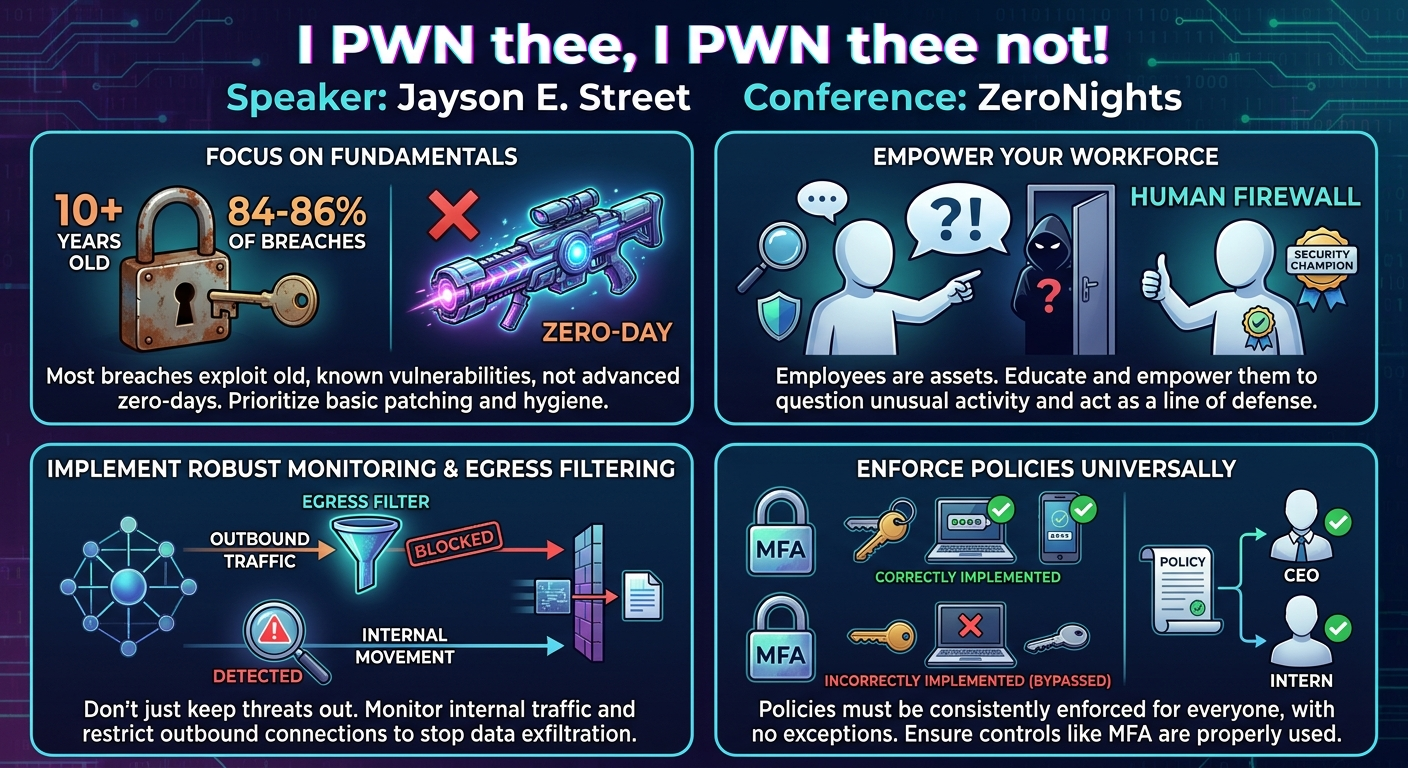
- Focus on Fundamentals: The vast majority of breaches (84-86%) exploit vulnerabilities over a decade old, not advanced zero-days. Prioritize basic security hygiene, patching, and configuration management over an exclusive focus on cutting-edge threats.
- Empower Your Workforce: Employees are assets, not just liabilities. Educate them on security risks, empower them to question unusual activity, and provide them with the confidence to act when something seems wrong.
- Enforce Policies Universally: Security policies must be clear, consistently applied, and enforced for everyone, from executives to entry-level staff. Lack of enforcement or exceptions creates exploitable weaknesses.
- Implement Robust Monitoring & Egress Filtering: Don't just focus on keeping threats out; monitor what leaves your network and moves internally. Implement strict egress filtering to block unnecessary outbound connections and detect anomalous activity.
- Properly Implement Multi-Factor Authentication (MFA): MFA is only effective if implemented correctly. Ensure physical tokens are not left easily accessible (e.g., plugged into laptops or in desk drawers), and combine physical access controls (like RFID) with unique, strong PINs.
- Be Transparent in Incident Response: After a breach, communicate facts accurately and promptly. Fabricating details or misleading the public will erode trust and cause more damage in the long run.
About the Speaker(s)
Jayson E. Street is a highly charismatic and experienced social engineer and penetration tester. He is known for his engaging presentation style, which blends humor with critical insights gained from his extensive career "robbing" organizations through non-technical means. Street has gained public recognition for his work, including being featured on National Geographic's "Break Through" series, where he demonstrated how he could compromise a bank in Beirut, Lebanon. He describes himself as someone who "lies for a living" in the context of his social engineering profession, highlighting his expertise in manipulating human trust and behavior to achieve security objectives. His talks often emphasize the importance of human factors and basic security hygiene over an exclusive focus on advanced technical solutions.
Reviews
Dr. Zero (Offensive Security Researcher) — WEAK
Jayson E. Street does real physical work, but this talk is a stand-up routine masquerading as insight. Reminding a room of security practitioners to patch MS08-067 and lock their screens brings exactly zero new research to the table. It's an entertaining war story that belongs at a corporate HR offsite, not a hacker con.
Heather Calloway (CISO) — SOLID
This is an engaging, well-executed reminder that foundational controls fail before advanced persistent threats arrive. The speaker correctly identifies that security budgets spent on next-gen tooling are wasted if physical access, egress filtering, and employee empowerment remain unfunded. It is not a net-new revelation, but it is a necessary reality check for leadership teams distracted by zero-days.