Cisco to Disco!
CiscoPangPang
ZeroNights 2019 · Day 1
Overview
In their ZeroNights presentation, "Cisco to Disco!", researchers from the CiscoPangPang team unveil a custom framework designed to tackle the notoriously difficult task of analyzing Cisco IOS. The talk addresses the significant challenges posed by Cisco's monolithic operating system, its vast number of functions (nearly 400,000), and the extensive diversity across different image versions, which collectively render traditional security analysis tools inadequate. Their work aims to demystify Cisco IOS internals, moving beyond mere exploit development to provide a deeper understanding of its architecture and potential vulnerabilities.
Key moments
- 0:00 Introduction to Cisco to Disco framework
- 2:00 Challenges of Cisco IOS analysis and existing tools
- 6:00 Key features of their custom Cisco IOS debugger
- 13:00 Challenges and approach to Cisco IOS function tracing
- 18:00 Detailed explanation of the function tracing method
- 22:00 Their custom fuzzer's architecture and crash identification
- 28:00 Demonstration of the SNMP fuzzer detecting a crash
- 30:00 Conclusion and ongoing research
Cisco to Disco!
Speakers: CiscoPangPang
Conference: ZeroNights
YouTube: https://www.youtube.com/watch?v=iNz_tPES_e8
Overview
In their ZeroNights presentation, "Cisco to Disco!", researchers from the CiscoPangPang team unveil a custom framework designed to tackle the notoriously difficult task of analyzing Cisco IOS. The talk addresses the significant challenges posed by Cisco's monolithic operating system, its vast number of functions (nearly 400,000), and the extensive diversity across different image versions, which collectively render traditional security analysis tools inadequate. Their work aims to demystify Cisco IOS internals, moving beyond mere exploit development to provide a deeper understanding of its architecture and potential vulnerabilities.
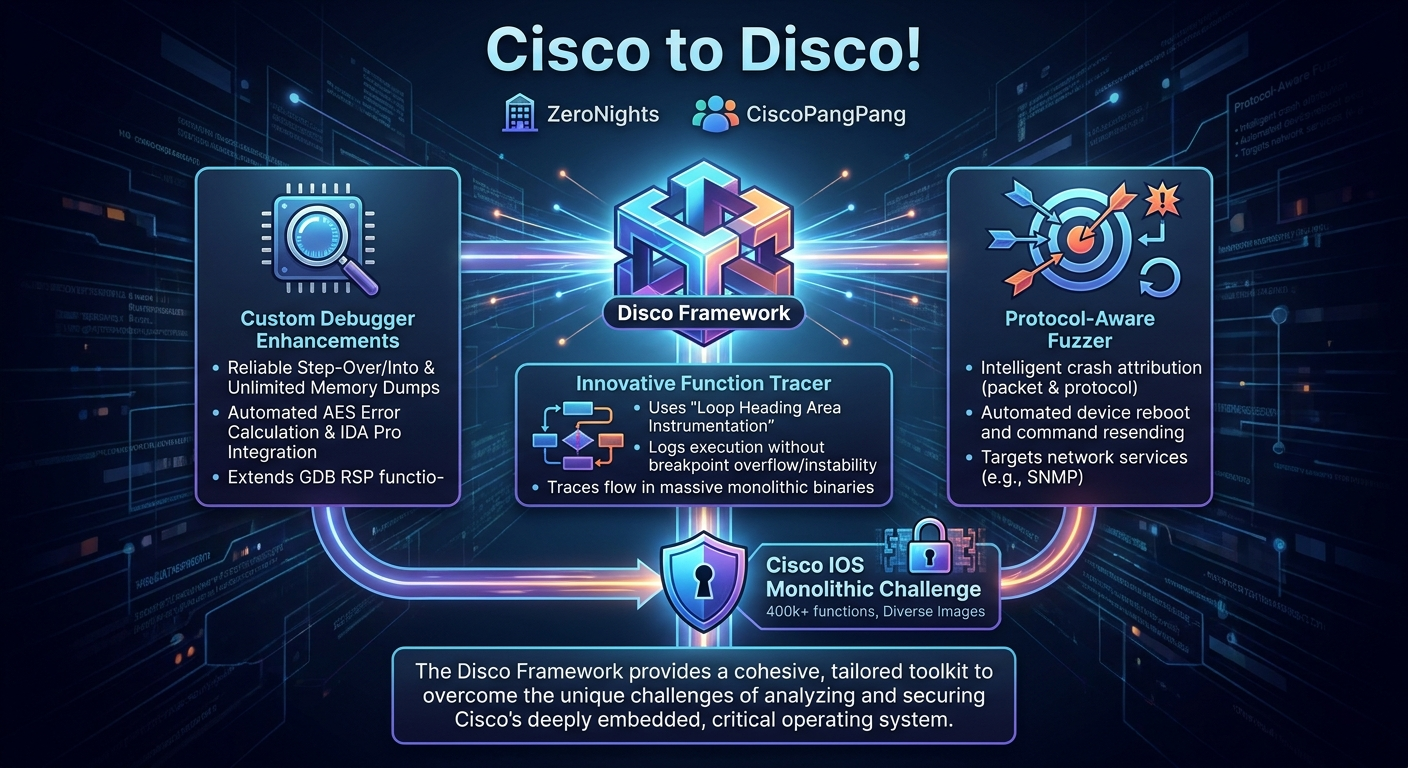
The core of their presentation revolves around the Disco framework, a multi-component solution comprising a custom debugger, an innovative function tracer, and a protocol-aware fuzzer. This framework is a direct response to the limitations observed in existing tools, such as the basic GDB RSP debugger and older fuzzing techniques that struggle with modern IOS images. By developing these specialized tools, the presenters demonstrate a comprehensive methodology for reverse engineering, vulnerability discovery, and in-depth security analysis within the complex Cisco IOS environment.
This article delves into the technical intricacies of the Disco framework, exploring how its custom debugger enhances basic GDB functionality, how its function tracer overcomes the hurdles of large binaries and anti-tampering measures, and how its fuzzer intelligently targets network protocols. The talk provides invaluable insights for security researchers and network defenders seeking to understand and secure Cisco devices against emerging threats, emphasizing the necessity of tailored approaches for such deeply embedded and critical systems.
Background
▶ Watch: Introduction to Cisco to Disco framework (0:00)
Analyzing Cisco IOS has long been recognized as a formidable challenge within the cybersecurity community, primarily due to several inherent characteristics of the operating system itself. First, Cisco IOS is a single monolithic operating system, meaning it's a massive, self-contained binary file containing an estimated 400,000 functions. This sheer scale makes comprehensive manual analysis practically impossible and overwhelms generic analysis tools. Second, there is an extensive diversity of images across different Cisco IOS versions and device models. Minor version changes can introduce significant differences in code, memory layouts, and functionality, making it difficult to apply findings or tools developed for one version to another. This lack of uniformity necessitates highly adaptable and robust analysis methodologies.
Prior attempts to analyze Cisco IOS have faced their own set of limitations. Kaspersky Lab researchers, including Artem Kondratenko, developed a MIPS debugger for Cisco IOS, which provided basic functionalities like memory read/write and disassembly. While foundational, this debugger relied heavily on GDB Remote Serial Protocol (RSP) and lacked advanced features crucial for in-depth debugging, such as reliable step-over/step-into capabilities or extensive memory dumping. Similarly, fuzzing techniques, such as those presented at Black Hat 2011, involved loading IOS images based on Dynamic (a binary analysis platform). However, Dynamic's support for the latest IOS images has waned, rendering this approach less effective for contemporary vulnerability research.
These limitations underscored the critical need for more sophisticated and purpose-built tools. Existing general-purpose debuggers like GDB or Windbg, while powerful, are not inherently optimized for the unique architecture and debugging interfaces of Cisco IOS. Furthermore, the focus of many prior Cisco IOS presentations had been primarily on exploit development rather than a holistic, deep-dive analysis of the system's internals. The "Cisco to Disco!" presentation aims to fill this gap by introducing a framework specifically engineered to overcome these historical obstacles, providing a robust platform for comprehensive Cisco IOS vulnerability research and internal understanding.
Key Findings
▶ Watch: Key features of their custom Cisco IOS debugger (6:00)
The central contribution of the "Cisco to Disco!" talk is the development and demonstration of the Disco framework, a multi-faceted toolkit designed to address the profound difficulties associated with Cisco IOS analysis. The framework's key findings and contributions can be categorized into three primary components:
- Custom Debugger Enhancements: Recognizing the deficiencies of existing Cisco IOS debuggers, particularly those based on GDB RSP, the team developed a custom debugger that significantly extends functionality. This includes implementing crucial features like reliable step-over and step-into, unlimited memory dumping (overcoming the 100-byte GDB RSP limit), advanced
continueoptions with message checking, and automatic calculation of AES errors (address translation errors). The integration with IDA Pro for real-time address correspondence and breakpoint management further streamlines the debugging process, providing analysts with unprecedented control and visibility into Cisco IOS execution.
- Innovative Function Tracer: The talk highlights a novel approach to function tracing within Cisco IOS, a notoriously challenging task given the system's size and lack of standard instrumentation methods. After initial attempts with static analysis and breakpoint-based dynamic tracing encountered limitations (such as breakpoint overflow causing system instability), the team pivoted to a sophisticated loop heading area instrumentation method. This technique involves carefully modifying the function prologue and epilogue to log execution flow without disrupting the original program control, even in functions with complex argument handling. This allows for comprehensive code coverage analysis and understanding of execution paths, which is critical for identifying vulnerable code segments.
- Protocol-Aware Fuzzer: To overcome the limitations of older fuzzers that lacked support for modern IOS images and struggled to pinpoint crash origins, the Disco framework introduces a protocol-aware fuzzer. This fuzzer utilizes a client-server architecture, maintaining a database of test cases and protocol templates. It monitors Cisco IOS for crashes, and crucially, when a crash occurs, it can identify the specific transmitted packet and protocol that triggered the fault. This intelligent feedback loop, combined with automated device reboot and resending of commands, dramatically improves the efficiency and precision of vulnerability discovery in network services running on Cisco IOS, exemplified by its application to SNMP fuzzing.
In essence, the Disco framework represents a significant advancement in Cisco IOS security research by providing a cohesive set of tools that address the system's unique analytical challenges. It moves beyond superficial analysis, enabling researchers to perform deep technical investigations into one of the most critical networking operating systems in the world.
Technical Deep Dive
▶ Watch: Detailed explanation of the function tracing method (18:00)
The Disco framework is meticulously engineered to dissect Cisco IOS, comprising a custom debugger, a robust function tracer, and an intelligent fuzzer. Each component was developed to overcome specific technical hurdles inherent to Cisco's monolithic and diverse operating system.
Custom Debugger
The custom debugger builds upon the foundation of Kaspersky Lab's MIPS debugger, which primarily leveraged GDB RSP for basic memory and register manipulation. The Disco team identified critical missing features that were essential for practical deep analysis.
- Enhanced Debugging Primitives:
- Step Over and Step Into: While GDB RSP allows basic instruction execution, implementing reliable step-over and step-into for complex branch and jump instructions within Cisco IOS was a significant undertaking. The debugger intelligently handles function calls and loops, allowing analysts to navigate code flow precisely.
- Advanced
continue: The default GDBcontinuecommand is basic. The Disco debugger'scontinuefeature includes options to check specific Cisco IOS messages or conditions, allowing for more targeted debugging sessions. - Unlimited Memory Dump: The standard GDB RSP memory dump is limited to 100 bytes (or 99 bytes as observed by the speakers). The Disco debugger overcomes this limitation, enabling analysts to dump arbitrary amounts of memory, crucial for inspecting large data structures or code segments.
- AES Error Calculation: Cisco IOS uses AES (Address Exception Syndrome) errors for memory management and protection. Calculating these errors and translating virtual addresses to physical ones (and vice-versa) is vital for understanding memory-related issues. The debugger integrates a calculator for this, streamlining an otherwise manual and error-prone process.
is_aliveandvmap: Theis_alivecommand allows checking if the Cisco IOS debugger process is still active, providing immediate feedback on system stability. Thevmapcommand parses and displays the output of Cisco'sshow regioncommand, providing a real-time virtual memory map, which is invaluable for understanding memory segmentation and identifying potential vulnerabilities.save_breakpoints: To support persistent research, the debugger can save all active breakpoints, base address information, and other valuable coverage data to a file. This allows researchers to resume their analysis without reconfiguring the debugging environment from scratch after a device reboot or debugger restart.
- Architecture and Integration:
The debugger operates by establishing a GDB RSP serial connection with the Cisco router. The framework's architecture involves the router running the debugger, which communicates with a host machine. On the host, the Disco debugger client interacts with IDA Pro. A key feature is the auto-calculation of corresponding addresses between the Cisco IOS execution environment and the IDA Pro disassembler view, providing a seamless analytical experience. This allows researchers to step through code in real-time on the device while observing the disassembled instructions and memory context directly within IDA.
Function Tracer
The development of the function tracer involved overcoming significant design challenges, leading to an innovative instrumentation approach.
- Initial Approaches and Limitations:
The team initially explored static analysis methods to bypass anti-tampering measures, such as those on the Cisco 2911 router, but these attempts failed. They then moved to dynamic tracing using breakpoint mode, where breakpoints were placed at the entry of functions. The idea was to extract function offsets from IDA, find their dynamic addresses, set breakpoints, and then monitor the program counter upon hitting a breakpoint. However, this method proved problematic:
- Breakpoint Limits: Cisco IOS could not handle a large number of breakpoints. While a few thousand worked for small demos, it was insufficient for tracing "hundreds of thousands of functions." Attempting to write too many breakpoints caused the device to crash or write breakpoints to incorrect locations.
- Performance Overhead: The real-time monitoring and processing required for each breakpoint hit introduced significant latency.
- Loop Heading Area Instrumentation:
The team abandoned the breakpoint-based approach in favor of loop heading area instrumentation. This method focuses on modifying the function's prologue to insert tracing code without altering the original control flow.
- Storing and Restoring Instructions: The core challenge is to insert custom code while ensuring the original instructions are preserved and executed. The tracer stores the initial instructions of a function's prologue (typically two instructions) before the instrumentation code is executed. After the instrumentation, these original instructions are restored and executed.
- Handling Arguments: A critical detail is that the first two instructions after the prologue often involve taking arguments from the caller, often using the
t5register. The instrumentation must account for this to ensure that arguments are correctly passed and that the function executes as intended. The size and type of the instructions to be restored can vary for each function, requiring dynamic handling. - Recovering Original Flow: The tracer is designed to "recover fetched instruction" and distinguish the current function, ensuring that the original program flow is maintained. This "dirty" but effective method allows for comprehensive function call logging without causing system instability.
- IDA Integration: Function offsets are easily obtained from IDA Pro. The
t5register is used to allocate stack space before returning to the original function, indicating careful attention to MIPS calling conventions.
Fuzzer (Disco Fuzzer)
The Disco fuzzer addresses the deficiencies of older fuzzers, particularly their inability to pinpoint the root cause of crashes in modern Cisco IOS.
- Protocol-Aware Fuzzing:
Unlike simple byte-flipping fuzzers, the Disco fuzzer is protocol-aware. It maintains a database containing information about test cases and protocol templates (e.g., for SNMP, HTTP, etc.). This allows it to generate syntactically valid but semantically malicious inputs, increasing the likelihood of finding vulnerabilities.
- Client-Server Architecture for Crash Analysis:
The fuzzer employs a sophisticated client-server model to enhance crash detection and attribution:
- Fuzzer Client: Runs on a host, sending crafted packets to the Cisco device.
- Cisco IOS Monitor: A component running on the Cisco device continuously monitors for crashes or abnormal behavior.
- Crash Attribution: When a crash occurs, the monitor communicates back to the fuzzer client. Crucially, it provides information about the most recently transmitted packet and the protocol that caused the crash. This eliminates the guesswork often associated with black-box fuzzing.
- Automated Recovery: Upon detecting a crash, the fuzzer automatically triggers a reboot of the Cisco device. Once the device is back online, it resends the crash-inducing commands or packets to confirm the vulnerability and gather more data.
- Database Update: All crash-related information, including the problematic packet and the protocol, is stored in the fuzzer's database. This structured data allows for efficient analysis and prioritization of vulnerabilities.
- Example: SNMP Fuzzer: The presentation specifically demonstrates fuzzing SNMP packets, showing how the fuzzer intelligently sends inputs, detects a crash, and records the event in its database.
The technical depth of the Disco framework underscores the team's commitment to building comprehensive, reliable tools for a notoriously difficult target, pushing the boundaries of what's possible in Cisco IOS security research.
Demo / Proof of Concept
▶ Watch: Their custom fuzzer's architecture and crash identification (22:00)
The "Cisco to Disco!" presentation included several live demonstrations to illustrate the capabilities of the Disco framework's components. While the speakers initially apologized for some "demo issues" and substituted other prepared demonstrations, the showcased functionalities were highly impactful.
The Custom Debugger demo highlighted its seamless integration with IDA Pro. Researchers could confirm the exact memory addresses in the live Cisco IOS environment corresponded accurately with the disassembled view in IDA. An "info file" was shown, containing crucial memory mapping information, base addresses, and recorded breakpoints, demonstrating the debugger's ability to capture and persist debugging session data. The continue command was also shown in action, illustrating precise control over program execution.
For the Function Tracer, the demonstration successfully showcased its ability to log function calls in real-time. As various functions were executed on the Cisco IOS device, the tracer actively printed the "current functioning" (i.e., the name or address of the currently executing function), validating its sophisticated instrumentation technique. This proved the tracer's effectiveness in providing detailed execution flow information, a critical asset for code coverage analysis and understanding complex program logic.
Finally, the Fuzzer was demonstrated with an SNMP fuzzer. The demo showed the fuzzer sending arbitrary SNMP packets to the Cisco device. The crucial part of this demonstration was observing the fuzzer's database after a crash occurred. The database clearly displayed the data sent by the fuzzer at the time of the crash, allowing researchers to pinpoint the exact input that triggered the vulnerability. This validated the fuzzer's intelligent crash attribution mechanism, a significant improvement over traditional fuzzing methods.
These demonstrations collectively provided concrete evidence of the Disco framework's practical utility, showcasing how its custom tools enable precise debugging, comprehensive function tracing, and effective vulnerability discovery within the challenging Cisco IOS environment.
Defensive Implications
▶ Watch: Conclusion and ongoing research (30:00)
The "Cisco to Disco!" presentation offers critical insights for network defenders and security professionals responsible for securing Cisco IOS devices. The development of such a sophisticated and comprehensive framework by researchers underscores that Cisco IOS remains a high-value target for both vulnerability research and potential exploitation.
Firstly, the talk highlights the persistent difficulty of analyzing and securing Cisco IOS due to its monolithic architecture, vast codebase, and diverse versions. This implies that relying solely on vendor-supplied patches or generic security tools may not be sufficient. Defenders must recognize that highly motivated attackers are willing to invest significant effort in developing custom tools like the Disco framework to uncover zero-day vulnerabilities.
Secondly, the capabilities demonstrated by the custom debugger and function tracer indicate that attackers can gain unprecedented visibility into Cisco IOS internals. This means they can precisely understand execution flows, identify vulnerable code paths, and craft highly effective exploits. Defenders should therefore prioritize patch management rigorously, ensuring that all Cisco devices are running the latest, most secure IOS versions to mitigate known vulnerabilities that could be leveraged by such deep analysis.
Thirdly, the protocol-aware fuzzer is a direct warning regarding the attack surface presented by network services running on Cisco devices. Protocols like SNMP, HTTP, BGP, and others are prime targets. Defenders should implement strict access controls for management interfaces and network services, limiting exposure to untrusted networks and users. Furthermore, network segmentation and intrusion detection/prevention systems (IDPS) configured to detect anomalous traffic patterns specific to these protocols can help identify and block fuzzing attempts or exploit payloads.
Finally, the methodology presented by the Disco framework can also serve as a blueprint for proactive defense. Security teams within organizations that extensively use Cisco equipment could adapt similar internal research methodologies to perform their own vulnerability assessments, develop custom monitoring solutions, or even validate the effectiveness of vendor-provided security fixes. Understanding the techniques used by advanced researchers and attackers is crucial for building robust defensive strategies against them. The talk emphasizes that a deep, analytical approach is required to truly understand and secure complex systems like Cisco IOS.
Key Takeaways
- Cisco IOS Analysis is Exceptionally Challenging: The monolithic nature, vast function count (approx. 400,000), and extensive version diversity of Cisco IOS render generic security tools inadequate for deep analysis.
- Custom Tooling is Essential: The Disco framework—comprising a custom debugger, function tracer, and fuzzer—demonstrates the necessity of purpose-built tools to overcome the unique technical hurdles of Cisco IOS.
- Advanced Debugging Capabilities: The custom debugger significantly enhances GDB RSP, providing crucial features like reliable step-over/into, unlimited memory dumping, AES error calculation, and seamless IDA Pro integration for precise control and visibility.
- Innovative Function Tracing: The team's shift to loop heading area instrumentation is a sophisticated solution for comprehensive function tracing, overcoming the limitations of breakpoint-based methods in large, complex binaries.
- Intelligent Protocol Fuzzing: The Disco fuzzer's protocol-aware approach, client-server architecture, and automated crash attribution (including packet identification and device reboot) dramatically improve the efficiency and precision of vulnerability discovery in network services.
- Proactive Defense is Key: The methodologies presented can guide network defenders in understanding attack surfaces, implementing stronger access controls, and potentially developing internal research capabilities to secure critical Cisco infrastructure.
About the Speaker(s)
The "Cisco to Disco!" talk was presented by members of the CiscoPangPang team based in South Korea. Their work focuses on the challenging domain of Cisco IOS vulnerability research and analysis. The project discussed, the Disco framework, is an ongoing effort aimed at developing advanced tools to understand and exploit vulnerabilities within Cisco's complex operating system, reflecting their deep expertise in reverse engineering and system security.
Reviews
Dr. Zero (Offensive Security Researcher) — SOLID
The CiscoPangPang team actually did the grueling engineering required to make Cisco IOS reversing less of a nightmare. They didn't just drop a single memory corruption bug; they built a coherent toolchain to bypass GDB RSP's limitations and instrument a massive monolithic binary without crashing the router.
Heather Calloway (CISO) — SOLID
This is deep-technical exploit development for Cisco IOS, well outside my usual governance lane. However, the strategic takeaway for leadership is clear: the barrier to entry for finding zero-days in our core routing infrastructure has fundamentally dropped. If your network team is still delaying Cisco patches to preserve uptime, this research invalidates that risk calculus.