Adversary Village Keynote
Joseph Mlodzianowski (Founder · Texas Cyber Summit)
Adversary Village @ c0c0n 2021 · Day 1 · Adversary Village
Overview
In this keynote address at the Adversary Village during the 13th annual c0c0n hacking and cybersecurity conference, Joseph Mlodzianowski, Founder of the Texas Cyber Summit, delved into the critical concept of the attacker mindset and how adversaries perceive organizational networks. Mlodzianowski’s talk emphasized the indispensable role of red teaming as a strategic approach to cybersecurity, moving beyond traditional penetration testing to simulate real-world threats. He highlighted that an adversary could range from a dedicated red team hired to assess security, to a nation-state, or a corporate competitor, each with varying levels of sophistication and persistence.
Key moments
- 0:40 Defining Red Teams and their core purpose
- 3:55 Blind spots: the most difficult defense challenge
- 6:00 Red Team mission: simulate threats, identify unknown risks
- 8:55 Military origins of red teaming and diverse perspectives
- 10:00 Key Red Team Rule 1: Always have an escape plan
- 13:00 Key Red Team Rule 4: The "10th Man" for dissent
- 24:00 Red Teaming's true goal: training and measuring effectiveness
Adversary Village Keynote
Speakers: Joseph Mlodzianowski, Founder, Texas Cyber Summit
Conference: Adversary Village @ c0c0n
YouTube: https://www.youtube.com/watch?v=mGx16SiQ0uE
Overview
In this keynote address at the Adversary Village during the 13th annual c0c0n hacking and cybersecurity conference, Joseph Mlodzianowski, Founder of the Texas Cyber Summit, delved into the critical concept of the attacker mindset and how adversaries perceive organizational networks. Mlodzianowski’s talk emphasized the indispensable role of red teaming as a strategic approach to cybersecurity, moving beyond traditional penetration testing to simulate real-world threats. He highlighted that an adversary could range from a dedicated red team hired to assess security, to a nation-state, or a corporate competitor, each with varying levels of sophistication and persistence.
The core of Mlodzianowski’s presentation focused on providing an adversary's view to empower organizations to identify and mitigate blind spots in their defenses. He argued that red team exercises are a hallmark of the information security lifecycle, offering invaluable insights into an organization's defensive and operational security teams. By challenging preconceived notions of security strength, red teaming fosters a deeper understanding of systemic risks, ultimately leading to more robust and resilient security postures. This talk serves as a vital guide for any organization seeking to evolve its security strategy from reactive defense to proactive, adversary-informed resilience.
Background
▶ Watch: Defining Red Teams and their core purpose (0:40)
The evolution of cybersecurity threats necessitates a shift from purely technical vulnerability assessments to a more holistic, adversarial simulation approach. Historically, organizations have relied on penetration testing and vulnerability assessments to identify technical flaws and reduce their attack surface. While these methods are valuable for uncovering known weaknesses and misconfigurations, Mlodzianowski contends that they often fall short in preparing an organization for a determined, adaptive adversary. Penetration tests, he explained, are often scripted exercises with a defined scope, whereas real adversaries operate without such constraints, probing continuously and adapting their tactics, techniques, and procedures (TTPs).
The problem, as Mlodzianowski articulated, lies in the pervasive existence of blind spots within organizational defenses. He cited an example of a well-resourced organization with top-notch security that had a development server exposed to the internet via a simple cable modem, unbeknownst to its security teams. Such overlooked entry points become critical vectors for sophisticated attackers. Furthermore, environments like Operational Technology (OT), prevalent in critical infrastructure, often feature older systems that cannot be easily patched and are protected by assumed air gaps or basic firewalls. These systems, when accessed by insiders or inadvertently exposed (e.g., an elevator system used for internet browsing), become susceptible to common attacks like drive-bys and watering holes, highlighting the inadequacy of static defenses against dynamic threats. The genesis of red teaming, originating from military forces, was precisely to address this gap by fostering diverse perspectives to challenge assumptions and identify vulnerabilities in complex systems, whether physical or virtual.
Key Findings
▶ Watch: Red Team mission: simulate threats, identify unknown risks (6:00)
Mlodzianowski's keynote underscored several critical findings regarding effective cybersecurity and the role of red teaming:
- Red Teaming as Adversary Emulation: A fundamental distinction was drawn between vulnerability assessments, penetration testing, and red teaming. While the former identify technical flaws, red teaming is explicitly defined as the process of using TTPs to emulate a real-world threat actor with the goal of training and measuring the effectiveness of an organization's people, resources, processes, and technology. It is not merely hunting for vulnerabilities but understanding how an adversary would exploit them.
- Uncovering Blind Spots and Unknown Risks: Red teams are uniquely positioned to identify previously unknown and unmitigated risks. By thinking outside the box and applying adversarial engineering, they challenge an organization's belief in its security strength, exposing areas that even internal security teams might overlook.
- The "12 Rules of Red Teaming Mindset": The talk's central contribution was the articulation of 12 foundational principles guiding the red team mindset. These rules provide a comprehensive framework for planning, executing, and learning from adversarial simulations, emphasizing adaptability, stealth, and strategic thinking.
- Importance of Diversity and Dissent: Mlodzianowski highlighted the "10th Man" rule, a strategy promoting dissenting opinions within a team. This concept stresses the importance of diverse perspectives within a red team to challenge majority assumptions and uncover unconventional attack vectors, no matter how "crazy" they might initially seem.
- Beyond Technical Flaws: Red teaming extends beyond merely technical exploitation. It assesses the human element (response times, awareness), operational security, and incident response capabilities, providing a holistic view of an organization's resilience. The ultimate goal is to generate actionable intelligence for the blue team to build robust, adaptive defenses.
Technical Deep Dive
▶ Watch: Military origins of red teaming and diverse perspectives (8:55)
The core of Mlodzianowski's technical discussion revolved around the "12 Rules of Red Teaming Mindset," a set of principles designed to guide successful adversarial emulation. These rules, originating from military strategy but fully applicable to cybersecurity, provide a robust framework for red team operations:
- Always Have an Escape Plan: This foundational rule emphasizes foresight and contingency planning. Red team operations, like any complex endeavor, are prone to failure. Therefore, having multiple backup plans and clear exit strategies is paramount. This applies not just to the immediate objective but to the entire engagement, ensuring the team can disengage safely and effectively if circumstances change or unexpected events occur.
- Be Aware of Your Surroundings: A red team must possess a comprehensive understanding of the target environment's defenses. This includes identifying intrusion detection systems (IDS), intrusion prevention systems (IPS), and multiple layers of firewalls. For a red teamer, these are not impenetrable barriers but merely "stepping stones" that require creative circumvention, rather than direct confrontation, especially under time constraints.
- Assume Everything's Messed Up: This rule encourages a black box mentality. Red teamers should operate under the assumption that they do not possess complete information about the target. This forces them to think outside the box, probe for unknown weaknesses, and avoid reliance on potentially inaccurate or incomplete intelligence. It promotes adaptability and resilience in the face of uncertainty.
- Always Have a Backup Plan (The 10th Man Rule): Building on the first rule, this principle introduces the 10th Man strategy. If a majority of a team agrees on a particular approach, it is the responsibility of one member (the "10th man") to offer a dissenting opinion or an alternative viewpoint, however improbable it may seem. This fosters critical thinking, challenges groupthink, and often uncovers unconventional, yet effective, attack vectors. Diversity in team composition is crucial for this rule to function effectively.
- Never Get Caught: Drawing from the principles of covert operations and spycraft, this is considered a "golden rule." Getting detected by the blue team during an engagement is a technical failure from the red team's perspective. While it can be a learning opportunity, the primary objective is to operate stealthily, demonstrating how a sophisticated, undetected adversary could compromise the system.
- Keep Your Mouth Shut (OPSEC): Operational Security (OPSEC) is as vital for red teams as it is for national security. Prematurely disclosing TTPs, tools, or techniques not only compromises future engagements but also deprives the blue team of a genuine learning experience. The goal is to allow the blue team to discover and adapt, not to simply patch known methods.
- Keep It Simple, Stupid (KISS): Complex plans are inherently more prone to failure. Red teams should strive for simplicity and modularity in their approach. Simpler attack paths are easier to execute, less likely to introduce errors, and more adaptable to changing circumstances during an engagement. This allows for rapid adjustments without derailing the entire operation.
- Simple and Light: This rule applies to both physical and digital operations. Being "nimble, small, and light" reduces the likelihood of detection and increases efficiency. In physical engagements, this means minimizing equipment. In digital attacks, it refers to using lightweight, efficient tools and avoiding overly complex backdoors that could fail or leave excessive traces. Furthermore, it advocates for smaller, highly skilled teams over large, unwieldy ones, as fewer interchangeable parts lead to faster momentum and easier adaptation.
- Plan, Execute, and Vanish: A successful red team engagement involves meticulous planning, precise execution, and a complete vanishing act. This means leaving no trace of their presence, whether physical (undetected exits) or digital (cleaning logs, using memory-resident attacks). The objective is to demonstrate impact without leaving forensic evidence that would immediately reveal the breach. Post-engagement, the red team explains their actions to the blue team, turning the "vanishing act" into a learning opportunity.
- You Don't Have to Like It, Just Do It (Reporting and Documentation): While not explicitly numbered as "Rule 10" in the speaker's original sequence (it was referred to as "Rule 11" before another "Rule 11"), this principle emphasizes the critical, often unglamorous, task of thorough documentation and reporting. Every action, observation, and result throughout the engagement must be meticulously recorded. This data is invaluable for the post-engagement debriefing, enabling the blue team to understand the attack chain and improve defenses effectively.
- Always Have the Right Gear: Red teamers must be equipped with the best available tools, whether physical or digital. This includes having a reliable attack platform with the latest attack vectors. Crucially, familiarity and proficiency with these tools are non-negotiable. Testing tools in a lab environment and building muscle memory ensures that the team can execute complex operations smoothly in the field without needing to consult documentation.
- Trust Your Gut: The final rule underscores the importance of intuition. If a red team member feels that something is amiss, that a plan isn't working, or that the team's efforts are unproductive, it's essential to pause, review the strategy, and re-engage with the team. Trusting one's instinct can prevent significant setbacks and lead to necessary adjustments, ensuring the overall success and safety of the mission.
Demo / Proof of Concept
▶ Watch: Key Red Team Rule 4: The "10th Man" for dissent (13:00)
As a keynote address, Joseph Mlodzianowski's presentation was primarily conceptual and methodological, focusing on the strategic principles of the attacker mindset and red teaming. Consequently, there were no live demonstrations or technical proofs of concept presented during the talk. The speaker relied on anecdotal examples and theoretical frameworks to illustrate his points.
Defensive Implications
▶ Watch: Red Teaming's true goal: training and measuring effectiveness (24:00)
The insights gleaned from Mlodzianowski's talk carry profound implications for cybersecurity defenders:
- Embrace Adversary Emulation: Organizations should move beyond traditional vulnerability assessments and penetration tests. Investing in or employing red team exercises is crucial for understanding how sophisticated adversaries truly operate against their specific environment, testing not just technology, but also people and processes.
- Identify and Mitigate Blind Spots: Actively seek out and remediate unknown or overlooked assets and exposures. The example of a development server on a cable modem highlights that even well-defended organizations can have critical blind spots. Regular, independent red team assessments are essential to uncover these.
- Prioritize OT Security: For organizations with Operational Technology (OT) environments, a critical focus on patching, segmentation, and monitoring is necessary. The speaker noted that many OT systems are old and unpatchable, often relying on insecure "air gaps." Defenders must implement compensating controls and ensure that personnel accessing these systems adhere to strict security protocols to prevent common attacks like drive-bys and watering holes.
- Train Blue Teams with an Adversarial Mindset: Defenders (blue teams) should undergo training that exposes them to red team methodologies and TTPs. Understanding what an adversary is looking for and how they operate empowers blue teams to anticipate attacks, improve detection capabilities, and develop more effective defensive strategies.
- Foster Internal Red Teaming Principles: Even without a formal red team, internal security teams can adopt the 12 Rules of Red Teaming Mindset. This includes developing robust contingency plans, promoting diverse perspectives (the "10th Man" rule), emphasizing OPSEC, simplifying defensive strategies, and meticulously documenting all security activities.
- Demand Comprehensive Reporting: Red team engagements should culminate in detailed, actionable reports. Defenders must insist on thorough documentation of every step taken by the red team, from initial reconnaissance to final exfiltration. This information is vital for understanding the attack chain, identifying gaps in defenses, and implementing targeted improvements.
- Continuous Learning and Adaptation: The ultimate goal of red teaming is to create a learning opportunity. Defenders should view red team findings not as failures, but as invaluable lessons that enable them to continuously refine their security posture, adapt to evolving threats, and build a more resilient defense-in-depth strategy.
Key Takeaways
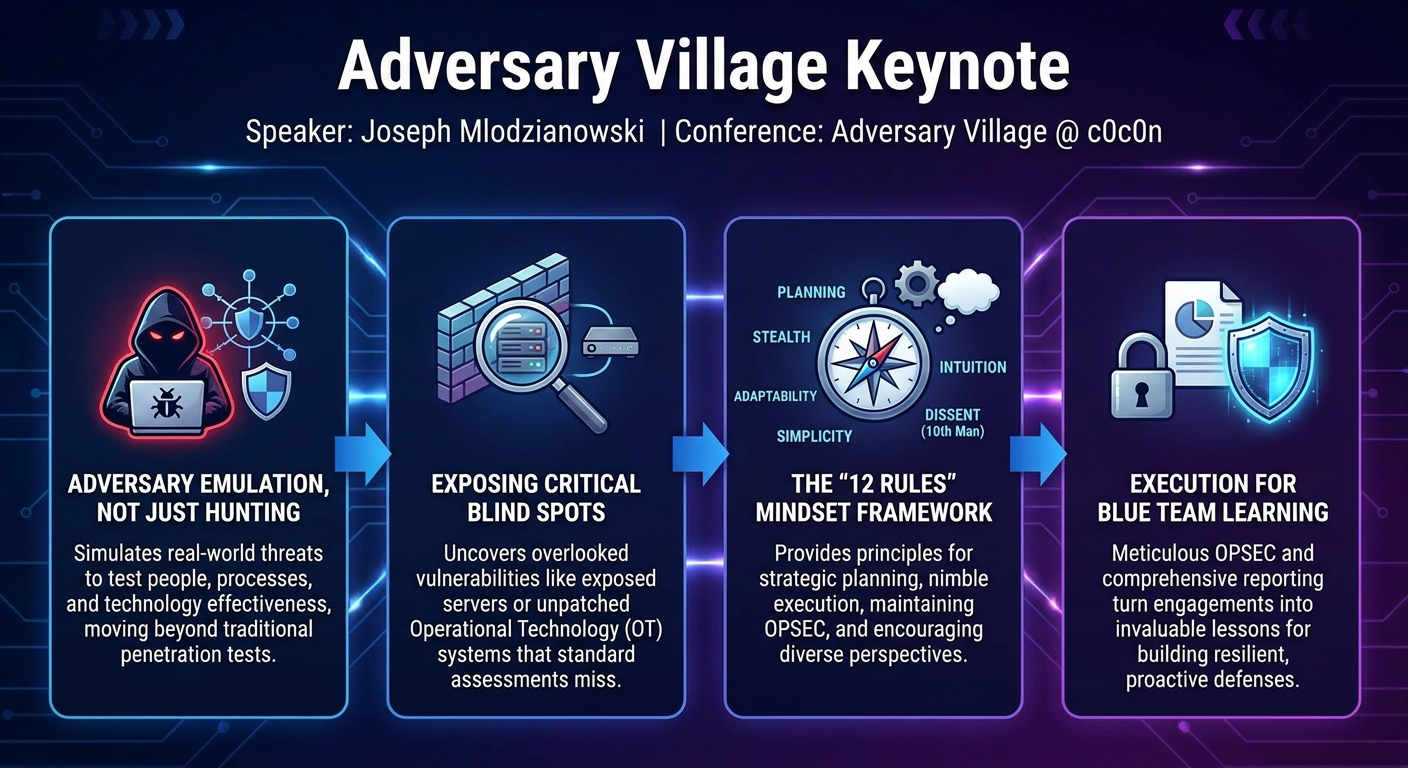
- Red teaming is adversary emulation, not vulnerability hunting. Its purpose is to simulate real-world threats to test the effectiveness of an organization's people, processes, and technology, extending beyond the scope of traditional penetration tests.
- Organizations harbor critical "blind spots" that only an adversarial perspective can uncover. These overlooked vulnerabilities, such as exposed development servers or unpatched OT systems, represent significant risks that traditional security assessments often miss.
- The "12 Rules of Red Teaming Mindset" provide a robust framework for effective adversarial simulation. These principles emphasize planning, stealth, adaptability, simplicity, and the importance of intuition in navigating complex security challenges.
- Effective red team operations demand meticulous OPSEC, nimble execution, and comprehensive documentation. Protecting TTPs, keeping plans simple, operating with small, skilled teams, and meticulously reporting findings are crucial for both engagement success and blue team learning.
- Diversity in thinking, exemplified by the "10th Man" rule, is vital for uncovering unconventional attack vectors. Challenging prevailing assumptions and encouraging dissenting opinions can lead to innovative approaches to breaching defenses.
- Red team engagements are a critical learning opportunity for blue teams, enhancing overall security posture. By understanding how adversaries operate and where defenses fail, organizations can build more resilient, adaptive, and proactive cybersecurity strategies.
About the Speaker(s)
Joseph Mlodzianowski is the Founder of the Texas Cyber Summit, a significant event in the cybersecurity community. As a seasoned professional in the field, Mlodzianowski brings a wealth of experience in understanding the attacker mindset and advocating for robust security methodologies. In his keynote at Adversary Village @ c0c0n, he demonstrated a deep appreciation for the community's efforts in educating future cyber defenders and researchers.
Reviews
Dr. Zero (Offensive Security Researcher) — HARD PASS
This is a 101-level motivational speech pretending to be an operational keynote. If you need a conference talk to tell you to 'trust your gut' and 'write a report,' you shouldn't be allowed anywhere near a production network.
Heather Calloway (CISO) — WEAK
This keynote attempts to elevate red teaming strategy but delivers a list of recycled military maxims. "Trust your gut" and "Keep it simple" are not operational frameworks your leadership team can use to validate controls. Skip this and spend the time reviewing your actual red team's latest attack chains.