Light Basin - Telecom roaming network attack case study
Akib Sayyed (Founder · Matrix Shell)
Adversary Village @ c0c0n 2021 · Day 2 · Adversary Village
Overview
In this insightful presentation at Adversary Village @ c0c0n, Akib Sayyed, Founder of Matrix Shell, provides a comprehensive case study of the "Light Basin" advanced persistent threat (APT) group. With a decade of experience navigating the complexities of the telecom sector, Sayyed sheds light on the evolving landscape of sophisticated attacks targeting critical telecom infrastructure. The talk specifically dissects Light Basin's methodologies, focusing on their exploitation of roaming networks for covert operations and data exfiltration. This deep dive into a real-world APT campaign is crucial for understanding the inherent vulnerabilities within global telecom systems and the advanced techniques adversaries employ to compromise them.
Key moments
- 0:00 Introduction to Light Basin telecom attack case study
- 2:40 Overview of top telecom attack vectors (SS7, Diameter, GTP)
- 16:30 Light Basin's multi-stage attack methodology (EDNS, lateral movement, GTP)
- 19:00 Detailed breakdown of tools used by Light Basin
- 22:00 Security recommendations for telecom operators and vendors
- 25:50 Diagrammatic explanation of the Light Basin attack flow
- 32:00 Q&A: 5G security enhancements and challenges
Light Basin - Telecom Roaming Network Attack Case Study
Speakers: Akib Sayyed, Founder, Matrix Shell
Conference: Adversary Village @ c0c0n
YouTube: https://www.youtube.com/watch?v=CXcImwhkJQE
Overview
In this insightful presentation at Adversary Village @ c0c0n, Akib Sayyed, Founder of Matrix Shell, provides a comprehensive case study of the "Light Basin" advanced persistent threat (APT) group. With a decade of experience navigating the complexities of the telecom sector, Sayyed sheds light on the evolving landscape of sophisticated attacks targeting critical telecom infrastructure. The talk specifically dissects Light Basin's methodologies, focusing on their exploitation of roaming networks for covert operations and data exfiltration. This deep dive into a real-world APT campaign is crucial for understanding the inherent vulnerabilities within global telecom systems and the advanced techniques adversaries employ to compromise them.
The Light Basin group, also identified as UNC1945, has been active since 2016, demonstrating a profound understanding of telecom network architecture and a knack for developing custom tools. Their operations underscore a significant threat to the integrity and confidentiality of communication networks worldwide. Sayyed's analysis serves as a stark reminder of the persistent and evolving nature of cyber threats in the telecom domain, emphasizing the need for robust defensive strategies against highly skilled adversaries who leverage intricate knowledge of protocols and network flows to achieve their objectives.
Background
▶ Watch: Introduction to Light Basin telecom attack case study (0:00)
The global telecommunications network, by its very nature, relies on complex interconnections and protocols to facilitate seamless communication, especially during roaming. Roaming allows subscribers to use their mobile services outside their Home Public Land Mobile Network (HPLMN) by connecting to a Visited Public Land Mobile Network (VPLMN). This intricate web of agreements and technical interfaces, while enabling global connectivity, also introduces numerous attack surfaces that sophisticated adversaries like Light Basin actively exploit.
Sayyed begins by outlining a spectrum of prevalent telecom attacks, setting the stage for Light Basin's specific techniques:
- SS7 (Signaling System No. 7) Abuse: This foundational signaling protocol remains a significant vulnerability. Attackers leverage SS7 flaws for location tracking, which can be sold on black markets for $5 to $200 per query. They also exploit it for monitoring call metadata, often by abusing the Intelligent Network (IN) system or billing systems, to gather details like subscriber location during calls, call recipients, and billing parameters. Tools like "YouLean Unlimited and Perfection" (active around 2012-2014, reportedly sold for $20 million) once offered comprehensive tracking capabilities.
- Diameter Abuse: As an evolution of the RADIUS protocol, Diameter is designed for AAA (Authentication, Authorization, Accounting) services. Despite being more robust than SS7, it still suffers from vulnerabilities, primarily location tracking and fake billing. Attackers can manipulate subscriber profiles to switch prepaid users to postpaid, generating fraudulent bills or obtaining free data. While less common, spoofing DNS through Diameter could also enable traffic interception.
- GTP (GPRS Tunneling Protocol) Abuse: GTP manages the tunneling of user data and signaling traffic within GPRS/UMTS/LTE networks. It comprises GTP-C (Control) for signaling and GTP-U (User) for data. Vulnerabilities here allow for identity impersonation, enabling access to private corporate networks via mobile data. Crucially, GTP can be abused to create covert channels over GRX (GPRS Roaming Exchange), a technique Light Basin demonstrably employed for data exfiltration.
- Radio Access Network (RAN) Exploitation: Direct attacks on the air interface, while some older methods like call deception are no longer viable, still include identity impersonation. This can be used to drain subscriber balances by making calls to premium rate numbers, where a portion of the call cost is paid to the number's owner (e.g., a TV show like KBC).
- Physical Infrastructure Attacks: Direct access to plant sites can enable traffic sniffing in transit by tapping fiber optic or Ethernet cables. Denial-of-Service (DoS) attacks can be performed by physically cutting cables, although resilient ring topologies require cutting at both ends.
- SIM Swap Attacks: A social engineering tactic where attackers convince subscribers to authorize a SIM card replacement, gaining control over their phone number. Indian operators have implemented mitigations like a one-day SMS delay for new SIMs, but this is often insufficient.
- IoT Botnets: IoT devices can be compromised to form botnets, consuming data, sending false sensor data, or participating in larger attack campaigns.
- SMS Spoofing and A2P (Application-to-Person) Bypass: Default configurations in roaming agreements often allow non-roaming partners to deliver SMS, creating an A2P bypass. This facilitates "all you can send" abuse, where attackers use SIM farms (e.g., 30 SIMs sending 100 SMS daily total 3000 SMS) to send bulk messages via gray routes, sometimes with the complicity of operators creating fake number series to obscure the origin.
- Routing Flaws: Exploiting misconfigurations or vulnerabilities in routing can allow attackers to reach internal core network elements, such as RAN equipment, border proxies, or core network components, which are not intended to be directly accessible from external networks.
It is against this backdrop of pervasive telecom vulnerabilities that the Light Basin group operates, demonstrating a mastery of these attack vectors to achieve their strategic objectives.
Key Findings
▶ Watch: Light Basin's multi-stage attack methodology (EDNS, lateral movement, GTP) (16:30)
The Light Basin APT group, also known as UNC1945, has distinguished itself through its sophisticated and targeted attacks on telecom infrastructure since 2016. Their operations reveal a deep understanding of telecom protocols and network architecture, enabling them to craft custom tools and orchestrate complex attack chains. A significant finding highlighted in the talk is their exploitation of External DNS (EDNS) servers as a primary ingress vector.
The core findings regarding Light Basin's attack methodology can be summarized as follows:
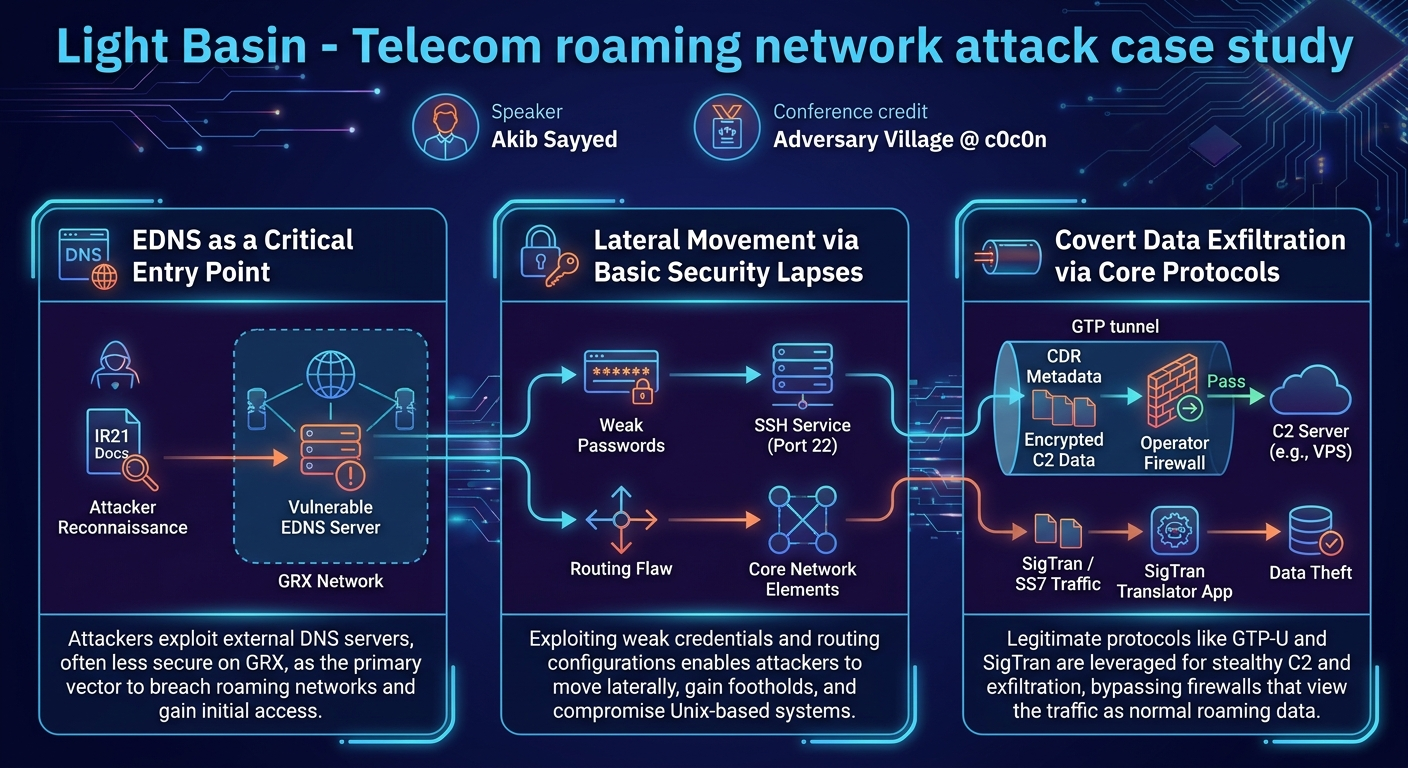
- Initial Access via EDNS Exploitation: Light Basin identified vulnerable EDNS servers, often using publicly available IR21 documents that detail roaming agreements and network configurations between operators. They leveraged already compromised networks, particularly in regions with weaker security postures (e.g., Africa), to launch attacks against EDNS servers. These EDNS servers, while often protected from the general internet, frequently had less stringent security controls when accessed via the GRX (GPRS Roaming Exchange) network, making them a prime target.
- Lateral Movement and Persistence: Once access to an EDNS server was achieved, Light Basin performed password spraying techniques against other network elements, particularly those with open SSH port 22, to gain further footholds. They exploited routing flaws that allowed them to reach core network components from the roaming network. To maintain persistence and obfuscate their activities, they replaced original system binaries with their own modified versions, using
iptablesrules for output filtering to control and hide exfiltrated data. - Covert Command and Control (C2) and Data Exfiltration: A critical aspect of their operation was the establishment of a C2 channel and data exfiltration mechanism over the GPRS roaming network. They specifically utilized GTP-U (GPRS Tunneling Protocol - User) tunnels for this purpose. By encapsulating their malicious traffic within legitimate-looking GTP-U flows, they bypassed standard operator firewalls and monitoring systems, which often perceive such traffic as normal roaming data. The exfiltrated data, including sensitive CDR (Call Detail Record) metadata, was sent to a C2 server, exemplified by the use of a Vultr VPS. They also employed SigTran, the IP-based version of SS7, for communication and data exfiltration, developing custom tools like the "SigTran Translator App" to facilitate this.
In essence, Light Basin's strategy involves meticulously mapping out telecom network elements, exploiting known vulnerabilities in commonly exposed services like EDNS, leveraging weak security practices (e.g., weak passwords), and then utilizing core telecom protocols (GTP, SigTran) as stealthy conduits for C2 and data theft. This multi-layered approach demonstrates a high level of sophistication and adaptability, making their campaigns particularly challenging to detect and mitigate.
Technical Deep Dive
▶ Watch: Detailed breakdown of tools used by Light Basin (19:00)
Light Basin's success hinges on a profound understanding of telecom protocols and network architecture, allowing them to craft a sophisticated, multi-stage attack. Their primary vector of compromise involves the External DNS (EDNS) servers, which are critical for resolving domain names within the telecom roaming ecosystem.
The attack typically commences with reconnaissance, where Light Basin identifies target operators and their EDNS configurations, often by analyzing IR21 documents. These documents, exchanged between operators, detail roaming agreements and technical parameters, including DNS server IPs. The initial compromise of an EDNS server is often facilitated by attacking from an already compromised network, potentially located in regions with laxer security such as Africa. While EDNS servers are typically internet-facing, they are often less protected when accessed via the GRX (GPRS Roaming Exchange) network compared to direct internet access, providing a strategic entry point for the attackers.
Once an EDNS server is compromised, Light Basin performs lateral movement within the target operator's network. They exploit routing flaws that allow them to reach internal core network elements from the GRX/IPX network. A common technique observed is password spraying against services like SSH (Secure Shell), often found on port 22, using a dictionary of common or weak passwords. Successful authentication grants them access to Unix-based systems within the core network.
To establish persistent control and facilitate their operations, Light Basin deploys a suite of custom and modified tools:
- Classic: This is a custom malware designed to control the compromised EDNS server. It likely provides remote access and command execution capabilities, allowing the attackers to manipulate DNS records or use the server as a pivot point.
- Modified SGSN Emulator: The SGSN (Serving GPRS Support Node) is a key component in GPRS/UMTS networks, responsible for delivering packet data. Light Basin utilized a modified version of an SGSN emulator, likely derived from open-source projects like Osmocom. This emulator allowed them to simulate an SGSN, creating a data traffic tunnel to their C2 server. By mimicking legitimate SGSN behavior, they could establish GTP-U (GPRS Tunneling Protocol - User) tunnels, which are primarily used for carrying subscriber data traffic. This is critical because GTP-U traffic is often less scrutinized by firewalls and monitoring systems than GTP-C (control plane) traffic, making it an ideal covert channel for data exfiltration.
- Tiny Shell: This tool was used in conjunction with the modified SGSN emulator to exfiltrate data. It likely functions as a lightweight shell or data transfer utility, leveraging the established GTP-U tunnel for stealthy communication.
- SigTran Translator App: Light Basin developed this custom tool to hide their communications and exfiltrate data, particularly CDR (Call Detail Record) metadata, over SigTran. SigTran is the IP-based adaptation layer for SS7 signaling, carrying critical control plane information. By disguising their malicious traffic within SigTran flows, they could bypass security measures designed to detect anomalous data exfiltration over standard data channels.
- First Reverse Proxy: This tool was used to connect back to their C2 infrastructure, providing an additional layer of obfuscation and making it harder to trace the origin of the attack.
- Microsoft: While not explicitly detailed, the mention of "Microsoft for internal pivot" suggests the use of common Microsoft tools, services, or Windows operating system features to move laterally within the network or to manage compromised systems.
- Core Scan: This tool was employed for network scanning and traffic capture, specifically tailored for telecom protocols. It allowed Light Basin to map reachable destinations, identify open ports, and capture traffic to understand network activity, extract location details, and gather call information.
- ProxyChains: An open-source tool, ProxyChains was used to force any TCP-based application to tunnel its connections through a series of proxies (SOCKS4, SOCKS5, HTTP). This provides anonymity and allows attackers to route their traffic through multiple hops, further obscuring their true origin and making it difficult to trace their C2 communications. For example,
proxychains telnet <IP>would route a Telnet session through the configured proxies.
The entire exfiltration process leverages the inherent trust within roaming networks. The established GTP-U tunnel to a C2 (e.g., a Vultr VPS) appears to the operator as legitimate roaming user traffic, allowing the attackers to smuggle sensitive data undetected. Similarly, SigTran-based exfiltration, disguised by the "SigTran Translator App," blends in with normal signaling traffic. This sophisticated blend of initial access, lateral movement, custom tooling, and protocol abuse showcases Light Basin's advanced capabilities and the critical need for specialized telecom security defenses.
Demo / Proof of Concept
▶ Watch: Diagrammatic explanation of the Light Basin attack flow (25:50)
During the presentation, the speaker mentioned a desire to demonstrate a possible method for the attack after the talk concluded. However, a live demonstration or a formal proof of concept was not performed within the recorded session. Instead, Akib Sayyed provided a conceptual illustration of the attack flow by drawing a diagram on screen, detailing how Light Basin exploited the EDNS server, established a GTP tunnel through a compromised "pond operator," and ultimately exfiltrated data to a C2 server on the internet, such as a Vultr VPS. This visual explanation served to clarify the technical steps involved rather than showcasing a live exploit or tool.
Defensive Implications
▶ Watch: Q&A: 5G security enhancements and challenges (32:00)
The Light Basin attack case study underscores critical vulnerabilities in telecom roaming networks, demanding a proactive and multi-layered defensive posture from operators. Akib Sayyed outlined several key defensive implications:
- Implement Strict GRX and GTP Firewalls: This is paramount. While firewalls for GTP-C (signaling) are often in place, GTP-U (user traffic) firewalls are frequently less robust or entirely absent, especially for roaming subscribers. Operators must deploy intelligent GRX firewalls that enforce strict whitelisting rules for allowed connections, protocols, and traffic types between roaming partners. These firewalls should inspect GTP-U traffic for anomalies that might indicate covert channels, not just allow it based on signaling plane authorization.
- Enhanced Logging and Monitoring of Unix Systems: Telecom core networks rely heavily on Unix-based systems. Operators must centralize and rigorously monitor all system activities, particularly SSH logins and command executions. Forwarding all relevant logs to a SIEM (Security Information and Event Management) system is crucial for real-time threat detection and forensic analysis. This includes tracking file integrity changes, as Light Basin replaced original binaries.
- Periodic Integrity Checks on Network Elements: Regular integrity checks are essential to detect unauthorized modifications to system binaries, configurations, and critical files. Automated tools should be deployed to verify the integrity of every network element, ensuring that no malicious code or altered binaries are running undetected.
- Conduct Periodic Compromise Assessments: Operators must move beyond compliance-driven audits and perform regular, in-depth compromise assessments. These assessments should actively search for indicators of compromise (IOCs), identify exploited vulnerabilities, and determine if the network is sending unauthorized or anomalous data. This proactive approach helps identify breaches that may have gone undetected by traditional security controls.
- Strictly Restrict and Audit Third-Party Vendor Access: Telecom networks frequently involve multiple vendors (e.g., Huawei, Ericsson, Nokia) and third-party applications (e.g., caller tune systems). All access granted to these entities must be strictly controlled, monitored, and regularly audited. This includes reviewing their activities, understanding the scope of their access, and ensuring they adhere to the highest security standards, especially concerning access to sensitive protocols like SS7. Vendors should not be allowed to bypass security measures or demand additional licenses for basic security functionalities.
- Strengthen DNS Security: Given EDNS exploitation was a key ingress point, operators must harden their DNS infrastructure. This includes ensuring EDNS servers are adequately protected from both the internet and the GRX network, implementing strong authentication, patching vulnerabilities promptly, and deploying DNSSEC (DNS Security Extensions) to prevent DNS spoofing and cache poisoning.
- Enforce Strong Password Policies and Multi-Factor Authentication (MFA): The use of password spraying against weak SSH credentials highlights the need for robust password policies, regular password rotations, and mandatory MFA for all administrative access to critical network elements.
By implementing these comprehensive defensive measures, telecom operators can significantly reduce their attack surface, enhance their detection capabilities, and improve their resilience against sophisticated APT groups like Light Basin.
Key Takeaways
- Sophisticated Threat to Telecom: Light Basin (UNC1945) is an advanced persistent threat group with deep telecom knowledge, capable of crafting custom tools and complex attack chains targeting roaming network infrastructure.
- EDNS as a Critical Entry Point: External DNS (EDNS) servers, particularly those with weaker security on the GRX network, serve as a primary initial access vector for compromising telecom operator networks.
- Covert C2 and Exfiltration via Core Protocols: Light Basin leverages legitimate telecom protocols like GTP-U and SigTran to establish covert command and control channels and exfiltrate sensitive data, including CDR metadata, often appearing as normal roaming traffic.
- Exploitation of Basic Security Lapses: Weak passwords, routing flaws, and inadequate monitoring of Unix systems and third-party vendor access remain critical enablers for lateral movement and persistence within compromised networks.
- Urgent Need for Enhanced Defenses: Telecom operators must implement strict GRX/GTP firewalls, robust logging, periodic integrity checks, regular compromise assessments, and rigorous auditing of third-party vendor access to mitigate these advanced threats.
- Beyond Compliance: Security efforts must extend beyond mere compliance, focusing on proactive threat hunting and continuous assessment to detect and respond to highly skilled adversaries.
About the Speaker(s)
Akib Sayyed is the Founder of Matrix Shell, a company focused on telecom security. With over 10 years of experience in the telecommunications field, Akib has witnessed and analyzed numerous shifts and challenges within the industry, including the emergence of sophisticated APT-level attacks. His expertise lies in understanding the intricate details of telecom protocols and network architectures, enabling him to provide insights into advanced threats like the Light Basin group.
Reviews
Dr. Zero (Offensive Security Researcher) — SOLID
This is a competent, practitioner-level breakdown of the UNC1945 telecom breaches, but it's ultimately just a recap of CrowdStrike's 2021 threat intel. Sayyed clearly understands the core network stack. But without new primary research or a functional lab demo, it's an educational primer rather than a groundbreaking drop. Solid if you're defending roaming infrastructure, skippable if you've already read the whitepapers.
Heather Calloway (CISO) — STRONG ACCEPT
This is a mandatory watch if you operate telecom infrastructure, and a sobering reality check for the rest of us relying on it. Sayyed dissects how the Light Basin APT exploited default trust in telecom roaming agreements—specifically GRX and GTP-U protocols—to bypass edge defenses and exfiltrate data. It proves that treating carrier interconnects as trusted channels is a structural failure.