Twitter Algorithmic Bias Bug Bounty Challenge Announcement
Peiter "Mudge" Zatko (Twitter), Rumman Chowdhury (Director, ML Ethics, Transparency and Accountability (META) · Twitter), Jutta Williams (Product Manager, META · Twitter)
AI Village @ DEF CON 29 · Day 1 · AI Village
Overview
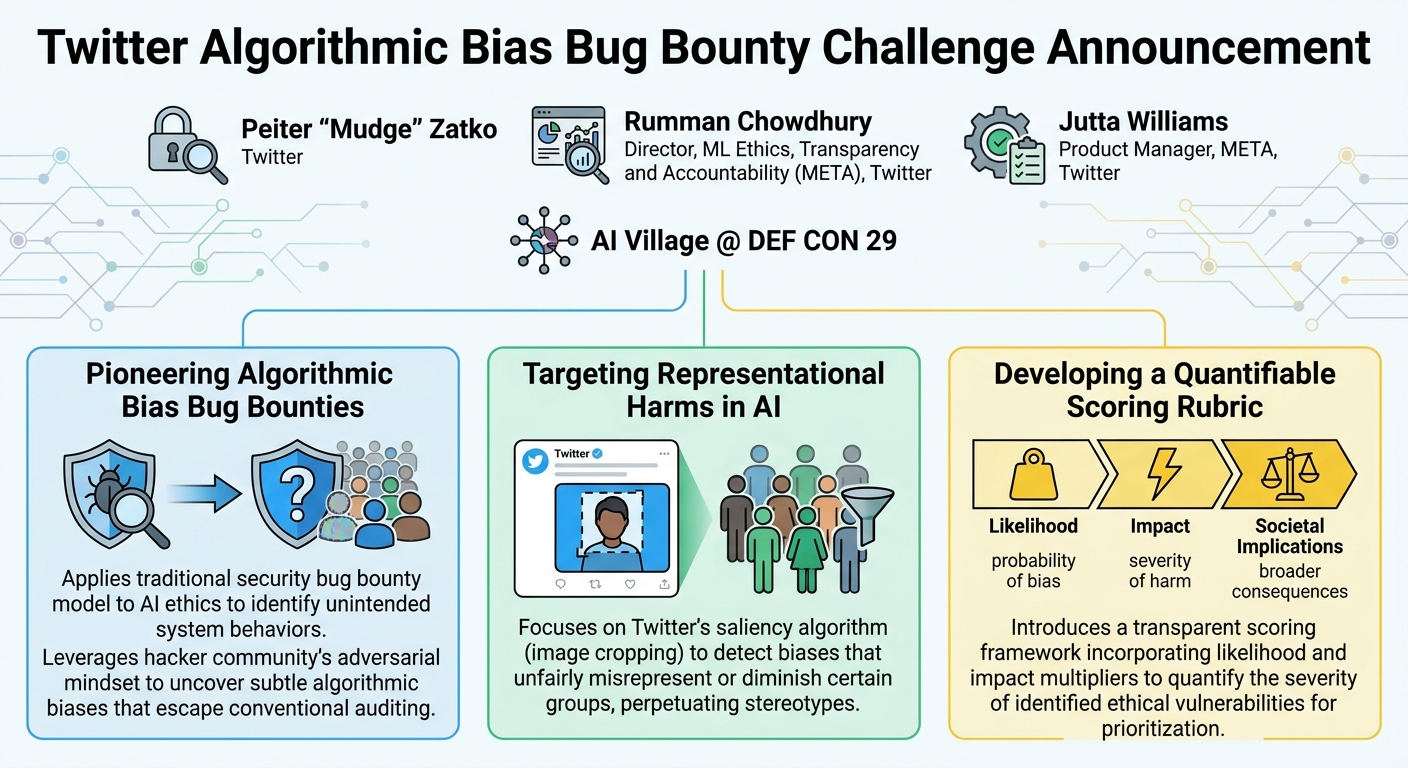
At DEF CON 29's AI Village, Twitter announced an unprecedented initiative: the Algorithmic Bias Bug Bounty Challenge. This pioneering program, spearheaded by Twitter's ML Ethics, Transparency and Accountability (META) team, marked a significant departure from traditional security bug bounties by focusing on ethical vulnerabilities within artificial intelligence systems. Peiter "Mudge" Zatko, a renowned figure in the hacking community and then-head of security at Twitter, introduced the challenge, emphasizing the hacker ethos of uncovering unintended system behaviors to improve technology for all. He highlighted the critical need to shine a light on the often-unseen biases embedded in algorithms, urging the community to "make a dent in the universe" by contributing to a safer, more equitable digital world.
Key moments
- 0:00 Mudge's introduction and hacker ethos for AI
- 4:00 Twitter's motivation and call for other companies
- 6:00 Origin of the Algorithmic Bias Bounty
- 9:00 How to submit: HackerOne platform walkthrough
- 11:00 Understanding representational harms and scoring rubric
- 12:00 Prizes, judges, and future iterations of the bounty
- 14:00 Submission deadlines and Sunday workshop details
- 15:00 Twitter's commitment to openness and hiring
Twitter Algorithmic Bias Bug Bounty Challenge Announcement
Speakers: Peiter "Mudge" Zatko (Twitter), Rumman Chowdhury (Director, ML Ethics, Transparency and Accountability (META), Twitter), Jutta Williams (Product Manager, META, Twitter)
Conference: AI Village @ DEF CON 29
YouTube: https://www.youtube.com/watch?v=ULC9pzTx2s8
Overview
At DEF CON 29's AI Village, Twitter announced an unprecedented initiative: the Algorithmic Bias Bug Bounty Challenge. This pioneering program, spearheaded by Twitter's ML Ethics, Transparency and Accountability (META) team, marked a significant departure from traditional security bug bounties by focusing on ethical vulnerabilities within artificial intelligence systems. Peiter "Mudge" Zatko, a renowned figure in the hacking community and then-head of security at Twitter, introduced the challenge, emphasizing the hacker ethos of uncovering unintended system behaviors to improve technology for all. He highlighted the critical need to shine a light on the often-unseen biases embedded in algorithms, urging the community to "make a dent in the universe" by contributing to a safer, more equitable digital world.
The challenge specifically targeted Twitter's saliency algorithm, which was historically used for image cropping, to identify and address representational harms. Dr. Rumman Chowdhury, Director of the META team, and Jutta Williams, a Product Manager supporting META, elaborated on the program's origins and objectives. They articulated a vision to merge the adversarial mindset of the security hacking community with the academic and programmatic focus of the algorithmic bias community. The goal was to leverage the collective intelligence of DEF CON attendees to expose and quantify biases, thereby fostering greater transparency and accountability in machine learning. This initiative underscored Twitter's commitment to serving healthy public conversation by proactively identifying and mitigating algorithmic manipulation and unconscious bias, setting a potential precedent for other technology companies to follow.
This challenge represents a crucial step in the evolving landscape of cybersecurity and ethical AI. As AI becomes increasingly integrated into critical societal functions, understanding and mitigating its potential for harm—whether intentional or unintentional—is paramount. By opening its algorithms to public scrutiny through a bug bounty model, Twitter aimed not only to improve its own systems but also to contribute to a broader conversation about responsible AI development. The program sought to identify novel methods for detecting bias, establish a robust framework for assessing algorithmic harms, and ultimately build more trustworthy and equitable AI technologies for the future.
Background
▶ Watch: Mudge's introduction and hacker ethos for AI (0:00)
The genesis of Twitter's Algorithmic Bias Bug Bounty Challenge is rooted in a confluence of factors: the increasing pervasiveness of AI, the growing awareness of algorithmic harms, and a desire to adapt the successful model of traditional security bug bounties to the nascent field of AI ethics. Peiter "Mudge" Zatko, drawing from decades of experience in the hacker community, articulated a core philosophy: hackers seek to understand systems, often by making them do things they weren't intended to do. This adversarial approach, historically applied to finding security vulnerabilities, is now being extended to uncover algorithmic biases and unintended consequences in AI. Mudge cited the book "Hello World: Being Human in the Digital Age" as essential reading for understanding the complexities of this field, suggesting that the "bad luck" of an algorithm producing a worst-case scenario can often be "manufactured" through creative exploration.
Dr. Rumman Chowdhury's journey to DEF CON, inspired by AI Village organizer Ariel Herbert-Voss, highlighted the gap between the adversarial security community and the academic-focused algorithmic bias community. While both groups share an ethos of improving technology for humanity, their methodologies and perspectives often differ. The challenge aimed to bridge this gap, recognizing that the hacker's ability to find edge cases and abuse scenarios could be invaluable in uncovering subtle or complex forms of algorithmic bias that might escape traditional auditing methods. Jutta Williams, with her background in security engineering and privacy, further emphasized the transformative impact of traditional bug bounties on improving software security. She saw the algorithmic bias bounty as a natural evolution, applying a proven community-driven approach to a new frontier of ethical vulnerabilities.
The problem of algorithmic bias arises because machine learning models, trained on vast datasets, can inadvertently learn and perpetuate societal prejudices, leading to unfair or discriminatory outcomes. These biases can manifest in various forms, from racial and gender biases in facial recognition to systemic inequalities in credit scoring or hiring algorithms. Unlike traditional software bugs that might cause system crashes or data breaches, algorithmic biases often result in representational harms or allocative harms, impacting individuals' opportunities, perceptions, or access to resources. Twitter, as a platform central to global public conversation, recognized its responsibility to ensure its algorithms do not inadvertently amplify harmful narratives or unfairly disadvantage certain groups. The challenge was thus conceived as a proactive measure to scrutinize their own systems, particularly the image cropping algorithm, which had previously faced public scrutiny for exhibiting racial and gender biases.
Key Findings
▶ Watch: Origin of the Algorithmic Bias Bounty (6:00)
As this talk served as an announcement for a new challenge rather than a presentation of completed research, there were no "findings" in the traditional sense of discovered vulnerabilities. Instead, the "Key Findings" section of this article focuses on the design principles, methodology, and types of harms the challenge aimed to uncover and quantify. The primary contribution of this talk was the articulation of a novel approach to addressing algorithmic bias, drawing lessons from the security bug bounty model.
The core "finding" articulated by the Twitter META team was the critical need to extend the bug bounty paradigm to the domain of algorithmic bias. They recognized that while traditional security vulnerabilities often manifest as system exploits or data breaches, algorithmic biases often lead to subtle yet pervasive representational harms. These harms occur when an algorithm unfairly represents or misrepresents certain groups, often perpetuating stereotypes or diminishing their visibility. The challenge specifically focused on this type of harm, as exemplified by issues with image cropping algorithms.
A significant "finding" in the challenge's design was the development of a scoring rubric for algorithmic harms. This rubric, the result of extensive research and collaboration between AI ethics researchers and security vulnerability program experts, aimed to quantify the severity and impact of identified biases. It assigned point values to different types of harms and introduced multipliers based on the likelihood and impact of the bias, mirroring concepts familiar from security threat modeling. This rubric was designed not only to evaluate submissions but also to provide transparency to participants, allowing them to self-score their findings and understand the criteria for success.
Furthermore, the challenge sought to identify original and generalizable methods for detecting bias. Recognizing this was a "1.0 iteration," Twitter actively sought community feedback on the rubric itself and the overall approach. The goal was not just to fix specific biases in one algorithm but to develop methodologies that could be applied across many different machine learning models and to evolve the framework for future iterations. The emphasis on "societal impact" within the grading criteria underscored the broader ambition to move beyond technical metrics and consider the real-world consequences of algorithmic decisions. This forward-looking aspect, combined with the commitment to transparency and community involvement, constituted the foundational "findings" that underpinned this groundbreaking initiative.
Technical Deep Dive
▶ Watch: Understanding representational harms and scoring rubric (11:00)
The technical core of Twitter's Algorithmic Bias Bug Bounty Challenge revolved around scrutinizing a specific component of their platform: the saliency algorithm. This algorithm was historically employed by Twitter for image cropping, specifically to automatically determine the most "interesting" or "salient" part of an image to display in previews, such as within the Twitter feed. The mechanism behind a saliency algorithm is rooted in computer vision and machine learning. It functions by analyzing every pixel within an image and, based on a model trained on extensive human eye-tracking data, identifies areas that a human observer would typically focus on. This process effectively generates a "heat map" of an image, highlighting regions of perceived importance.
While seemingly innocuous, the reliance on human eye-tracking data for training can inadvertently embed and perpetuate human biases within the algorithm. If the training data disproportionately reflects the gaze patterns of a specific demographic, or if it contains inherent biases in how different subjects are perceived, the algorithm can learn and amplify these biases. For instance, a saliency algorithm might consistently prioritize lighter skin tones over darker ones, or male faces over female faces, leading to representational harms where certain groups are systematically excluded or deemphasized in image previews. This was precisely the type of bias that Twitter had faced public criticism for, prompting the decision to decommission the automatic image cropping feature and launch this challenge.
The challenge's technical framework, hosted on HackerOne.com, required participants to submit detailed reports demonstrating identified biases. Submissions needed to include:
- A README file explaining the nature of the bias.
- Self-grading recommendations based on Twitter's provided rubric.
- Code (if used) to reproduce the demonstrated bias or exploit.
The grading rubric itself is a critical technical artifact, blending principles from security vulnerability assessment with ethical AI considerations. It quantifies algorithmic harms by considering:
- Types of Harms: The challenge specifically focused on representational harms, but the rubric was designed to be adaptable. These harms are categorized and assigned initial point values.
- Likelihood: How probable it is for the bias to occur in real-world scenarios. This acts as a multiplier, increasing the score for more frequent or easily triggered biases.
- Impact: The severity of the harm caused by the bias. This also acts as a multiplier, giving higher scores to biases with significant negative consequences for individuals or groups.
- Justification and Societal Impact: Beyond technical reproducibility, participants were asked to articulate why the identified harm is important to address and its broader societal implications. This moves the assessment beyond purely technical metrics to encompass ethical and social considerations.
The challenge also incentivized submissions that were most original and most generalizable. The "most generalizable" aspect is particularly significant from a technical perspective, aiming to identify methods or types of biases that are not unique to Twitter's saliency algorithm but could be found in other computer vision models or even different types of machine learning systems. This pursuit of generalizability reflects a desire to contribute foundational knowledge to the broader field of ethical AI, moving beyond ad-hoc fixes to develop robust, transferable detection mechanisms. The involvement of esteemed judges—including Mudge, Ariel Herbert-Voss (OpenAI), Matt Mitchell (Crypto Harlem), and Patrick Hall (B&H)—underscored the technical rigor and multidisciplinary expertise applied to evaluating these complex submissions.
Demo / Proof of Concept
▶ Watch: Prizes, judges, and future iterations of the bounty (12:00)
While the DEF CON talk itself was an announcement and not a live demonstration of a specific exploit, Jutta Williams provided a "demo" of the challenge submission process, effectively illustrating the Proof of Concept (PoC) mechanism for participants. This demonstration walked attendees through how to interact with the HackerOne platform, which served as the official portal for the Algorithmic Bias Bug Bounty Challenge.
The demo began by guiding potential participants to hackerone.com, emphasizing its user-friendly interface for security researchers. For those without an existing account, the process of creating one was highlighted as quick and straightforward. Once logged in, participants were directed to the dedicated "Twitter Algorithmic Bias" landing page within HackerOne.
This landing page was presented as the central hub for the challenge, providing comprehensive details about its nature, Twitter's motivations, and crucially, the scoring rubric. Williams stressed the importance of reviewing this literature, as it offered transparent guidelines for how submissions would be evaluated and how participants could self-score their findings. This transparency was a key aspect, allowing hackers to understand the specific criteria for identifying and quantifying algorithmic harms, including the point values for different types of biases and the multipliers for likelihood and impact.
The actual submission process, as described, required participants to provide several key components, acting as their "proof of concept" for an identified bias:
- A README file: This document was to detail the nature of the bias discovered, explaining the algorithm's unintended behavior and its observed effects. It required clear articulation of the problem.
- Self-grading recommendations: Based on the provided rubric, participants were asked to assess their own findings, recommending a score for the bias they identified. This encouraged a deeper understanding of the evaluation criteria.
- Supply code (if used): For biases demonstrated through programmatic means, participants were required to provide the code used to identify or reproduce the bias. This is a standard practice in security bug bounties, ensuring reproducibility and enabling Twitter's researchers to validate the findings. The code would serve as the technical PoC, demonstrating how the saliency algorithm could be made to exhibit biased behavior.
This "demo" of the submission process highlighted Twitter's commitment to making the challenge accessible and transparent for the hacking community. It underscored that the "proof of concept" in this context wasn't a traditional exploit payload, but rather a robust, reproducible demonstration of algorithmic bias, meticulously documented and justified according to a novel ethical rubric. The challenge was effectively soliciting "ethical PoCs" that could reveal the subtle, yet impactful, flaws in AI systems. The fact that seven submissions had already been received even before the official deadline indicated the community's enthusiasm and readiness to engage with this new form of vulnerability research.
Defensive Implications
▶ Watch: Twitter's commitment to openness and hiring (15:00)
The Twitter Algorithmic Bias Bug Bounty Challenge carries profound defensive implications, not just for Twitter but for any organization developing and deploying AI systems. This initiative signals a shift in how companies should approach the security and ethics of their machine learning models, moving beyond reactive fixes to proactive, community-driven vulnerability research.
Firstly, the challenge champions proactive bias detection and mitigation as a core defensive strategy. Rather than waiting for public outcry or regulatory pressure, Twitter chose to actively solicit external scrutiny of its algorithms. This demonstrates a commitment to transparency and accountability that can build user trust and preempt potential reputational damage or legal liabilities. Other companies should consider implementing similar programs, integrating ethical AI assessments into their development lifecycle from conception to deployment.
Secondly, it highlights the immense value of merging adversarial security mindsets with ethical AI research. Mudge's opening remarks underscored that "bad luck" in algorithms can be "manufactured" by hackers seeking edge cases and unintended behaviors. This adversarial perspective, traditionally focused on system exploitation, is invaluable for uncovering subtle, non-obvious biases that might elude internal audits. Defenders should actively engage with security researchers, ethicists, and diverse communities to stress-test their AI systems against a broader spectrum of potential harms, including those that manifest as representational or allocative biases.
Thirdly, the development of a quantifiable rubric for algorithmic harms provides a critical defensive tool. By defining and scoring different types of biases based on likelihood and impact, organizations can establish standardized metrics for assessing ethical vulnerabilities. This allows for prioritization of fixes, allocation of resources, and clearer communication about the severity of identified issues. Companies should invest in developing similar internal frameworks, potentially adapting Twitter's "1.0 iteration" rubric, to systematically evaluate their own AI models for ethical risks.
Fourthly, the challenge underscores the importance of transparency and community engagement. By opening its algorithms and even its evaluation rubric to public feedback, Twitter created a feedback loop that not only helps improve specific algorithms but also fosters a shared understanding of ethical AI challenges. Defenders should foster similar open dialogues, publish research on their AI ethics efforts, and consider external advisory boards or community challenges to gain diverse perspectives on potential harms. This collaborative approach can lead to more robust and equitable AI systems.
Finally, the initiative has hiring implications for defensive teams. Dr. Chowdhury explicitly mentioned hiring for the META team, indicating a growing demand for professionals who can bridge the gap between machine learning, ethics, and security. Organizations need to build interdisciplinary teams that possess both deep technical expertise in AI and a strong understanding of societal impact, human rights, and ethical frameworks. Training existing security teams in AI ethics and vice-versa will be crucial for effective defense in the age of intelligent systems. The defensive posture against algorithmic bias is not just about patching code; it's about fostering an organizational culture of ethical responsibility and continuous, community-driven improvement.
Key Takeaways
- Algorithmic Bias is a New Frontier for Bug Bounties: The challenge pioneered the application of the traditional security bug bounty model to identify and quantify ethical vulnerabilities like algorithmic bias, signaling a new era for AI security and ethics.
- Hacker Ethos is Crucial for Ethical AI: The adversarial mindset of the hacker community, focused on finding unintended system behaviors and edge cases, is invaluable for uncovering subtle and complex algorithmic biases that might be missed by conventional auditing.
- Representational Harms are a Key Concern: The challenge specifically targeted representational harms in Twitter's saliency algorithm, highlighting how algorithms can perpetuate stereotypes or unfairly deemphasize certain groups through mechanisms like image cropping.
- Quantifiable Rubrics for Bias are Essential: Twitter developed a transparent, quantifiable scoring rubric for algorithmic harms, incorporating likelihood, impact, and societal implications, providing a framework for evaluating and prioritizing ethical vulnerabilities.
- Transparency and Community Feedback are Paramount: By openly soliciting submissions and feedback on its rubric and approach, Twitter demonstrated a commitment to transparency and acknowledged that community collaboration is vital for advancing ethical AI.
- Proactive Ethical AI is a Defensive Imperative: This initiative encourages organizations to proactively scrutinize their AI systems for bias, integrating ethical considerations and community-driven research into their development lifecycle to build more trustworthy and equitable technologies.
About the Speaker(s)
Peiter "Mudge" Zatko: A legendary figure in the hacker community, Mudge has a long history of making significant impacts in cybersecurity. He has been attending DEF CON for decades and is known for his work with the hacker collective The Loft. At the time of this talk, Mudge was part of the executive team (referred to as "staff") at Twitter, focusing on security. He champions the hacker ethos of finding and revealing system behaviors to improve technology for everyone, aligning his career with making a positive "dent in the universe." He expressed excitement about being on the judging panel for the challenge.
Dr. Rumman Chowdhury: As the Director of the Machine Learning Ethics, Transparency and Accountability (META) team at Twitter, Dr. Chowdhury is at the forefront of ethical AI development in industry. Her background bridges the academic research world of algorithmic bias with the practical application of technology. She was instrumental in bringing the idea of an algorithmic bias bounty to Twitter after being inspired by traditional bug bounties at her first DEF CON. Her team was responsible for building the challenge's rubric and getting the initiative off the ground, and she actively promotes the merging of adversarial and ethical AI communities.
Jutta Williams: A Product Manager supporting Dr. Chowdhury's META team at Twitter, Jutta Williams brings a strong background in security engineering and privacy to the field of ethical AI. She was a key partner in developing and launching the algorithmic bias bounty, drawing parallels between the historical impact of security bug bounties and the potential for similar success in addressing algorithmic bias. Williams is focused on the long-term consequences of data use and societal impact, emphasizing the importance of authentic and unfiltered community engagement to improve product outcomes.
Reviews
Dr. Zero (Offensive Security Researcher) — SOLID
This isn't a technical exploit deep-dive, it's a structural policy announcement—and it's one of the few that actually matters. Mudge and Rumman Chowdhury didn't just talk about AI ethics; they dropped the industry's first concrete bug bounty rubric for machine learning bias, fundamentally shifting how the security community treats representational harms.
Heather Calloway (CISO) — SOLID
Twitter’s announcement of the first algorithmic bias bug bounty represents a fundamental shift in how we manage AI risk. By applying standard vulnerability management frameworks and scoring rubrics to ML ethics, they turned a nebulous brand risk into a measurable security function. This is required viewing for any CISO whose organization is deploying commercial AI models.