Stasis in AI Ethics
Abhishek Gupta (Founder and Principal Researcher · Montreal AI Ethics Institute)
AI Village @ DEF CON 29 · Day 3 · AI Village
Overview
In a candid and thought-provoking presentation at AI Village @ DEF CON 29, Abhishek Gupta, founder and principal researcher of the Montreal AI Ethics Institute, delivered a "spicy take" on the current state of artificial intelligence ethics. Titled "Stasis in AI Ethics," Gupta’s talk critically examines the systemic issues hindering meaningful progress in the field, arguing that despite a proliferation of guidelines and discussions, real-world impact remains limited. He posits that the AI ethics community is caught in a state of stagnation, largely due to an over-reliance on theoretical frameworks and a disconnect from the practical realities of deploying AI systems.
Key moments
- 0:00 Introduction and speaker's perspective on AI ethics
- 4:00 Defining 'Stasis' in AI ethics and 10 key issues
- 6:00 Problem of over-focus on bias and privacy
- 12:00 Proliferation of under and ill-informed opinions
- 16:20 Over-sensitive ecosystem prohibiting honest conversations
- 18:40 The widening chasm between principles and practice
- 22:50 Misunderstanding of AI systems in production environments
- 25:00 Q&A: AI security, ethics, and MLOps collaboration
Stasis in AI Ethics
Speakers: Abhishek Gupta, Founder and Principal Researcher, Montreal AI Ethics Institute
Conference: AI Village @ DEF CON 29
YouTube: https://www.youtube.com/watch?v=sjkIWubV-rU
Overview
In a candid and thought-provoking presentation at AI Village @ DEF CON 29, Abhishek Gupta, founder and principal researcher of the Montreal AI Ethics Institute, delivered a "spicy take" on the current state of artificial intelligence ethics. Titled "Stasis in AI Ethics," Gupta’s talk critically examines the systemic issues hindering meaningful progress in the field, arguing that despite a proliferation of guidelines and discussions, real-world impact remains limited. He posits that the AI ethics community is caught in a state of stagnation, largely due to an over-reliance on theoretical frameworks and a disconnect from the practical realities of deploying AI systems.
Gupta, drawing on his multifaceted experience as an ML engineer at Microsoft, a community builder, and a pragmatist, outlines ten specific challenges contributing to this stasis. His analysis is not merely a critique but a call to action, offering concrete solutions aimed at fostering a more grounded, effective, and honest approach to AI ethics. The talk challenges conventional wisdom, urging practitioners, researchers, and policymakers to move beyond superficial discussions and engage with the complexities of AI deployment in production environments.
This article delves into Gupta's incisive observations, exploring the roots of the identified problems and the proposed pathways to meaningful change. It highlights the speaker's emphasis on lived experience, interdisciplinary collaboration, and a pragmatic mindset as essential ingredients for breaking free from the current stagnation and building genuinely responsible AI systems.
Background
▶ Watch: Introduction and speaker's perspective on AI ethics (0:00)
The field of AI ethics has exploded in recent years, propelled by growing awareness of the potential societal impacts of artificial intelligence. From algorithmic bias and privacy concerns to questions of accountability and transparency, the discourse around ethical AI has become a prominent feature in academic conferences, industry forums, and public debate. Numerous organizations, from tech giants to international bodies like the OECD, have published guidelines, principles, and frameworks aimed at steering AI development towards more responsible outcomes.
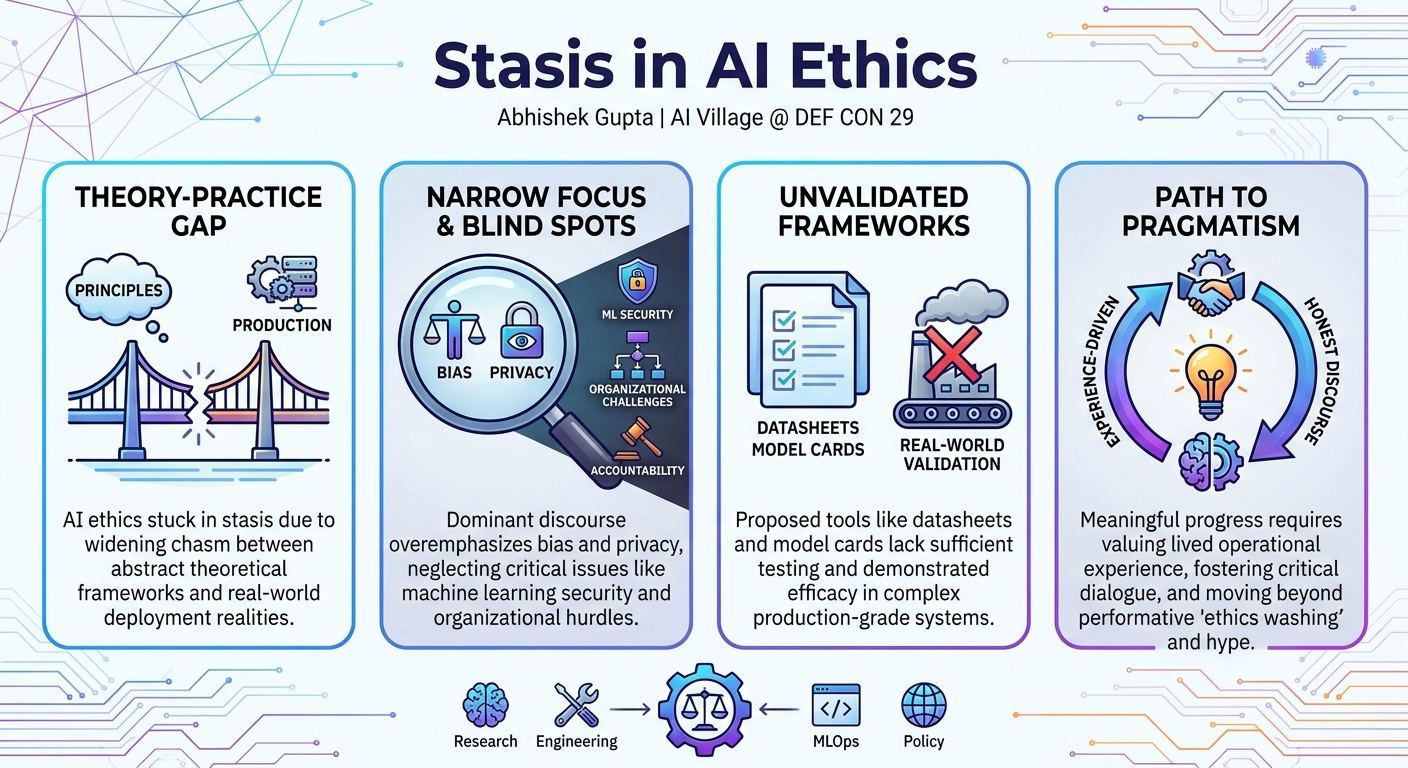
Despite this heightened attention and the sheer volume of intellectual output, Abhishek Gupta argues that the field is largely in stasis. This stagnation, he contends, stems from a fundamental disconnect between the theoretical aspirations of AI ethics and the practical challenges of implementing these principles in real-world, production-grade AI systems. Gupta contextualizes his critique from his unique position as a practitioner who builds machine learning systems at Microsoft, a community builder fostering grassroots engagement through the Montreal AI Ethics Institute, and a pragmatist who believes in incremental change and compromise to achieve meaningful progress.
He stresses that while the proliferation of ideas and diverse viewpoints is generally positive, the current ecosystem often lacks the critical mechanisms to validate these ideas against operational realities. This leads to a cycle where untested frameworks are widely cited but rarely applied, and where discussions become detached from the technical, business, and organizational constraints faced by those deploying AI. The problem, as Gupta frames it, is not a lack of interest in AI ethics, but rather an ineffective approach to addressing its challenges, creating an illusion of progress without substantive impact.
Key Findings
▶ Watch: Problem of over-focus on bias and privacy (6:00)
Abhishek Gupta systematically identifies ten critical issues that collectively contribute to the "stasis" in AI ethics, offering potential solutions for each. These issues highlight a broad spectrum of problems, ranging from research priorities to community dynamics and media representation:
- Over-focus on a Few Areas: The dominant discourse in AI ethics heavily emphasizes bias and privacy, often overshadowing other crucial concerns such as organizational challenges, accountability, transparency, and critically, machine learning security. This skewed focus distorts research and investment priorities, leading to an incomplete understanding of real-world ethical landscapes.
- Lack of Case Studies: Many proposed frameworks and tools, such as datasheets for datasets and model cards for model reporting, suffer from a scarcity of documented case studies demonstrating their efficacy in practical, production-grade systems. Their theoretical appeal often does not translate into actionable utility.
- Proliferation of Under- and Ill-Informed Opinions: The growing popularity of AI ethics has attracted many new voices, but not all contributions are equally grounded in practical, operational experience. There's a risk of giving undue weight to untested frameworks and guidelines from individuals or groups lacking deep applied expertise.
- Ethics Washing: Initiatives are often launched to improve a company's image rather than genuinely address ethical violations. This phenomenon is particularly prevalent among consulting firms that offer non-transparent tools and frameworks, creating a veneer of responsibility without substantive change.
- Hype Train Hopping: Similar to the proliferation of uninformed opinions, the mainstream appeal of AI ethics has attracted individuals and organizations primarily seeking to capitalize on a popular trend rather than genuinely contribute to ethical development. Credentials alone are insufficient to judge the quality of proposed solutions.
- Oversensitive Ecosystem: The current environment can prohibit honest, critical conversations. Discussions sometimes become overly focused on identity rather than lived experience, making it difficult to openly critique the work of prominent figures or challenge established (but ineffective) ideas without fear of backlash.
- Widening Chasm Between Principles and Practice: A significant gap exists between abstract ethical principles and their practical application. Much of the current guidance is not actionable for practitioners, largely due to its origins in controlled sandbox experiments that fail to account for real-world complexities.
- Weaponized Media: Media outlets, while crucial for public awareness, can inadvertently exacerbate the stasis by misreporting or selectively highlighting certain stories. Journalists often rely on preferred sources, leading to a narrow and potentially skewed representation of AI ethics challenges and solutions.
- Lack of Veritable Interdisciplinary Experts: True interdisciplinary expertise, especially combining technical and social sciences with actual experience deploying production-grade AI systems, remains rare. This scarcity hinders the development of holistic and practical solutions.
- Misunderstanding of How AI Systems Work in Production: There's a widespread misconception about the complexities of AI systems in real-world deployment. Production-grade systems face unique technical, business, and organizational constraints that are often overlooked in academic or theoretical discussions, leading to proposed solutions that are impractical or ineffective.
Gupta emphasizes that addressing these issues requires a shift towards a more pragmatic, experience-driven, and critically aware approach within the AI ethics community.
Technical Deep Dive
▶ Watch: Over-sensitive ecosystem prohibiting honest conversations (16:20)
While "Stasis in AI Ethics" isn't a traditional security talk detailing vulnerabilities or exploit techniques, its "technical deep dive" lies in its analytical dissection of the systemic and structural issues within the AI ethics domain itself. Gupta effectively "reverse-engineers" the stagnation, exposing the underlying mechanisms that prevent meaningful progress.
One of the primary technical critiques revolves around the over-focus on specific issues like bias and privacy. Gupta points out that while critical, this narrow lens often overlooks equally important concerns such as machine learning security. He references a paper by Ram S.S.D. from Microsoft, which highlights the varying degrees of awareness and application of mitigation strategies for machine learning security problems in industry. This suggests a technical blind spot where threats like adversarial examples, data poisoning, and model inversion attacks are not given the same prominence as bias detection, even though they can have profound ethical and societal implications. The proposed solution involves a more accurate understanding of the proliferation and frequency of various AI ethics challenges in the wild, moving beyond "toy challenges and toy datasets" to consult with industry practitioners.
Another significant technical hurdle is the lack of case studies for proposed tools. Gupta specifically calls out datasheets for datasets and model cards for model reporting as examples. These frameworks, intended to enhance transparency and accountability by documenting data characteristics and model performance, are lauded in academic circles but, anecdotally, see limited practical application in "working production-grade systems." The "technical" failure here is the inability to translate theoretical constructs into robust, deployable methodologies that can genuinely inform development and deployment decisions. Gupta advocates for rigorous application of these tools to real systems, documenting both their failures and successes to build a practical evidence base.
The proliferation of under- and ill-informed opinions and hype train hopping also have technical ramifications. The speaker notes the existence of over 100 documents on the OECD AI Observatory alone, offering guidelines and frameworks. The technical challenge is discerning which of these are genuinely applicable and effective, especially when many originate from individuals or committees lacking practical operational experience or applied expertise. Relying on "fancy titles" or "credentials" without examining their relevance to the technical challenges of AI development can lead to the adoption of ineffective or even counterproductive "solutions."
The widening chasm between principles and practice is a core technical disconnect. Ethical guidelines often remain abstract, failing to provide actionable advice for engineers making daily decisions in a production environment. This gap is attributed to solutions primarily derived from "controlled sandbox experiments" that do not account for the messy realities of "real-world production-grade systems," including their unique technical, business, and organizational constraints. The "technical deep dive" here reveals that the complexity of real-world interactions in AI systems means outcomes cannot always be fully anticipated, making a direct leap from sandbox to production fraught with peril.
Finally, the misunderstanding of how AI systems work in production is perhaps the most foundational technical issue. Gupta emphasizes that production-grade systems are not merely scaled-up versions of research prototypes. They involve complex interactions, continuous integration and deployment (CI/CD) pipelines, specific hardware/software stacks, and evolving user behaviors. The disconnect between those who operate these systems daily and those who study their ethical implications (often from outside industry) leads to impractical or irrelevant ethical solutions. Gupta suggests fostering a "collaboratory" approach to bridge this gap, where tools and frameworks are crafted and tested directly on production systems, leading to a better understanding and adoption across the industry. This calls for a shift in research methodology to incorporate more engineering rigor and system-level thinking into AI ethics.
Demo / Proof of Concept
▶ Watch: The widening chasm between principles and practice (18:40)
Abhishek Gupta's talk, "Stasis in AI Ethics," is a critical analysis and conceptual framework rather than a demonstration of a technical tool or a proof of concept exploit. The presentation did not include any live code demonstrations, system walkthroughs, or specific technical vulnerability disclosures. Instead, the "proof" for his assertions comes from his extensive field experience as an ML engineer and researcher, combined with his critical observation of the AI ethics landscape.
The talk itself serves as a comprehensive "diagnostic" of the problems, with the speaker leveraging his unique vantage point to highlight the practical shortcomings of current approaches. While there was no tangible demo, the strength of the presentation lies in its detailed breakdown of the systemic issues and the clear articulation of why many existing ethical tools and frameworks fail to translate from theory to practice in real-world, production-grade AI systems.
Defensive Implications
▶ Watch: Q&A: AI security, ethics, and MLOps collaboration (25:00)
For practitioners, researchers, and organizations operating in the AI space, Gupta's talk offers crucial "defensive" insights to guard against the pitfalls leading to stasis and to foster more effective AI ethics practices. The implications span technical, organizational, and cultural shifts:
- Prioritize Production-Grade Validation: The most significant defensive implication is the call to rigorously test and validate AI ethics tools and frameworks against working production-grade systems. Organizations should move beyond theoretical discussions and controlled sandbox experiments. Before adopting any ethical guideline or tool (e.g., datasheets for datasets, model cards for model reporting), demand evidence of its efficacy and applicability in real-world deployment scenarios. This includes documenting both failures and successes transparently.
- Broaden the Scope of Ethical Concerns: Defenders must expand their focus beyond just bias and privacy. Critical areas like machine learning security (e.g., adversarial attacks, data poisoning), organizational challenges, accountability mechanisms, and transparency need equal attention. Incorporate security-by-design principles into AI systems from the outset, recognizing the ethical implications of robust defense against malicious actors.
- Cultivate True Interdisciplinary Expertise: Building effective AI ethics teams requires more than just combining technical and social science backgrounds. It demands individuals with prior experience deploying production-grade AI systems. Organizations should invest in training and recruiting experts who understand the unique technical, business, and organizational constraints of real-world AI, fostering a "collaboratory" environment where operators and ethicists work hand-in-hand.
- Beware of Ethics Washing and Hype: Organizations must develop a critical eye towards initiatives that merely serve to improve image or capitalize on trends. When evaluating consulting services or new frameworks, scrutinize their transparency, the practical experience of their proponents, and their actual track record of delivering tangible, measurable improvements in ethical AI deployment. Engage with on-the-ground staff to distinguish between marketing speak and real-world implementation.
- Foster an Open and Critical Discourse: Internally and externally, organizations should encourage an ecosystem where honest conversations are possible, and where ideas—even those from prominent figures—can be openly critiqued without fear of retribution. This means valuing lived experience and practical insights over identity or institutional affiliation, and being bold in pointing out solutions that simply don't work.
- Engage with Media and Adjacent Fields: Proactively engage with journalists to help them better understand the complexities and nuances of AI ethics in practice, offering insights from operational experience. Furthermore, look to adjacent fields like MLOps (Machine Learning Operations). MLOps provides methodologies and tools for managing the entire AI lifecycle, which can be adapted to integrate ethical considerations not as one-off checks, but as continuous processes, accounting for dynamic factors like model drift and concept drift. This ensures ethical considerations evolve with the system, rather than becoming static, outdated mitigations.
By adopting these defensive strategies, organizations can move beyond performative ethics and build AI systems that are genuinely more responsible, resilient, and aligned with societal values.
Key Takeaways
- AI ethics is currently in "stasis," characterized by a significant gap between theoretical principles and practical application, hindering meaningful progress despite increased attention.
- Over-reliance on untested theoretical frameworks like datasheets for datasets and model cards for model reporting, without sufficient production-grade validation, is a major impediment.
- A narrow focus on bias and privacy overshadows other critical AI ethics challenges, including machine learning security, organizational issues, and accountability.
- Genuine progress requires pragmatic, experience-driven approaches, fostering honest, critical discourse, and valuing lived experience in deploying AI systems over mere credentials or hype.
- Organizations must beware of "ethics washing" and the proliferation of under-informed opinions, instead seeking out veritable interdisciplinary experts with practical production experience.
- Adopting methodologies from fields like MLOps can help integrate ethical considerations as continuous processes throughout the AI lifecycle, addressing dynamic issues like model drift and ensuring relevance in real-world deployments.
About the Speaker(s)
Abhishek Gupta is a highly accomplished and multi-faceted professional deeply embedded in the field of AI ethics. He is the Founder and Principal Researcher of the Montreal AI Ethics Institute, an international non-profit research institute dedicated to democratizing AI ethics literacy globally. In this role, he leads efforts to make complex ethical considerations accessible and actionable for a wider audience.
Beyond his non-profit work, Gupta is a Machine Learning Engineer at Microsoft, where he works in Commercial Software Engineering, focusing on building robust ML systems. His practical experience in developing and deploying AI solutions in an industrial setting provides him with a unique perspective on the real-world challenges and constraints of ethical AI. He also serves on the Responsible AI board for Commercial Software Engineering within Microsoft, contributing to the internal ethical governance of AI systems.
Further demonstrating his commitment to responsible technology, Abhishek Gupta recently started a position as the Chair of the Standards Working Group for the Green Software Foundation. In this capacity, he is instrumental in building comparable and standardized methodologies for sustainable computing, bridging the gap between technological advancement and environmental responsibility. Gupta consistently emphasizes his background as a practitioner, a community builder, and a pragmatist, underscoring his belief in field experience, collaborative efforts, and incremental, meaningful change as essential drivers for progress in AI ethics.
Reviews
Dr. Zero (Offensive Security Researcher) — SOLID
Gupta stands on the AI Village stage and says out loud what practitioners already know: the AI ethics field is hijacked by academics and grifters who have never pushed a model to production. It’s a necessary, systemic teardown of theoretical frameworks that don’t survive contact with reality.
Heather Calloway (CISO) — SOLID
Gupta dismantles the performative AI ethics industry and replaces it with an operator's reality. This is mandatory viewing for any leader responsible for AI governance, giving us the ammunition to reject academic "ethics washing" in favor of concrete ML security and production resilience.