How AI Is Revolutionizing Phishing Attacks & Defenses
Levone Campbell
Blacks in Cyber Village @ DEF CON 33 · Day 1 · Blacks in Cyber Village
Overview
Levone Campbell's compelling talk, "Hooks and Hooks: How AI Is Revolutionizing Both Fishing Attacks and Our Defenses," delivered at the Blacks in Cyber Village, delves into the escalating "arms race" between attackers and defenders in the realm of phishing. Campbell, a seasoned cybersecurity expert, meticulously dissects the dual-edged nature of artificial intelligence, illustrating how it simultaneously empowers threat actors to launch more sophisticated and scalable phishing campaigns while also providing defenders with advanced tools for detection and prevention. The presentation serves as a critical update to his previous talk, "Will AI Take My Job?", emphasizing that while AI may not entirely replace human roles, it fundamentally transforms the landscape of cyber warfare, demanding a proactive and adaptive approach from security professionals.
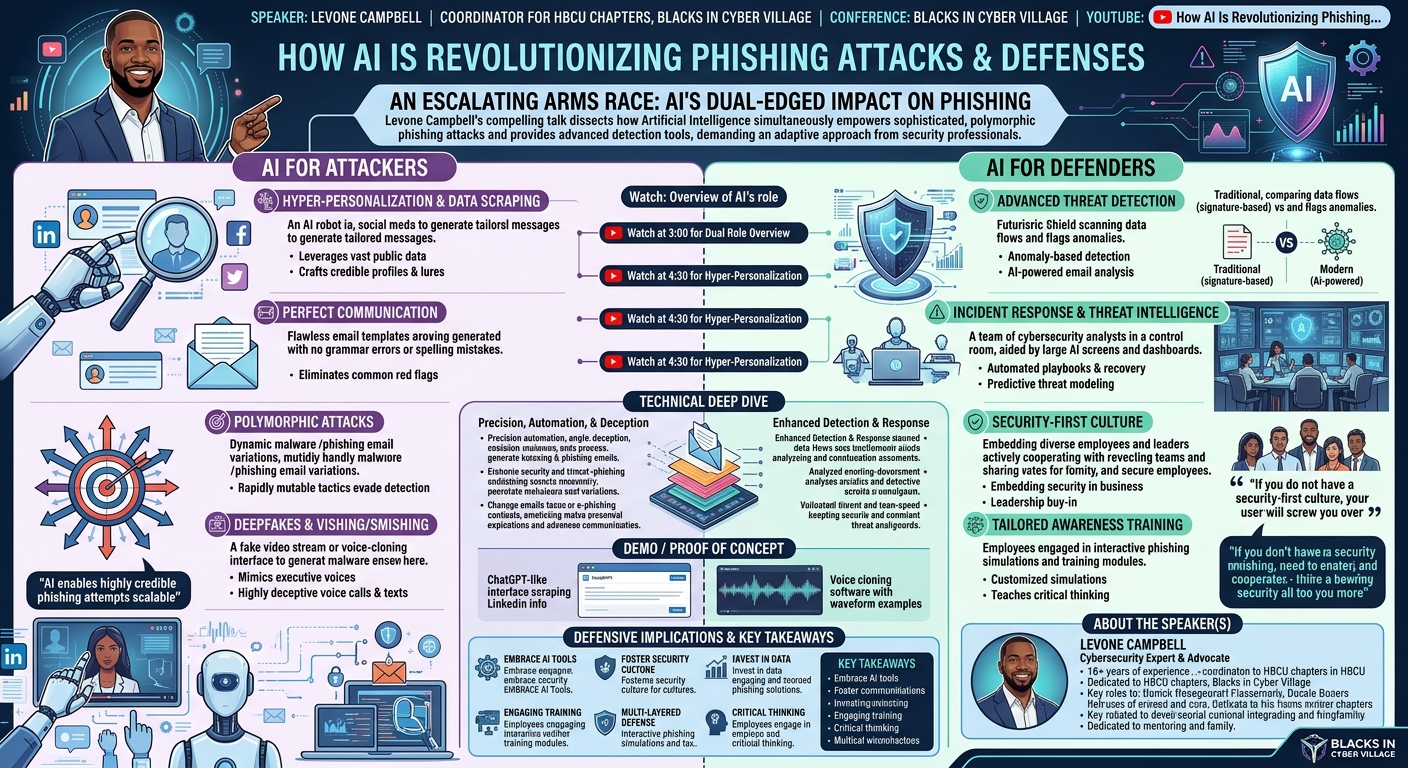
Key moments
- 3:00 Overview of AI's dual role in phishing
- 3:30 From traditional email scams to modern BEC attacks
- 4:30 How AI creates highly personalized phishing emails
- 6:00 Demonstrating AI scraping LinkedIn for targeted attacks
- 7:30 The danger of over-sharing personal data online
- 8:30 AI eliminates misspellings, creating perfect phishing emails
- 9:00 ChatGPT's ability to generate sophisticated phishing campaigns
How AI Is Revolutionizing Phishing Attacks & Defenses
Speakers: Levone Campbell, Coordinator for HBCU Chapters, Blacks in Cyber Village
Conference: Blacks in Cyber Village
YouTube: https://www.youtube.com/watch?v=7IFsoRaYYgs
Overview
Levone Campbell's compelling talk, "Hooks and Hooks: How AI Is Revolutionizing Both Fishing Attacks and Our Defenses," delivered at the Blacks in Cyber Village, delves into the escalating "arms race" between attackers and defenders in the realm of phishing. Campbell, a seasoned cybersecurity expert, meticulously dissects the dual-edged nature of artificial intelligence, illustrating how it simultaneously empowers threat actors to launch more sophisticated and scalable phishing campaigns while also providing defenders with advanced tools for detection and prevention. The presentation serves as a critical update to his previous talk, "Will AI Take My Job?", emphasizing that while AI may not entirely replace human roles, it fundamentally transforms the landscape of cyber warfare, demanding a proactive and adaptive approach from security professionals.
The talk highlights the profound shift from traditional "spray and pray" phishing tactics to highly personalized and polymorphic attacks, all orchestrated by AI. Campbell articulates that the sheer volume of personal data available online, coupled with the generative capabilities of AI, enables attackers to craft perfectly tailored and grammatically flawless lures that are increasingly difficult to distinguish from legitimate communications. Crucially, the discussion extends beyond email, encompassing smishing (SMS phishing), vishing (voice phishing), and deepfake technologies, underscoring the multi-channel threat landscape. For defenders, AI offers a beacon of hope, enhancing threat detection, incident response, and predictive capabilities, yet its successful integration hinges on a security-first culture, continuous training, and multi-layered defenses.
Campbell's presentation is particularly pertinent in an era where cyber threats are growing in complexity and frequency. By exploring both the offensive and defensive applications of AI, he provides a holistic view of the current state and future trajectory of phishing. The talk not only educates on the technical advancements of AI in this domain but also stresses the indispensable role of human judgment, critical thinking, and tailored security awareness programs. It's a call to action for organizations and individuals alike to adapt their strategies, embrace AI responsibly, and foster a robust security posture to navigate the evolving digital threats.
Background
▶ Watch: Overview of AI's dual role in phishing (3:00)
The evolution of phishing attacks has been a persistent challenge in cybersecurity, constantly adapting to defensive measures. Historically, phishing began with rudimentary, broad-stroke email scams, famously exemplified by the "Nigerian Prince" schemes. These early attempts were characterized by obvious grammatical errors, generic greetings, and often implausible narratives, making them relatively easy to spot for a discerning eye. As users became more aware, attackers refined their techniques, moving towards more sophisticated methods like using trusted cloud storage services (e.g., Dropbox) to host malicious links or leveraging legitimate-looking templates.
This progression led to spear phishing, a more targeted approach where attackers would research specific individuals or roles within an organization to craft personalized emails. Instead of mass blasts, these campaigns focused on higher-value targets, increasing their success rate. Further advancements brought vishing (voice phishing), where attackers use phone calls to trick victims, and smishing (SMS phishing), leveraging text messages. Levone Campbell highlighted instances where attackers would clone a president's email secretary or other executives to send out fraudulent requests, showcasing the increasing sophistication. A particularly insidious development Campbell noted is Business Email Compromise (BEC), especially when a SaaS provider or service company's customer is compromised, allowing attackers to leverage legitimate email chains to target the provider's customers. This creates a supply chain vulnerability, making it difficult for recipients to discern authenticity.
The advent of Artificial Intelligence has dramatically accelerated and amplified these trends. The core problem, as Campbell articulates, stems from the vast amount of personal and organizational data readily available online, particularly on social media platforms like LinkedIn, Facebook, and Instagram. This wealth of information serves as the training data for AI models, enabling them to construct highly detailed profiles of potential targets. Prior to AI, attackers relied on manual research and crafting, which limited the scale and personalization of campaigns. With AI, this bottleneck is removed, allowing for unprecedented levels of automation, adaptability, and personalization, fundamentally altering the economics and efficacy of phishing. Campbell's previous talk, "Will AI Take My Job?", set the stage for this discussion, implying that AI's impact would not be a direct replacement but a transformative force requiring new skills and strategies from security professionals.
Key Findings
▶ Watch: How AI creates highly personalized phishing emails (4:30)
Levone Campbell's talk reveals several critical findings regarding the transformative impact of AI on both phishing attacks and defensive strategies:
- AI Significantly Amplifies Phishing Efficacy: AI enables attackers to move beyond generic "spray and pray" tactics to highly personalized spear phishing and whaling attacks. By leveraging publicly available data from social media and professional networks, AI can generate tailored lures that exploit individual interests, roles, and even personal details, making them far more convincing. A study by Hawk cited in the talk found that AI-generated phishing emails had a failure rate of just 2.9%, significantly outperforming human-crafted scams.
- Polymorphic and Adaptive Attacks: AI models introduce polymorphism and adaptability to phishing campaigns. Attackers can rapidly generate numerous variants of emails, links, and even conversational flows, constantly changing their tactics to evade traditional signature-based detection mechanisms. This dynamic nature means that security tools must evolve to keep pace with the speed of change.
- Deepfakes Elevate Vishing and Smishing: The rise of deepfake technology, particularly voice cloning, adds a new, highly deceptive layer to vishing attacks. Attackers can mimic the voices of executives or trusted individuals, creating incredibly convincing voicemails or calls that bypass traditional red flags and manipulate victims into complying with fraudulent requests.
- AI is Indispensable for Modern Defenses: Traditional, rule-based security tools are increasingly ineffective against AI-powered attacks. AI-driven defense mechanisms, utilizing anomaly-based detection, machine learning models, and predictive threat modeling, are becoming essential for identifying sophisticated phishing attempts, analyzing malware, and automating incident response playbooks. These tools enhance human capabilities by providing faster, more efficient threat intelligence.
- The "Arms Race" Demands Proactive AI Adoption: The cybersecurity landscape is characterized by a rapidly escalating "arms race" where attackers are evolving their technology faster than defenders can react. Organizations that hesitate to integrate AI into their defensive strategies risk falling critically behind. Campbell stresses that embracing AI for defense is no longer optional but a necessity to maintain a competitive edge against increasingly sophisticated threats.
- The Human Element Remains Critical: Despite the advancement of AI on both sides, human judgment, critical thinking, and continuous training are more vital than ever. AI tools enhance human capabilities but do not replace the need for users to question suspicious communications, verify requests through alternative channels, and understand the nuances of evolving threats. A "security-first culture" and customized awareness campaigns are paramount to mitigate the risks posed by even the most sophisticated AI-driven attacks.
Technical Deep Dive
▶ Watch: Demonstrating AI scraping LinkedIn for targeted attacks (6:00)
The technical core of Campbell's talk lies in dissecting how AI's capabilities are being leveraged by both attackers and defenders, showcasing a rapid evolution in the cyber threat landscape.
AI for Attackers: Precision, Automation, and Deception
1. Hyper-Personalization through Data Scraping:
Campbell emphasizes that the proliferation of personal data on platforms like LinkedIn, Facebook, and Instagram provides a goldmine for AI-driven phishing. Attackers can use Large Language Models (LLMs), such as ChatGPT, to scrape public profiles and synthesize detailed dossiers on targets. This enables the creation of highly personalized spear-phishing emails that resonate deeply with the recipient's professional interests, personal hobbies, or current projects. Campbell demonstrated this by having ChatGPT analyze his own LinkedIn profile and, within three minutes, generate a perfectly tailored CISO job application email, complete with a malicious link. This level of personalization, previously time-consuming for human attackers, is now automated and scalable.
2. Flawless and Adaptive Communication:
One of the most significant advancements is the elimination of common phishing indicators like misspellings and poor grammar. AI-powered LLMs can generate grammatically perfect, contextually appropriate emails that are virtually indistinguishable from legitimate communications. This removes a primary red flag that users and traditional security filters once relied upon. Furthermore, AI enables adaptive phishing, where the attacker's system can engage in back-and-forth conversations, adjusting its responses based on the victim's replies, effectively "guiding" them towards the desired action. Campbell even noted scenarios where AI has recorded full reply chains, indicating a sophisticated level of interaction.
3. Polymorphic Attacks and Evasion:
AI allows for the rapid generation of polymorphic phishing campaigns. Instead of a single email template, AI can produce numerous variants of an email's wording, subject lines, and embedded links. If one variant is detected and blocked, the AI can immediately generate and deploy new, subtly altered versions. This constant mutation makes it exceedingly difficult for signature-based detection systems to keep pace, as they are often looking for known patterns that are continually changing. Campbell questioned how existing security tools are adapting to this "constant change" and "flip-flopping" of attack vectors.
4. Deepfake Technology for Vishing and Smishing:
Beyond text-based attacks, AI has revolutionized vishing (voice phishing) through deepfake voice cloning. Attackers can use samples of a target's voice (easily found in public videos, social media, or even voicemails) to create incredibly realistic audio impersonations. Campbell illustrated this with a personal anecdote about creating a deepfake voice message for his wife, demonstrating how easily convincing such fakes can be. This technology can be used to impersonate CEOs asking for gift cards or urgent transfers, adding a layer of authenticity that is hard to dispute, especially when combined with a spoofed caller ID or a contextual email.
AI for Defenders: Enhanced Detection and Response
1. Advanced Threat Detection and Prevention:
AI empowers defenders with sophisticated tools for anomaly-based detection, moving beyond simple signature matching. Machine learning models can analyze vast datasets of network traffic, email patterns, and user behavior to identify deviations that might indicate a phishing attempt or malware infection. This includes advanced malware detection and phishing detection systems that learn from new threats and adapt their detection capabilities.
2. Automated Incident Response and Threat Intelligence:
AI can significantly enhance incident response by automating various tasks. Automated playbooks can be triggered upon detection of a threat, streamlining containment, eradication, and recovery processes. AI can perform rapid root cause analysis by correlating data from multiple security tools and logs. Furthermore, AI-driven threat intelligence systems can ingest and analyze global threat data, providing organizations with predictive threat modeling capabilities, anticipating future attacks based on current trends and historical data. Campbell notes that tools like ChatGPT can be used to identify threat sources, IP histories, and frequency of malicious activity, enhancing human analysis.
3. Overcoming Limitations of Traditional Methods:
Campbell succinctly explains why traditional defenses are failing:
- Layered Construction: Many sophisticated phishing emails are constructed in multiple layers, which basic filters cannot fully dissect.
- Keyword Evasion: AI-generated content avoids typical "bad" keywords that older filters might flag.
- Polymorphic Nature: The constant changing of email content and links renders static signatures useless.
- Speed of Change: Traditional tools cannot keep up with the rapid generation of new variants, allowing multiple malicious emails to penetrate an environment before detection.
4. AI-Powered Security Tools:
Modern security solutions integrate heuristic-based knowledge detection, machine learning models, and predictive threat modeling. Campbell contrasted generic malware analysis tools, which might provide vague alerts like "this might be bad," with more advanced AI-powered email analysis tools. A "good one," as he described, would break down the entire attack analysis, show traffic patterns not just within the organization but worldwide, indicate a machine learning confidence level, and provide historical information about the sender. This level of detail empowers security analysts to make informed decisions quickly. One audience member mentioned their organization uses Exchange Online Protection (EOP) which removes approximately 38% of messages, supplemented by other AI tools that remove an average of 2400 campaigns (not individual messages) monthly, highlighting the layered approach.
In essence, the technical deep dive reveals a dynamic interplay where AI-powered attacks demand an equally sophisticated, AI-powered defense, pushing the boundaries of what's possible in cybersecurity.
Demo / Proof of Concept
▶ Watch: AI eliminates misspellings, creating perfect phishing emails (8:30)
Levone Campbell provided two compelling demonstrations and personal anecdotes to illustrate the power of AI in both generating highly personalized phishing attacks and creating deceptive deepfakes.
The first demonstration showcased the ease and speed with which AI can craft a targeted spear-phishing email. Campbell described using ChatGPT to scrape his own LinkedIn profile. In a matter of "like 3 minutes," he instructed the AI to "highlight everything about this guy me." ChatGPT processed his public professional data, including his education, speaking engagements, and published articles. Immediately afterward, Campbell tasked the AI to "create an email for a CISO job opener" and "use my information to match that job." The result was a "beautiful email" that he could send to himself, complete with a link, demonstrating how effortlessly an attacker could generate a highly personalized and seemingly legitimate job offer or other professional lure based on publicly available information. This quick, practical example underscored the threat of AI in making highly credible phishing attempts scalable.
The second demonstration involved deepfake voice cloning, highlighting its potential in vishing attacks. Campbell recounted a personal experiment where he used deepfake technology to create an audio message for his wife. In the message, his cloned voice asked her to pick up unusual grocery items like "pork rinds" and "empowered shrimp" (presumably a mishearing or playful alteration of "jumbo shrimp"). His wife, upon hearing the message, was genuinely confused, asking, "I know you don't eat pork and I know you love shrimp. She's like, you know what, what caused you to do this?" Campbell explained, "I just wanted to show you how easy it was." This anecdote, while lighthearted, effectively conveyed the alarming realism and accessibility of deepfake technology, which could be weaponized to impersonate executives or family members in high-stakes social engineering schemes. He specifically linked it back to the common scam where a secretary receives a voicemail from a "boss" asking for gift cards, emphasizing how a cloned voice would make such a scam far more convincing.
These demonstrations served as practical illustrations of the technical capabilities discussed, making the abstract concepts of AI-driven attacks tangible and immediate for the audience.
Defensive Implications
▶ Watch: ChatGPT's ability to generate sophisticated phishing campaigns (9:00)
Levone Campbell's talk provides a clear roadmap for organizations and individuals to bolster their defenses against AI-powered phishing, emphasizing a multi-faceted approach that integrates technology, culture, and continuous education.
1. Embrace AI-Powered Security Tools:
The most critical implication is the necessity of adopting AI into defensive strategies. Traditional security tools are simply outmatched by the speed, adaptability, and sophistication of AI-generated attacks. Organizations must invest in AI-driven threat detection and prevention systems that utilize machine learning models for anomaly-based detection, predictive threat modeling, and advanced email analysis. These tools can identify polymorphic attacks, analyze traffic patterns globally, and provide confidence levels for suspicious activities, surpassing the capabilities of older, signature-based systems. Campbell highlighted the need for tools that can break down attack analysis comprehensively, not just offer vague warnings.
2. Foster a Security-First Culture:
Campbell vehemently stressed the importance of a security-first culture within organizations. He noted, "Black companies do not have this mindset. If you do not have a security first culture, your usual will screw you over every single time." This cultural shift means embedding security as a priority in all business operations, not just as an afterthought. It requires leadership buy-in and a pervasive understanding among all employees that security is everyone's responsibility.
3. Invest in Data Elements and Intelligence:
Defenders must invest in understanding and leveraging data elements. AI thrives on data, and defenders can use this to their advantage by collecting and analyzing internal and external threat intelligence. This includes understanding attack patterns specific to their environment, historical data on IP addresses, and the evolving tactics, techniques, and procedures (TTPs) of threat actors. This data-driven approach enables better predictive capabilities and more informed security decisions.
4. Implement Customized and Engaging Security Awareness Training:
Generic, "one-shot" security awareness videos are ineffective against sophisticated AI attacks. Campbell advocated for regular, customized phishing simulations and awareness campaigns that are highly relevant to the specific business context and roles within an organization. For example, sales teams, who frequently interact with external proposals and lead databases, should receive training focused on the specific types of phishing attempts they are likely to encounter. Training should be interactive, perhaps through team meetings or internal content creation, making it relatable and memorable. The goal is to train users to "question everything" and to "break the communication line" by verifying suspicious requests through alternative, trusted channels (e.g., calling the sender directly using a known number, starting a new email thread).
5. Adopt a Multi-Layered Defense Strategy:
Relying on a single security tool is a recipe for disaster. Campbell firmly believes in multi-layered defense, where organizations "stack tools" to create redundant and overlapping security controls. As attacks become more sophisticated and multi-modal (combining email, SMS, and voice), a layered approach ensures that if one defense mechanism fails, others are in place to catch the threat. This includes combining email gateway protections, endpoint detection and response (EDR), user awareness, and AI-powered analytics.
6. Prioritize the Human Element and Critical Thinking:
Even with advanced AI tools, the human element remains paramount. Employees must be trained not only on using AI tools efficiently for detection but also on developing critical thinking skills to identify and respond to highly sophisticated social engineering tactics. This means fostering an environment where employees feel empowered to question suspicious requests, even from superiors, and to report potential threats without fear of reprimand. Campbell highlighted that "if you leave somebody behind, that's going to be the one that gets control," underscoring the importance of bringing everyone up to speed.
In summary, defending against AI-powered phishing requires a holistic strategy that integrates cutting-edge AI technology, a strong security culture, continuous and tailored human training, and a robust multi-layered defense architecture. The "arms race" demands proactive adaptation and a recognition that security is an ongoing, evolving process.
Key Takeaways
- AI Amplifies Both Attack and Defense: Artificial intelligence is a dual-edged sword, significantly enhancing the sophistication and scale of phishing attacks while simultaneously offering powerful tools for detection and prevention. The "arms race" between attackers and defenders is intensifying.
- Hyper-Personalization is the New Norm: Leveraging public data from social media and professional networks, AI can craft highly personalized, grammatically flawless, and adaptive phishing emails, making them extremely difficult for humans and traditional filters to distinguish from legitimate communications.
- Multi-Modal Attacks are Evolving: Phishing is no longer confined to email; AI-powered deepfakes (especially voice cloning) are making vishing and smishing attacks incredibly convincing, requiring defenders to anticipate threats across multiple communication channels.
- Traditional Defenses Are Insufficient: Rule-based and signature-based security tools cannot keep pace with the polymorphic nature, speed of change, and complex layering of AI-generated attacks, necessitating the adoption of AI-driven anomaly detection, machine learning, and predictive threat modeling.
- Human Element Remains Critical: Despite technological advancements, well-trained and critically thinking human users are indispensable. Organizations must invest in customized, engaging security awareness training that empowers employees to question suspicious communications and verify requests through alternative, trusted channels.
- Proactive, Multi-Layered Defense is Essential: A robust defense strategy requires a "security-first culture," continuous investment in data intelligence, and a multi-layered approach that stacks various AI-powered and traditional security tools to create resilient protection against evolving threats.
About the Speaker(s)
Levone Campbell is a highly respected cybersecurity expert with over 18 years of experience specializing in the critical intersection of artificial intelligence and social engineering attacks. Throughout his extensive career, Campbell has served as a trusted advisor to numerous Fortune 500 companies and government agencies, guiding them on proactive strategies to counter evolving cyber threats.
A proud alumnus of North Carolina State University, Levone Campbell is not only a seasoned industry professional but also a dedicated advocate for cybersecurity education and community building. He is a prominent feature speaker at various conferences globally, sharing his insights and expertise. Notably, Campbell holds a significant role as the Coordinator for HBCU (Historically Black Colleges and Universities) Chapters within the Blacks in Cyber (Bic) Village, an initiative aimed at establishing and expanding Bic chapters at HBCUs. His commitment to the Bic Village runs deep, as he proudly served as the very first speaker for the organization five years prior, and returned to kick off their 5th-anniversary celebrations. Beyond his professional endeavors, he identifies as a devoted dad and husband. Levone Campbell also humbly acknowledged his mentors, including the late Paul Baker, John Qu, and another unnamed individual, crediting them for shaping him into the cybersecurity professional he is today.
Reviews
Dr. Zero (Offensive Security Researcher) — WEAK
A well-intentioned awareness talk that competently surveys AI-phishing terrain most practitioners have already mapped. Campbell clearly knows the domain and can engage an audience, but this is a 2024 blog post delivered as a conference session — no original research, no novel findings, no technical depth beyond what you'd get from reading the Proofpoint or Cofense annual threat report.
Heather Calloway (CISO) — WEAK
Campbell is a credible speaker with genuine community purpose, and the AI-phishing framing is timely. But this talk stays firmly in the awareness layer — it describes the problem with energy and accessible examples, without giving security leaders, program owners, or governance decision-makers anything to act on that they don't already know.