Opening Remarks
Jeff Moss (Founder · DEF CON and Black Hat)
BlueHat Asia 2026 · Day 2 · Main Stage
Overview
In his BlueHat Asia keynote, "Opening Remarks," Jeff Moss, the visionary founder of DEF CON and Black Hat, offered a deeply personal and reflective journey through his decades-long career at the intersection of hacking, cybersecurity, and global policy. Drawing from his experiences as a grassroots hacker, a government advisor for the Department of Homeland Security, the first Chief Security Officer at ICANN, and a board member for a luxury goods company, Moss shared invaluable lessons that transcend technical domains, emphasizing the human element in an ever-evolving digital landscape.
Key moments
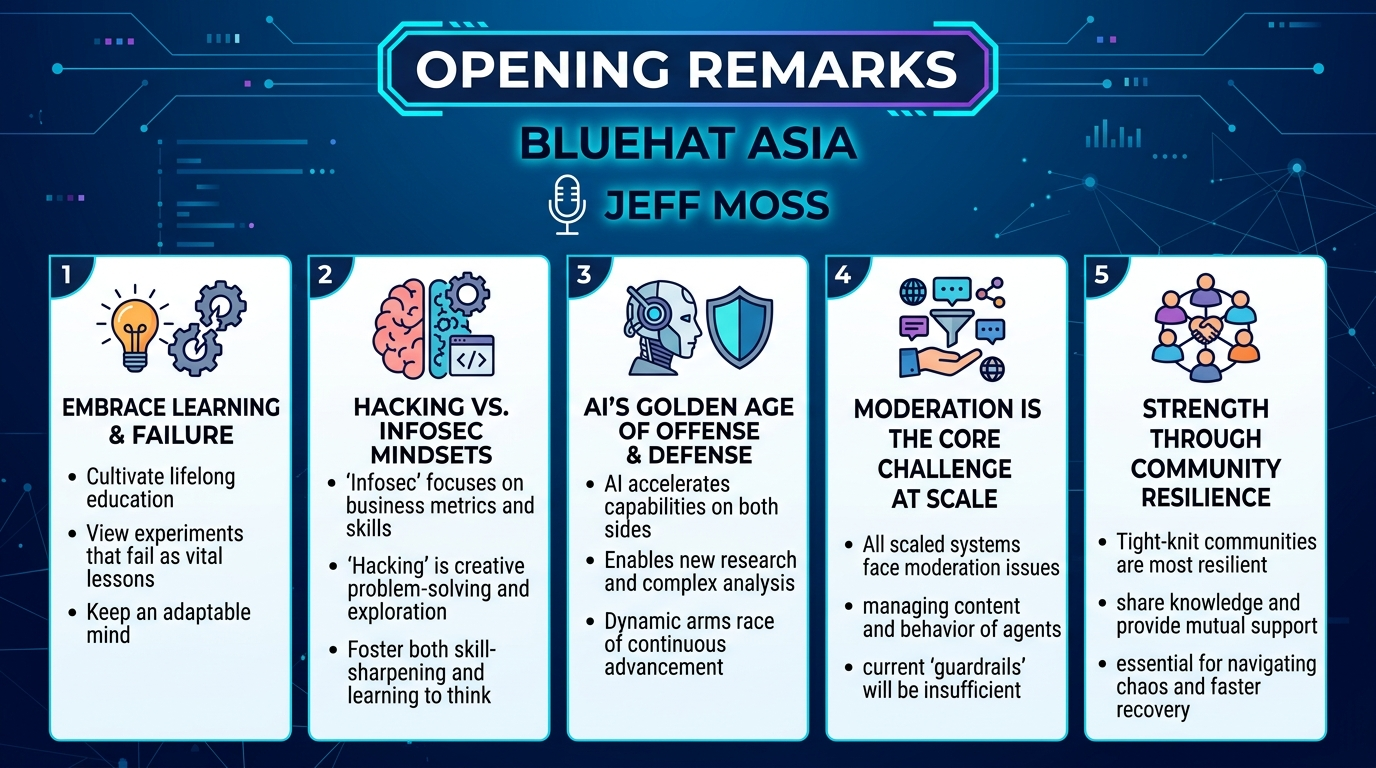
- 0:00 Early hacker community values and unexpected journey
- 2:00 Mentorship and confronting fear of the unknown
- 4:00 Learning from failure and lifelong flexible thinking
- 6:00 Black Hat vs. DEF CON: training vs. learning to think
- 9:00 Luxury security: balancing assets, employee safety, and artists
- 12:00 All problems at scale are moderation problems
- 16:00 Tight-knit communities are resilient and thrive in chaos
Opening Remarks
Speakers: Jeff Moss, Founder, DEF CON and Black Hat
Conference: BlueHat Asia
YouTube: https://www.youtube.com/watch?v=hZtI_JM-xkQ
Overview
In his BlueHat Asia keynote, "Opening Remarks," Jeff Moss, the visionary founder of DEF CON and Black Hat, offered a deeply personal and reflective journey through his decades-long career at the intersection of hacking, cybersecurity, and global policy. Drawing from his experiences as a grassroots hacker, a government advisor for the Department of Homeland Security, the first Chief Security Officer at ICANN, and a board member for a luxury goods company, Moss shared invaluable lessons that transcend technical domains, emphasizing the human element in an ever-evolving digital landscape.
The talk serves as a meditation on the fundamental principles that have guided Moss, from the early days of anonymous online communities to the complex challenges of modern infosec. He explores the distinction between pure "hacking" as a mode of thought and "information security" as a professional discipline, highlighting the critical role of continuous learning, embracing failure, and fostering resilient communities. Moss also casts a forward-looking gaze, contemplating the profound implications of artificial intelligence on both offensive and defensive security paradigms, and underscoring the universal challenge of effective moderation in a world increasingly shaped by autonomous agents.
This address is particularly significant as it encapsulates the wisdom of a figure who has not only observed but actively shaped the cybersecurity world. It provides a unique lens through which to understand the historical trajectory of the field, its current dilemmas, and the foundational mindsets required to navigate its future. Moss's insights are not merely technical prescriptions but a philosophical framework for resilience, adaptation, and ethical engagement within the global security community.
Background
▶ Watch: Early hacker community values and unexpected journey (0:00)
Jeff Moss's journey began in the nascent days of the hacking community, an environment characterized by its grassroots nature and anonymity. In this early era, without video, pictures, or widespread audio, interactions were based purely on the quality of ideas and arguments. This fostered a culture where age, ethnicity, race, or religion were irrelevant, programming Moss to prioritize intellectual merit above all else. This foundational experience also underscored the necessity of mentorship, creating a "virtuous cycle of constant education" where knowledge was shared freely.
As the internet matured and financial stakes grew, the term "hacking" unfortunately became synonymous with "computer criminal," leading to public fear of what was not understood—a phenomenon Moss parallels with current societal anxieties surrounding Artificial Intelligence (AI). This shift necessitated a re-evaluation of how the community communicated its purpose and value. Moss observed a divergence between the "hacking" ethos—driven by the "joy of discovery, joy of failure, spontaneous discovery"—and the more structured "infosec" profession, focused on "business goals, career goals, metrics, KPIs." He cites Max, the first Chief Security Officer at Facebook, who intentionally sent his teams to DEF CON "to teach them how to think" rather than just sharpen their existing skills at Black Hat, illustrating this crucial distinction.
Moss’s career path provided him with a unique vantage point to observe and influence these evolving dynamics. From establishing DEF CON as a community hub and Black Hat as a professional forum, to advising the Department of Homeland Security for 11 years, serving as the first Chief Security Officer at ICANN, and more recently joining the board of a luxury goods company, his experiences have spanned the full spectrum of security challenges, from the purely technical to the deeply human and organizational. These diverse roles provided the rich context for the lessons he shared, highlighting universal truths about risk, resilience, and human behavior.
Key Findings
▶ Watch: Learning from failure and lifelong flexible thinking (4:00)
Moss's keynote, while not presenting traditional "findings" from a research project, instead offered a series of profound insights and lessons learned from his extensive experience across various sectors. These insights serve as critical reflections for anyone operating within or adjacent to the cybersecurity domain.
A central theme is the imperative of lifelong learning and the acceptance of failure. Moss emphasized that in infosec, experiments fail far more often than they succeed, making a willingness to admit and learn from failure a non-negotiable trait. He noted a concern when individuals or organizations are unwilling to share stories of their failures, suggesting a critical gap in learning and adaptability. This ethos of continuous exploration and embracing "what if" scenarios is what keeps the mind flexible in a field where rules and possibilities constantly shift.
Moss also highlighted the historical significance of community-driven innovation, citing the 30th anniversary of Capture the Flag (CTF) at DEF CON 4. This spontaneous creation, born from hackers "messing with each other on our network," led to foundational rules like "don't attack the infrastructure" after the "Mad Swedes" famously won by taking over the router. This anecdote underscores how organic experimentation can drive tool and technique evolution, and serves as a cautionary tale for modern AI development regarding infrastructure integrity.
His tenure on the board of a luxury goods company unveiled a fascinating duality of security challenges: "atoms problems" (physical threats like gold theft, organized crime truck ramming, or inventory theft by individuals hiding in air ducts) and "electron problems" (cyber threats such as design theft, impersonation, and ransomware). A key lesson from this experience was the critical balance between physical security hardening and employee safety. Moss learned that making defenses too strong, such as unbreakable glass, could provoke attackers and put employees at greater risk, necessitating a strategic approach to delay and response rather than absolute prevention. Furthermore, he identified the most important asset for business continuity in this sector: the artists. Their creativity is the source of all value, providing a clear prioritization for protection that often gets muddled in other industries.
Looking to the future, Moss asserted that moderation is the core problem at scale, stating, "All problems at scale are moderation problems." He traced this concept from early spam email to current challenges with AI-driven content and "edgelords" pushing boundaries on social media. The advent of agentic bots, potentially malicious, will exponentially complicate moderation, rendering current "guardrails" insufficient. This leads to the prediction of a "golden age of offense and defense," where AI accelerates capabilities on both sides, making the landscape one of rapid, continuous advancement rather than a decisive victory for either.
Finally, Moss underscored the profound resilience of tight-knit communities. Citing a DHS report on post-Katrina recovery, he noted that communities with strong internal support networks recovered "twice as fast" with less emotional trauma and external aid. This lesson, he argued, is vital for navigating the current chaotic global landscape, emphasizing that mutual support within communities like the cybersecurity collective will be indispensable.
Technical Deep Dive
▶ Watch: Black Hat vs. DEF CON: training vs. learning to think (6:00)
While Jeff Moss's keynote was primarily philosophical, it touched upon several technical concepts and implications, particularly concerning the evolution of hacking, the nature of security defenses, and the future impact of AI.
In the earliest days of Capture the Flag (CTF) at DEF CON, the "Mad Swedes" demonstrated a profound understanding of network protocols and operating system internals. Their tactic of taking over the network router highlighted a core vulnerability—control of infrastructure—and led to the first CTF rule: "don't attack the infrastructure." Their subsequent actions, such as recompiling TCP kernels to ignore FIN (Finish) flags, illustrate a sophisticated level of low-level system manipulation. By ignoring FIN packets, their sessions could not be cleanly terminated by opponents, effectively making their connections "alive forever" and demonstrating a deep mastery of network persistence techniques. This early example underscores the creative and often unconventional technical thinking born from the hacking community.
Moss further explored the concept of moderation as a pervasive technical challenge. He framed it as requiring "rules and enforcement of the rules," which in a technical context translates to various security controls. Examples provided include packet filtering, rate limiting, and DDoS detection and prevention for network moderation. For content and bot-related issues, he mentioned AI scrapers, JavaScript challenges, crypto challenges, and botnet detection frameworks. These are all technical mechanisms designed to enforce behavioral rules and prevent abuse at scale, whether on a network, web application, or social media platform. The anticipated rise of agentic bots—autonomous software agents, potentially malicious—will elevate moderation from a content and traffic management problem to a complex challenge of controlling self-propagating, goal-oriented entities, demanding entirely new forms of technical oversight and intervention beyond simple "guardrails."
The impact of Artificial Intelligence (AI) on both offensive and defensive security was a significant technical point. Moss referenced keynote speakers at Black Hat, including Dweezil from Microsoft, who discussed AI's role in defense, specifically mentioning its potential for rewriting code and the use of Large Language Models (LLMs) for formal verification. Formal verification, a highly rigorous mathematical technique for proving the correctness of algorithms or software, is traditionally labor-intensive. AI-driven LLMs could revolutionize this by automating parts of the process, leading to more secure and bug-free codebases. Conversely, Zardoz's talk highlighted AI's role in offense, not as a wrecker, but as an enabler of "incredible new research" that was previously too time-consuming or complex for human researchers. This implies AI's capacity to automate exploit generation, vulnerability discovery, and sophisticated attack planning, creating an arms race where both sides leverage advanced autonomous capabilities.
In the context of physical security within the luxury sector, Moss described "atoms problems" versus "electron problems." While "electron problems" directly relate to traditional cybersecurity (e.g., design theft, ransomware, impersonation), "atoms problems" involve the physical world. The discussion of strengthening display cases against smash-and-grab attacks, and the subsequent decision against maximum hardening due to employee safety concerns, highlights a crucial intersection of physical security engineering and human factors. It demonstrates that technical solutions must be designed with a holistic understanding of their impact on all stakeholders, not just the asset being protected. The optimal solution was a balance of delay, detection, and rapid response, rather than an impenetrable, potentially dangerous, static defense.
Demo / Proof of Concept
▶ Watch: All problems at scale are moderation problems (12:00)
This keynote address, "Opening Remarks" by Jeff Moss, was a reflective and forward-looking discussion rather than a technical presentation of new research or tools. As such, it did not include any live demonstrations or proofs of concept. The insights shared were drawn from his extensive personal and professional experiences, serving to educate and provoke thought rather than showcase a specific technical capability.
Defensive Implications
▶ Watch: Tight-knit communities are resilient and thrive in chaos (16:00)
Jeff Moss's "Opening Remarks" provides a crucial framework for security defenders, moving beyond mere technical fixes to encompass strategic thinking, organizational culture, and community resilience.
Firstly, defenders must prioritize education to combat fear. Moss explicitly linked public fear of AI to a lack of understanding, paralleling it with the historical mischaracterization of "hackers." Security professionals, especially those dealing with emerging threats like AI, have a responsibility to demystify complex technologies and communicate risks clearly to prevent irrational responses and foster informed decision-making across organizations and society.
Secondly, embracing failure and lifelong learning is paramount. The infosec landscape changes constantly, and rigid adherence to past methods is a recipe for obsolescence. Defenders must cultivate an environment where experimentation, even if it leads to failure, is seen as a valuable learning opportunity. This includes encouraging "what if" thinking and sharing lessons learned from both successes and setbacks, fostering a culture of continuous improvement and adaptability.
Moss's distinction between "hacking" (learning how to think) and "infosec" (sharpening skills) offers a vital lesson for building effective blue teams. While technical training is essential, organizations should also invest in developing their defenders' critical thinking, problem-solving, and creative exploration capabilities. Sending teams to events like DEF CON, or fostering similar internal environments, can cultivate the kind of innovative mindset needed to anticipate and counter novel threats, rather than just reacting to known ones.
The lessons from the luxury goods sector provide concrete defensive strategies. The prioritization of employee safety over absolute hardening of physical assets serves as a powerful metaphor for cybersecurity. Defenders must avoid implementing security measures that inadvertently put users or business operations at undue risk. A balanced approach that integrates delay, detection, and rapid response is often more effective and ethical than creating "unbreakable" perimeters that can backfire. Furthermore, identifying the "most important asset"—like the artists in the luxury company—is critical. For many organizations, this translates to intellectual property, key personnel, or core business processes. Defensive strategies must be built outward from protecting these crown jewels, ensuring that resources are allocated where they will have the greatest impact on business continuity.
Looking forward, the omnipresent challenge of moderation demands proactive engagement. As AI-driven threats, including agentic bots and sophisticated "edgelords," become more prevalent, defenders need to evolve their capabilities beyond traditional perimeter defenses. This involves developing advanced AI-powered detection and response mechanisms for anomalous behavior, sophisticated botnet detection, and dynamic content filtering. The focus should shift towards building adaptive, community-centric moderation systems, rather than relying solely on centralized, easily circumvented "guardrails."
Finally, Moss's emphasis on community resilience offers a profound defensive implication. In an era where both offensive and defensive capabilities are rapidly advancing through AI, no single organization or individual can stand alone. Building and actively participating in tight-knit security communities—sharing threat intelligence, best practices, and mutual support—is not just beneficial, but essential for collective defense. These communities provide the shared knowledge and emotional resilience needed to navigate chaotic times and accelerate recovery after incidents.
Key Takeaways
- Embrace Failure and Lifelong Learning: The cybersecurity domain is characterized by constant change and frequent setbacks. Cultivating a mindset that accepts failure as a learning opportunity and prioritizes continuous education is crucial for adaptability and innovation.
- Distinguish Hacking from Infosec: While infosec focuses on professional skills and metrics, "hacking" embodies creative problem-solving and critical thinking. Organizations should foster both, encouraging teams to "learn how to think" through exploration and experimentation, not just "sharpen the knife" with existing skillsets.
- Moderation is the Core Problem at Scale: From spam to AI-driven "edgelords" and agentic bots, managing behavior and content at scale is a fundamental and growing challenge. Effective moderation requires a combination of clear rules, robust enforcement mechanisms, and community-centric approaches, moving beyond simplistic "guardrails."
- Balance Security with Human Safety and Core Assets: Security measures must be holistic. Physical hardening should not inadvertently endanger employees, and cybersecurity defenses must prioritize the protection of an organization's most critical assets (e.g., intellectual property, creative talent) to ensure true business continuity.
- AI Accelerates Both Offense and Defense: Artificial intelligence is ushering in a "golden age" for both offensive and defensive security. AI will enable new research and capabilities on both sides, necessitating that defenders rapidly adopt AI-powered tools for detection, response, code analysis (e.g., LLMs for formal verification), and threat intelligence.
- Community Resilience is Paramount: In an increasingly chaotic and complex world, tight-knit, supportive communities are the most resilient. Building and participating in strong cybersecurity networks for mutual support, knowledge sharing, and collective defense will be essential for navigating future challenges and recovering from incidents.
About the Speaker(s)
Jeff Moss, widely known by his hacker handle "Dark Tangent," is a seminal figure in the global cybersecurity community. He is the visionary founder of both DEF CON, the world's largest and longest-running underground hacker conference, and Black Hat, a premier executive and technical cybersecurity conference series. His unique position has allowed him to bridge the gap between the hacker underground and the mainstream security industry. Beyond these influential events, Moss has held significant roles in government and enterprise, serving for 11 years as an advisor to the Department of Homeland Security on cybersecurity issues and acting as the first Chief Security Officer (CSO) at ICANN (Internet Corporation for Assigned Names and Numbers), where he was responsible for the security, stability, and resiliency of the Internet's naming and numbering systems. More recently, he has brought his extensive security expertise to the board of a luxury goods company, offering a unique perspective on diverse threat landscapes. Moss's career is a testament to his lifelong dedication to understanding and navigating the complex interplay of technology, security, and human behavior.
Reviews
Dr. Zero (Offensive Security Researcher) — WEAK
Jeff Moss reflecting on 30 years of hacking and security culture is inherently interesting, but this is a fireside chat, not a talk. You get war stories, some decent aphorisms about failure and community, and a few genuinely sharp observations about moderation at scale. No new signal, no hard commitments, nothing you couldn't have guessed from his previous keynotes.
Heather Calloway (CISO) — SOLID
Jeff Moss reflecting on 30 years of community building and career lessons. Genuine wisdom from someone who's earned the perspective, but this is a fireside chat, not a working session. Your leadership team doesn't need to see this unless they're new to the field and need context on why the hacker-to-boardroom pipeline matters.