How to make Belgium one of the least cyber vulnerable countries?
Phédra Clouner (Deputy Director · Centre for Cybersecurity Belgium (CCB))
BruCON 0x0D · Day 2
Overview
In an insightful and candid presentation at BruCON, Phédra Clouner, Deputy Director of the Centre for Cybersecurity Belgium (CCB), outlined Belgium's ambitious strategy to transform itself into one of Europe's least cyber vulnerable nations by 2025. This talk delved into the historical evolution of Belgium's cybersecurity posture, the challenges faced by a relatively young national agency, and the comprehensive roadmap articulated in its new cybersecurity strategy. Clouner's discussion underscored the critical importance of a coordinated national approach, shared responsibility across all societal layers, and robust international collaboration in an increasingly digital and threat-laden world.
Key moments
- 0:00 Introduction: Belgium's first cybersecurity strategy (2012).
- 3:30 CCB created after major incidents; starting small.
- 11:40 Safeonweb's success: 12,000 phishing reports daily.
- 22:00 Escalating threats: 60% of Belgian companies hacked.
- 35:20 New strategy vision: shared responsibility for cyber resilience.
- 39:00 Critical challenge: the 'war for talent' in cybersecurity.
- 54:00 Why work for the CCB? Training and meaningful projects.
How to make Belgium one of the least cyber vulnerable countries?
Speakers: Phédra Clouner, Deputy Director, Centre for Cybersecurity Belgium (CCB)
Conference: BruCON
YouTube: https://www.youtube.com/watch?v=fyxU8fnPd58
Overview
In an insightful and candid presentation at BruCON, Phédra Clouner, Deputy Director of the Centre for Cybersecurity Belgium (CCB), outlined Belgium's ambitious strategy to transform itself into one of Europe's least cyber vulnerable nations by 2025. This talk delved into the historical evolution of Belgium's cybersecurity posture, the challenges faced by a relatively young national agency, and the comprehensive roadmap articulated in its new cybersecurity strategy. Clouner's discussion underscored the critical importance of a coordinated national approach, shared responsibility across all societal layers, and robust international collaboration in an increasingly digital and threat-laden world.
The presentation provided a rare look into the strategic thinking behind national cybersecurity initiatives, moving beyond technical vulnerabilities to encompass policy, legal frameworks, economic implications, and societal awareness. Clouner highlighted the CCB's journey from a nascent two-person operation to a pivotal national entity, emphasizing the continuous adaptation required to counter evolving cyber threats. The talk is particularly relevant for policymakers, cybersecurity professionals, and organizations seeking to understand the complexities of national cybersecurity defense and the strategic imperatives driving governmental action.
Clouner's address serves as a compelling case study for other nations grappling with similar challenges, illustrating how a dedicated agency, even with limited resources, can significantly impact national resilience. Her frank assessment of ongoing struggles, such as the talent gap and the need for sustained political will and funding, added a layer of realism to the ambitious vision, making the CCB's journey both relatable and inspiring.
Background
▶ Watch: Introduction: Belgium's first cybersecurity strategy (2012). (0:00)
Belgium's journey towards a comprehensive national cybersecurity strategy began in 2012, when the government recognized the imperative for a coordinated approach to safeguard its digital landscape. The initial strategy focused on three classical yet crucial objectives: establishing a safe and reliable cyberspace, ensuring optimal security and protection of critical infrastructure and government systems, and fostering the development of indigenous cybersecurity capabilities. Prior to this, various actors—including police, law enforcement, the National Crisis Center, and OCAM—operated largely in silos, lacking unified coordination or a cohesive national policy.
However, the real impetus for creating a dedicated national agency came in 2014, following significant cyber incidents that exposed Belgium's vulnerabilities. Notably, the Belgacom incident and a sophisticated hacking of the Ministry of Foreign Affairs served as wake-up calls, accelerating the decision to establish the Centre for Cybersecurity Belgium (CCB). Launched in 2015, the CCB initially began with a mere two individuals, a stark contrast to larger counterparts like France's ANSSI (600 people) or Germany's BSI. Despite these humble beginnings, the CCB has grown to 51 staff members in six years, demonstrating significant progress under resource constraints.
The CCB operates under a Royal Decree and, more significantly, the NIS law. The latter, a transposition of a European directive, significantly augmented the CCB's authority, enabling it to mandate security obligations for Operators of Essential Services (OES) and critical infrastructure. This legal framework underpins the CCB's broad mandate, which includes implementing Belgian cybersecurity policy, unifying disparate actors, coordinating efforts across institutional, private, and academic sectors, managing cyber crises, providing guidance to governmental bodies, and raising citizen awareness. The agency also plays a crucial role in transposing European directives and regulations, ensuring Belgium's alignment with broader European cybersecurity initiatives.
Key Findings
▶ Watch: Safeonweb's success: 12,000 phishing reports daily. (11:40)
The talk highlighted several critical findings that underscore the evolving threat landscape and the rationale for Belgium's updated cybersecurity strategy. Phédra Clouner emphasized that while Belgium currently holds a respectable 6th place in some cybersecurity ratings (e.g., BitSight), the threat environment has significantly intensified since the CCB's inception in 2015.
One of the most striking findings is the dramatic increase in incident notifications. From a handful of notifications per year at the CERT's integration in 2017, the CCB now receives approximately 7,000 notifications annually. Clouner stressed that this figure represents only "the top of the iceberg," as many organizations, particularly due to reputational concerns, still refrain from reporting cyber incidents. This indicates a much higher actual incidence of cyberattacks across the country.
Phishing remains a pervasive and significant threat. The CCB's Safeonweb project, which encourages citizens to forward suspicious emails to [email protected], has seen an exponential increase in submissions. Starting with hundreds of emails per week three to four years ago, the service now receives around 12,000 malicious emails daily. This volume underscores the persistent vulnerability of citizens to social engineering tactics.
The economic impact of cyberattacks is also a major concern. Clouner cited a McAfee study estimating the global annual cost of cyberattacks at $1 trillion. Locally, an Agoria study revealed that 60% of Belgian companies have already been hacked, highlighting the widespread nature of cyber compromise within the business sector. The actual cost to victims is often underestimated, extending beyond immediate remediation to include prolonged downtime, loss of sales, and the expense of replacing compromised hardware and systems. Small and Medium-sized Enterprises (SMEs) are particularly vulnerable, often lacking the resources and expertise to adequately protect themselves, making them "easy targets" for cybercriminals.
The context of European policy is also a key finding. The NIS 1 directive (2016), though challenging to transpose in Belgium due to its complex governmental structure, has been instrumental in compelling OES to adopt secure behaviors. The upcoming NIS 2 directive aims to simplify OES identification, expand sectoral coverage beyond traditional critical infrastructure (energy, transport, banking, health) to include a wider array of services, and crucially, integrate the public sector—a long-standing advocacy point for the CCB. Furthermore, the Cybersecurity Act is establishing a European certification framework for ICT products, processes, and services, akin to a "CE label," to enhance trust in the digital single market and promote quality security standards.
Finally, a major systemic challenge identified is the global war for talent in cybersecurity. Belgium, like many other countries, faces a severe shortage of skilled cyber specialists. This problem is exacerbated for governmental agencies like the CCB, which struggle to compete with private sector salaries, making it difficult to recruit and retain the necessary expertise to fulfill their expanding mandate.
Technical Deep Dive
▶ Watch: Escalating threats: 60% of Belgian companies hacked. (22:00)
The CCB's operational framework and the new strategy outline a multi-faceted approach involving several technical initiatives and strategic objectives. For citizen protection, the Safeonweb platform is a cornerstone. Citizens are encouraged to forward suspicious emails to [email protected]. The CCB processes these submissions to identify and block malicious websites associated with phishing campaigns, effectively creating a real-time defense mechanism. An upcoming mobile application, set to launch on November 15th, will further empower citizens. Users will be able to input their Wi-Fi network information into the app and receive direct notifications about vulnerabilities or infections detected within their network, enabling proactive self-protection.
For organizations, particularly Operators of Vital Interest (OVIs) such as critical infrastructure, government bodies, and OES (mobility, energy, nuclear, health, banking), the CCB employs a tiered warning system. An early warning system disseminates threat intelligence to OVIs, providing timely alerts on emerging cyber threats targeting their sectors. Complementing this is the spear warning project, which leverages open and commercial intelligence sources to identify specific infected or vulnerable systems and directly notify their owners, facilitating targeted remediation.
The CCB actively supports governmental bodies through various technical assistance programs. This includes funding penetration testing for critical government systems, recognizing that many public entities lack the budget for such essential security assessments. They also invest heavily in training civil servants, having spent approximately 2 million EUR to train around 1,200 individuals in implementing robust security measures. During the COVID-19 crisis, the "We Help Our Hospitals" initiative mobilized cybersecurity professionals to assist hospitals and vaccination centers, underscoring the CCB's operational readiness in emergencies.
The new strategy's six strategic objectives include several technical tenets:
- Strengthening the Digital Environment and Increasing Trust: This involves investing in secure network infrastructure by encouraging technologies like secure DNS and cryptography. The CCB aims to offer testbeds for organizations to securely evaluate new infrastructure and applications before production deployment, mitigating risks associated with rapid digitalization without adequate security considerations.
- Cyber Greenhouse and Certification: A planned "cyber greenhouse" will foster innovation and research and development in cybersecurity. Furthermore, the CCB, designated as the national certification authority under the Cybersecurity Act, will implement European cybersecurity certification schemes. This initiative aims to establish a common CE label for ICT products, processes, and services across Europe, ensuring adherence to standardized security frameworks and promoting quality in the digital market, thereby improving supply chain security.
- Improving Intelligence and Security Agency Skills: Recognizing the evolving nature of state-sponsored threats, the strategy calls for enhancing the cybersecurity capabilities of intelligence services (both civil and military). This involves increasing personnel and specialized training to better address complex international cyber threats and attribution challenges, often involving geopolitical considerations.
- Disrupting Criminal Cyber Infrastructure: The CCB aims to collaborate with law enforcement and international partners to actively disrupt cybercriminal operations, even when infrastructure is located abroad. This requires strengthening the resources of legal actors, including specialized cyber prosecutors and police units, who currently face significant knowledge gaps at the local level.
- Cyber Defense Capabilities: Acknowledging cyberspace as a distinct domain of warfare, the strategy emphasizes developing appropriate cyber defense capabilities within the military to respond to cyber warfare scenarios.
These technical and operational initiatives are underpinned by a philosophy of shared responsibility, where the CCB provides tools and guidance, but citizens, companies, and governmental bodies are expected to actively invest in and implement cybersecurity measures.
Demo / Proof of Concept
▶ Watch: Critical challenge: the 'war for talent' in cybersecurity. (39:00)
While the talk itself did not feature a live, interactive technical demonstration, Phédra Clouner effectively showcased the CCB's practical impact through established initiatives and upcoming projects that serve as tangible proofs of concept for their strategic approach. These initiatives demonstrate the CCB's commitment to proactive defense and citizen empowerment.
The Safeonweb platform (accessible via [email protected]) stands as a prominent example. This project, which encourages citizens to forward suspicious emails, is a highly successful, large-scale demonstration of collective defense. The shift from hundreds to 12,000 malicious emails received daily clearly illustrates its adoption and effectiveness in identifying and enabling the blocking of malicious websites. This collective intelligence gathering and subsequent action directly contribute to a safer online environment for Belgian citizens, acting as a real-world, continuous proof of concept for the CCB's awareness and protection efforts.
Furthermore, Clouner announced a significant upcoming initiative: a new mobile application for citizens, scheduled for launch on November 15th. This app will allow users to input their Wi-Fi network details and receive direct notifications about vulnerabilities or infections. This proactive tool, once deployed, will serve as a direct demonstration of the CCB's "spear warning" concept applied to the general public, empowering individuals with actionable intelligence to secure their home networks. It embodies the strategy's goal of strengthening the digital environment and increasing trust by providing concrete, user-friendly security tools.
Beyond citizen-focused tools, the CCB's early warning system and spear warning project for Operators of Vital Interest (OVIs) represent ongoing operational proofs of concept. These systems continuously demonstrate the CCB's capability to gather, analyze, and disseminate critical threat intelligence, directly influencing the defensive postures of Belgium's most crucial sectors. The consistent investment in pentesting for government systems and comprehensive training for civil servants also serves as an indirect but powerful demonstration of the CCB's commitment to raising the baseline security posture across the public sector.
These initiatives, though not presented as live code demonstrations during the talk, collectively illustrate the CCB's practical, results-driven approach to national cybersecurity, embodying the strategic objectives outlined in the new plan.
Defensive Implications
▶ Watch: Why work for the CCB? Training and meaningful projects. (54:00)
The CCB's new cybersecurity strategy carries profound defensive implications for all stakeholders in Belgium, emphasizing a shift towards a shared responsibility approach. Defenders, whether in government, private industry, or as individual citizens, must recognize their active role in national cybersecurity.
For organizations of vital interest (OVIs) and Operators of Essential Services (OES), the defensive implications are clear:
- Compliance and Proactive Security: The NIS law and its upcoming NIS 2 iteration mandate stringent security obligations. OVIs must move beyond mere compliance to adopt proactive, robust security measures, including regular penetration testing and adherence to baseline security guidelines provided by the CCB.
- Threat Intelligence Integration: OVIs should actively leverage the CCB's early warning system and spear warning project to stay informed about targeted threats and remediate vulnerabilities promptly.
- Crisis Preparedness: Participation in CCB-organized exercises and continuous improvement of internal cyber crisis management plans are crucial for effective incident response and recovery.
For SMEs and private enterprises:
- Prioritize Cybersecurity Investment: The statistic that 60% of Belgian companies have been hacked underscores the urgent need for SMEs to invest in cybersecurity. The CCB aims to provide more concrete actions and guidelines tailored for them.
- Support Local Innovation: Enterprises are encouraged to invest in and adopt cybersecurity products and services offered by Belgian startups and companies, fostering a national cybersecurity industry.
- Supply Chain Security: With the Cybersecurity Act and its certification framework, organizations should prioritize procuring ICT products and services that meet European security standards, enhancing the security of their supply chains.
For governmental bodies:
- Budget Allocation: Political leaders must ensure sustained funding for cybersecurity initiatives, recognizing that cuts in this area lead to increased vulnerability and higher costs in the long run.
- Talent Development: Investing in specialized training for civil servants and creating attractive career paths for cyber prosecutors and specialized police officers is critical to address the talent gap.
- Inter-agency Collaboration: Law enforcement, intelligence services, and defense must enhance their coordination and information sharing to effectively disrupt criminal infrastructure and manage geopolitical cyber threats.
For citizens:
- Active Awareness: Citizens must remain vigilant against threats like phishing and actively participate in awareness campaigns. Tools like Safeonweb and the upcoming Wi-Fi vulnerability app empower them to take personal defensive actions.
- Digital Literacy: Continuous education on safe online practices is essential to build collective resilience against common cyberattacks.
Overall, the defensive strategy hinges on collaboration—public-private-academic partnerships (like the Cyber Security Coalition and Cyber Wall initiative) are vital for sharing knowledge, developing solutions, and collectively elevating Belgium's cybersecurity posture. The CCB's commitment to becoming the national competence center for research and innovation, and the national certification authority, positions it as a central enabler for these defensive efforts.
Key Takeaways
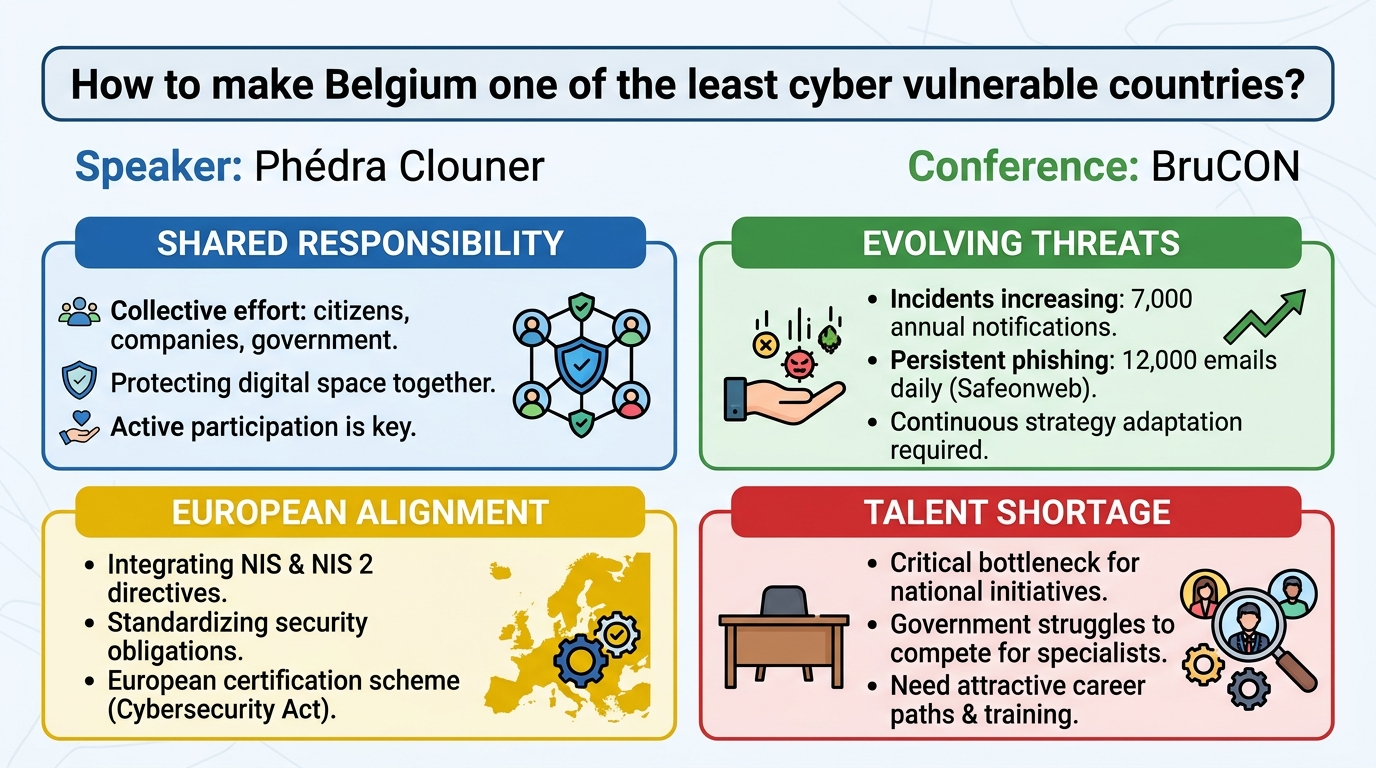
- Shared Responsibility is Paramount: Belgium's cybersecurity strategy is built on the principle that protecting the digital space is a collective effort, requiring active participation from citizens, private companies, academic institutions, and all levels of government.
- Evolving Threats Demand Continuous Adaptation: The dramatic increase in incident notifications (7,000 annually) and persistent phishing attempts (12,000 Safeonweb mails daily) highlight the dynamic and escalating cyber threat landscape, necessitating a constantly evolving national defense strategy.
- Strategic European Alignment is Key: Belgium actively integrates European directives like NIS 1 and the upcoming NIS 2, and the Cybersecurity Act, leveraging these frameworks to standardize security obligations, expand sectoral coverage, and establish a common certification scheme for ICT products and services.
- Talent Gap is a Critical Bottleneck: A severe shortage of cybersecurity specialists, particularly within governmental agencies struggling to compete with private sector salaries, poses a significant challenge to implementing and sustaining national cybersecurity initiatives.
- Proactive Tools and Awareness Empower Defense: Initiatives like the Safeonweb platform and the upcoming citizen app for Wi-Fi vulnerability checks demonstrate the CCB's commitment to providing tangible tools and fostering widespread awareness as foundational elements of national resilience.
- Investment in Capabilities and Innovation is Essential: The strategy emphasizes strengthening secure network infrastructure (e.g., secure DNS, cryptography), establishing testbeds, fostering innovation through a "cyber greenhouse," and enhancing the capabilities of law enforcement and intelligence services to effectively counter and disrupt cyber threats.
About the Speaker(s)
Phédra Clouner serves as the Deputy Director of the Centre for Cybersecurity Belgium (CCB), the national authority responsible for implementing Belgium's cybersecurity policy. Her presentation at BruCON underscored her deep expertise and passionate commitment to enhancing Belgium's digital resilience. Clouner is a driving force behind the CCB's strategic direction, navigating the complexities of governmental bureaucracy, resource constraints, and the rapidly evolving cyber threat landscape.
Throughout her talk, Phédra Clouner demonstrated a frank and engaging communication style, openly discussing the challenges faced by the CCB, such as its initial small size (starting with just two people) compared to larger European counterparts, and the ongoing struggle to attract and retain cybersecurity talent. Her dedication to the CCB's mission is evident in her relentless pursuit of a coordinated national approach, strong European collaboration, and comprehensive initiatives spanning citizen awareness, critical infrastructure protection, and the development of national cyber capabilities. She also serves on the management board and as a national liaison officer for ENISA, the European Cybersecurity Agency, highlighting her influence and involvement in broader European cybersecurity efforts.